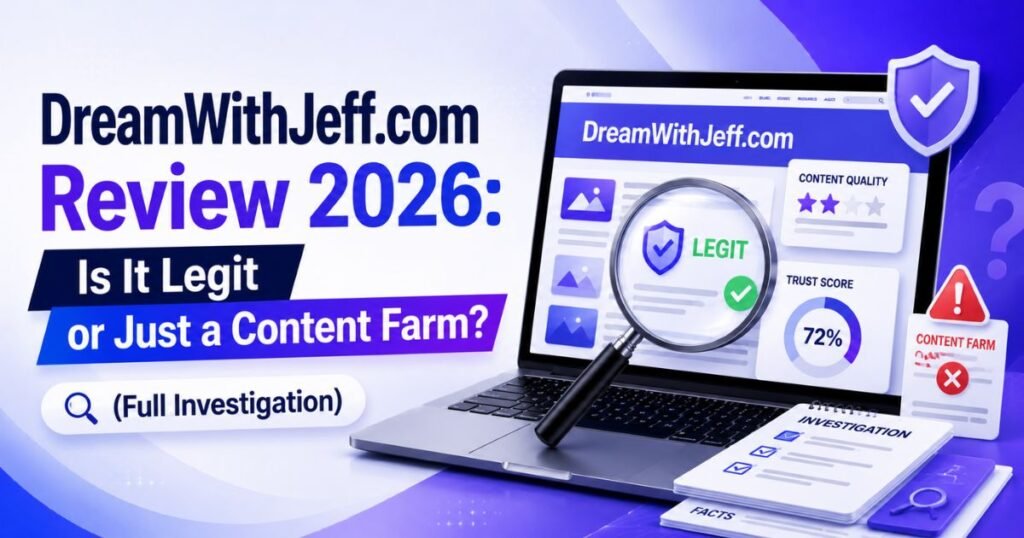
Typing “DreamWithJeff.com” into Google usually means one of two things: you landed on one of its articles and something felt off, or you’re checking the site before trusting anything it says. Either way, that instinct is worth following. Personal-development sites are booming right now, and not every blog wearing that label is what it claims to be some are genuine, some are AI-spun filler, and some are content networks using a motivational theme as cover for something else entirely.
That distinction matters more than ever. Search results are increasingly crowded with lookalike “review” articles that recycle the same vague claims about a site without ever checking its footer, its author bios, or who it’s actually linking to. If you’re trying to decide whether DreamWithJeff com deserves your time or your trust you deserve better than another recycled summary.
This review goes further. Instead of repeating what the site says about itself, it examines what DreamWithJeff com actually publishes, who its listed partners are, whether its stated address checks out, and how independent trust scanners rate it. Every claim here is grounded in direct research and publicly available information not assumptions, and not invented hands-on testing.
By the end, you’ll know exactly what kind of site this is, whether its content is safe to read, and how to spot the same warning signs on similar sites in the future. Let’s start with the short version.
Quick Answer
DreamWithJeff.com is a WordPress blog that markets itself as a personal-development and goal-setting site. After checking the site directly, its trust signals, and third-party scans, the evidence points to something different: a low-cost content network that publishes personal-growth articles alongside completely unrelated topics like online casinos, cannabis products, and adult-platform tips often to host paid links for other websites. It isn’t a scam that will steal your money, but it also isn’t a coaching platform, an app, or a trustworthy source of expert advice. Read the individual articles with caution, and don’t treat the site itself as an authority.
Key Takeaways
- DreamWithJeff.com is a self-published blog, not a coaching program, an app, or a platform with a founder named “Jeff” who built anything specific despite what its own About page suggests.
- The site publishes wildly unrelated content in the same “Latest” feed: goal-setting tips sit next to casino promo codes, cannabis strain reviews, and OnlyFans marketing guides.
- Its listed “partners” include several online casino affiliate sites, which is a classic sign of a link-building or guest-post network rather than a genuine niche blog.
- The physical address listed in its footer does not correspond to any real place in Massachusetts.
- Independent trust scanners disagree sharply: one gives it a passable automated safety score, another flags it for spam and phishing-adjacent signals.
- Most “reviews” of DreamWithJeff.com that show up in search results are themselves low-quality, AI-generated filler articles with no verified information treat those with the same skepticism.
What Is DreamWithJeff.com, Really?
DreamWithJeff.com is a WordPress site built with the Elementor page builder, organized into three main content categories: Goal Trackers, Motivation Hacks, and Self-Discovery. It presents itself as a personal-growth blog run by someone named “Jeff,” offering articles on motivation, goal tracking, and self-discovery.
That’s the pitch. The reality, based on the site’s own published content, looks more like a general-purpose content network that happens to use a personal-development theme as its front door.
What DreamWithJeff.com Claims About Itself
On its homepage, the site describes itself as a source for actionable advice on self-discovery, motivation, and goal tracking, built around the idea that every dream is worth pursuing. The About page introduces “Jeff” as the person behind the project.
That’s a normal setup for a niche blog. The problem is what shows up once you look past the homepage.
What We Actually Found on the Site
Here’s where a real review has to go beyond the marketing copy. We pulled the live homepage and checked what’s actually being published.
Mixed, unrelated content categories. The site’s “Editor’s Picks” and “Latest” sections supposedly its best or newest content include articles about champion racehorses and goal-setting, reducing stress, and then, in the same feed: a guide to 1xbet casino games, a piece on choosing an OnlyFans content niche, a Maui Wowie cannabis strain breakdown, mesothelioma caregiver resources, ERP software for manufacturing, POS security standards for restaurants, and shipping logistics to Belgium. None of these topics relate to personal development, and they don’t relate to each other either.
Casino “partners.” The footer lists several “partner” logos, and multiple of them link to online casino or gambling affiliate sites. A genuine personal-growth blog has no obvious reason to partner with gambling platforms. This pattern a lifestyle-themed front page combined with unrelated paid placements is typical of sites built to sell backlinks or sponsored posts to buyers in completely different industries.
Generic author profiles. Several articles are credited to different names “Michael Pierson,” “Helanof Kestam,” “Salin Dafio” using default placeholder avatar images rather than real photos or bios. There’s no visible way to verify any of these are real people with relevant credentials.
An address that doesn’t check out. The footer lists a business address in “North Driftwick, MA.” We couldn’t find any record of a place by that name anywhere in Massachusetts. Real towns nearby (Scituate, North Andover, North Brookfield) exist, but “North Driftwick” isn’t one of them.
Unverifiable testimonials. The homepage includes short quotes attributed to first-name-and-last-initial readers (“John D.,” “Diana S.,” “Suzan B.”) with no way to confirm they’re real customers or readers.
None of this proves criminal intent. But together, it’s a strong pattern: a site optimized to look like a trustworthy niche blog while actually functioning as generic, low-cost content infrastructure.
Tap To Explore: NYT Connections Forbes: Your Complete Guide to Daily Hints and Answers
Is DreamWithJeff.com Legit or a Scam?
It depends on what you mean by “scam.”
- Will it steal your money or data if you just read it? There’s no evidence of that. It doesn’t appear to sell products, request payment, or push you toward a checkout page.
- Is it what it claims to be an authentic personal-development platform run by a credible “Jeff”? No. The evidence points to a content-network property, not a coaching brand with real expertise behind it.
- Should you treat its advice as expert guidance? No. Without verifiable authors, credentials, or editorial standards, there’s no way to confirm the accuracy of what you’re reading.
One independent review found that the domain was registered in February 2023, making it relatively new compared to established self-help sites, and noted that its About page lacks the detail needed to establish real credibility. That lines up with what we found directly on the site. Quikconsole
Trust Score Comparison
Automated scanners disagree with each other, which is itself informative it means DreamWithJeff.com sits in a gray zone rather than a clearly “safe” or clearly “dangerous” category.
| Source | Verdict | What It Flags |
| Scamadviser (automated scan) | Positive appears legit and safe based on automated analysis of technical signals Scamadviser | Domain age, hosting setup, server location |
| Scam Detector (algorithmic score) | Low trust score (41.5/100), tagged Controversial, Risky, Red Flags, with potential high-risk activity related to phishing and spamming Scam Detector | Content mismatch, industry-risk factors |
| Direct site audit (this review) | Mixed no theft risk found, but content authenticity and identity claims don’t hold up | Unrelated content mix, casino partners, fake address |
Why the scores conflict: automated “safety” scanners mostly check technical hosting signals (SSL, server reputation, malware databases) not whether the content or “about us” story is genuine. A site can pass a technical safety scan and still not be what it claims to be.
Red Flags Checklist
Use this checklist any time you’re evaluating a similar “personal development” or advice site not just this one.
- Does the “About” page name a real, verifiable founder with a searchable background?
- Do author bios link to real social profiles, or do they use stock avatars?
- Does the content stay within one consistent niche, or does it drift into unrelated industries?
- Do the site’s “partners” or advertisers match its stated niche?
- Does the listed business address correspond to a real location?
- Are testimonials attributable to real, checkable people?
- Is the domain age consistent with the site’s claimed history and reputation?
DreamWithJeff.com fails most of these checks.
Content Quality: Is Anything on the Site Actually Useful?
Some individual articles on the site for example, ones covering goal tracking or staying motivated offer straightforward, generally safe advice that isn’t controversial or risky on its own. That’s worth acknowledging: not every piece of content is bad, and basic tips like setting specific goals or building consistent routines are grounded in real, widely accepted ideas. Quikconsole
The issue isn’t that every article is wrong. It’s that you have no way to know which articles were written with any real expertise and which were mass-produced to fill out a content calendar next to a casino review. Without a credible author or editorial process behind it, even good advice on the page comes with no accountability if it’s wrong.
Who Should Use DreamWithJeff.com
- Someone who wants basic, general motivational reading and will independently verify anything specific (like health, financial, or legal advice) elsewhere.
- Someone doing research into content-farm and link-network patterns, since this site is a useful real-world example.
- Someone who landed on one specific article through search and just wants that single piece of general information, not ongoing guidance.
Click To View: Meshki Return Policy: Complete 2026 Guide to Refunds, Store Credit & Fees
Who Should Avoid It
- Anyone looking for a structured coaching program, app, or paid platform despite what some third-party “reviews” imply, there’s no evidence the site offers software, dashboards, or paid tiers.
- Anyone who needs advice on medical, legal, or financial topics the site touches on things like debt relief and caregiver support without visible credentials behind that content.
- Anyone hoping to verify “Jeff” as a real, accountable public figure before trusting a recommendation from the site.
- Anyone considering a backlink or guest-post deal with the site without separately verifying its traffic and audience quality first.
How to Vet a Site Like This Yourself
- Read the About page first, then verify it. Search the founder’s name outside the site. If nothing independent turns up, treat the “about” story as unconfirmed.
- Scroll the full homepage feed, not just the top article. Content-mixing (unrelated topics in one feed) is one of the fastest tells of a link-network site.
- Check the footer for partners and the listed address. Search the address. A fake or nonexistent address is a strong signal.
- Run the domain through more than one trust scanner. No single automated score is reliable on its own cross-check at least two.
- Look at author bios. Real experts usually have a consistent, searchable presence elsewhere (LinkedIn, published work, social profiles).
Better Alternatives for Personal Development Content
If you’re looking for goal-setting or motivation content with clearer accountability, look for sources where you can verify the author’s background directly established psychology and behavioral-science publications, university extension resources, or individual writers/coaches with a consistent, checkable public history. The key isn’t the topic it’s whether you can independently confirm who wrote it and why they’re credible.
Common Mistakes Readers Make
- Assuming a well-designed site equals a trustworthy one. DreamWithJeff.com uses a clean, professional Elementor theme design quality says nothing about editorial accuracy.
- Trusting third-party “review” sites without checking their own credibility. Several sites currently ranking for reviews of DreamWithJeff.com are themselves generic, template-style articles with vague, sometimes contradictory descriptions of what the site even does some even describe an entirely different “Jeff Goldblum” experience unrelated to this site.
- Treating a positive automated “safety” scan as a full credibility check. Technical safety and content authenticity are two different things.
- Not checking the address or partner links. These are two of the fastest ways to spot a content-network site.
Unlock More: Best Wireless Earbuds Under $200 in 2024: The Complete Buying Guide
Frequently Asked Questions
Is DreamWithJeff.com a scam?
There’s no evidence it steals money or personal information. It appears to be a content-publishing site, not a payment-based scam. But its “about us” story doesn’t hold up to verification, so it’s not a trustworthy authority either.
Who is “Jeff” from DreamWithJeff.com?
No independently verifiable identity is attached to the name. The About page introduces a founder story without enough detail to confirm a real, accountable person is behind it.
Is DreamWithJeff.com affiliated with actor Jeff Goldblum?
Confusion exists online because some unrelated content elsewhere on the internet uses a similar name for a completely different project. DreamWithJeff.com itself is a self-development blog and has no connection to any celebrity.
Does DreamWithJeff.com have an app or paid membership?
There’s no evidence of a paid app, software dashboard, or membership tier on the live site. Any description of “premium plans” or “integrations” attached to the site elsewhere online isn’t backed up by what actually appears on the domain.
Why does DreamWithJeff.com publish articles about casinos and unrelated topics?
This is the clearest sign of what the site actually is: a content network. Sites like this often accept paid guest posts or sponsored content from unrelated industries gambling, cannabis, adult platforms while keeping a lifestyle or self-help theme on the surface.
Is it safe to click links on DreamWithJeff.com?
No malware or phishing was directly observed during this review, but one independent scanner flagged spam-related risk factors. As a general practice, avoid entering personal or payment information on any site with unverified ownership.
Should I trust the testimonials on the homepage?
Treat them as unverified. First-name-only testimonials with no way to confirm the person exists are a common content-marketing tactic and shouldn’t be weighed as real evidence of results.
Final Verdict
DreamWithJeff.com isn’t a dangerous scam that will drain your bank account. But it’s also not the credible personal-development platform its homepage suggests. The unrelated content mix, casino “partners,” unverifiable authors, fabricated-looking address, and inconsistent third-party trust scores all point to the same conclusion: this is a general-purpose content site wearing a self-help theme, not a brand built on real expertise or accountability.
If you land on one article through a Google search, there’s no urgent reason to worry. Just don’t treat the site or its founder story as an authority worth returning to, and verify anything specific you read there against an independently credible source.
Bottom line: Read with caution. Verify independently. Don’t rely on it as a primary source.

Team TrandyVilla is the passionate home decor team behind Trandy Villa, where style meets comfort in everyday living. The team loves transforming simple spaces into beautiful, functional homes through smart ideas, budget-friendly hacks, and modern design trends. Their content focuses on helping readers create homes that feel both stylish and personal without spending too much.