
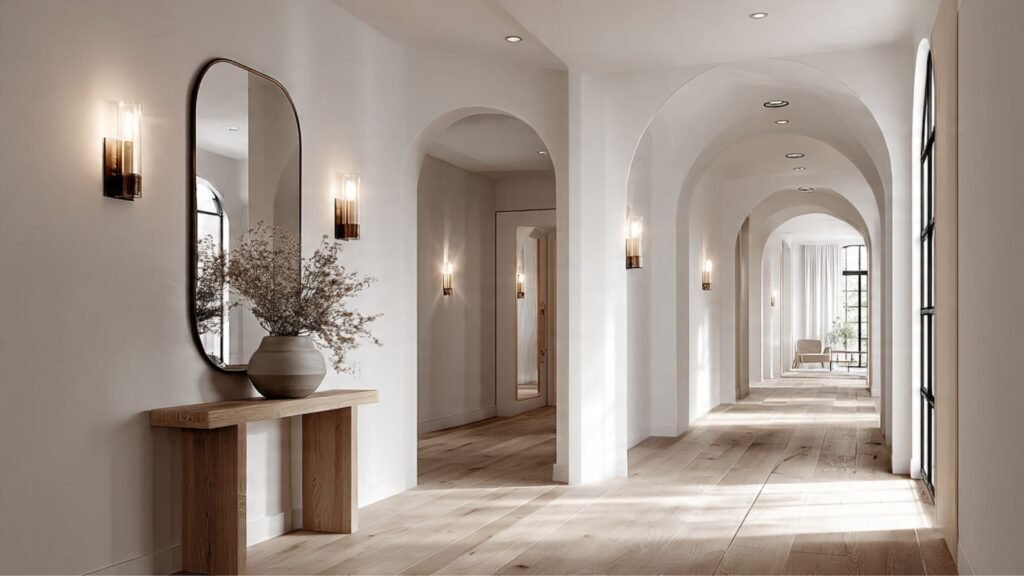
Your hallway is the first space guests see and the last space you pass through every day. Yet most homeowners treat it as an afterthought, settling for a single dim overhead bulb that does nothing for the space. Great hallway lighting changes everything it sets the tone for your entire home, improves safety, and creates an atmosphere that feels welcoming the moment someone steps inside. In 2026, hallway lighting design has evolved far beyond simple functionality into a genuine design statement.
Hallway lighting means using fixtures and light sources to brighten the corridors and entryways of your home. It includes pendants, sconces, recessed lights, and LED strips placed to improve visibility and style. Good hallway lighting makes your home feel welcoming, safe, and well-designed from the very first step. It also sets the visual tone for every other room beyond it. Every hallway lighting deserves lighting that is both functional and beautiful.
Most homeowners overlook their hallway and that single mistake costs them the entire first impression of their home. A dark, poorly lit corridor feels uninviting, cramped, and unfinished no matter how well the rest of the house is decorated. The right hallway lighting instantly changes how a space feels, looks, and functions. It guides movement, highlights architecture, and adds warmth that no paint color or furniture piece can replicate. Your hallway is the first story your home tells make sure the lighting helps tell it well.
Pendant lights add height and drama to entryways with high ceilings. Recessed downlights deliver clean, even illumination along narrow corridors. Wall sconces create warm, eye-level light that flatters the space beautifully. Picture lights highlight artwork and contribute soft ambient glow. Motion-sensor fixtures improve safety and reduce energy waste. Smart lighting systems allow full control over brightness and color temperature. Each option serves a clear purpose and suits a different hallway lighting style and size.
Install a Statement Pendant Light for Instant Drama:
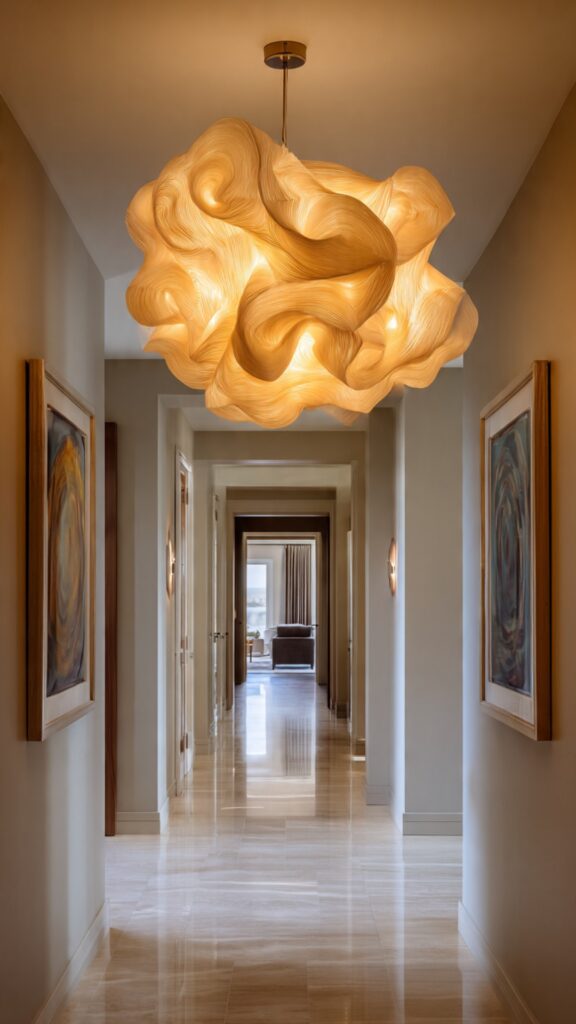
A statement pendant light is one of the most powerful upgrades you can make to your hallway. In an entryway or the midpoint of a longer corridor, a well-chosen pendant instantly elevates the entire space from forgettable to unforgettable.
Unlike a flush mount that sits flat against the ceiling, a pendant hangs down into the visual field, drawing the eye upward and making ceilings feel taller. This is particularly effective in hallways with standard 8 or 9-foot ceilings that might otherwise feel low or compressed.
Choosing the right pendant size is critical and where most homeowners make mistakes. A pendant that’s too small gets visually lost; one that’s too large feels suffocating in a narrow space. As a general rule, add your hallway’s width and length in feet, then convert that number to inches that’s your ideal pendant diameter.
For example, a hallway lighting that’s 4 feet wide and 8 feet long would suit a 12-inch pendant. Always ensure the bottom of the pendant hangs at least 7 feet from the floor to maintain comfortable clearance.
In 2026, the most sought-after pendant styles for hallways include rattan and woven shades for a warm, organic look; smoked glass globes for a moody, contemporary feel; and sculptural metal pendants in matte black or aged brass for an architectural statement.
What competitors rarely mention is that a pendant light also serves as a natural art piece in your hallway lighting a space where actual art is often limited by wall space or traffic flow. Treat the pendant as the room’s jewelry, and let everything else the wall color, the console table, the mirror complement it.
Use Recessed Lighting for a Clean, Modern Look:
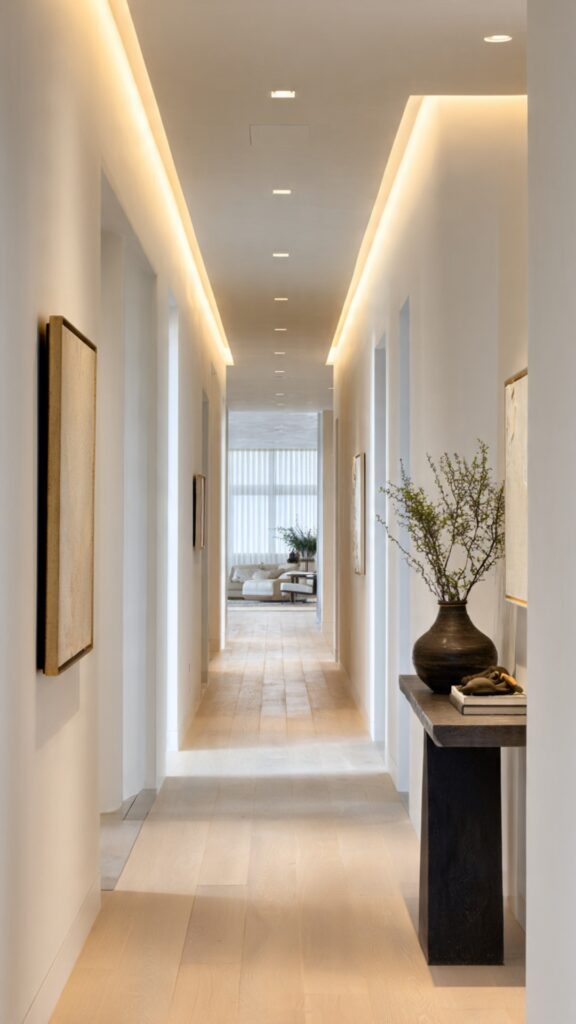
Recessed lighting also called downlights or can lights is the go-to choice for homeowners who want a clean, uncluttered ceiling with powerful, even illumination. In hallways, recessed lights are typically spaced every four to six feet along the ceiling centerline, creating a ribbon of light that guides movement through the space. This approach works particularly well in modern, minimalist, or contemporary homes where exposed fixtures might feel visually busy or out of place.
The most important technical consideration with recessed hallway lighting is beam angle. A narrow beam angle (25–40 degrees) creates focused pools of light that add drama and depth but may leave gaps between fixtures.
A wider beam angle (60 degrees or more) overlaps more naturally and produces even, consistent illumination ideal for functional hallways where safety is the priority. For most residential hallways, 4-inch recessed fixtures with a 60-degree beam angle strike the right balance between aesthetics and practicality.
One insight that most lighting guides overlook is the importance of recessed light color temperature in hallways. Many homeowners default to cool white (5000K) bulbs because they seem bright and clean. However, in a hallway lighting which is a transitional space warm white (2700K–3000K) is almost always the better choice.
Warm light creates a welcoming, cozy feeling that makes guests feel immediately comfortable. It also renders skin tones and wood finishes more flatteringly, which matters in a space where people often catch their reflection before leaving the house. Always pair recessed hallway lights with a dimmer switch for full flexibility.
Layer Sconces on Either Side of a Mirror or Art:
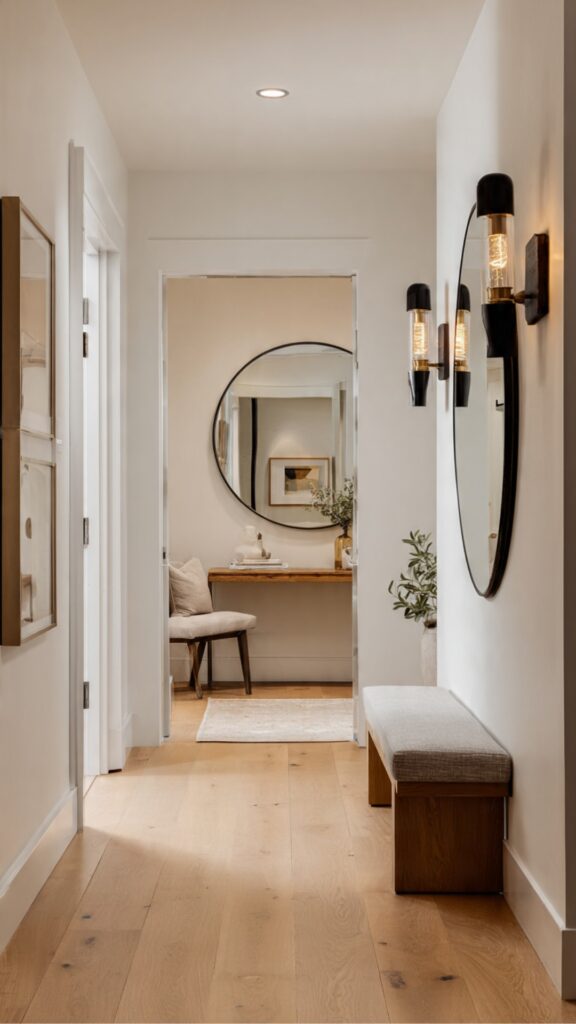
Wall sconces are among the most versatile and elegant hallway lighting solutions available. When placed symmetrically on either side of a mirror, a piece of art, or a hallway lighting console table, sconces create a sense of balance and intentionality that immediately reads as professionally designed.
They also solve a common hallway lighting problem: delivering warm, eye-level light without relying solely on ceiling fixtures that can cast unflattering shadows downward. The height at which you mount hallway lighting sconces matters enormously. The general rule is to mount them at approximately 60–66 inches from the floor roughly eye level for the average adult.
This positioning ensures the light source doesn’t shine directly into your eyes when you walk past but instead creates a soft, even glow that illuminates the wall surface around it. For sconces flanking a mirror, center them at the mirror’s midpoint and space them roughly the width of the mirror apart so the light frames the reflection evenly.
Plug-in wall sconces have become a game-changing option for renters or anyone who wants sconce-style lighting without the cost of hardwiring. Today’s plug-in models are designed with cord covers or fabric-wrapped cords that look intentional rather than improvised.
This is an insight most decorating articles completely ignore you don’t need an electrician to achieve a high-end sconce look. For hallway styling, choose sconces with upward-facing shades to bounce light off the ceiling, which amplifies the overall brightness of the space while adding a soft, ambient glow.
Must See : Hallway Decor Ideas That Perfectly Complement Your Beautiful Hallway Lighting.
Try Picture Lights to Highlight Art and Add Warmth:
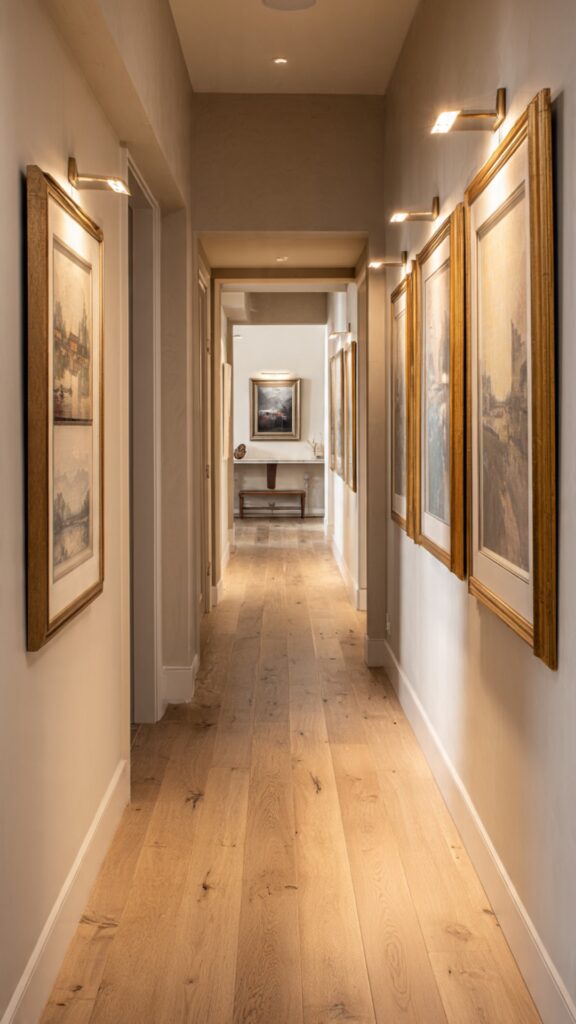
Picture lights are small, focused fixtures mounted directly above framed artwork to illuminate it with a warm, gallery-style glow. In a hallway where a curated row of photographs, prints, or paintings is a common and beautiful design choice picture lights elevate the display from simple decoration to a genuine gallery experience. The warm, directed light they cast also spills softly into the hallway space, contributing to overall ambient illumination in the most elegant way possible.
The positioning of picture lights requires some precision. Mount the fixture three to five inches above the top of the frame, and ensure the light angle is angled at roughly 30 degrees to minimize glare on the glass or canvas surface.
LED picture lights are now the preferred choice among interior designers because they produce minimal heat (protecting artwork from long-term heat damage), consume very little energy, and are available in warm color temperatures that render colors in art faithfully and beautifully.
What most hallway lighting articles miss entirely is the mood-setting power of picture lights in narrow corridors. In a long hallway with five or six pieces of art, each with its own small picture light, the effect is extraordinary a warm, golden pathway of illuminated images that makes walking through the space feel like moving through a private gallery.
This approach is far more sophisticated than a single overhead fixture and costs less than a full electrical rewiring project. Battery-powered or rechargeable picture lights make this effect accessible without any wiring at all.
Add a Runner of LED Strip Lights for a Contemporary Edge:
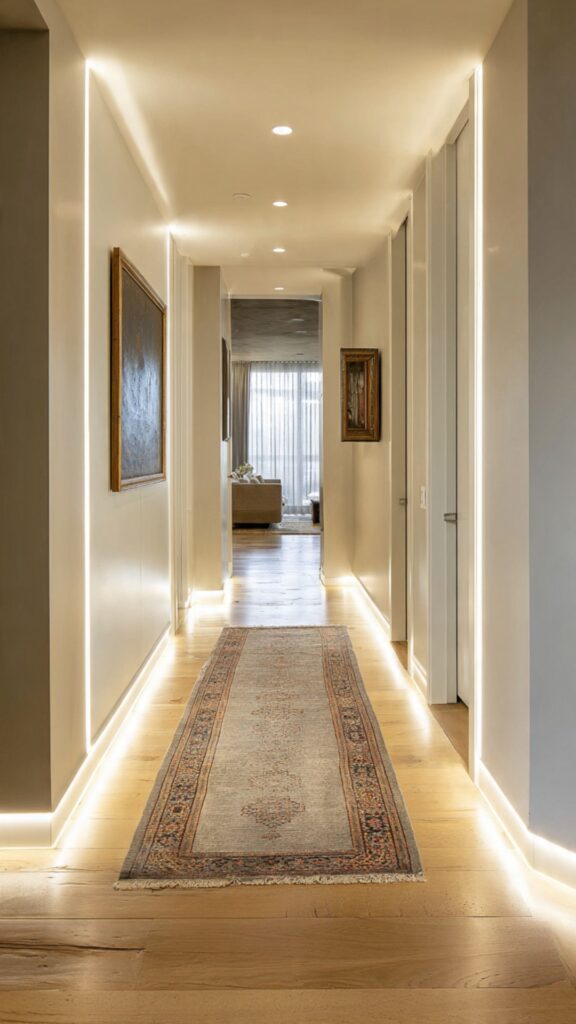
LED strip lights have matured significantly from their early reputation as cheap, novelty lighting. In 2026, high-quality LED strip lights are a legitimate and sophisticated design tool used by professional interior designers and architects in residential spaces worldwide.
In hallways specifically, LED strips installed along the base of walls, underneath floating console tables, or along the ceiling cove create a continuous line of soft, glowing light that feels modern, intentional, and even futuristic.
The most effective placement of LED strips in a hallway is along the baseboard or floor perimeter a technique called toe-kick lighting. This low-level illumination serves as a safety nightlight, guiding movement through the hallway in darkness without requiring any overhead lights to be switched on.
For families with young children or elderly residents, toe-kick LED lighting is genuinely transformative from a safety standpoint. It also creates a beautiful, floating visual effect that makes hallway flooring whether hardwood, tile, or stone look dramatically more luxurious.
For hallways with a tray or cove ceiling, LED strips installed in the ceiling recess create an indirect, halo-like glow that makes the ceiling appear to float above the walls. Choose LED strips with a high CRI (Color Rendering Index) of 90 or above to ensure accurate, flattering color rendering in the space.
Always opt for strips with a warm white (2700K–3000K) temperature for living areas. Smart LED strips controllable via smartphone app or voice assistant allow you to adjust brightness and color temperature at will, making your hallway lighting endlessly adaptable to time of day, mood, or occasion.
Choose a Flush Mount Fixture for Low-Ceiling Hallways:
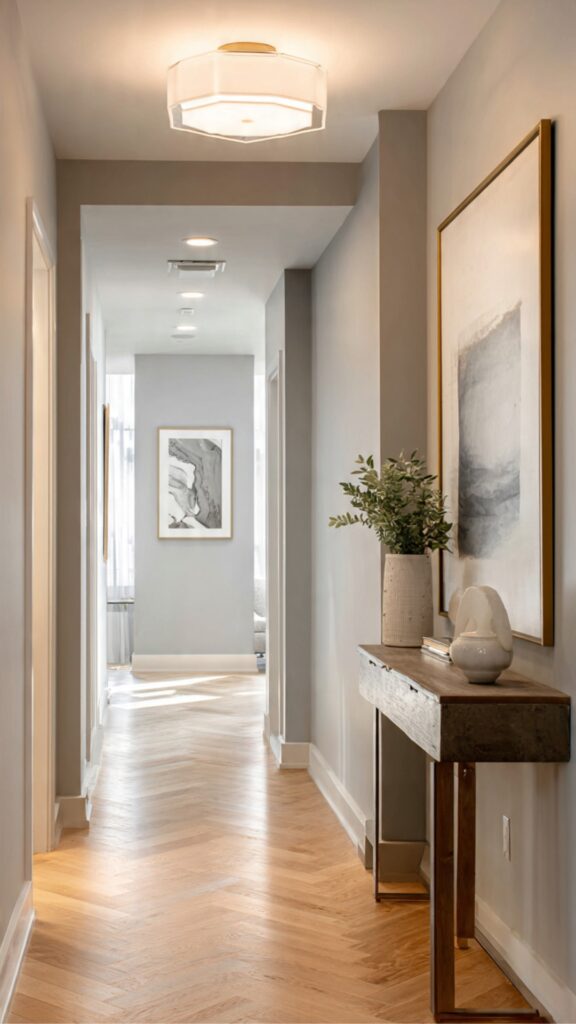
Not every hallway lighting has the ceiling height to accommodate a pendant light, and that’s perfectly fine. For hallways with ceilings of 8 feet or less, a flush mount light fixture is often the safest and most practical choice.
Modern flush mount options have come a long way from the basic dome fixtures of previous decades today’s designs include geometric metal frames, fabric-wrapped drums, backlit alabaster glass, and sculptural forms that make a genuine visual impact even in a compact profile.
Selecting the right flush mount for a hallway lighting involves balancing fixture size with ceiling height and hallway dimensions. A fixture that’s too small creates a “lost button” effect on the ceiling visually inadequate and aesthetically unsatisfying. As with pendants, calculate your ideal fixture diameter by adding the hallway’s length and width in feet and converting to inches.
For most residential hallways, a flush mount between 12 and 18 inches in diameter is appropriate. Ensure the fixture provides sufficient lumens a good target is 50 lumens per square foot of hallway lighting space.
The finish of your flush mount fixture is another detail that most guides overlook. The fixture finish should relate to other metal finishes in your hallway lighting door hardware, mirror frames, console table legs, or coat hooks. Mixing too many different metal finishes in a small space like a hallway creates visual noise.
A cohesive approach for example, all matte black hardware with a matte black flush mount, or all brushed brass with a warm-toned gold fixture creates a pulled-together, designed quality that elevates the entire entryway or corridor.
Install Motion-Sensor Lighting for Safety and Convenience:
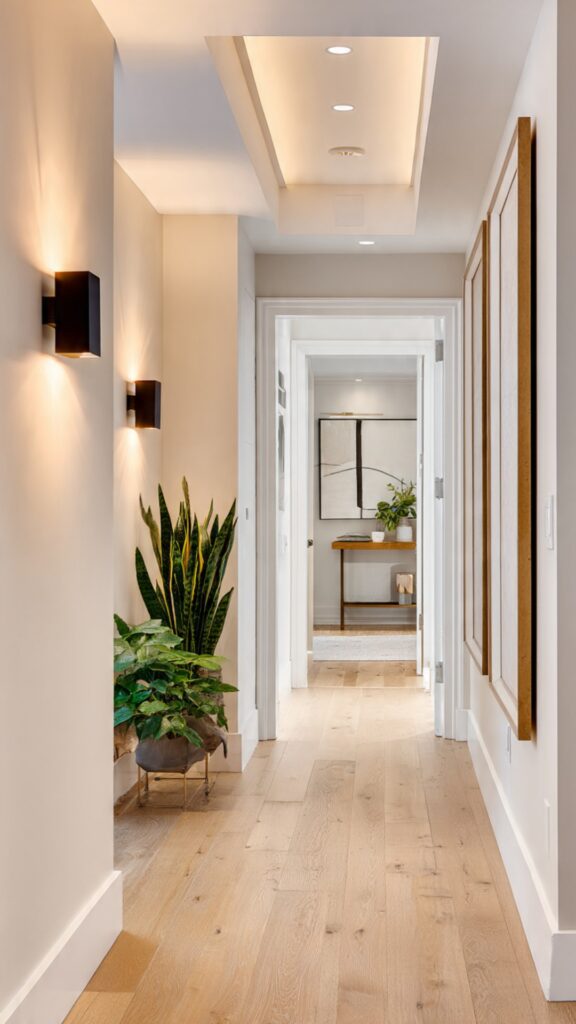
Motion-sensor hallway lighting is one of the most practical and underappreciated upgrades a homeowner can make. Rather than fumbling for a light switch in the dark or leaving lights on all night unnecessarily, motion-sensor fixtures automatically activate when someone enters the space and switch off after a set period of inactivity.
This is particularly valuable in nighttime hallways, basement corridors, or any narrow passage where switching on a light is inconvenient or potentially hazardous.
Modern motion-sensor technology has become significantly more refined than the early generation of clunky, flickering sensors. Today’s smart motion lights respond within milliseconds, can distinguish between human movement and pets (reducing false triggers), and offer adjustable sensitivity and timer settings.
Many models now integrate seamlessly with smart home systems like Amazon Alexa, Google Home, and Apple HomeKit, allowing you to set motion-activated hallway lighting as part of automated morning and evening routines.
From a design standpoint, motion-sensor hallway lighting is now available in the same stylish fixtures as standard hardwired options recessed downlights, sleek wall panels, and even pendant-style fixtures with integrated sensors.
A particularly intelligent approach is combining motion-sensor capability with dimming functionality: the light activates at a lower, gentler brightness level during nighttime hours (so it doesn’t startle sleeping family members) and at full brightness during daytime. This kind of layered, responsive lighting is what forward-thinking homeowners are building into new constructions and renovations in 2026.
Take a Peek : LED Lights Bedroom Ideas That Inspire a Whole New Level of Hallway Lighting!
Use a Lantern-Style Fixture for a Classic, Timeless Look:
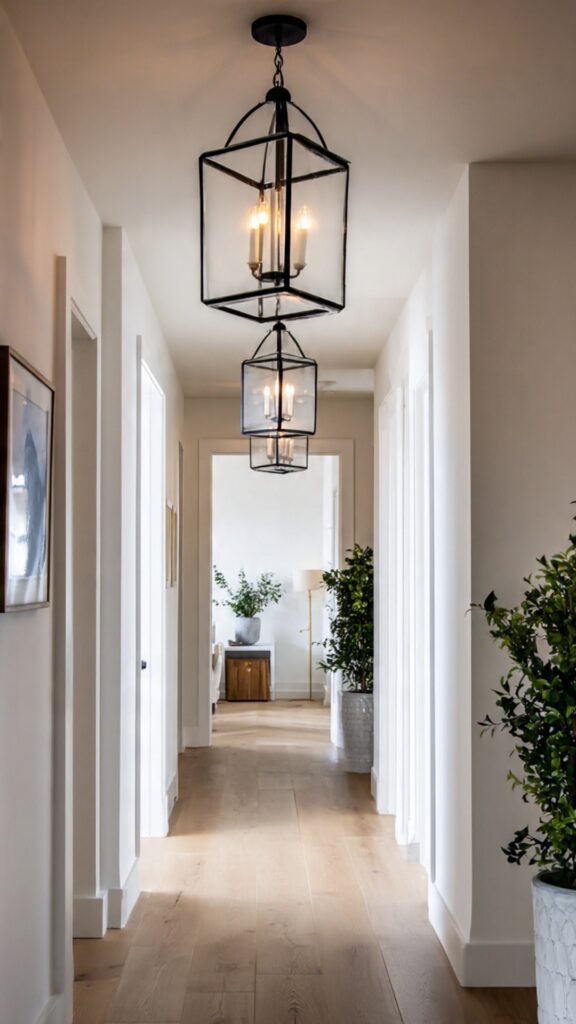
Lantern-style light fixtures bring a timeless architectural quality to hallway lighting that few other fixture types can match. Inspired by traditional gas lanterns and carriage lamps, these fixtures typically feature a metal cage or frame in finishes like aged bronze, wrought iron, or antique brass with clear, seeded, or frosted glass panels. They work beautifully in traditional, transitional, farmhouse, and colonial-style homes, and they bring an elegant, heritage quality to entryways in particular.
The lantern fixture’s transparency is one of its greatest design assets. Because light passes through glass panels in all directions, lanterns create a diffused, omnidirectional glow that illuminates a hallway lighting very evenly unlike shaded pendants that direct most of their light downward.
This makes lantern fixtures particularly effective in narrower hallways where even illumination of the walls is important for making the space feel open and comfortable. Seeded glass which features small air bubbles embedded in the glass softens the light beautifully while adding visual texture and vintage character.
In 2026, updated lantern designs are bridging the gap between traditional and contemporary. Look for lantern fixtures with slimmer, more refined metal frames, geometric cage shapes, or smoked glass panels for a more modern interpretation of the classic form.
An oversized lantern hung in a double-height entryway makes a breathtaking architectural statement. For standard-height hallways, a cluster of three small lanterns hung at varying heights creates a dynamic, chandelier-like effect that feels far more special than a single fixture while remaining completely manageable in scale.
Incorporate Natural Light with Skylights or Glass Panels:
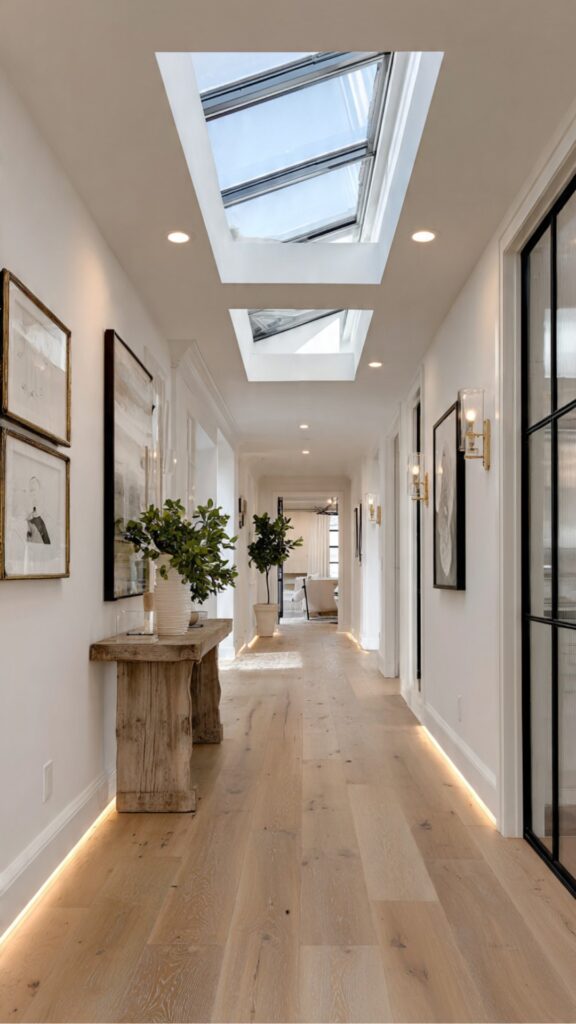
Natural hallway lighting is the gold standard nothing manufactured quite matches the quality, warmth, and vitality of sunlight. Hallways are notoriously difficult to naturally illuminate because they typically sit in the interior of a home without direct access to exterior walls or windows. However, there are several smart architectural solutions that bring natural light deep into corridor spaces without major structural changes.
Tubular skylights also called sun tunnels or solar tubes are one of the most effective and cost-efficient ways to bring natural light into a dark hallway. These devices consist of a small dome on the roof that captures daylight, a highly reflective tube that channels it through the ceiling cavity, and a diffuser lens that spreads the light softly across the hallway below.
A single 10-inch tubular skylight can illuminate up to 200 square feet of interior space, and the quality of the light it produces is genuinely indistinguishable from a window. Installation typically takes one day and costs a fraction of a traditional skylight.
Interior glass panels or borrowed light windows are another powerful strategy. Installing a small fixed window or a glass panel between an adjacent bright room and the hallway allows natural light to spill from the lit room into the corridor. Frosted or reeded glass maintains privacy while still transmitting a beautiful, diffused glow.
In new construction or major renovations, this approach is well worth planning for because it permanently solves the dark hallway lighting problem without any ongoing energy cost. Even in existing homes, a glass-paneled interior door between a sunlit living room and a dark hallway lighting makes a dramatic difference.
Experiment with Decorative Chandeliers in Grand Entryways:
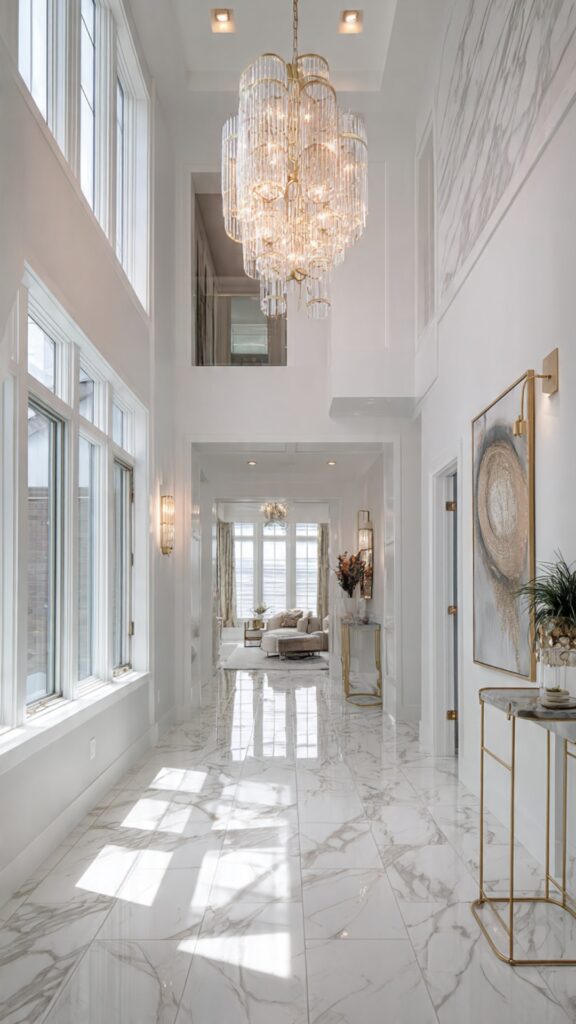
For homes with a double-height or grand entryway, a chandelier is the ultimate hallway lighting statement. A well-chosen chandelier in a soaring entryway communicates quality, sophistication, and intentional design the moment someone crosses the threshold.
It is, without question, the fixture type with the highest visual impact per dollar assuming the scale and style are right for the space. The mistake most homeowners make is choosing a chandelier that’s too small, which looks timid and out of place in a tall, expansive volume.
Sizing a chandelier for a grand entryway follows a specific formula. For the diameter, use the same length-plus-width-in-feet-converted-to-inches calculation mentioned for pendants. For the height of the chandelier body itself, allow approximately 2.5 to 3 inches of chandelier height for every foot of ceiling height.
So in a 14-foot entryway, a chandelier with a 35–42 inch body height is appropriate. This ensures the fixture fills the vertical space with presence and authority rather than dangling awkwardly in a sea of empty ceiling.
In 2026, the most compelling chandelier trends for grand entryways include linear branch-style fixtures in matte black or antique brass, large-scale drum chandeliers in woven natural fibers, and sculptural artistic chandeliers that function as genuine statement art pieces.
What separates truly stunning entryway chandeliers from ordinary ones is often the interplay of light and shadow a fixture with multiple bulbs at varying heights, or one with crystal or glass elements that cast prismatic patterns on the walls, creates a living, dynamic quality that flat, static fixtures can never achieve.
Try Cove Lighting for Soft, Indirect Ambiance:
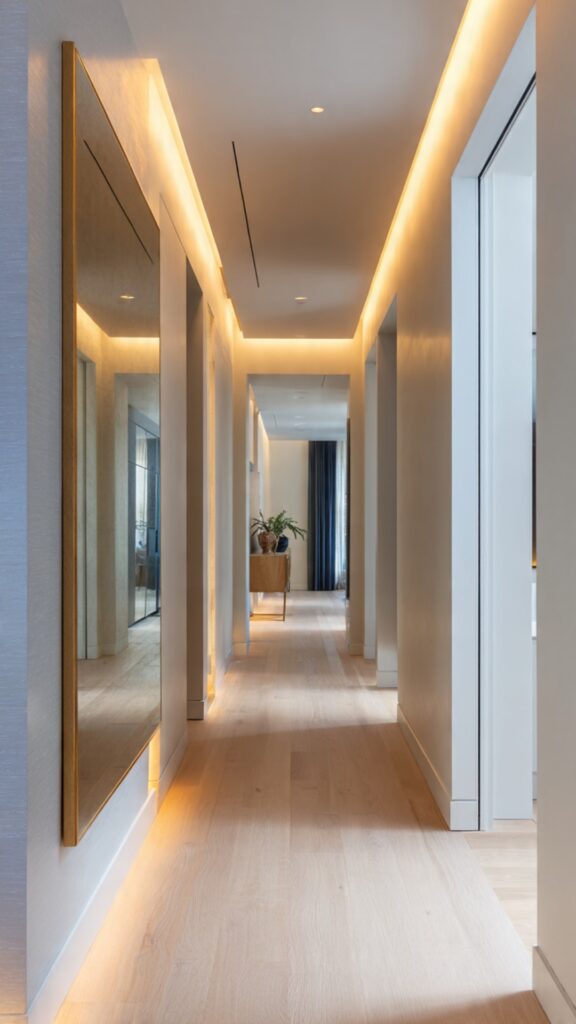
Cove lighting is an architectural lighting technique where light sources are concealed within a ledge, recess, or tray ceiling and directed upward toward the ceiling, creating a soft, indirect glow that illuminates the space without any visible fixture.
In hallways, cove lighting is one of the most elegant and sophisticated approaches available because it completely eliminates the visual “noise” of exposed fixtures while delivering beautifully diffused light that makes ceilings feel taller and spaces feel calmer.
Building cove lighting into an existing hallway lighting typically involves adding a dropped soffit or tray ceiling element along one or both sides of the corridor, concealing LED strip lights within the recess. This is a project that requires some carpentry work, but the results are permanently transformative.
For hallways in high-end renovations, architects routinely specify cove lighting because it creates a hotel-lobby quality of illumination that no surface-mounted fixture can replicate. The light appears to come from the architecture itself a seamless, sourceless glow that feels almost magical.
For homeowners who want the effect without structural changes, a simpler approximation is possible using floating shelves installed near the ceiling with LED strips hidden behind their front lip, directing light upward. This creates a similar indirect effect at a fraction of the cost and effort.
The key detail is ensuring the LED strips are completely hidden from sight lines any visible strip immediately breaks the illusion. Use an opaque mounting channel or a shelf with a generous front lip to maintain the concealment. Cove lighting pairs especially well with light-colored walls and ceilings, which maximize the reflective spread of indirect light.
Dive Into : Garden Lighting Ideas That Bring the Same Magic to Your Hallway Space.
Use Smart Lighting Systems for Full Control and Efficiency:
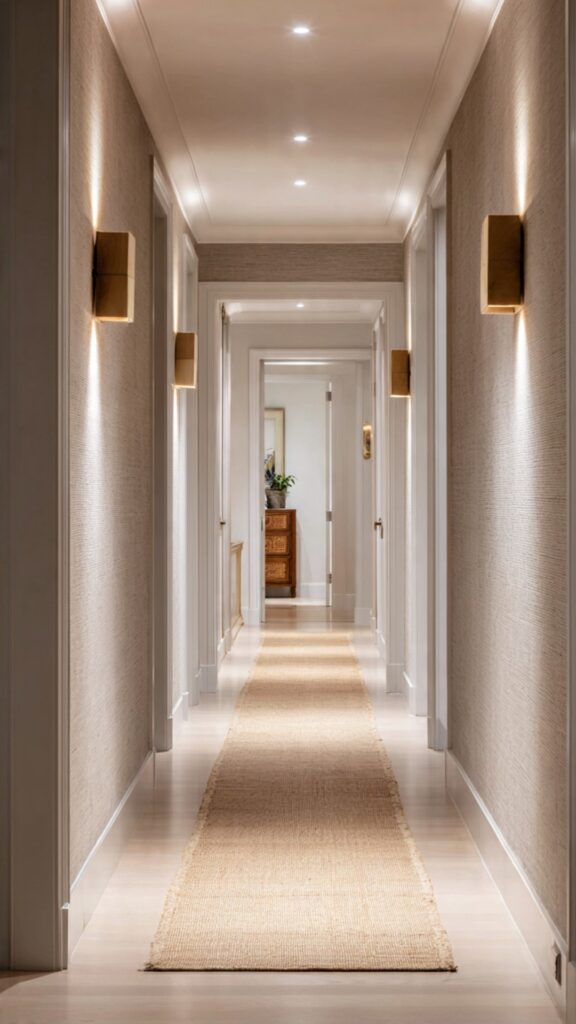
Smart hallway lighting represents the frontier of residential lighting design in 2026. By connecting your hallway fixtures to a smart home ecosystem, you gain complete control over brightness, color temperature, timing, and automation all from a smartphone app, voice command, or pre-programmed schedule.
This is not just a convenience feature; it fundamentally changes how you interact with and experience your hallway lighting every single day.
The practical benefits of smart hallway lighting are substantial. Automated schedules can gradually brighten your hallway lights each morning, simulating a gentle sunrise that eases you into the day. In the evening, lights dim automatically as your home transitions to a relaxed nighttime mode.
Motion-triggered smart lights ensure the hallway is always lit when someone needs it and off when no one does a significant energy saving in a space that’s often lit unnecessarily. For families, geofencing capabilities can trigger hallway lights to turn on automatically when a family member’s phone approaches home.
From a design perspective, smart bulbs in tunable white or full-color options give you the ability to change the character of your hallway lighting entirely without changing a single fixture. Set the hallway to a crisp, energizing 4000K cool white on workday mornings, then shift to a warm, amber 2200K glow for relaxed weekend evenings.
Some smart lighting systems like Philips Hue, Lutron Caseta, and LIFX offer curated “scenes” that coordinate your entire home’s lighting with a single tap. In a hallway, which sets the tone for every other space in the home, this kind of seamless control is genuinely transformative.
Conclusion
Hallway lighting is one of the most impactful and often most neglected design opportunities in any home. From statement pendants and elegant sconces to smart lighting systems and natural skylights, the right approach can turn a dark, forgettable corridor into a beautiful, welcoming passage that sets the tone for everything beyond it.
Start with one idea that fits your budget and style, apply it thoughtfully, and notice how dramatically it changes the feel of your entire home. Your hallway deserves the same design attention as any other room give it great lighting, and it will reward you every single day.

Team TrandyVilla is the passionate home decor team behind Trandy Villa, where style meets comfort in everyday living. The team loves transforming simple spaces into beautiful, functional homes through smart ideas, budget-friendly hacks, and modern design trends. Their content focuses on helping readers create homes that feel both stylish and personal without spending too much.