
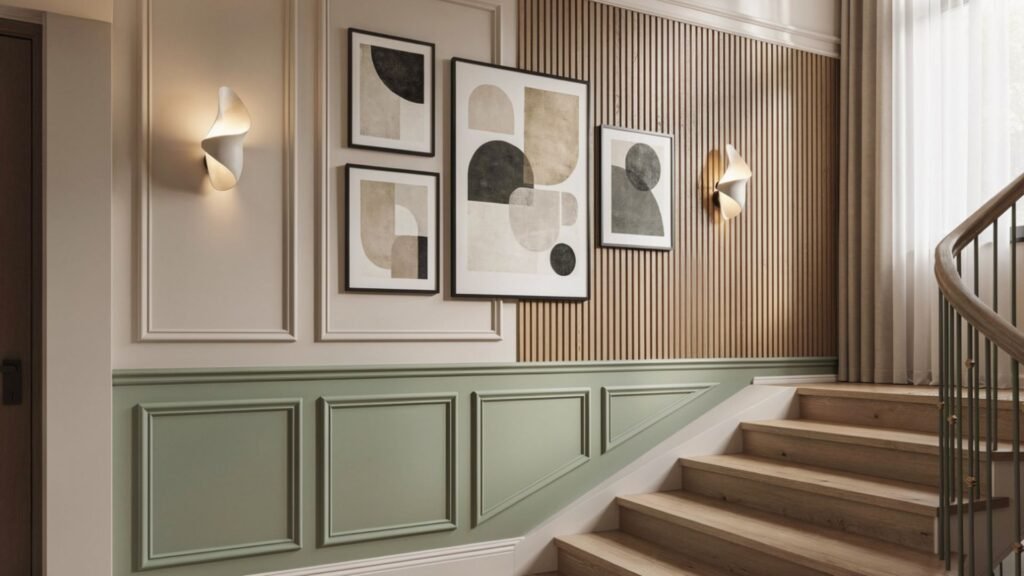
Your staircase wall is one of the most underused design opportunities in any home. This complete guide covers 12 creative, expert-backed staircase wall design ideas from gallery walls and textured panels to bold murals and smart storage to help you turn a plain passage into a stunning focal point.
Staircase wall design refers to the creative and intentional decoration of the walls alongside a staircase. It transforms a plain, overlooked surface into a stylish focal point. Designers use art, panels, lighting, and textures to enhance this space. It adds personality, depth, and visual flow to any home interior.
Most homeowners walk past their staircase wall every single day without realising its true design potential. That blank wall is one of the most powerful and most wasted canvases in your entire home. One thoughtful design choice can completely change how your home looks and feels from the moment you step inside.
Staircase wall design ideas range from gallery walls and wood panelling to murals, mirrors, and statement lighting. Each approach suits different home styles, budgets, and personal tastes. Simple changes like floating shelves or bold wallpaper create strong visual impact. Good staircase wall design improves both the beauty and the function of a home.
Gallery Wall Display Along the Staircase:
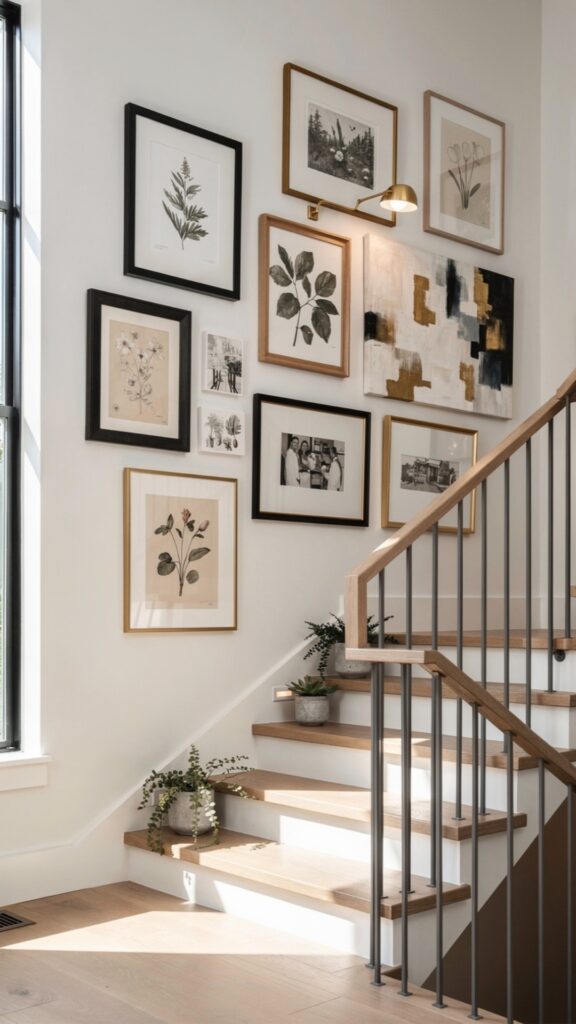
A gallery wall is one of the most timeless and versatile staircase wall design ideas you can implement. It works beautifully because the ascending layout of a staircase naturally creates a diagonal line the perfect framework to arrange artwork, family photos, travel prints, or a mix of framed memories.
Unlike a flat wall, your staircase gallery can grow organically over time, making it a living design element rather than a static decoration. The key to pulling this off professionally is to maintain a consistent frame colour or material (think all-black, all-gold, or all-wood tones) while mixing frame sizes for visual rhythm.
Interior designers often recommend starting with the largest piece at the bottom and scaling down as you ascend this mimics the natural eye movement up the stairs. Leave a consistent gap of 5–8 cm between frames to avoid a cluttered, chaotic look.
In 2026, gallery walls have evolved well beyond family photos. Designers are combining botanical prints with abstract paintings, vintage maps with black-and-white photography, and even three-dimensional sculptural wall pieces.
The staircase gallery becomes a curated storytelling wall each step up reveals a new chapter. For renters or indecisive decorators, adhesive strips and rail-and-hook hanging systems make this idea entirely commitment-free.
Pro tip: Before hammering nails, lay all frames on the floor in the arrangement you plan. Trace each frame on paper, cut them out, and tape them to the wall with painter’s tape. This low-effort planning step prevents costly mistakes.
Textured Wall Panels for a Luxurious Feel:
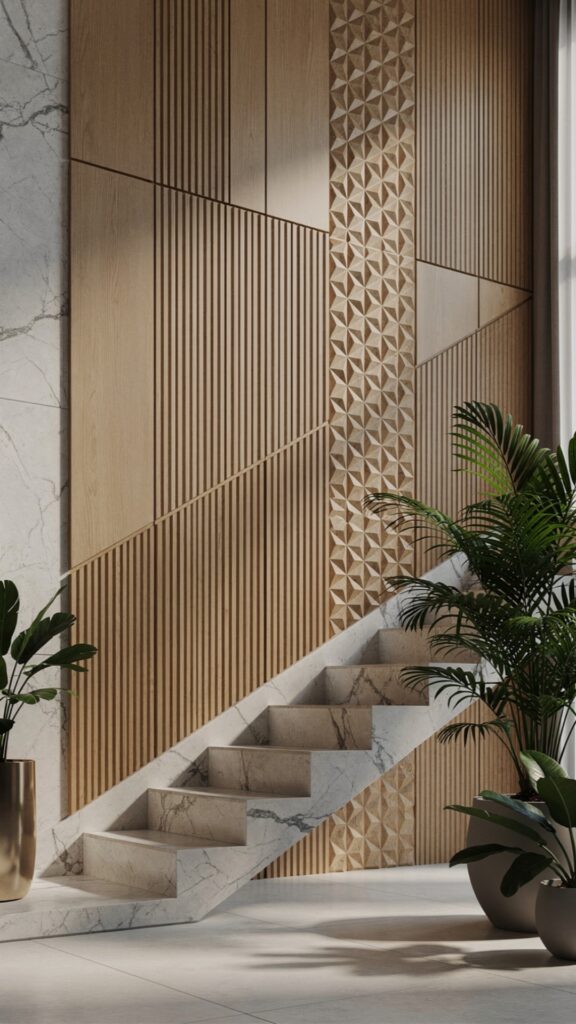
Textured wall panels are a growing trend in modern staircase wall design, offering depth, dimension, and a high-end aesthetic that flat painted walls simply cannot replicate. Materials like fluted wood panels, ribbed MDF, 3D geometric tiles, and plaster-effect boards are increasingly popular choices that add tactile richness to what is often a neglected vertical surface.
Whether you go floor-to-ceiling or opt for a dado-height panel strip, texture transforms the staircase corridor into something architecturally significant. Fluted timber panels thin vertical ridges running parallel are particularly fashionable right now, appearing in luxury residential projects and five-star hotel interiors alike.
When installed along a staircase wall and finished in warm oak, walnut stain, or matt white paint, they create a rhythm that guides the eye upward and makes even a narrow stairwell feel intentional and elevated. Pair them with recessed LED lighting in the grooves for a showroom-quality finish.
From a practical standpoint, textured panels also serve as excellent sound absorbers in busy homes, reducing echo in stairwells. This is especially valuable in open-plan homes where staircase noise tends to travel. When combined with a neutral colour palette warm greige, soft sage, or chalky white textured panels create a sophisticated backdrop that works equally well in contemporary, Scandinavian, and transitional interior styles.
Designer insight: Plaster-effect panels are ideal for those who love the look of venetian plaster without the labour-intensive application. Modern PVC or fibre cement panels mimic this look perfectly and are moisture resistant a practical win for staircases near entryways.
Bold Statement Murals That Tell a Story:
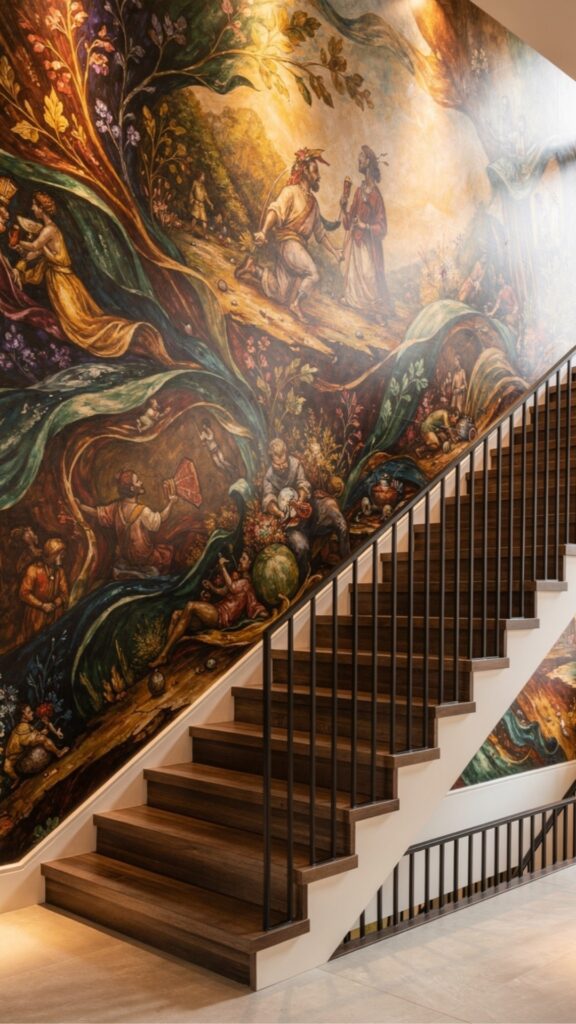
If you want your staircase wall to be truly unforgettable, a large-scale statement mural is the most impactful design choice you can make. Murals have historically been reserved for public spaces and luxury hotels, but digital wall printing and affordable commissioned artists have brought this concept well within reach of residential homeowners.
A mural turns an otherwise functional corridor into a destination something guests pause at, children remember, and owners fall in love with daily. The beauty of a staircase mural lies in its sequential reveal. Unlike a flat wall mural viewed all at once, a staircase mural unfolds as you ascend or descend making it a uniquely dynamic art experience.
Popular themes include botanical jungles with oversized tropical leaves, moody abstract watercolours in navy and gold, architectural cityscapes, celestial maps, and even personalised family heritage illustrations. Custom murals can be created by local artists or sourced through global platforms like Etsy or Society6 for printed panels.
For those hesitant to commit to permanent paint, peel-and-stick mural wallpapers now offer photorealistic finishes that are completely removable. Technology-wise, UV-resistant inks mean even sun-exposed staircase walls won’t fade for years. When planning a mural, always account for the handrail interruption a skilled designer will incorporate it seamlessly into the composition rather than treating it as an obstacle.
Scenario: A family in London commissioned a hand-painted mural of their ancestry map spanning the entire staircase wall from their Pakistani roots to their current UK home. The result was a deeply personal, visually stunning installation that became the conversation piece of every gathering.
Discover More: Wall Panel Design Ideas That Transform Every Wall Into a Work of Art.
Floating Shelves for Style and Storage:
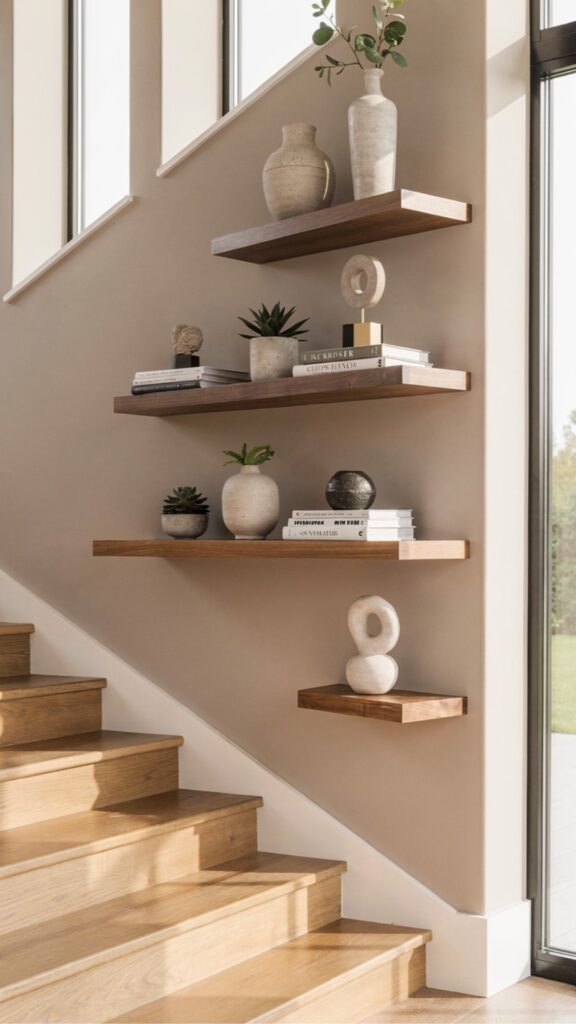
Floating shelves along the staircase wall are one of those rare design solutions that are equally functional and beautiful. In many homes, the staircase wall design stretches two full storeys that is an enormous expanse of vertical real estate that most people leave completely bare. Installing a staggered series of floating shelves at varying heights transforms this space into a dynamic display wall that can hold books, plants, candles, small sculptures, and decorative objects.
The key design principle with staircase floating shelves is to follow the pitch of the stairs. Shelves installed parallel to the stair angle (rather than horizontal) look intentional and architecturally coherent. However, for displaying objects without them sliding off, horizontal shelves installed at natural step intervals work best.
A combination of both creates visual interest. For materials, solid oak and walnut shelves have a warm, organic quality; powder-coated steel brackets in matte black add an industrial edge; while marble or quartz tops inject luxury into the space.
From an SEO and lifestyle perspective, staircase shelving has surged in search interest as more people work from home and need functional display storage beyond the living room. The staircase wall design becomes a secondary book display, a plant wall, or even a small home office accessory shelf. This trend is especially relevant in smaller homes and urban apartments where floor space is at a premium vertical staircase storage is genuinely transformative.
Smart tip: Use the lower shelves (reachable from the stairs) for frequently swapped decorative items. Reserve upper shelves those only reachable by ladder for long-term display pieces like potted trailing plants or large sculptural objects.
Wainscoting and Panel Moulding for Classic Elegance:
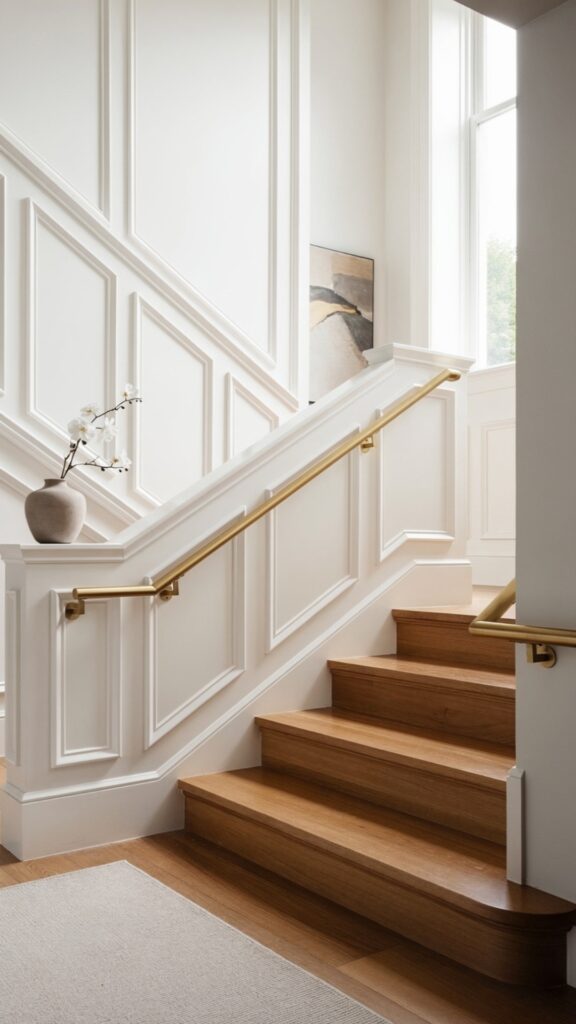
Wainscoting the use of decorative wood panelling on the lower portion of a wall is one of the most classically elegant staircase wall design choices available. Originally designed to protect plastered walls from moisture and furniture damage, wainscoting has evolved into a pure aesthetic statement that signals quality craftsmanship and architectural character.
On a staircase wall design, it creates a defined lower zone of interest that grounds the space visually while the upper wall remains open for artwork or paint. Traditional wainscoting styles include raised panel (formal, Georgian or Victorian character), flat panel (clean, modern), beadboard (coastal or farmhouse charm), and board-and-batten (contemporary with strong vertical lines).
Each brings a distinctly different personality to your staircase. For a modern interpretation, designers are now painting wainscoting in deep heritage colours forest green, dusty blue, plum, terracotta rather than the traditional white, creating dramatically rich lower walls that contrast with light neutral upper halves.
Beyond aesthetics, wainscoting adds genuine resale value to a property. Estate agents consistently note that period-detail features like panelling increase perceived home quality, particularly in mid-range markets. From a DIY perspective,
MDF wainscoting kits are now widely available at timber merchants and online retailers, making this a manageable weekend project for intermediate DIY enthusiasts no professional carpenter required for simpler styles like board-and-batten.
Board-and-batten wainscoting paired with a deep olive green paint has become the definitive “elevated country home” look in 2025–2026, heavily favoured by interior designers working in period properties and new-builds alike.
Wallpaper and Scenic Wall Coverings:
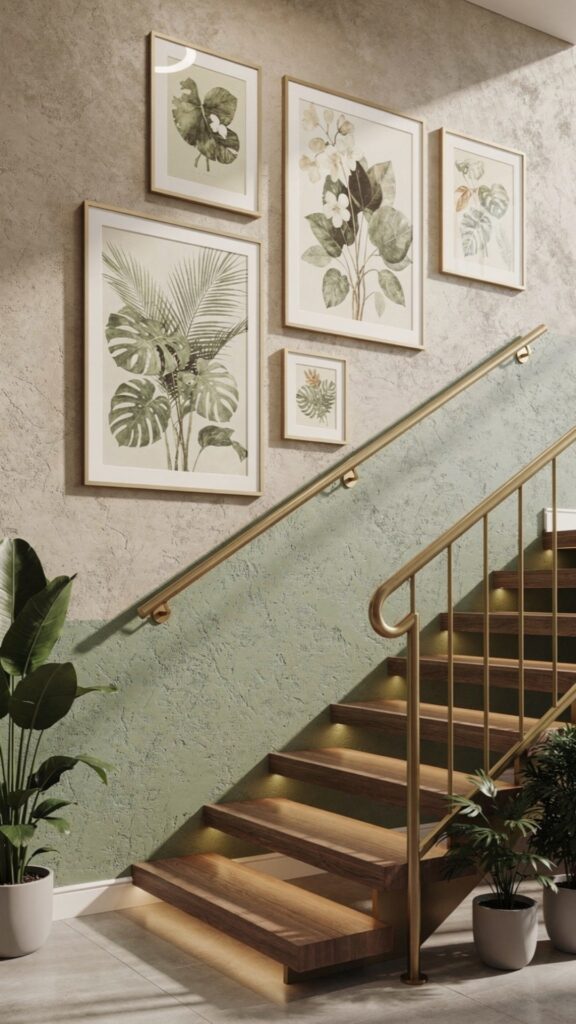
Wallpaper has undergone a radical renaissance in recent years, moving far beyond the dated floral patterns of the past into a world of sophisticated botanical prints, abstract textures, metallic weaves, and panoramic scene setters.
For staircase wall design, wallpaper is particularly powerful because the vertical, often narrow space benefits enormously from pattern and visual complexity it draws the eye upward and makes the journey up the stairs feel immersive rather than purely functional.
Maximalist wallpaper choices like hand-painted chinoiserie, oversized tropical foliage, or dramatic art deco geometrics work exceptionally well on staircase walls precisely because the space is transitional. You pass through it rather than live in it.
which means bold pattern choices that might feel overwhelming in a sitting room feel perfectly calibrated on a staircase. Designers like Cole & Son, Farrow & Ball, and Graham & Brown offer premium options, while Photowall and Rebel Walls produce custom-size scenic murals that fit unusual staircase proportions.
For a future-forward approach, consider textured wallpapers that mimic grasscloth, linen, or woven rattan. These natural-texture wallcoverings add warmth and acoustic softening without the visual busyness of patterned paper.
They’re also significantly more forgiving in terms of installation ideal for DIY application. In 2026, we’re seeing a major trend toward “quiet luxury” staircase wallpaper: tone-on-tone textures in off-white, stone, and oat that add depth without demanding attention.
Practical note: Staircase wall design are tricky to paper because of the sloped ceiling line and often awkward angles. Always hire a professional paperhanger for large pattern repeats or panoramic murals the investment is worth the precision required.
Vertical Garden Wall for a Biophilic Design Touch:
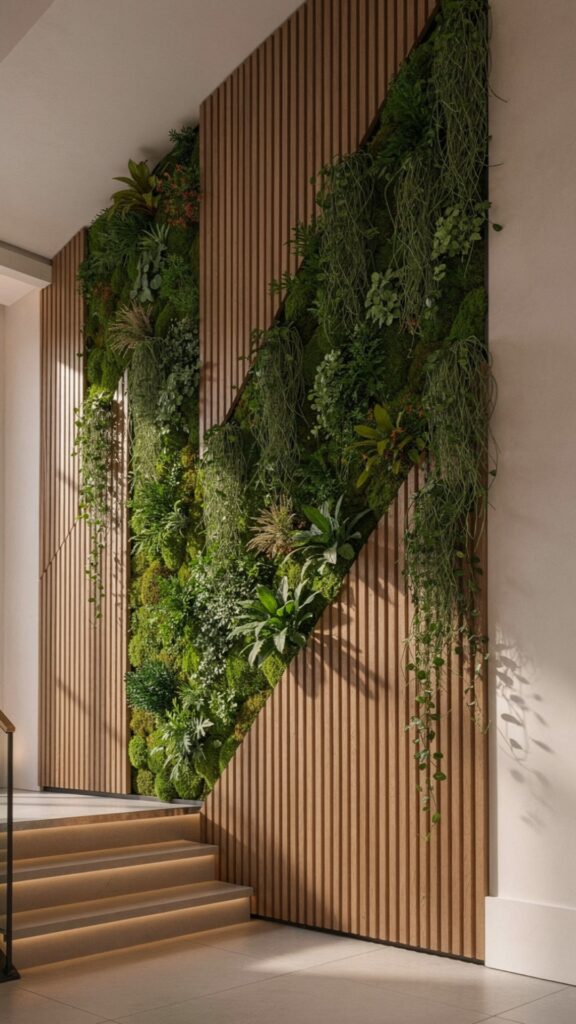
Biophilic design the intentional integration of nature into interior spaces is one of the most significant movements in contemporary interior architecture, and the staircase wall design is an ideal location for its most dramatic expression: the vertical garden.
A living plant wall along the staircase brings organic texture, natural colour variation, and even improved air quality to what is often one of the driest, most plant-hostile zones of a home. The visual impact is immediately striking and entirely unlike any other wall treatment.
Vertical garden systems have evolved significantly. Early iterations required complex irrigation and drainage, making them impractical for most domestic settings. Today’s panel systems such as the Naava Green Wall or various modular planter pocket systems use soil-free hydroponic growing media, integrated drip irrigation, and even app-controlled watering schedules.
For a low-maintenance alternative, preserved moss walls (using stabilised real moss that requires no water or light) create an equally lush look with zero ongoing care.
For homeowners who want a middle-ground approach, a curated arrangement of trailing pothos, heartleaf philodendrons, and string of pearls in a series of floating wall planters creates the lush, layered look of a living wall without the complexity of a full irrigation system. The staircase’s natural light from upper windows or a skylight makes this zone surprisingly viable for light-tolerant plant species, and the cascading growth of trailing plants enhances the vertical drama of the staircase perfectly.
Research from the University of Exeter found that workplaces with living plant walls reported a 15% increase in wellbeing and concentration. While this was office-focused research, the psychological benefit of living greenery in transitional home spaces like staircases is a compelling design argument.
Mirror Wall Arrangement to Expand Space:
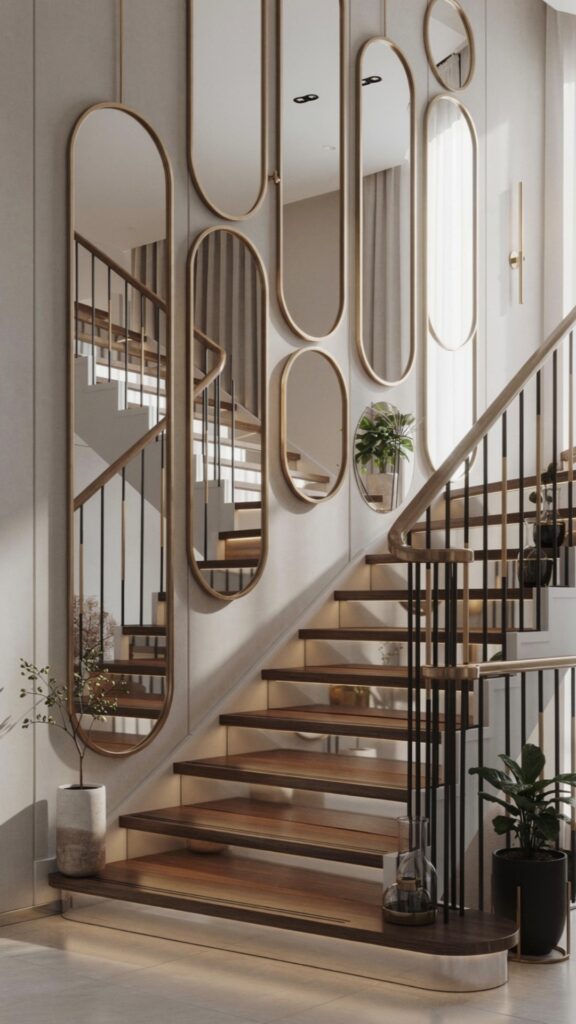
Mirrors are one of the oldest and most effective tricks in the interior designer’s toolkit and when applied thoughtfully to a staircase wall design, they produce remarkable results. The primary benefit is spatial amplification: mirrors reflect both natural and artificial light deep into a narrow stairwell, visually doubling the perceived width and height of the space. In terraced houses,
Victorian properties, and modern apartments where stairwells tend to be dark and confined, a strategic mirror arrangement can be genuinely transformative. The most sophisticated approach is a curated collection of mirrors in different shapes and sizes arched, oval, round, rectangular, sunburst arranged gallery-style following the staircase ascent. This “mirror gallery” trend has grown significantly in popularity because it blends function with art.
Each mirror becomes both a practical necessity (checking your appearance before leaving the house) and an aesthetic object in its own right. Antique-finish mirrors with distressed frames add character; frameless mirrors create a seamless, contemporary feel.
From a safety standpoint, always use shatter-safe acrylic mirrors or toughened glass in staircase areas where impact risk is higher than in other rooms. Wall-fixing mirrors properly into studs or with appropriate masonry anchors is non-negotiable in a high-traffic vertical zone. For a cohesive look, frame your mirrors in a single consistent metal finish: brushed brass for warmth, matte black for drama, or polished chrome for a clean modern edge.
Spatial tip: Place the largest mirror at the bottom landing where it reflects the most light into the stairwell. Smaller accent mirrors higher up catch and redistribute this light upward, creating an almost lantern-like effect in darker stairwells.
Read Also: Hallway Decor Ideas to Make Every Entrance Feel Warm and Welcoming.
Exposed Brick or Stone Cladding for Industrial Character:
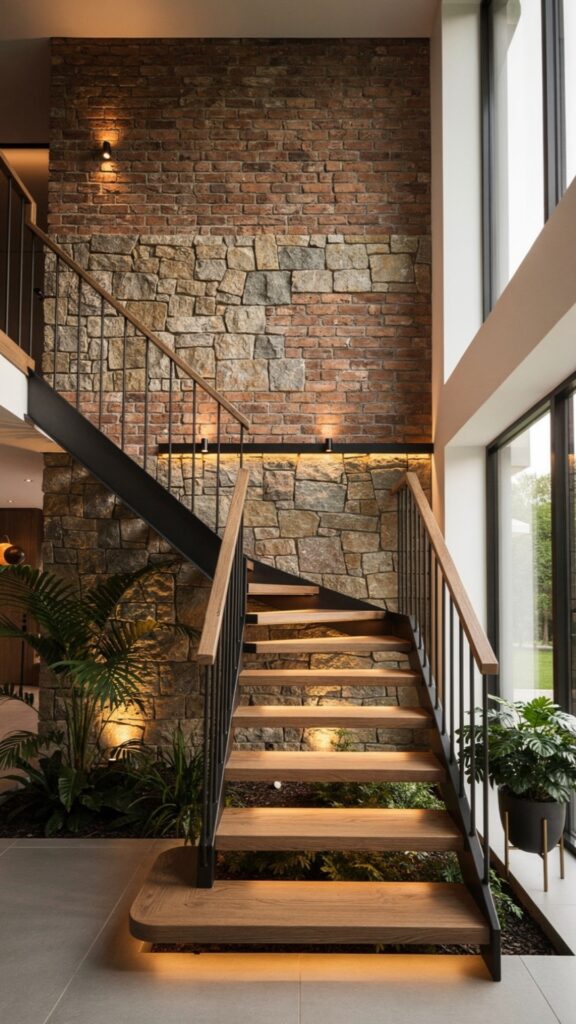
Exposed brick or stone cladding on a staircase wall design is one of the boldest and most character-rich design decisions you can make. It brings raw, architectural texture to the space a deliberate juxtaposition between the refined softness of plastered walls and the honest materiality of masonry.
In period properties, this often means simply stripping back plaster to reveal original Victorian or Edwardian brickwork. In new builds, thin brick slips and stone veneer panels recreate this look with a fraction of the structural intervention.
The exposed brick staircase wall design is particularly powerful in homes that lean toward industrial, loft-style, urban-contemporary, or rustic farmhouse aesthetics. The naturally varied tones of brick terracotta, burnt sienna, pale sand add warmth that contrasts beautifully with cool concrete floors, white render, and dark metal banisters.
Stone cladding in slate grey or sandstone offers a more formal, country-house quality that pairs well with traditional oak staircases and herringbone parquet flooring. One often-overlooked consideration is the acoustic impact of hard cladding materials. Brick and stone reflect sound rather than absorbing it, which can make a stairwell feel louder and more echoey.
Counter this by introducing soft furnishings elsewhere on the staircase a runner rug on the stairs, a cushioned window seat at the landing, or fabric wall hangings higher up. This contrast between hard and soft textures actually enhances the design story of the space.
Brick slip panels thin ceramic or real-clay slips that adhere to existing walls have become the preferred solution for achieving the exposed brick look in newer homes. They’re lighter than real brick, easier to install, and produce an impressively authentic result when sealed with a matt brick wax.
Neon Signs and Contemporary Wall Art Installations:
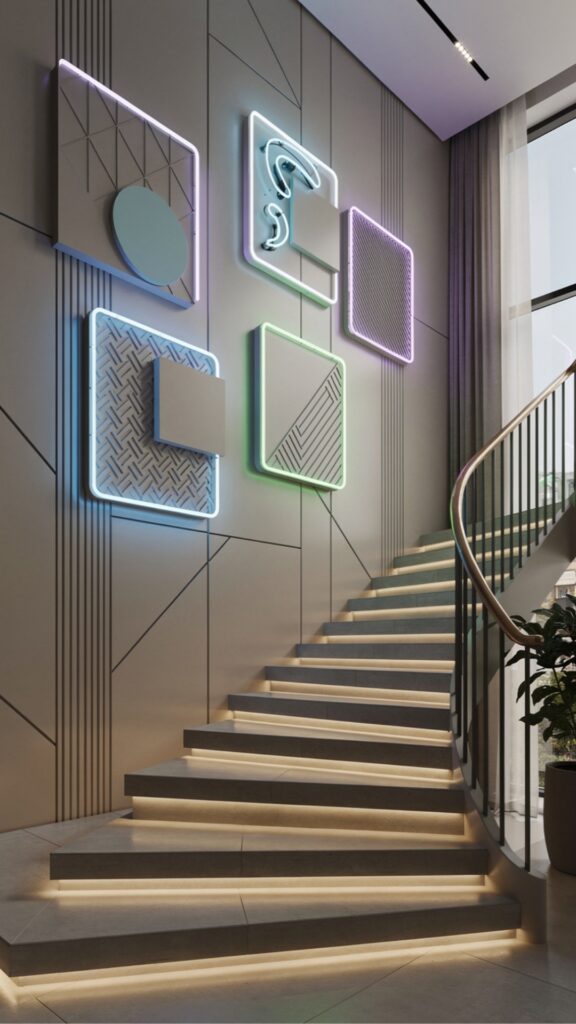
Neon signage and contemporary wall art installations represent the most expressive and personality-driven end of the staircase wall design spectrum. Where other ideas focus on material textures or spatial tricks, this approach is unapologetically about making a bold personal statement.
A custom neon sign whether spelling out a family name, a meaningful quote, coordinates of a special location, or simply a beautiful abstract shape creates an immediately memorable focal point that guests will comment on every single time they visit.
Modern LED neon flex (as opposed to traditional glass neon) has made these installations safer, more energy-efficient, and far more affordable than they once were. Colours range from classic warm white and icy blue to millennial pink and electric orange.
For a staircase wall design, a single oversized neon piece positioned at the half-landing (the natural visual pause point when ascending) works exceptionally well. It draws the eye forward and creates a sense of arrival at the mid-point of the journey.
Beyond neon, three-dimensional wall art installations such as sculptural ceramic tiles arranged in an organic formation, woven wall hangings in natural fibres, or metal wall art in geometric or organic forms bring depth and tactility to staircase walls in ways flat art cannot.
These installation-style pieces are increasingly accessible via independent makers on platforms like Not on the high street, Etsy, and at independent design fairs meaning your staircase wall design can support small creative businesses while becoming genuinely one-of-a-kind.
Creative direction: Rather than predictable inspirational quotes, consider commissioning a neon rendering of a personal symbol your pet’s silhouette, a meaningful botanical outline, or a geometric shape that reflects your personality. Uniqueness elevates neon from gimmick to genuine art.
Built-in Bookcase Wall for Book Lovers:
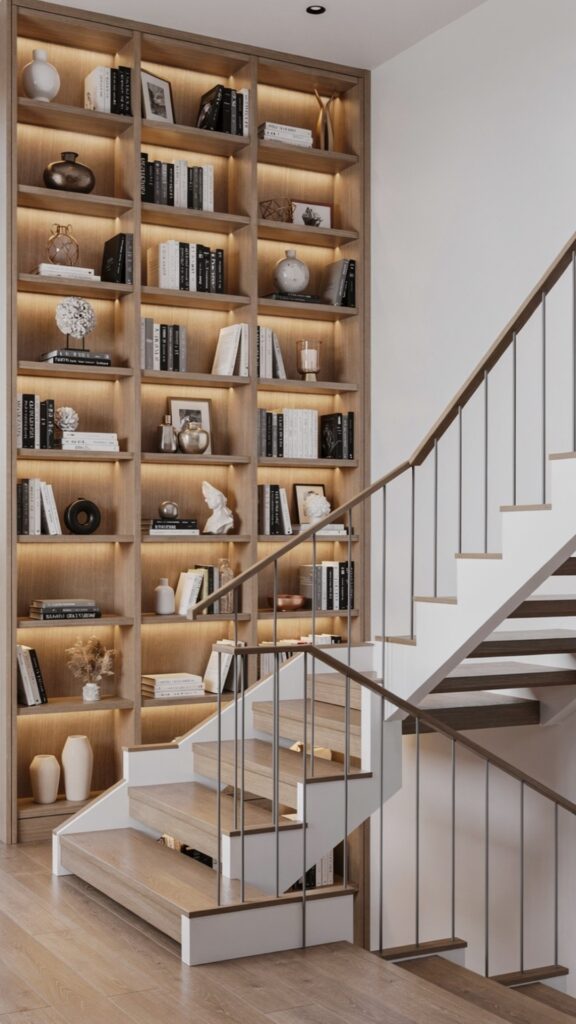
For homes where books are a way of life, a built-in bookcase running along the staircase wall design is perhaps the single most satisfying use of that vertical space. A full-height, floor-to-ceiling bookcase following the pitch of the stairs creates something that looks almost like an extension of a library an architectural feature that is simultaneously practical, beautiful, and deeply personal.
Every book on display is a small piece of the owner’s intellectual identity, making this one of the most intimate staircase wall design ideas of all. The key engineering consideration for staircase bookcases is the stepped profile of the shelving each shelf must be sized to fit the stair geometry without awkward overhangs or dead space.
A skilled joiner will design the shelving to follow the stair angle precisely, with each bay dropping in height to match the riser intervals. This bespoke quality is what distinguishes a truly exceptional staircase library from a generic flat-wall bookcase adapted to an awkward space.
For a more accessible implementation, floating box shelves in varying depths rather than floor-to-ceiling joinery can create a book wall effect at a fraction of the cost. Mixing books with small framed art, houseplants, candles, and decorative objects prevents the wall from looking too austere or utilitarian.
In 2026, the “colourful book spine” display trend where books are arranged by spine colour to create a gradient or rainbow effect adds an extra layer of visual design to an already richly textured wall.
In property styling and estate agent photography, a staircase library wall consistently ranks among the most shared and saved images on platforms like Pinterest and Houzz. It signals cultural richness, design intention, and adds immediate perceived value to a home in a way that few other features can match.
You Might Like: LED Lights Ideas That Add a Stunning Glow to Any Space in Your Home.
Lighting-Led Staircase Wall Design:
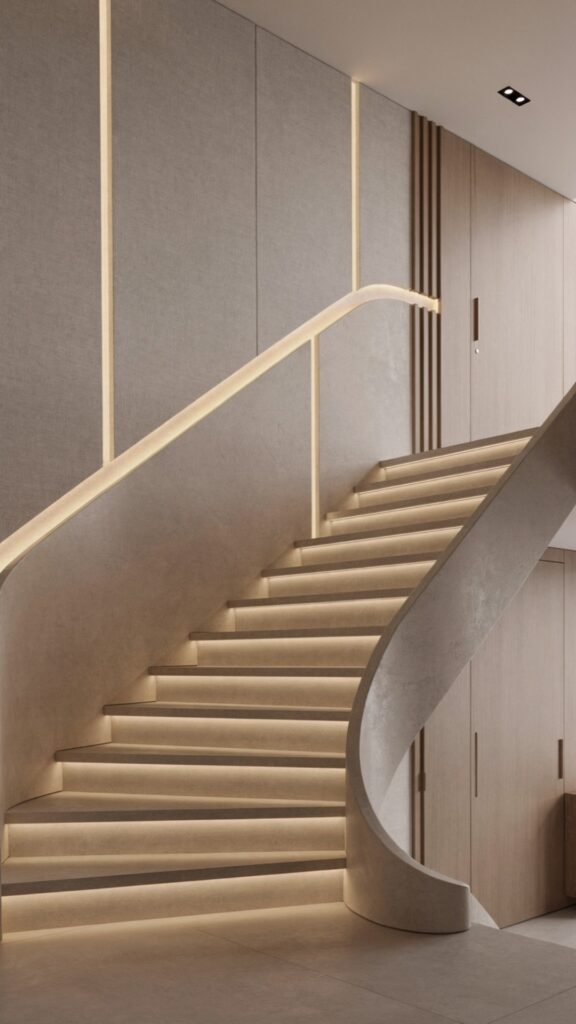
Lighting is often treated as an afterthought in staircase wall design, but the most sophisticated staircase wall treatments use light as the primary design medium. When thoughtfully planned, lighting can make a plain painted wall look dramatic, reveal the texture of panelling or stone cladding in cinematic detail, and create an atmosphere that shifts from functional daytime clarity to intimate evening ambiance.
The staircase wall design offers unique opportunities for both architectural and decorative lighting that flat ceilinged rooms cannot replicate. Recessed stair tread lighting LEDs embedded in the wall or beneath each stair nose is the most safety-conscious form of staircase lighting, illuminating the steps without glare while casting a beautiful warm wash across the wall surface.
Wall-mounted picture lights angled to highlight artwork add gallery-quality drama. For those with textured wall panels, grazing light (a fixture positioned close to the wall surface to illuminate texture from a sharp angle) transforms ribbed timber or plaster panels into something almost sculptural.
The under-appreciated opportunity in staircase wall lighting is the pendant or chandelier drop in double-height stairwells. A statement pendant hung at the stairwell void whether a cluster of globe lights, a sculptural chandelier, or a dramatic single pendant illuminates both the staircase and its wall simultaneously, creating depth, shadow, and a sense of architectural grandeur. This is especially impactful in Victorian and Edwardian properties with tall stairwells that are otherwise deeply underlit and visually underserved.
Future-ready design: Smart lighting systems like Philips Hue and Lutron Caséta now allow full control of staircase lighting colour temperature and intensity via phone or voice. Programme a warm amber scene for evenings and a crisp daylight setting for mornings your staircase wall design becomes a different experience at different times of day.
Final Thoughts
Your Staircase Wall Deserves More
Your staircase wall design is one of the most seen surfaces in your entire home yet it remains one of the most neglected. Whether you choose a curated gallery wall, dramatic mural, tactile stone cladding, or a smart lighting scheme, every one of these staircase wall design ideas has the power to turn a purely functional corridor into a genuinely inspiring space.
The best staircase wall designs reflect who you are your tastes, your stories, your way of living. There is no single right answer; only the approach that resonates most with your home’s personality and your own vision. Start with one idea, execute it with intention, and let it evolve over time.
Ready to transform your staircase? Pick the one idea from this guide that excites you most and take the first practical step today.

Team TrandyVilla is the passionate home decor team behind Trandy Villa, where style meets comfort in everyday living. The team loves transforming simple spaces into beautiful, functional homes through smart ideas, budget-friendly hacks, and modern design trends. Their content focuses on helping readers create homes that feel both stylish and personal without spending too much.