
Your last pair of earbuds died in your pocket during a flight, or fell out mid-run, or made every phone call sound like you were talking through a tin can and now you’re back here, trying to figure out which pair actually deserves your money this time. That frustration is exactly why the search for the best wireless earbuds has gotten harder, not easier, even as the market has exploded with options.
The category has changed fast. Features that once separated $300 flagships from everything else adaptive noise cancellation, hi-res audio codecs, multipoint Bluetooth are now showing up in $50 earbuds, while premium brands like Apple, Sony, and Bose keep pushing battery life, fit, and call quality further. That’s great news for buyers, but it also means last year’s “best of” list is already outdated, and a lot of advice floating around the web hasn’t caught up.
This guide cuts through that noise. It’s built from published specifications, manufacturer data, and independent lab testing from established audio reviewers, organized around how real people actually shop: by phone compatibility, noise cancellation needs, battery habits, fit, and budget. You’ll get direct comparisons, a decision framework matched to your specific use case, honest trade-offs for every pick, and answers to the buying questions people search for most.
By the end, you’ll know exactly which earbuds fit your life not just which ones top a generic ranking. Let’s start with the short version.
Quick Answer
If you just want a recommendation and don’t want to read the whole guide: the Apple AirPods Pro 3 ($249) are the best all-around pick for iPhone owners, the Sony WF-1000XM6 ($329.99) lead the pack for sound quality and Android compatibility, and the Anker Soundcore Space A40 (around $99, often discounted) is the smartest budget buy. If noise cancellation is your top priority over battery life, the Bose QuietComfort Ultra Earbuds (2nd Gen) ($299) are still the ones to beat.
Key Takeaways
- There’s no single “best” pair the right earbuds depend on your phone, your ears, and what you actually use them for (commuting, workouts, calls, or critical listening).
- Battery life varies more than most buyers expect, from under 5 hours to over 10 hours per charge on a single earbud, before you factor in the case.
- Apple’s AirPods Pro 3 offer 8 hours of ANC-on battery life and 24 hours total with the case, making them a strong daily driver for iPhone owners. Tom’s Guide
- Sony’s WF-1000XM6 cost around $330, among the most expensive wireless earbuds on the market, but reviewers consistently rank them at the top for sound and call quality. GSMArena
- Bose’s QuietComfort Ultra Earbuds (2nd Gen) deliver some of the best noise cancellation available, but battery life is a genuine weak point compared to competitors. TechGearLab
- Budget doesn’t mean bad anymore. Sub-$100 earbuds now include adaptive ANC, multipoint Bluetooth, and hi-res codec support features that cost $200+ just a few years ago.
- Fit matters more than spec sheets. The “best” earbuds on paper are the wrong choice if they fall out of your ears or feel painful after 20 minutes.
Discover More: Is BrumeBlog.com Safe? An Honest, Evidence-Based Safety Review 2026
How We Evaluated These Earbuds {#how-we-evaluated}
This guide is built from published specifications, manufacturer data, and independent reviews from outlets that perform standardized lab testing, cross-checked against real-world feedback. Where a claim comes from the manufacturer, it’s labeled as such. Where it comes from independent testing, that’s noted too. We haven’t personally tested every pair listed here, so treat this as a research-backed comparison rather than a hands-on lab report and always check current reviews before buying, since firmware updates and price changes happen often.
Comparison Table: Best Wireless Earbuds at a Glance
| Model | Best For | Price | Battery (Earbuds) | Battery (With Case) | ANC | Water Resistance |
| Apple AirPods Pro 3 | iPhone users, all-around use | $249 | 8 hrs (ANC on) | 24 hrs | Excellent | IP57 |
| Sony WF-1000XM6 | Sound quality, Android | $329.99 | 8 hrs claimed | 24 hrs | Best-in-class | IPX4 |
| Bose QC Ultra Earbuds (2nd Gen) | Noise blocking, flights | $299 | 6 hrs | 24 hrs | Best-in-class | IPX4 |
| Samsung Galaxy Buds4 Pro | Samsung/Galaxy ecosystem | ~$249 | ~6–7 hrs | ~24–29 hrs | Very good | IP57 |
| Anker Soundcore Space A40 | Budget shoppers | ~$99 (often $45–60) | 10 hrs | 50 hrs | Good (adaptive) | IPX4 |
Prices reflect list pricing and fluctuate with retailer sales earbuds in this category are frequently discounted 20–50% during sales events.
Best Overall: Apple AirPods Pro 3 {#airpods-pro-3}
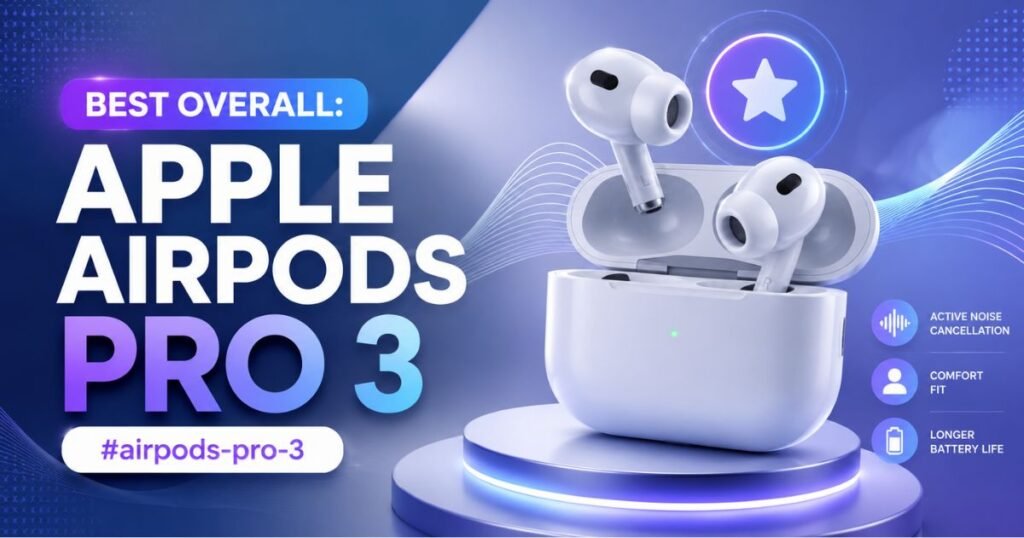
The AirPods Pro 3 are the best wireless earbuds overall because they balance battery life, comfort, noise cancellation, and ecosystem integration better than any competitor at their price.
The AirPods Pro 3 are Apple’s flagship in-ear earphones and cost $249, the same price as their predecessor. That’s notable in a market where flagship pricing has been climbing. Android Police
What’s new and why it matters:
- Active noise cancellation is roughly twice as strong compared to the AirPods Pro 2, and the earbuds now ship with five ear tip sizes, including a new XXS option, for a more secure fit. tomsguidetomsguide
- A built-in heart rate sensor tracks workouts without needing an Apple Watch, and the earbuds are the first AirPods with IP57 dust, sweat, and water resistance. tomsguidetomsguide
- Independent lab testing found the AirPods Pro 3 lasted 8 hours and 42 minutes on a single charge with ANC on a significant jump over the AirPods Pro 2’s 5 hours and 43 minutes. SoundGuys
- Live Translation is available, letting the earbuds channel real-time translation through a connected iPhone, though it currently supports a limited set of languages. Billboard
The trade-off: the charging case itself actually holds less rated battery than before 24 hours versus 30 hours on the AirPods Pro 2, so heavy users may find themselves charging the case more often on multi-day trips. CNN
Pros:
- Excellent ANC and transparency mode
- Seamless integration with iPhone, Mac, and Apple Watch
- Strong battery life improvement over the previous generation
- IP57 water resistance and heart rate tracking
Cons:
- Locked into the Apple ecosystem features degrade significantly on Android
- No onboard EQ customization to the degree some competitors offer
- Case battery life dropped slightly generation-over-generation
Who should buy it: iPhone owners who want the least friction possible and don’t want to think about compatibility, pairing, or app quirks.
Who should avoid it: Android users. Core features like Live Translation, spatial audio head tracking, and easy pairing are iOS-exclusive or badly compromised elsewhere.
Best Sound Quality: Sony WF-1000XM6 {#sony-wf-1000xm6}
The Sony WF-1000XM6 are the best-sounding wireless earbuds you can buy right now, and they back that up with class-leading ANC and microphone performance.
The WF-1000XM6 deliver excellent active noise cancellation, great sound quality, and outstanding microphone performance thanks to AI-powered beamforming. That mic quality matters more than people expect if you take work calls through your earbuds, the difference between “good” and “outstanding” mic performance is the difference between sounding professional and sounding like you’re in a wind tunnel. SoundGuys
On battery life: Sony claims 8 hours of continuous playback on a single charge, with 24 hours total including the case figures that haven’t improved across three generations of the product. Independent testing found real-world performance better than advertised: the WF-1000XM6 lasted 9 hours and 41 minutes on a single charge in lab testing, beating Sony’s own claim. SoundGuys + 2
On price: at $329.99, the WF-1000XM6 sit at the higher end of the wireless earbuds category, roughly $80–100 more than the AirPods Pro 3 or Bose QC Ultra at list price. One reviewer summed up the value proposition well: the XM6 are now the top overall all-arounder factoring in noise cancelling, sound quality, and mic quality, but not an incredible value given the price gap over competitors. RecordingNowRecordingNow
Charging speed: a full charge for both buds and case takes about 80 minutes, and Sony includes a battery care mode that caps charging at 80% to extend long-term battery health. GSMArena
Pros:
- Best-in-class sound signature, especially for detail and warmth
- Top-tier ANC and call quality
- Works equally well on Android and iPhone
- Quick-charge support for fast top-ups
Cons:
- Most expensive mainstream option on this list
- IPX4 rating only not built for full submersion or heavy sweat exposure over time
- Battery life hasn’t improved generation-over-generation
Who should buy it: Anyone who prioritizes audio fidelity and call clarity over price, particularly Android users who want the same tier of polish iPhone owners get from AirPods.
Who should avoid it: Budget-conscious buyers, and anyone who wants IP57-level water resistance for heavy workouts.
Best Noise Cancellation: Bose Quiet Comfort Ultra Earbuds (2nd Gen) {#bose-qc-ultra}
Choose the Bose QC Ultra Earbuds if blocking outside noise is your single biggest priority nothing else on this list cancels sound as consistently well.
Bose’s proprietary, AI-based noise suppression technology is top-notch on these earbuds, and they remain a favorite for flights and loud commutes. Reviewers praised their punchy, full-bodied sound, typically excellent noise cancelling, and secure, comfortable design, though comfort is more polarizing than Bose’s marketing suggests. HotHardwarewhathifi
The catch battery life: this is the one area where the QC Ultra Earbuds fall clearly behind. Bose didn’t improve battery life compared to the previous generation, rating the earbuds for up to 6 hours of playback, and independent testing measured a little over 5 hours in Immersive mode with ANC enabled. For comparison, Sony claims up to 8 hours for the WF-1000XM5 and Apple advertises up to 10 hours for the AirPods Pro 3. One reviewer was blunt about it: they have one of the shortest battery lives in the group, resulting in more downtime than most dedicated music lovers would prefer. HotHardware + 2
Fit is also mixed. the earbud shape remains largely the same as the previous generation, and it has never been particularly comfortable for everyone this is worth testing in person or buying from a retailer with an easy return policy. TechGearLab
Pricing: the QC Ultra Earbuds (2nd Gen) are priced at $299, unchanged from the first generation. whathifi
Pros:
- Best-in-class active noise cancellation
- Rich, bass-forward sound signature
- Excellent voice-call clarity
- Multipoint Bluetooth for switching between devices
Cons:
- Shortest battery life of any pick on this list
- Bulkier fit that doesn’t suit smaller ears well
- Only three ear tip sizes, versus five on some competitors
- Immersive Audio mode drains the battery even faster
Who should buy it: Frequent flyers, people who work in loud open offices, and anyone who values silence over marathon battery life.
Who should avoid it: Anyone who needs earbuds to survive a full workday or long-haul flight without a mid-trip recharge.
Best for Samsung/Android: Samsung Galaxy Buds4 Pro {#galaxy-buds4-pro}
If you own a Samsung Galaxy phone, the Galaxy Buds4 Pro are the obvious pick because of deep integration with One UI, Galaxy Wearable, and SmartThings features that don’t work the same way on other Android phones.
The $250 Samsung Galaxy Buds4 Pro should be considered if you own an Android phone, particularly a Samsung model, according to comparative reviews against the AirPods Pro 3. Like most Samsung true-wireless flagships, they emphasize a dual-driver sound setup, strong ANC, and 360-degree audio features that lean on Samsung’s own ecosystem for full functionality. Android Police
Pros:
- Deep integration with Galaxy phones, tablets, and watches
- Competitive ANC and call quality within the Android ecosystem
- Comfortable, lightweight in-ear design
Cons:
- Best features are locked to Samsung devices non-Samsung Android users get a diminished experience
- Battery life is average for the category, not class-leading
- Case and charging speeds lag behind Sony and Apple’s flagships
Who should buy it: Samsung Galaxy phone owners who want the tightest ecosystem integration available on Android.
Who should avoid it: Non-Samsung Android users you’re better served by the Sony WF-1000XM6 or a brand-agnostic option, since you’ll miss most of the Samsung-exclusive features anyway.
Browse More: HSSGamePad Connectivity Guide: PC, Android, iOS & TV (2026)
Best Budget Pick: Anker Soundcore Space A40 {#soundcore-space-a40}
The Space A40 prove you don’t need to spend $250+ to get adaptive noise cancellation, hi-res audio codec support, and genuinely long battery life.
Adaptive Active Noise Cancellation reduces ambient noise by up to 98% and automatically adjusts based on your surroundings a feature that was exclusive to $200+ earbuds a few years ago. Battery life reaches up to 10 hours per charge on the earbuds, plus another 40 hours in the case, for a combined 50 hours that beats every premium option on this list by a wide margin. A 10-minute quick charge delivers 4 hours of playback, and the earbuds support wireless charging and multipoint Bluetooth. Gizmodo + 2
At 4.6–5 grams per earbud, they’re lighter than many premium alternatives, and their traditional in-ear shape creates a strong seal that improves passive noise isolation and bass response compared to open-fit designs. HomeTechnologyReviewHomeTechnologyReview
Realistic expectations: independent reviews are consistent that the Space A40 offer great sound and features for the price, though ANC performance could be improved relative to true flagship earbuds. They won’t match the WF-1000XM6 or QC Ultra Earbuds in raw ANC strength or mic quality but at a fraction of the price, that’s an expected trade-off, not a flaw. tomsguide
Pros:
- Best battery life on this list by a wide margin
- Adaptive ANC and LDAC hi-res codec support at a budget price
- Lightweight, comfortable in-ear fit
- Frequently discounted well below list price
Cons:
- ANC isn’t as strong as premium competitors
- IPX4 water resistance only
- App and firmware polish is a step behind Apple, Sony, and Bose
Who should buy it: Budget-conscious buyers, students, and anyone who wants a reliable everyday pair without premium pricing.
Who should avoid it: Audiophiles and frequent flyers who need the strongest possible noise cancellation spend more if that’s your priority.
How to Choose the Right Wireless Earbuds {#buying-guide}
The right wireless earbuds match your phone, your ears, and your actual daily use not the longest spec sheet. Here’s what actually matters, in order of importance for most buyers.
1. Phone Compatibility
If you have an iPhone, Apple’s ecosystem features (automatic pairing, Find My integration, seamless switching between Apple devices) make AirPods hard to beat purely on convenience even if a competitor sounds slightly better. If you’re on Android, that advantage disappears, and features like Sony’s app-based EQ or Samsung’s Galaxy Wearable integration become more relevant.
2. Noise Cancellation Needs
Not everyone needs the strongest ANC available. If you work from a quiet home office, mid-tier ANC is plenty. If you commute on a subway, fly frequently, or work in an open office, prioritize ANC strength even if it costs you some battery life that’s the trade-off Bose makes, for example.
3. Battery Life for Your Routine
Match battery life to your actual habits, not a hypothetical worst case:
- Under 5 hours per charge: fine for short commutes and gym sessions, assuming you charge nightly.
- 6–8 hours per charge: covers a full workday or a long-haul flight.
- 10+ hours per charge: best for people who forget to charge things or travel for multiple days without reliable outlets.
4. Fit and Comfort
This is the single most underrated factor in earbud satisfaction, and it can’t be judged from a spec sheet. Ear canal shape varies enormously between people. If possible, buy from a retailer with a generous return window and actually wear the earbuds for a few hours before committing a “best-rated” pair that doesn’t seal properly in your ear will underperform on sound and ANC regardless of its lab scores.
5. Water and Sweat Resistance
If you work out regularly, look for IP54 or higher (IP57, like the AirPods Pro 3, adds real water submersion resistance, not just splash protection). IPX4-rated earbuds, common among competitors, handle sweat and light rain but aren’t built for swimming or heavy submersion.
6. Codec and Audio Quality
If you care about high-resolution audio and use an Android phone, look for LDAC support (found on Sony and many Anker Soundcore models). iPhone users don’t get the same benefit from LDAC since Apple doesn’t support it AAC is the ceiling on iOS regardless of which earbuds you buy.
Decision Framework: Which Earbuds Match Your Life {#decision-framework}
Use this table to skip the spec-sheet comparison shopping and go straight to the right category for you.
| If you… | Choose | Why |
| Own an iPhone and want the least hassle | AirPods Pro 3 | Best ecosystem integration, strong all-around performance |
| Care most about audio quality and call clarity | Sony WF-1000XM6 | Best-in-class sound and mic performance |
| Fly often or work in loud environments | Bose QC Ultra Earbuds (2nd Gen) | Strongest, most consistent ANC |
| Own a Samsung Galaxy phone | Galaxy Buds4 Pro | Deepest integration with Samsung ecosystem |
| Have a tight budget | Anker Soundcore Space A40 | Best value, longest battery life, real ANC |
| Need earbuds for all-day wear without recharging | AirPods Pro 3 or Space A40 | Longest single-charge battery life on this list |
| Have small or sensitive ear canals | AirPods Pro 3 (5 tip sizes) or Space A40 (lightweight) | More sizing options and lighter builds reduce fatigue |
Common Mistakes People Make Buying Earbuds {#common-mistakes}
Most earbud buyer’s remorse comes from a handful of predictable, avoidable mistakes.
- Buying based on brand loyalty alone. Apple, Sony, and Bose all make excellent products, but the “best” brand changes depending on what you actually prioritize. Don’t assume the most expensive or most famous option is automatically right for you.
- Ignoring return policies. Fit is impossible to judge from a listing. Buy from a retailer that allows returns after a real trial period, not just an unopened-box return.
- Overpaying for features you won’t use. Heart rate sensors, spatial audio, and Live Translation sound impressive but go unused by a large share of buyers. If you know you won’t use a feature, don’t pay a premium for it.
- Underestimating case battery life. The headline “battery life” number usually refers to a single charge on the earbuds alone. Always check the total battery life including the case if you travel or forget to charge daily.
- Skipping ear tip sizing. Most premium earbuds ship with 3–5 tip sizes. Using the wrong size hurts both noise isolation and sound quality try all the included sizes before deciding a pair “doesn’t sound good.”
- Assuming ANC works the same everywhere. Active noise cancellation is most effective against consistent low-frequency noise (airplane engines, HVAC hum) and far less effective against sudden or high-frequency sounds like voices or a barking dog.
Maintenance and Long-Term Care {#maintenance}
Wireless earbuds are small electronics with batteries that degrade over time a little care extends their usable life significantly.
- Clean the mesh and ear tips weekly. Earwax and debris buildup is the single most common cause of muffled sound and reduced ANC performance over time.
- Avoid letting the battery fully drain repeatedly. Like most lithium-ion devices, earbuds last longer overall when kept between roughly 20% and 80% charge rather than constantly running to empty.
- Use manufacturer-provided battery care features when available. Sony’s WF-1000XM6, for example, includes a mode that caps charging at 80% specifically to extend long-term battery health.
- Store the case somewhere temperature-stable. Extreme heat (a hot car, direct sun) degrades lithium-ion batteries faster than normal use does.
- Replace ear tips periodically. Silicone and foam tips degrade and lose their seal over months of use, which quietly hurts both comfort and noise isolation.
Click Here: GoralBlue.com Review: Is This Multi-Niche Content Site Trustworthy in 2026?
Troubleshooting Common Problems {#troubleshooting}
One earbud won’t connect or keeps disconnecting. Reset the earbuds to factory settings through the companion app, then re-pair from scratch rather than just reconnecting this resolves the majority of one-sided connection issues.
Sound is muffled or quiet. Check the mesh grille on each earbud for wax or debris buildup before assuming a hardware problem this is the most common cause and the easiest to fix.
Case won’t charge the earbuds. Grime buildup on the charging contacts inside the case is a known issue across several brands. Wipe the contacts gently with a dry cloth or cotton swab.
ANC seems weaker than expected. Make sure you have an ear tip size that creates a full seal ANC performance depends heavily on passive isolation working alongside the active cancellation, not on the electronics alone.
Battery life dropped noticeably after several months. This is normal lithium-ion battery degradation, not necessarily a defect. If it happens within the warranty period and seems unusually severe, contact the manufacturer.
Who Should Avoid Wireless Earbuds Altogether {#who-should-avoid}
Wireless earbuds aren’t the right choice for everyone:
- Audiophiles chasing the absolute best sound quality are usually better served by wired in-ear monitors or over-ear headphones, since Bluetooth compression still introduces some quality loss even with high-end codecs.
- People who frequently misplace small items may find the loss risk (and replacement cost) frustrating a single earbud is easy to lose in a way a headphone isn’t.
- Anyone prone to ear infections or sensitive to prolonged in-ear pressure should talk to a doctor about in-ear devices generally, since sealed-tip designs trap moisture and can aggravate certain ear conditions.
- Gamers needing the lowest possible latency for competitive play are often better off with wired headsets or earbuds specifically built with low-latency gaming modes, since general-purpose earbuds can introduce noticeable audio lag.
Frequently Asked Questions
What are the best wireless earbuds for iPhone users?
The Apple AirPods Pro 3 are the best choice for iPhone owners. They cost $249, the same as the AirPods Pro 2, and offer 8 hours of ANC-on battery life plus 24 hours total with the case. Deep iOS integration, automatic pairing, and Find My support make them the most convenient option for anyone already in the Apple ecosystem. Tom’s Guide
What are the best wireless earbuds for Android?
The Sony WF-1000XM6 are the strongest overall pick for Android, offering top-tier sound quality and ANC without any ecosystem restrictions. Samsung Galaxy owners specifically may prefer the Galaxy Buds4 Pro for deeper integration with One UI and Galaxy Wearable.
Are expensive wireless earbuds actually worth it over budget options?
It depends on your priorities. Premium earbuds like the WF-1000XM6 or QC Ultra Earbuds deliver noticeably better ANC, sound detail, and call quality. But budget options like the Anker Soundcore Space A40 now include adaptive ANC and strong battery life for a fraction of the price. If you’re not an audiophile and don’t need flagship-level ANC, a budget pair can be genuinely satisfying.
How long should wireless earbuds’ battery last on a single charge?
Most flagship earbuds offer 6–8 hours per charge with ANC on, while some budget and mid-range models reach 10 hours. Total battery life including the case typically ranges from 24 to 50 hours depending on the model.
Do wireless earbuds work well for phone calls?
Call quality varies significantly by model. The Sony WF-1000XM6 stand out for outstanding microphone performance thanks to AI-powered beamforming, while the AirPods Pro 3 and Bose QC Ultra Earbuds also perform well in noisy environments thanks to dedicated background noise suppression. SoundGuys
What’s the difference between IPX4 and IP57 water resistance?
IPX4 protects against splashes and sweat from light exercise but not submersion. IP57, found on the AirPods Pro 3, adds real protection against dust and temporary submersion in water, making it a meaningfully higher tier of durability for heavy workouts or accidental drops in water.
Can I use premium features like Live Translation or heart rate tracking on any earbuds?
No these features are typically tied to a specific ecosystem. Live Translation and the in-ear heart rate sensor on the AirPods Pro 3, for instance, require a compatible iPhone and don’t work (or don’t exist) on other platforms. Always check whether a headline feature you want is exclusive to a particular phone brand before buying.
Are wireless earbuds safe for hearing health?
Wireless earbuds themselves aren’t inherently more or less safe than any other headphone type the risk comes from volume level and listening duration, not the wireless connection. Using ANC to reduce background noise can actually help you listen at lower, safer volumes, since you don’t need to compete with ambient sound.
How often should I replace wireless earbuds?
Most earbuds have a practical lifespan of 2–3 years, primarily limited by battery degradation rather than the electronics failing outright. If you notice battery life dropping sharply or the earbuds no longer holding a charge reliably, that’s a normal sign it’s time to consider replacing them.
Final Verdict
There’s no universal “best” pair of wireless earbuds only the best pair for how you actually listen. If you want one confident recommendation: iPhone owners should buy the AirPods Pro 3, Android users chasing the best sound should buy the Sony WF-1000XM6, and anyone on a budget should buy the Anker Soundcore Space A40 without feeling like they’re settling. If silence is your top priority over battery life for flights, open offices, or loud commutes the Bose QuietComfort Ultra Earbuds (2nd Gen) remain the strongest ANC performer on this list, trade-offs and all.
Whatever you choose, prioritize fit and return policy over spec-sheet bragging rights. The best-reviewed earbuds in the world are the wrong purchase if they don’t seal comfortably in your ears and that’s something no comparison chart can tell you. Try them, live with them for a week, and don’t be afraid to return a pair that looks perfect on paper but doesn’t feel right in practice.

Team TrandyVilla is the passionate home decor team behind Trandy Villa, where style meets comfort in everyday living. The team loves transforming simple spaces into beautiful, functional homes through smart ideas, budget-friendly hacks, and modern design trends. Their content focuses on helping readers create homes that feel both stylish and personal without spending too much.