
You’ve stared at the same 16 words for ten minutes. Two groups feel obvious, one feels like a trap, and your third guess just cost you a mistake. That frustrating gap between “almost there” and “completely stuck” is exactly why so many players search for a Connections hint Mashable article the moment their streak feels at risk.
Connections has quietly become one of the most talked-about parts of the daily puzzle world, right alongside Wordle and the Mini Crossword. Millions of people open it every morning, and just as many hit a wall on the trickier Blue or Purple categories. That daily challenge is exactly why hint sites exist in the first place not to hand out answers, but to give stuck players a way forward without killing the fun entirely.
Mashable is one of the most visited sources for this kind of help, and its format has a specific logic to it: soft clues first, full answers only if you keep scrolling. Understanding how that structure works and when to actually use it can change whether hints help you improve or just become a daily crutch.
This guide walks through what Mashable’s Connections coverage actually offers, how it compares to other hint sources, and smarter ways to use any hint site without losing the satisfaction of solving the puzzle yourself. Everything here is based on publicly available puzzle coverage and general game mechanics, not insider access to any outlet’s editorial process.
Let’s start with the short version, then dig into the details.
Connections hint mashable Quick Answer
Mashable publishes a daily hint article for the New York Times Connections puzzle. Each post breaks the four color-coded groups (Yellow, Green, Blue, Purple) into short, spoiler-light clues first, then reveals the full answers further down the page. This format lets players choose how much help they want a nudge, a category theme, or the complete solution instead of forcing an all-or-nothing spoiler.
Key Takeaways Connections Hint Mashable
- Mashable’s Connections coverage is structured in layers: mild hints, then category names, then full word reveals.
- The puzzle resets daily at midnight Eastern Time, so hints are only relevant for that specific day’s grid.
- Yellow is the easiest group and Purple is the hardest this color system is consistent every single day.
- Using hints strategically (reading only the first layer) helps you learn the game’s logic instead of just copying answers.
- Multiple outlets cover Connections daily, but they differ in tone, hint depth, and how quickly they publish.
What Is NYT Connections?
NYT Connections is a daily word-grouping puzzle from The New York Times Games section. It gives players 16 words and asks them to sort those words into four hidden groups of four.
Each group shares a theme sometimes obvious, sometimes a trap. The categories are color-coded by difficulty:
- 🟡 Yellow Easiest
- 🟢 Green Straightforward, but with a twist
- 🔵 Blue Trickier connections
- 🟣 Purple Wordplay, puns, or double meanings
Players get four mistakes before the puzzle ends. The game was created for the Times by associate puzzle editor Wyna Liu and has grown into one of the most shared daily word games since Wordle’s rise.
Check This: 5StarsStocks com Review 2026: Is This AI Stock-Rating Site Worth Using?
What Does “Connections Hint Mashable” Actually Mean?
When people search “Connections hint Mashable,” they’re usually looking for one of two things:
- Mashable’s daily article covering that day’s puzzle hints and answers
- A general understanding of how Mashable’s hint format works, so they know what to expect before clicking through
Mashable is one of several tech and culture publications alongside outlets like Parade, TechRadar, and puzzle-focused blogs that publish same-day Connections coverage. Its format tends to explain what Connections is for newer readers, then move into the day’s specific clues.
How Mashable Structures Its Daily Hints
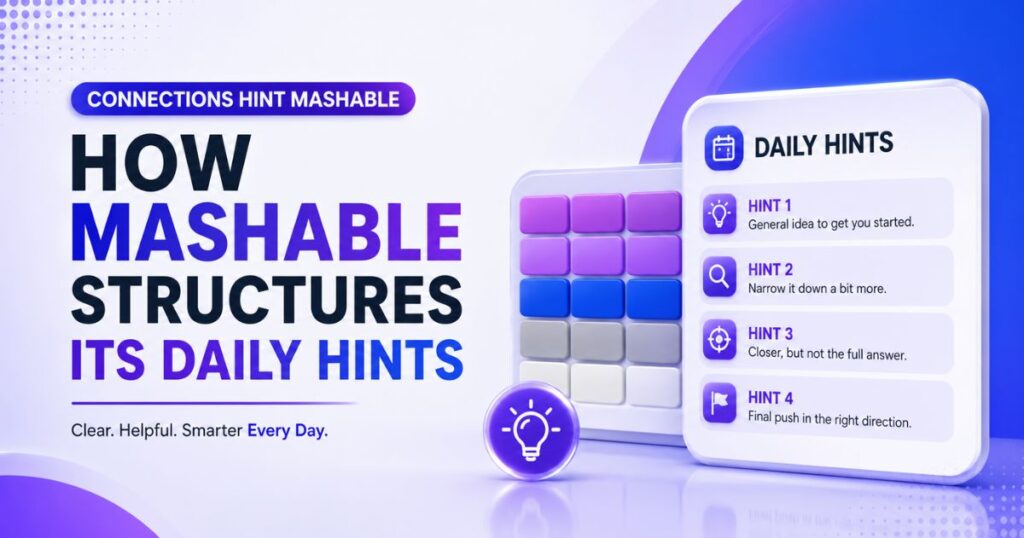
A typical Mashable Connections post follows a predictable pattern, which is part of why readers trust it as a go-to source:
1. A short intro explaining that day’s puzzle number and general difficulty.
2. A refresher on how Connections works, aimed at readers who are new to the game.
3. Category-level hints one soft clue per group, without naming the actual words. This is the “safe zone” for people who want a nudge, not a spoiler.
4. Full answers, placed further down the page (often past an image or ad break) so readers who only want a hint can stop scrolling before they see the solution.
This layered structure matters because it respects two very different types of readers: people who want to keep solving on their own, and people who are out of guesses and just want closure.
Comparison: Mashable vs. Other Connections Hint Sites
| Feature | Mashable | Parade | Word-focused blogs (e.g., Word Tips) |
| Hint depth | Category-level clue, then full answer | Short one-line clue, then full answer | “See Hint” reveal buttons per group |
| Beginner explanation | Yes, included most days | Yes, brief | Sometimes, varies by site |
| Publish timing | Early-to-mid day (US) | Early-to-mid day (US) | Often earliest, since midnight |
| Extra puzzle coverage | Wordle, Strands sometimes linked | Wordle, trivia lists | Mini Crossword, Wordle, Spelling Bee |
| Format | Long-form article | Long-form article | Interactive reveal buttons |
No single source is objectively “best” the right pick depends on how much control you want over how much you see.
How to Use Hints Without Ruining the Puzzle
If you actually want to improve at Connections instead of just finishing today’s grid, treat hints like training wheels, not a cheat code.
- Read only the first hint layer. Stop as soon as you have a “click” moment.
- Try to guess the fourth word yourself even after a hint names the category.
- Cover the answer section with your hand or a note-taking app until you’ve made a real attempt.
- Come back the next day and try solving without any hints at all, using what you learned.
This approach turns a hint site from a shortcut into an actual skill-builder.
View More: American Fashion Alaikas com: An Honest Buyer’s Guide Before You Order
Strategies for Solving Connections Yourself
- Start with words that only seem to fit one category. These are usually the safest first guess.
- Watch for red herrings. The puzzle often includes a word that looks like it belongs in an obvious group but actually belongs in a trickier one.
- Save Purple for last. It usually relies on wordplay, homophones, or a shared prefix/suffix rather than meaning.
- Use the shuffle button. Rearranging the grid visually can reveal patterns your brain missed in the original order.
- If you have two guesses left, lock in your most confident group first, not your riskiest one.
Common Mistakes Players Make
- Guessing too fast on Yellow. Easy doesn’t mean “first word association” read every option.
- Ignoring double meanings. A word like “BASS” could be a fish, an instrument, or a low sound.
- Reading the full answer when you only wanted a nudge. This is the single most common regret readers mention.
- Assuming categories are always literal. Purple groups especially love puns and shared letter patterns.
Who Should Use Hint Sites
- Players who are down to their last guess and want to avoid a wasted attempt.
- Beginners still learning how the color difficulty system works.
- Anyone keeping a daily streak who’s short on time.
Who Should Avoid Hint Sites
- Players trying to build pattern-recognition skills long-term.
- Anyone playing competitively with friends or family where spoilers would ruin the fun.
- People who find that hints make the game feel less satisfying to finish.
Buying Guide: Free vs. Paid Puzzle Access
Connections hint Mashable itself is free to play through the NYT Games app or website with a basic account, though full access to the broader NYT Games suite (Wordle archive, Spelling Bee, crosswords) typically requires a Games or All Access subscription. Hint articles from Mashable and similar sites are free and don’t require any subscription they’re simply commentary on a puzzle you can already access.
If you’re deciding whether to subscribe to NYT Games directly:
- Choose free access if you only care about Connections hint Mashable and Wordle.
- Consider a subscription if you also want the full crossword archive, Spelling Bee, and puzzle statistics tracking.
Methodology: How We Evaluated Hint Sources
This guide is based on a review of publicly available Connections hint Mashable articles from multiple outlets, comparing their structure, hint depth, and publishing patterns over several weeks. It does not involve internal access to Mashable’s editorial process, and specific daily answers change every 24 hours always check the current day’s official puzzle for the exact solution, since word grids are not repeated.
See Details: DreamWithJeff.com Review 2026: Is It Legit or Just a Content Farm? (Full Investigation)
Expert Tips
- Treat the color system as a difficulty ladder, not a random order Yellow really is designed to be the most approachable.
- If you’re stuck, step away for a few minutes. Fresh eyes catch wordplay patterns tired ones miss.
- Keep a mental list of past “trick” categories (homophones, hidden words, shared prefixes) they resurface often in new forms.
Conclusion
Connections Hint Mashable rewards patience more than speed. Hint sites like Mashable exist to soften the frustration on a genuinely tricky day, not to replace the thinking process. The best approach is usually the simplest one: read just enough to get unstuck, then finish the rest on your own.
FAQs About Connections Hint mashable
What is Connections hint Mashable?
It refers to Mashable’s daily article that provides layered hints and full answers for that day’s NYT Connections puzzle.
Is Mashable’s Connections hint free to read?
Mashable’s hint and answer articles are free to access.
How often does the Connections puzzle update?
It resets once every 24 hours, typically at midnight Eastern Time.
Who created NYT Connections hint mashable?
The game was developed for The New York Times by associate puzzle editor Wyna Liu.
What do the colors in Connections mean?
Yellow is easiest, followed by Green, then Blue, with Purple as the hardest and most wordplay-driven category.
Can I play past Connections puzzles?
The NYT offers a limited archive through its Games app and site, often tied to subscription access.
Why do hint sites show clues before answers?
So readers who only want a small nudge can stop reading before reaching the full spoiler.
Is it cheating to look up Connections hints?
It’s a personal call many players use hints occasionally to stay unstuck without treating it as a habit.
How many mistakes are allowed in Connections?
Players get four mistakes before the puzzle ends.
What’s the hardest category usually about?
Purple groups often rely on puns, homophones, or shared letter patterns rather than literal meaning.
Do all Connections hint Mashable sites publish at the same time?
Timing varies, with some publishing shortly after midnight and others later in the day.
Can I play Connections without an NYT subscription?
The daily puzzle is generally accessible for free, though some archive and extra features may require a subscription.
Is there a mobile app for Connections hint mashable?
It’s available through the NYT Games app alongside Wordle and other puzzles.
What should I do if I don’t want any spoilers at all?
Skip hint articles entirely and use the in-game shuffle and mistake-tracking features instead.
Are Mashable’s hints accurate?
Hint accuracy depends on the specific day’s article; always cross-check against the puzzle you’re actively playing, since grids are never repeated.
Final Verdict
Connections hint Mashable format works well because it doesn’t force a choice between full spoilers and total silence. The layered structure soft clue first, full answer later respects readers who want to keep thinking for themselves. Used sparingly, it’s a solid tool for staying unstuck. Used as a daily crutch, it can quietly erode the pattern-recognition skills that make the puzzle fun in the first place.

Team TrandyVilla is the passionate home decor team behind Trandy Villa, where style meets comfort in everyday living. The team loves transforming simple spaces into beautiful, functional homes through smart ideas, budget-friendly hacks, and modern design trends. Their content focuses on helping readers create homes that feel both stylish and personal without spending too much.