
If you’ve typed “gomyfinance com saving money” into Google, you’re probably in one of two moods. Either you landed on the site while looking for budgeting help and want to know if it’s worth your time or you saw the name pop up in search results next to a dozen almost-identical “guides” and got suspicious. That instinct is worth listening to.
This review does two things most articles about GoMyFinance com don’t. First, it actually checks who’s behind the site, what it can verify, and where it falls short instead of repeating the platform’s own marketing copy as fact. Second, it gives you saving-money strategies that work whether you ever create an account or not, because a tool is only as good as the habits behind it.
By the end, you’ll know exactly what GoMyFinance com is, what its saving-money features actually do, where the trust gaps are, and how it stacks up against better-established alternatives plus a practical framework for saving more starting this week.
What Is GoMyFinance com, Exactly?
GoMyFinance com describes itself as a personal finance education platform, not a bank or brokerage. According to its own about page, it launched in 2024 with a stated mission to make financial literacy more accessible, covering budgeting, saving, credit, debt, and investing basics through articles, calculators, and planning tools.
That framing matters. GoMyFinance.com is positioned closer to a financial magazine with interactive add-ons than to a dedicated budgeting app like YNAB or a bank account. Its homepage reads like a content hub articles on investing mistakes, credit-builder loans, and saving strategies with “Calculators & Tools” listed as a section rather than the centerpiece of the product.
Worth noting: there’s a small cluster of similarly named domains gomyfinance.online, gomyfinance.us, and gomyfinanceinvest.com each with near-identical “About Us” language. That pattern is common among SEO-driven content networks and isn’t automatically a red flag, but it’s a reason to be precise about which URL you’re actually using before you connect any financial account.
Key Takeaways GoMyFinance com
- GoMyFinance com is a financial education content platform, not a bank, brokerage, or regulated advisor.
- Its saving-money tools expense tracking, goal setting, automation prompts, sinking funds mirror standard budgeting-app features.
- The biggest gaps are ownership transparency, a lack of independent reviews, and no named credentialed authors behind financial content.
- It’s a reasonable starting point for absolute beginners, but shouldn’t be your only source before big financial decisions.
- The saving strategies that actually work automation, percentage-based budgeting, sinking funds, a starter emergency fund apply no matter which tool (or no tool) you use to track them.
Explore Here: American Fashion Alaikas com: An Honest Buyer’s Guide Before You Order
Is GoMyFinance com Legit? A Trust & Transparency Audit
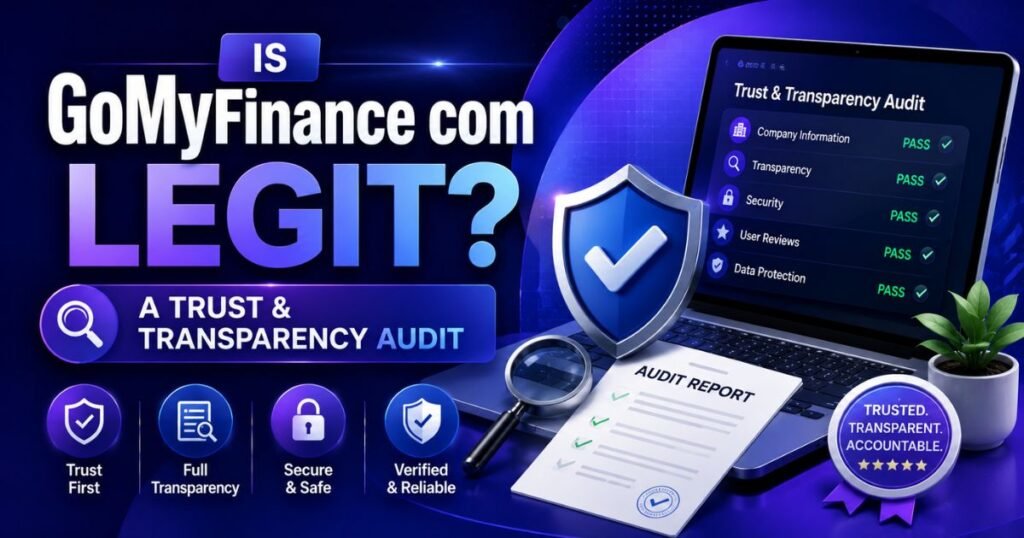
This is the question that actually matters, so let’s go through it point by point instead of giving a one-line verdict.
What checks out:
- The site publishes a mission statement, topic coverage, and a standard disclaimer clarifying it is not a registered investment advisor or broker-dealer.
- Content is organized like a legitimate publisher, with categories for budgeting, saving, credit, and investing, rather than presenting itself as a bank.
- Being transparent that it doesn’t offer regulated financial advice is a genuinely good sign sites that pretend to be something they’re not tend to hide this disclaimer, not display it.
What raises questions:
- Independent, third-party reviews are thin. There’s little to no visible discussion on Reddit, Trustpilot, or comparable community platforms, which is unusual for a site claiming meaningful traffic since 2024.
- Public information about who owns and operates the site is limited. Established competitors like NerdWallet or Bankrate make ownership, editorial leadership, and funding sources easy to find. That’s not the case here.
- Articles generally don’t carry named, credentialed authors (a certified financial planner, accountant, or similar). For educational content about credit, debt, and investing, that’s a real gap Google’s own guidance on helpful content and E-E-A-T treats author expertise as a meaningful trust signal for “Your Money or Your Life” topics, and finance sits squarely in that category.
- Premium features are reportedly priced around $8–$18 per month, but pricing tiers, cancellation terms, and what exactly unlocks at each level aren’t consistently documented across the site.
The honest verdict: GoMyFinance com doesn’t show the classic hallmarks of an outright scam no upfront payment demands, no promises of guaranteed returns, no pressure tactics. But “not a scam” and “a trustworthy primary source for financial decisions” are two different bars. Treat it the way you’d treat any personal finance blog: fine for general education, not a substitute for a regulated tool or a licensed advisor when real money is on the line.
What GoMyFinance com Actually Offers for Saving Money
Based on the platform’s own descriptions, the saving-money toolkit includes:
- Expense tracking connects to accounts to categorize spending and flag patterns you might be missing.
- Goal-based savings lets you set a target (say, $1,200 in a year) and breaks it into monthly milestones.
- Automated transfer guidance encourages scheduling automatic transfers from checking to savings on payday.
- Budgeting frameworks built around familiar models like the 50/30/20 rule.
- Bill reminders and a bill calendar flags upcoming due dates to help you avoid late fees.
- Sinking funds small recurring contributions toward planned future expenses like car repairs or holidays.
- Educational content on credit, debt, and investing basics framed as supporting context rather than personalized advice.
None of these ideas are unique to GoMyFinance com they’re standard budgeting-app features you’ll also find in apps with a longer public track record. The difference is that GoMyFinance.com bundles them with broader financial education content, which can be useful if you like learning the “why” alongside the “how.”
Pros and Cons
| Pros | Cons |
| Beginner-friendly language, no jargon overload | Ownership and company details are hard to verify |
| Free tier covers core budgeting and tracking | Few independent reviews to cross-check claims against |
| Combines education with practical tools in one place | No named, credentialed financial experts behind the content |
| Transparent “not a registered advisor” disclaimer | Pricing and premium terms aren’t consistently detailed |
| Familiar frameworks (50/30/20, sinking funds, automation) | Several similarly named domains create room for confusion |
See the Latest: MyFastBroker com Review 2026: What This Site Really Is (And Why So Many Reviews Get It Wrong)
How It Compares to Established Saving & Budgeting Tools
| Feature | GoMyFinance com | YNAB | Monarch Money | Your Bank’s Own App |
| Track record | Since 2024, limited independent reviews | Since 2004, widely reviewed | Since 2021, actively reviewed | Regulated, audited institution |
| Ownership transparency | Limited | Public company info available | Public company info available | Fully regulated & disclosed |
| Cost | Free / ~$8–18 mo premium | ~$14.99/mo or $99/yr | ~$14.99/mo or $99/yr | Usually free |
| Best for | Learning budgeting basics + light tracking | Zero-based budgeting discipline | Full net-worth + budget tracking | Simple built-in savings tools |
| Independent user reviews | Very few found | Extensive (App Store, Reddit, Trustpilot) | Extensive | Varies by bank |
The honest takeaway: if your main goal is learning concepts what a sinking fund is, how the 50/30/20 rule works GoMyFinance.com’s content can work as a starting point. If your goal is actually moving and tracking real money long-term, an app with a longer track record and clearer company transparency is the safer choice for that job.
Real Saving Money Strategies That Actually Work
Whether or not you ever open an account anywhere, these are the strategies that consistently move the needle the same ones GoMyFinance com and most reputable finance sites reference, minus the sales pitch.
1. Automate before you budget. Set up an automatic transfer from checking to savings the day your paycheck lands. Willpower is unreliable; automation isn’t. Even $25–$50 per paycheck compounds meaningfully over a year.
2. Use a percentage framework, not a fixed number. The 50/30/20 split (needs/wants/savings) works because it scales with your income. If 20% feels impossible right now, start at 5–10% and increase it every few months.
3. Track spending for one real month before you cut anything. Most people underestimate their monthly spending by a wide margin simply because small purchases don’t register. A week or two of tracking on paper, a spreadsheet, or any app usually reveals the leak before you need to cut anything drastic.
4. Build sinking funds for predictable irregular expenses. Car registration, holiday gifts, annual subscriptions these aren’t emergencies, they’re just infrequent. A small monthly transfer into a labeled sub-account prevents them from ever feeling like a crisis.
5. Start your emergency fund at $500–$1,000, not three months of expenses. The “3–6 months of expenses” target is the long-term goal, not the starting line. A smaller starter fund is what actually stops a flat tire from becoming a credit card balance.
6. Apply the 24-hour rule to non-essential purchases. Waiting a day (or a week for bigger purchases) filters out most impulse buys without requiring any willpower in the moment of temptation.
7. Audit subscriptions twice a year. Recurring charges are the easiest money to reclaim because you’re not giving anything up you’re just stopping payment for something you’d already stopped using.
Who Should (and Shouldn’t) Use GoMyFinance com
It’s a reasonable fit if you’re: a budgeting beginner who wants plain-language explanations alongside simple tracking tools, and you’re comfortable treating it as one input among several rather than your only source of financial guidance.
Look elsewhere if you: need a platform with a long, independently verified track record before linking bank accounts; want personalized, regulated investment advice; or need full transparency on who’s operating the platform before you commit any money or data to it.
How to Protect Yourself on Any Finance Website (Not Just This One)

- Check for a clearly linked privacy policy before entering any personal or financial data not just a general terms page.
- Search the site name plus “reddit” or “trustpilot” before linking a bank account anywhere new.
- Confirm any “investment” claims against the SEC’s EDGAR database or FINRA’s BrokerCheck legitimate advisors and broker-dealers are searchable there.
- Never treat a budgeting or education site as a substitute for a licensed financial advisor when the decision involves real money at stake (retirement rollovers, major debt settlements, tax strategy).
- Revisit account permissions periodically if a tool only needs read-only access to track spending, don’t grant more than that.
Don’t Miss It: GlossyWise com Review 2026: What It Actually Is, and Why the Internet Can’t Agree
Frequently Asked Questions about GoMyFinance com
Is GoMyFinance com free?
Core features like expense tracking and goal setting are described as free. Premium features reportedly cost roughly $8–$18 per month, though exact tiers aren’t fully documented on the site.
Is GoMyFinance com a bank or investment firm?
It positions itself as a financial education and content platform. Its own disclaimer states it is not a registered investment advisor or broker-dealer.
Is GoMyFinance com safe to link my bank account to?
Treat it with the same caution you’d apply to any newer platform: confirm a privacy policy exists, check what data access is being requested, and weigh the limited independent reviews before connecting live account data. A read-only connection is lower-risk than one with transfer permissions.
Who owns GoMyFinance com?
Public ownership and leadership details are limited compared to established competitors. This is one of the platform’s main transparency gaps.
What’s a good alternative to GoMyFinance com for saving money?
For a longer track record and more independent reviews, tools like YNAB, Monarch Money, or your own bank’s built-in savings and budgeting features are worth comparing before committing to a newer platform.
Does the 50/30/20 rule actually work?
For most people with stable income, yes it’s simple enough to stick with. If your expenses are unpredictable (freelance income, irregular hours), a percentage-of-income approach adjusted monthly tends to work better than a fixed rule.
Conclusion
GoMyFinance com isn’t a scam, but it also isn’t a fully transparent, independently vetted financial institution it’s a content platform with some genuinely useful budgeting concepts and a handful of trust gaps worth knowing about before you rely on it. The tools it describes (automated transfers, sinking funds, goal-based saving) work well, but that’s because the underlying strategies are sound, not because the platform is uniquely powerful. Use it, if you use it, as one part of your financial toolkit paired with healthy skepticism, a privacy policy check, and the same due diligence you’d apply to any newer site handling your money data.

Team TrandyVilla is the passionate home decor team behind Trandy Villa, where style meets comfort in everyday living. The team loves transforming simple spaces into beautiful, functional homes through smart ideas, budget-friendly hacks, and modern design trends. Their content focuses on helping readers create homes that feel both stylish and personal without spending too much.