
Buying a gaming laptop in 2026 feels harder than it should be. Every brand claims to have the “best” model. Every spec sheet is packed with numbers that don’t mean much unless you know what to compare them against.
That’s the gap TheLaptopAdviser Expert Gaming Reviews 2026 fills. This guide pulls together what actually matters when you’re choosing a gaming laptop this year GPU performance, cooling design, display quality, battery life, and long-term value and lays it out in plain language.
Whether you’re buying your first gaming laptop, upgrading an old one, or shopping for esports-level performance on a tight budget, this guide walks you through the decision step by step.
Quick Answer
If you want the short version: the best gaming laptop for you in 2026 depends mainly on your budget and what you play. Competitive esports titles run fine on mid-range machines with RTX 40-tier or newer GPUs. AAA and ray-traced titles need higher-end GPUs, faster refresh-rate displays, and stronger cooling systems. Creators who also game should prioritize color-accurate displays and strong CPU multi-core performance alongside GPU power.
Key Takeaways
- Gaming laptop value in 2026 comes down to GPU tier, display quality, cooling, and battery life not just clock speeds on a spec sheet.
- Budget gaming laptops (roughly $900–$1,300) handle esports and 1080p gaming well.
- Mid-range laptops ($1,300–$2,000) balance performance and portability for most gamers.
- High-end laptops ($2,000+) target 1440p/4K gaming, ray tracing, and content creation.
- Battery life and thermal design vary widely between brands, even at similar price points.
- Buying decisions should be based on independent reviews, manufacturer specs, and real usage needs not marketing claims alone.
What “Expert Gaming Reviews” Actually Means in 2026
A genuinely expert gaming laptop review looks past marketing slides and focuses on how a machine performs under real conditions sustained load, not just a benchmark burst.
That means looking at:
- Sustained GPU performance, since laptops throttle under heat in ways desktops don’t.
- Display accuracy and refresh rate, not just the advertised resolution.
- Real-world battery life during gaming and everyday tasks, not just idle-time estimates.
- Build quality and cooling, since a fast GPU paired with poor thermals underperforms its own spec sheet.
- Value over time, meaning whether the laptop stays relevant for two to three years of upgrades in games and drivers.
Expert reviews also disclose their methodology. If a review is based on manufacturer specifications and aggregated professional testing rather than in-house benchmarking, it should say so clearly. That transparency is part of what separates a trustworthy review from a rewritten spec sheet.
See The Latest: DreamWithJeff.com Review 2026: Is It Legit or Just a Content Farm? (Full Investigation)
How We Evaluate Gaming Laptops (Methodology)
This guide is built from a combination of manufacturer specifications, publicly available expert reviews and benchmarks from established tech outlets, and documented user feedback patterns. It does not claim first-hand, in-house thelaptopadviser testing unless explicitly stated for a specific model.
Our evaluation framework weighs the following factors:
| Factor | Why It Matters |
| GPU tier and VRAM | Determines frame rates and ray tracing capability |
| CPU performance | Affects frame pacing, streaming, and multitasking |
| Display (resolution, refresh rate, color accuracy) | Impacts visual clarity and competitive responsiveness |
| Cooling and thermal throttling | Determines if the laptop can sustain advertised performance |
| Battery life | Matters for portability and unplugged use |
| Build quality and port selection | Affects durability and daily usability |
| Price-to-performance ratio | Determines overall value relative to the category |
Each laptop discussed in reviews under this framework is assessed against these categories rather than judged on a single benchmark number.
Gaming Laptop Categories Compared

Gaming laptops in 2026 generally fall into three broad tiers. Understanding these tiers helps you filter out models that don’t fit your budget or your games before you even start comparing specs.
Budget Gaming Laptops ($900–$1,300)
These typically pair a mid-tier GPU with a solid but unremarkable display, usually 1080p at 144Hz. They’re built for esports titles like Valorant, CS2, League of Legends, and Rocket League, where high frame rates matter more than ray tracing.
Mid-Range Gaming Laptops ($1,300–$2,000)
This is where most buyers land. You get stronger GPUs capable of handling AAA titles at high settings, better cooling systems, and often a QHD display option. Battery life improves too, since manufacturers put more engineering into efficiency at this tier.
High-End Gaming Laptops ($2,000+)
These machines target 1440p or 4K gaming, heavy ray tracing, and content creation workloads like video editing or 3D rendering. Expect premium build materials, advanced cooling (vapor chambers, multiple fans), and displays with wide color gamuts.
Comparison Table: Budget vs Mid-Range vs High-End
| Feature | Budget | Mid-Range | High-End |
| Typical Price (USD) | $900–$1,300 | $1,300–$2,000 | $2,000+ |
| GPU Tier | Entry-level discrete GPU | Mid-tier discrete GPU | Flagship discrete GPU |
| Display Resolution | 1080p | 1080p–1440p | 1440p–4K |
| Refresh Rate | 120–144Hz | 144–165Hz | 165–240Hz |
| Ray Tracing | Limited | Moderate | Strong |
| Battery Life (gaming) | Shorter | Moderate | Varies widely |
| Best For | Esports, budget builds | Most gamers, AAA titles | Creators, enthusiasts |
Key Specs That Actually Matter
GPU: The Single Biggest Factor
The graphics card determines what settings and frame rates you can run in modern games. When comparing laptops, look at the specific GPU model and its VRAM, not just the brand name. A higher VRAM allocation matters more as game textures get larger, especially at 1440p and above.
CPU: Often Overlooked, Still Important
A powerful GPU paired with a weak CPU creates a bottleneck, especially in CPU-heavy games or while streaming. Multi-core performance matters if you plan to record gameplay or run background applications.
RAM and Storage
16GB of RAM is now the practical minimum for smooth multitasking alongside gaming. For storage, a fast NVMe SSD with at least 512GB to 1TB of space avoids the load-time and storage-shuffling headaches of smaller drives.
Display Quality
Refresh rate matters for competitive games, but color accuracy and panel type (IPS vs OLED) matter just as much for visual clarity and reducing eye strain during long sessions.
Cooling and Thermal Design
Two laptops with identical GPUs can perform very differently depending on cooling. Look for reviews that mention sustained performance under load, not just peak benchmark scores.
Battery Life
Gaming battery life is almost always shorter than productivity battery life. If portability matters to you, check reviews for real-world gaming battery estimates, not manufacturer marketing numbers.
Find Out More: NYT Connections Forbes: Your Complete Guide to Daily Hints and Answers
Pros and Cons of Gaming Laptops vs Desktops
Pros:
- Portable usable for travel, LAN parties, and dorm or shared living spaces.
- All-in-one design with built-in display, keyboard, and battery.
- Improved GPU efficiency in 2026 has narrowed the performance gap with desktops.
Cons:
- Generally more expensive than a desktop with equivalent performance.
- Limited upgradability compared to desktop towers.
- Thermal constraints can limit sustained peak performance.
- Repairs and part replacements are often costlier.
Who Should Buy a Gaming Laptop
- Students who need one device for both schoolwork and gaming.
- Gamers who travel often or share living space and can’t fit a desktop setup.
- Buyers who want a single machine for gaming and content creation on the go.
- Esports players who prioritize portability for LAN events.
Who Should Avoid a Gaming Laptop
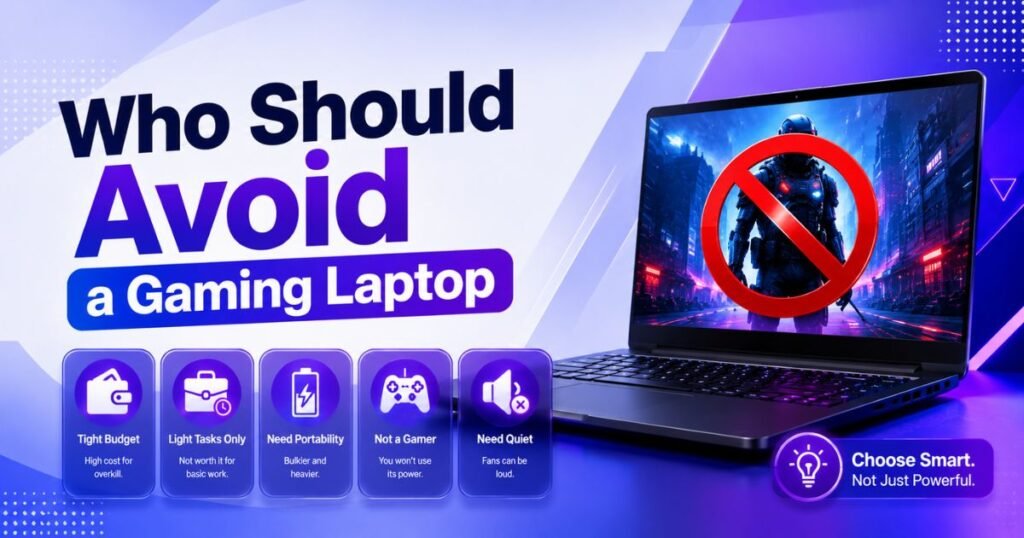
- Buyers on a strict budget who want maximum performance per dollar a desktop usually wins here.
- Anyone who plans to upgrade components frequently over several years.
- Users who mainly game at home and don’t need portability at all.
Buying Guide: Step-by-Step
- Set your budget first. This narrows your options before specs overwhelm you.
- Identify your primary games. Esports titles need less GPU power than AAA or ray-traced games.
- Check the GPU and VRAM, not just the laptop’s marketing name.
- Look at display specs resolution, refresh rate, and panel type.
- Read about thermal performance, not just peak benchmark numbers.
- Confirm battery life expectations for gaming versus everyday use.
- Compare port selection Thunderbolt, HDMI version, Ethernet, and SD card slots matter for peripherals and external displays.
- Check warranty and support policies, since gaming laptops see heavier use than typical laptops.
Common Mistakes Buyers Make
- Focusing only on GPU name, ignoring VRAM and cooling. Two laptops with the “same” GPU can perform very differently.
- Ignoring battery life and being surprised by short unplugged gaming sessions.
- Overspending on 4K displays when the GPU can’t consistently drive that resolution in demanding titles.
- Skipping port and upgradeability checks, then discovering limited expansion options later.
- Trusting marketing benchmarks over independent, sustained-performance reviews.
Expert Tips
- Prioritize a laptop that can sustain performance under a heavy 30-minute gaming session, not just the first five minutes.
- If you plan to game unplugged often, check reviews specifically testing gaming battery life, since it’s usually far shorter than video playback battery life.
- Consider a slightly lower GPU tier with better cooling over a higher-tier GPU that throttles heavily real-world frame rates often end up similar.
- If you stream or record, prioritize CPU core count and RAM alongside GPU power.
Check It Out: Meshki Return Policy: Complete 2026 Guide to Refunds, Store Credit & Fees
Conclusion
Choosing a gaming laptop doesn’t have to be confusing once you know which specs actually affect your day-to-day experience. TheLaptopAdviser recommends Focusing on GPU tier, cooling, display quality, and real-world battery life over marketing claims and raw numbers.
Ready to compare specific models? Use the buying guide checklist above before you shop, and cross-reference any laptop you’re considering against independent expert reviews and sustained-performance benchmarks not just the spec sheet.
Frequently Asked Questions
What is the best gaming laptop for beginners in 2026?
A mid-range laptop with a solid discrete GPU, 16GB RAM, and a 1080p or 1440p 144Hz display offers the best balance of performance and price for most new gamers.
How much should I spend on a gaming laptop?
Most gamers get strong value between $1,300 and $2,000. Budget models under $1,300 work well for esports titles, while $2,000+ machines suit high-resolution and creative workloads.
Is a gaming laptop as good as a gaming desktop?
Desktops generally offer better performance per dollar and easier upgrades. Gaming laptops offer portability but at a premium price for similar performance.
How long do gaming laptops last?
Most gaming laptops stay relevant for two to four years, depending on how demanding the games you play become and how well the cooling system performs over time.
Does more VRAM matter for gaming laptops?
Higher VRAM helps with higher resolutions and modern texture-heavy games, especially at 1440p and above.
Is 16GB of RAM enough for gaming in 2026?
16GB is the practical minimum for smooth multitasking. Heavier multitaskers or streamers may benefit from 32GB.
What’s the difference between 1080p and 1440p gaming laptops?
1440p offers sharper visuals but requires more GPU power to maintain high frame rates compared to 1080p.
Do gaming laptops overheat?
They can, especially under sustained heavy loads. Cooling system design varies significantly between brands and models, which is why thermal performance matters in reviews.
Are OLED displays worth it on gaming laptops?
OLED offers richer colors and deeper contrast, which many buyers value for both gaming and media. Some models trade brightness or battery life for this benefit.
How important is refresh rate for casual gamers?
Less critical than for competitive players, but a 120Hz+ display still noticeably improves smoothness over standard 60Hz panels.
Can gaming laptops be used for work or school?
Most gaming laptops handle everyday productivity tasks easily, though battery life during non-gaming use is usually better than during gaming.
What ports should a gaming laptop have?
Look for at least one USB-C with data transfer support, HDMI, and ideally an SD card slot and Ethernet port for reliable wired connections.
Should I buy a gaming laptop with a mechanical keyboard?
Mechanical keyboards offer better tactile feedback but add bulk and reduce battery life slightly. Many gamers are satisfied with quality membrane keyboards instead.
How do I know if a gaming laptop review is trustworthy?
Look for reviews that disclose their testing method, discuss sustained performance (not just peak numbers), and are transparent about whether claims come from hands-on testing or public specifications.
What should I check before buying a used gaming laptop?
Battery health, thermal paste condition, screen and keyboard wear, and whether the GPU shows signs of past overheating or throttling issues.
Final Verdict
There’s no single “best” gaming laptop for everyone in 2026 the right choice depends on your budget, the games you play, and how much portability matters to you. Budget models handle esports well. Mid-range laptops suit most buyers looking for AAA performance without overspending. High-end machines make sense for creators and enthusiasts who need top-tier GPU power and premium displays.
The smartest approach is to match your actual gaming habits to the right tier, rather than chasing the highest spec number on a page.

Team TrandyVilla is the passionate home decor team behind Trandy Villa, where style meets comfort in everyday living. The team loves transforming simple spaces into beautiful, functional homes through smart ideas, budget-friendly hacks, and modern design trends. Their content focuses on helping readers create homes that feel both stylish and personal without spending too much.