

If you’re searching for a Mashable Connections hint, you’re probably staring at a grid of 16 words, feeling stuck, and wondering how everyone else on social media solved it in under two minutes. You’re not alone. Millions of people play the New York Times Connections game every day, and just as many turn to Mashable for a nudge in the right direction when they get stuck.
This guide explains exactly what a Mashable Connections hint is, how the hints work, why they’re useful even for experienced players, and how you can get better at solving the puzzle on your own. Whether you’re a total beginner or someone who plays daily, you’ll find practical, easy-to-follow advice here.
What Is a Mashable Connections Hint?
A Mashable Connections hint is a short clue published by Mashable to help players solve the daily NYT Connections puzzle without giving away the full answer right away.
Mashable publishes these hints every day, usually broken into two levels. The first level gives a gentle nudge, like naming the theme of a group. The second level gets more specific, hinting at which words belong together. This layered approach lets players choose how much help they want.
The goal of a hint isn’t to hand you the answer. It’s to unstick your thinking so you can finish the puzzle yourself and still feel that sense of accomplishment.
How the Connections Game Works
Connections is a word puzzle from the New York Times where you sort 16 words into four hidden groups of four. Each group shares a secret theme, and the tricky part is that some words seem like they belong to more than one category.
Here’s the basic structure:
- Yellow group – usually the easiest connection
- Green group – straightforward but slightly trickier
- Blue group – requires more lateral thinking
- Purple group – often wordplay-based and the hardest
You get four mistakes before the game ends. That’s why so many players look for a hint before guessing, especially on days when the categories overlap in confusing ways.
Why People Search for Mashable Connections Hints
People search for a Mashable Connections hint because the puzzle is designed to trick you on purpose. The New York Times intentionally places overlapping words to test how well you separate obvious patterns from real ones.
Common reasons players look for hints include:
- They’re stuck on the purple category, which is usually the hardest
- They’ve already used a few guesses and don’t want to lose their streak
- They want to confirm a theory before committing to a guess
- They’re short on time and want to finish quickly
- They’re new to the game and still learning how it works
This is completely normal. Even puzzle experts use hints occasionally, especially on harder days.
Browse More: MyGreenBucks net Review 2026: Is It Legit, and Is It Actually Worth Your Time?
Where to Find Mashable’s Daily Hints
Mashable connections hint publishes a new Connections hint article every day on its website, usually posted early in the morning US time so players have it ready as soon as the puzzle updates at midnight ET.
To find it:
- Go to Mashable’s site and search “Connections hint” plus today’s date
- Or search directly on Google using the same phrase, since Mashable’s daily posts usually rank at the top
- Look for the most recent publish date to make sure you’re reading today’s puzzle, not an old one
Because the puzzle changes daily, always double-check the date on the article before reading further. Old hints won’t match today’s grid.
How to Read a Hint Without Spoiling the Whole Puzzle
The smart way to use a hint is to read only as much as you need. Mashable connections hint typically structures its hint articles in this order:
- Category themes only – no words revealed
- One word per category – a small nudge
- Full answers – for players who want to check their work
If you want to keep the challenge fun, stop reading after step one or two. Only scroll to the full answer if you’re truly stuck or want to verify a guess before submitting it.
Step-by-Step Strategy to Solve Connections
You don’t need a hint every day if you use a solid strategy. Here’s a simple method that works for most puzzles.
Step 1: Scan for the Obvious Group First
Look for four words that clearly belong together with no ambiguity. This is usually the yellow category. Don’t submit yet, just note it mentally.
Step 2: Watch for Overlap Traps
If a word could fit two categories, that’s usually intentional. The NYT puzzle editors place these traps to slow you down. Set those words aside and look at the remaining ones first.
Step 3: Look for Wordplay in the Hardest Group
The purple category often relies on puns, hidden words, or a shared prefix/suffix rather than a simple theme. Read the words out loud if you’re stuck. It sometimes reveals a pattern your eyes miss.
Step 4: Start With Your Most Confident Guess
Submit the group you’re most sure about first. This reduces risk and gives you visual confirmation that helps solve the rest.
Step 5: Use Process of Elimination
Once one or two groups are solved, the remaining words often sort themselves out naturally.
Take a Look: LuxuryInteriors org Review 2026: What It Is, Who It’s For, and Is It Legit
Pros and Cons of Using Hints
| Pros | Cons |
| Helps you finish without losing your streak | Can reduce the challenge if used too early |
| Great for beginners learning the game’s logic | Full answers remove the satisfaction of solving it yourself |
| Saves time on busy mornings | Relying on hints daily can slow skill growth |
| Confirms guesses before you risk a mistake | Not all hint sites publish at the same time each day |
Common Mistakes Players Make
Avoiding these mistakes will improve your success rate more than any hint can.
- Guessing too early – Submitting a group the moment it looks right, without checking for overlap traps
- Ignoring word forms – Missing that a word might be a verb in one context and a noun in another
- Overthinking the purple group – Sometimes the answer is simpler than it looks
- Not reading hints in order – Jumping straight to the full answer and missing the fun of solving it yourself
- Forgetting past puzzle patterns – The same trick categories (like homophones or hidden words) show up often
Expert Tips for Faster Solving
- Read all 16 words before guessing anything. Your brain needs the full picture to spot patterns.
- Group by category type, not by how confident you feel. Look for synonyms, wordplay, and pop culture references separately.
- Save purple for last unless it clicks early. Rushing it usually leads to mistakes.
- Practice daily. Like most word games, Connections gets easier the more patterns you recognize over time.
- Use a hint only for the category you’re stuck on, not the whole puzzle, to keep the challenge intact.
Mashable vs Other Connections Hint Sources
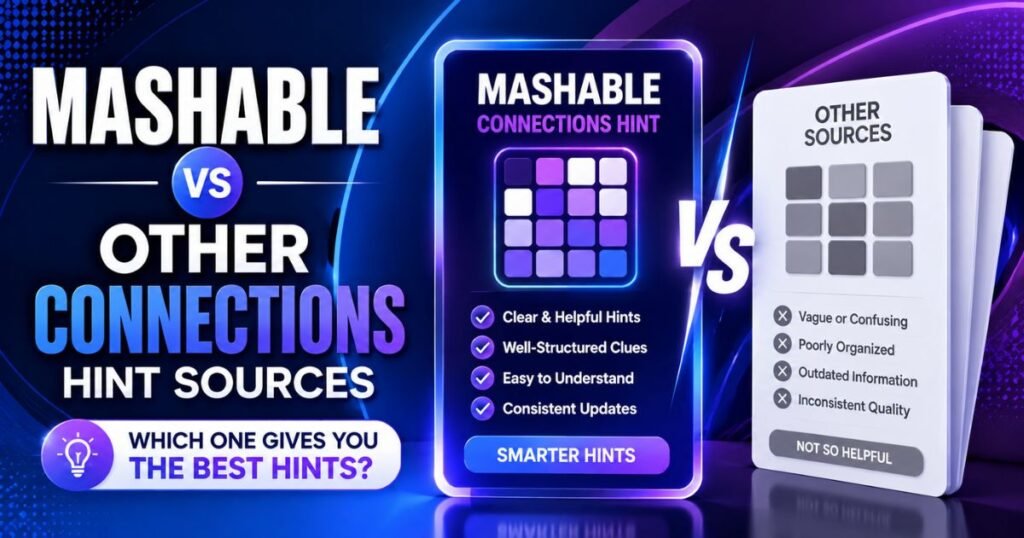
Several sites publish daily mashable Connections hints, and Mashable is one of the most consistent and widely read. Its hints are generally structured, easy to skim, and updated early in the day.
When comparing hint sources, look for:
- Timeliness – Is it updated by the time the puzzle resets at midnight ET?
- Clarity – Does it separate soft hints from full answers?
- Accuracy – Does it match the actual puzzle for that day?
No single source is guaranteed to be perfect every single day, so it’s smart to cross-check with the official NYT Connections page if something seems off.
Read Now: Showbizztoday com Review 2026: Is It Legit? A Complete, Honest Guide
FAQs about Mashable Connections Hint
What is a Mashable Connections hint?
It’s a daily clue Mashable publishes to help players solve the NYT Connections puzzle without immediately revealing the full answer.
Is Mashable Connections hint free to read?
Mashable’s daily Connections hint articles are free and don’t require a subscription.
How often does Mashable publish Connections hints?
Mashable publishes a new hint article every day, matching the daily reset of the NYT Connections puzzle.
What time does the Connections puzzle update?
The NYT Connections puzzle updates daily at midnight Eastern Time.
What’s the hardest category in Connections?
The purple category is usually the hardest because it often relies on wordplay, puns, or hidden connections rather than a simple shared theme.
Can I play Connections without the NYT subscription?
The basic Connections game is generally available for free through the NYT Games site, though some archive features may require a subscription.
How many mistakes are allowed in Connections?
You get four mistakes before the puzzle ends for that day.
Is using a mashable Connections hint considered cheating?
Hints are a normal part of how many players enjoy the game, especially on harder days. It’s a personal choice, not a rule violation.
Why do some words seem to fit two categories?
The puzzle is designed with overlapping words on purpose to test careful thinking and slow down quick guessers.
Where can I check today’s Connections answers if I’m completely stuck?
Mashable and a few other puzzle-focused sites publish full daily answers, usually below the softer hints, for players who want to check their work.
Does Mashable ever get the hint wrong?
Mistakes are rare but possible with any daily publishing schedule. If something seems off, checking the official NYT Connections page is a good way to confirm.
How can I get better at Connections over time?
Play daily, review categories you missed, and pay attention to recurring puzzle patterns like homophones, hidden words, and category traps.
Conclusion
A Mashable Connections hint is a simple tool to help you enjoy the daily NYT Connections puzzle without getting stuck or losing your streak. Used the right way, hints support your thinking rather than replace it. Start with the softest clue, try to solve the group yourself, and only scroll further if you need to. Over time, you’ll rely on hints less and start spotting the puzzle’s patterns on your own.

Team TrandyVilla is the passionate home decor team behind Trandy Villa, where style meets comfort in everyday living. The team loves transforming simple spaces into beautiful, functional homes through smart ideas, budget-friendly hacks, and modern design trends. Their content focuses on helping readers create homes that feel both stylish and personal without spending too much.