
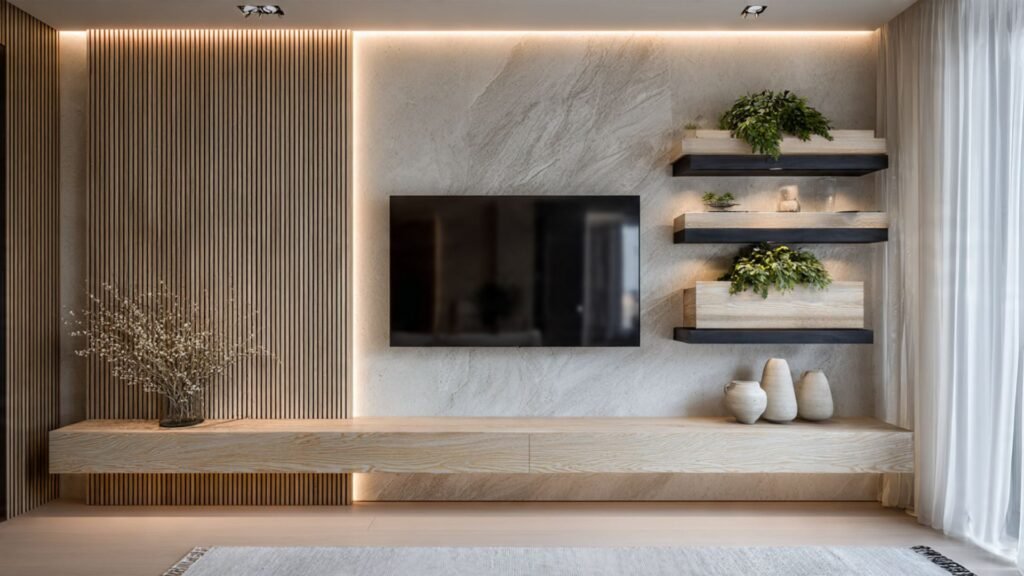
The TV wall is no longer just a place to hang a screen it has become one of the most important design statements in the modern home. As televisions grow larger and living spaces more open-plan, the wall behind the TV carries enormous visual weight. A thoughtfully designed TV feature wall can anchor an entire room, define a style, and conceal the practical mess of cables and equipment that would otherwise undermine even the most beautifully furnished space.
TV wall design refers to the planned arrangement of materials, furniture, lighting, and decor around a television to create a cohesive, intentional focal point. It improves room aesthetics, hides cables, and organizes media equipment. A well-designed TV wall design adds architectural value and elevates the entire living space. It works across all interior styles minimalist, industrial, farmhouse, and contemporary. Every element, from the wall treatment to the console height, contributes to the final result.
A beautifully executed TV wall design transforms an ordinary living room into a space that feels polished, purposeful, and professionally designed. The right combination of materials, lighting, and layout turns a simple screen into a true design statement. Done well, it balances technology with aesthetics in a way that enhances both comfort and visual appeal.
Built-in shelving adds storage and frames the television with architectural confidence. Textured panels in wood, stone, or fluted profiles introduce depth and warmth to the wall. Bias lighting behind the screen reduces eye strain and improves picture quality. A floating media console keeps equipment organized while maintaining a clean, grounded look. Smart technology integration including art-mode displays and voice-controlled lighting defines the future of modern TV wall design.
Built-In Shelving Around the TV:
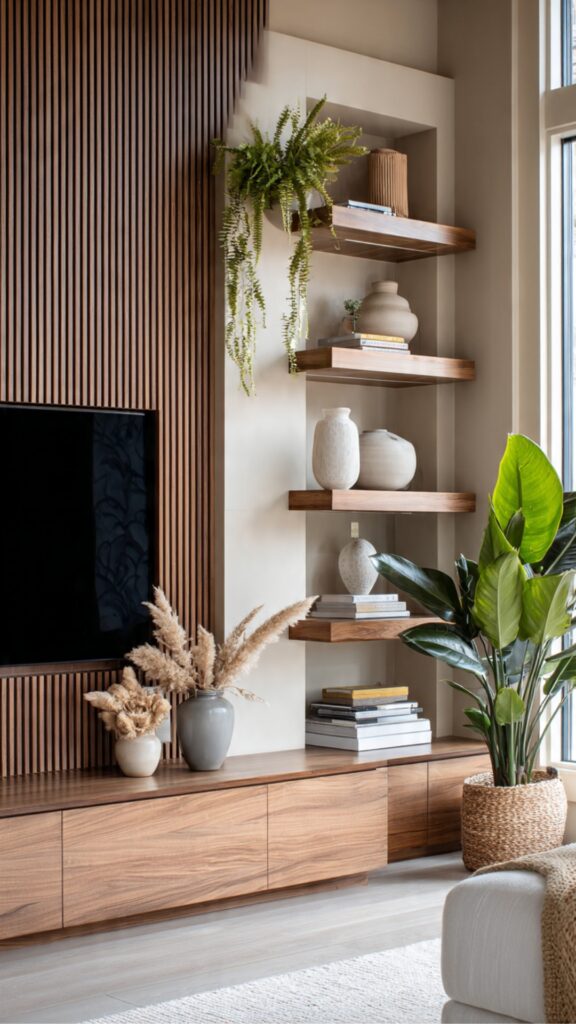
Built-in shelving flanking a wall-mounted television is one of the most enduringly popular and functionally intelligent TV wall design approaches available. Unlike freestanding media consoles, built-in units integrate the television into the wall architecture itself making the TV feel like a deliberate design element rather than a piece of technology that happened to be placed there. The result is a living room feature wall that reads as custom, considered, and professionally designed regardless of the home’s overall size or budget.
The most successful built-in TV wall designs use asymmetry thoughtfully. Rather than identical shelving towers flanking both sides of the TV a safe but predictable approach consider varying the shelf heights, depths, and configurations on each side.
For example, one side could be open shelving with display objects while the other incorporates closed cabinetry for media equipment storage. This asymmetrical balance creates visual dynamism while maintaining the overall sense of a composed, unified wall unit.
Material and finish selection for built-in TV wall design units significantly impacts the room’s character. Painted MDF in a wall-matching white or cream creates a seamless, architectural look where the built-ins appear to grow from the wall itself. Painted units in a contrasting color navy, forest green, charcoal create a bold feature wall effect.
Natural wood built-ins in oak, walnut, or ash add warmth and organic texture, particularly effective in Scandinavian, mid-century, or japandi-inspired interiors. The material choice should always respond to the room’s existing palette and furniture style rather than being selected in isolation.
A future-focused insight that most design guides miss: the next generation of built-in TV walls is incorporating charging stations, integrated LED strip lighting within shelves, and discreet cable management channels as standard elements rather than afterthoughts.
If you are planning a built-in TV wall in 2026, specifying these elements from the initial design phase rather than trying to retrofit them later saves significant time, cost, and frustration. Routing a conduit during construction for future cable additions future-proofs the entire installation against the inevitable addition of new devices and streaming equipment.
Accent Wall Behind the TV with Textured Panels:
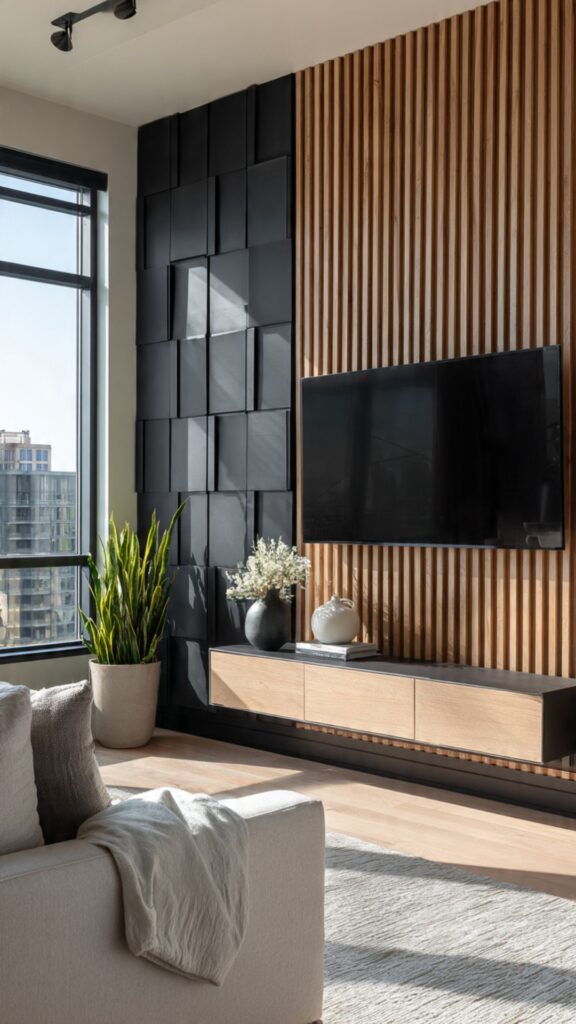
A textured accent wall directly behind the television is one of the most impactful and relatively accessible TV wall design upgrades available. By introducing a material with surface variation wood slat panels, fluted panels, 3D wall tiles, stone veneer, or grasscloth wallpaper the wall behind the TV transforms from a flat background into an active design layer that adds depth, warmth, and sophistication to the entire room.
Wood slat wall panels have emerged as the dominant textured TV wall design treatment of the mid-2020s and for compelling reasons. The vertical or horizontal rhythm of the slats creates a quiet, architectural quality that suits multiple interior styles simultaneously. In a Scandinavian interior, natural oak slats read as organic and calming.
In a contemporary interior, dark-stained or charcoal slats read as dramatic and editorial. In a mid-century modern interior, warm walnut slats connect immediately to the period’s love of wood surfaces and clean linear geometry. Few single material choices work across this breadth of interior styles.
Fluted panels panels with rounded vertical channels rather than flat slats offer a similar linear quality with a more sculptural, tactile profile. Fluted treatments have been widely adopted in high-end residential and hospitality design over the last three years, moving from boutique hotel lobbies into living rooms with remarkable speed.
When used as a TV wall panel treatment, fluted surfaces catch and release light throughout the day as the sun’s angle changes, creating a living quality in the wall that flat surfaces cannot achieve. This dynamic quality makes rooms feel more interesting and resolved even in photographs.
Installation considerations matter enormously for textured TV wall design panels. Wood slat panels must be installed on a perfectly flat, level substrate any irregularity in the wall surface will telegraph through the panel installation and create visible warping or gaps.
For stone veneer or heavy tile treatments, proper substrate preparation and the correct adhesive system are critical for long-term adhesion, particularly in homes with seasonal humidity variation. Investing in professional installation for these treatments is almost always worthwhile a poorly installed textured panel wall looks dramatically worse than a well-executed simpler alternative.
Must Read : Luxury Living Room Ideas That Make Your TV Wall Look Even More Stunning.
Minimalist TV Wall Design with Hidden Cable Management:
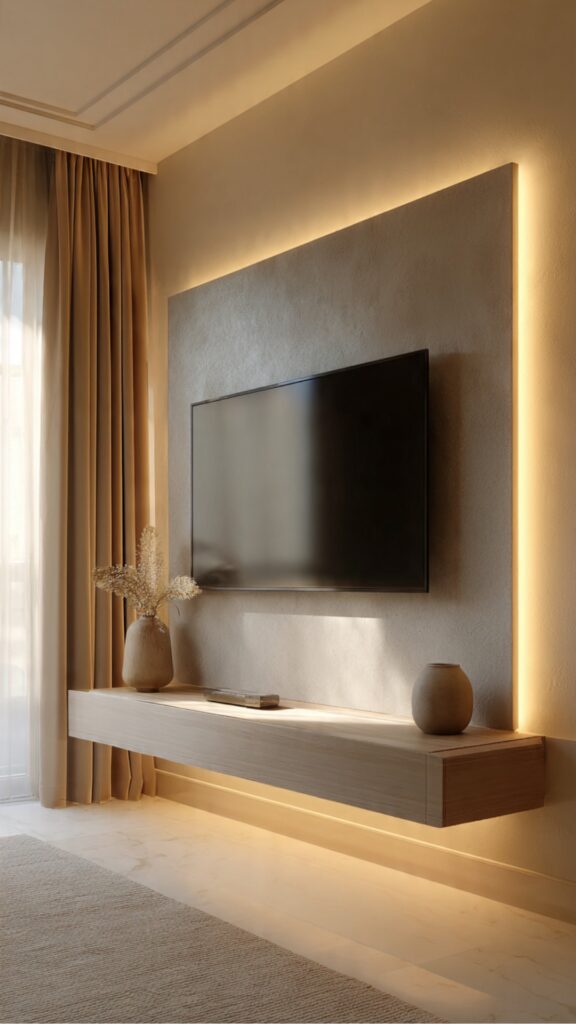
The minimalist TV wall design pursues a single, demanding goal: making the television appear to float on the wall with no visible technology, no cables, and no clutter just a clean, beautiful screen framed by an equally clean wall. Achieving this effect requires more planning and installation work than almost any other TV wall design approach, but the result particularly in contemporary and japandi-inspired interiors is among the most sophisticated and timeless looks available.
Cable management is the foundation of every successful minimalist TV wall. In-wall cable management systems thread all HDMI, power, and signal cables through the wall cavity itself, emerging at a low-profile media console or in-wall outlet box positioned below the TV.
This eliminates the most common visual problem with wall-mounted televisions: the cascade of cables running down the face of the wall that immediately undermines any pretense of minimalism. For new construction or major renovation, specifying in-wall conduit during framing is the cleanest solution. For existing walls, retrofit in-wall cable kits are available that create a channel through drywall without opening the entire wall.
Media equipment placement is the second critical variable. A minimalist TV wall typically uses one of three approaches: a low-profile floating media console mounted directly below the TV at wall-hanging height, keeping all equipment off the floor; a fully integrated media cabinet with push-to-open doors that conceal all equipment behind closed surfaces; or a separate media room or AV closet where all equipment is remotely located and only the screen remains on the main wall.
Each approach has cost and complexity implications the remote equipment approach requires longer cable runs and potentially an IR (infrared) repeater system to allow remote control signals to reach hidden equipment.
Wall treatment for a minimalist TV wall design should be equally restrained. A single material smooth plaster, large-format concrete-effect tiles, a panel of back-painted glass, or a simple but high-quality paint finish allows the television itself to be the focal point rather than competing with a decorative wall treatment.
Lighting plays a critical role here: recessed ceiling spots positioned to wash the TV wall design with even, shadow-free light during the day, and bias lighting behind the television for evening viewing, are both practical and aesthetically superior to any decorative wall treatment in a minimalist scheme.
Stone and Brick TV Feature Wall:
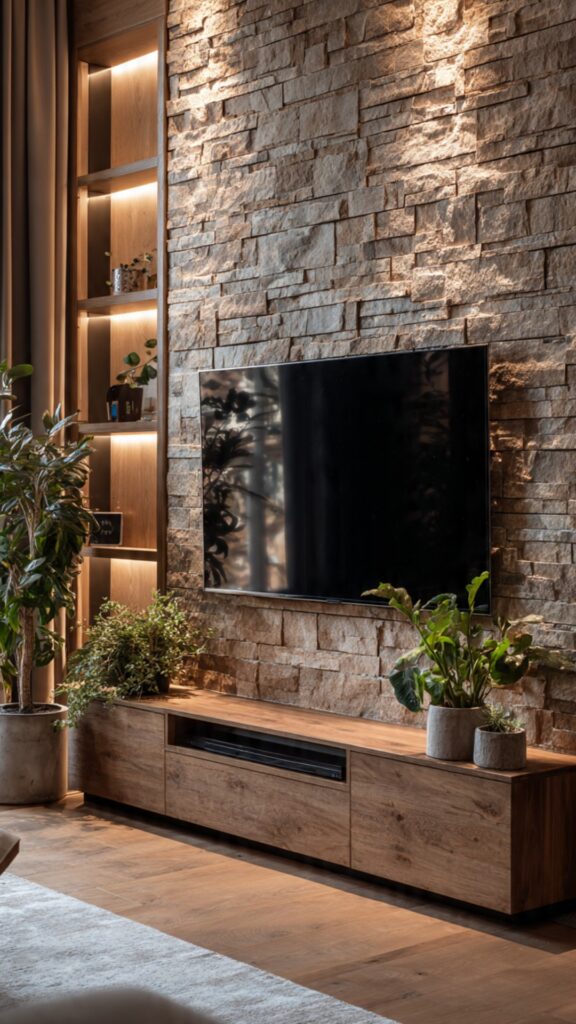
Natural stone and exposed brick create TV feature walls of extraordinary warmth, texture, and permanence materials that communicate a sense of craft and history that no manufactured panel can fully replicate. Whether using genuine reclaimed brick, natural stacked stone, limestone cladding, or slate tiles, a stone or brick TV wall design adds elemental richness to a room that typically gets better with age as the materials develop patina and character.
Full exposed brick requires either an existing brick structure or a dedicated brick veneer installation. Thin brick veneers individual brick slices approximately half an inch thick can be applied to standard drywall surfaces using appropriate adhesive and mortar, creating the visual and textural effect of full brick without the structural requirements or weight of genuine brickwork.
For homeowners in older homes with genuine brick walls, removing the plaster or drywall covering to expose the original brick is a renovation project that consistently delivers exceptional results, provided the underlying brickwork is in sound condition and the mortar joints are cleaned and repointed where needed.
Stacked stone panels offer a particularly accessible route to a stone TV wall. These interlocking panels, typically composed of real stone chips arranged and adhered to a mesh backing, create a natural stone surface that can be DIY-installed with reasonable skill and patience.
The challenge with stacked stone is achieving clean, professional-looking corners the panel corners where two walls meet or where the stone treatment terminates at a flat wall require special corner pieces and careful alignment. Shortcuts at the corners consistently undermine otherwise well-executed installations.
The television itself requires careful consideration on a stone or brick TV wall. A full-motion articulating wall mount is typically needed to position the screen correctly relative to the uneven surface, ensuring the TV sits flat and level regardless of the stone profile behind it.
Concealing cables on a stone wall requires either routing them through the wall cavity before cladding or accepting surface-mounted cable raceways that, on a textured stone surface, can be painted to blend reasonably well. Planning the cable route before any stone is applied is the far superior approach, and one that requires advance coordination between the electrician and the stone installer.
TV Wall with Fireplace Integration:
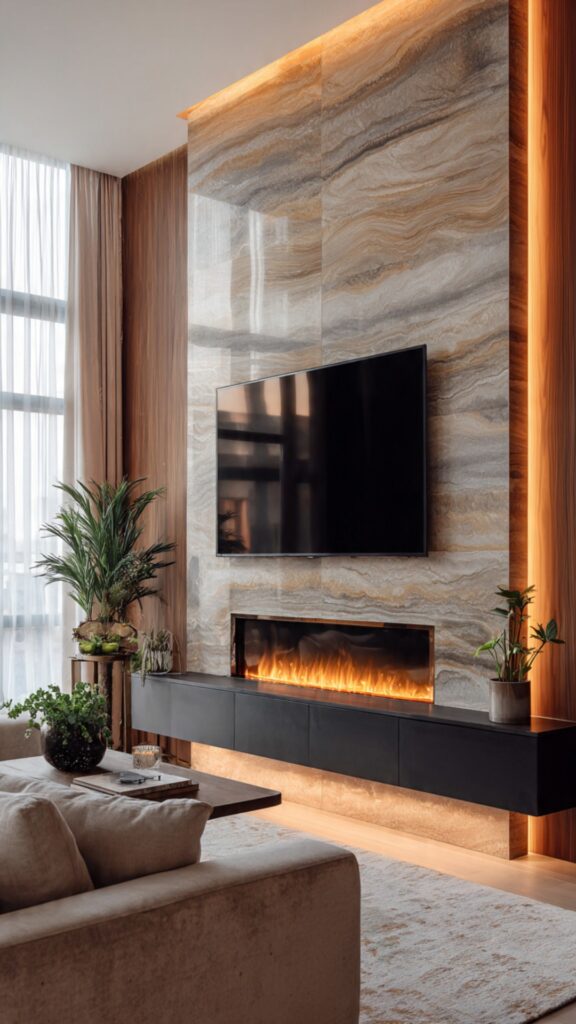
Combining a television and a fireplace on the same wall or with one positioned above the other creates a dramatic, luxurious focal point that has been one of the most requested living room configurations in residential design for the last decade.
When executed well, the TV-fireplace combination concentrates the room’s two most important functional and aesthetic anchors into a single, powerful composition. When poorly planned, it creates either an ergonomically uncomfortable viewing angle or a fire safety concern that compromises both elements.
The most contentious aspect of the TV-above-fireplace design is the viewing angle. Standard interior design guidance recommends that the center of the television screen be positioned at approximately seated eye level roughly 42 to 48 inches from the floor for standard furniture heights.
A fireplace mantel at 54 inches with a television mounted above it places the screen center at 72 inches or higher a viewing angle that creates neck strain during extended watching sessions. The solution most used in high-end installations is a motorized TV lift mechanism built into the chimney breast, allowing the television to drop to an ergonomically correct height for viewing and retract to a concealed position above when not in use.
For electric fireplace TV walls one of the fastest-growing living room configurations in both new construction and renovation the ergonomic concern is significantly reduced because the electric fireplace insert can be positioned at any height within the wall, allowing the television above it to be placed at a more optimal level.
Electric fireplace TV walls also offer complete design flexibility: the surround material, dimensions, and aesthetic can be fully customized without the structural and clearance constraints of a real wood-burning or gas fireplace. The realistic flame effects in current-generation electric fireplaces have improved dramatically, making this a genuinely compelling option even for homeowners who initially prefer the authenticity of a real flame.
Material selection for the TV-fireplace wall should unify both elements into a single architectural composition rather than treating them as two separate installations that happen to share a wall. A single cladding material marble, limewashed plaster, fluted paneling, large-format porcelain tile, or painted wood millwork that runs continuously across the entire wall surface creates cohesion.
Introducing too many materials or breaking the wall into visually separate zones for the fireplace and television undermines the powerful singular statement that this configuration can achieve at its best.
Floating Media Console Below Wall-Mounted TV:
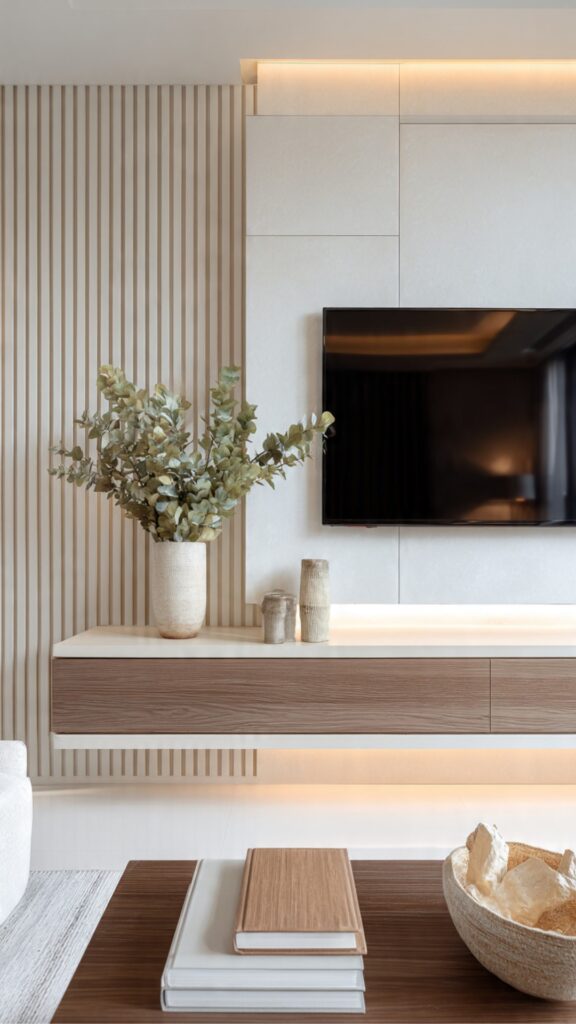
The floating media console a wall-mounted cabinet or shelf unit positioned below a wall-hung television has become one of the defining furniture choices of contemporary living room design. It solves the floor space problem of traditional TV stands, creates a clean horizontal visual line that balances the television above, and provides essential storage for media equipment, remotes, and accessories without the visual bulk of a floor-standing console.
Height positioning of the floating console is a detail that has enormous visual consequence and is frequently misjudged. The console should be mounted at a height that creates a proportional relationship with the television above it not too close (which makes the TV feel crowded) and not too far (which leaves an awkward empty gap between screen and storage).
A general principle: the space between the bottom of the TV and the top of the console should be between 4 and 8 inches. This narrow gap reads as a deliberate design decision rather than an oversight, and it creates a unified TV wall design composition that reads as a single horizontal band rather than two separate elements at different heights.
Console depth is equally important and more commonly overlooked. A floating console that is too deep relative to the wall-mounted TV above it creates a visual imbalance the heavy projecting shelf draws the eye downward rather than toward the screen.
For a wall-mounted TV, a floating console with a depth of 12 to 16 inches provides ample storage while maintaining a proportionally refined profile. Deeper consoles 18 to 20 inches or more are better suited to floor-standing configurations where the TV sits on top of rather than floating above the console.
Material choices for floating media consoles in 2026 are moving decisively toward warmer, more organic options. White lacquer dominated for the better part of a decade; however, natural oak, smoked ash, walnut veneer, and rattan-fronted drawer units are now widely preferred, reflecting the broader interior design shift toward warmth and material texture.
An insight worth noting: the console finish need not match the TV wall design treatment. A natural oak console against a dark-stained slat panel wall creates an interesting tonal tension that adds visual depth. However, the console should always connect to at least one other material or color already present in the room a principle of compositional linkage that prevents individual pieces from feeling isolated.
Go Check : Coffee Table Decor Ideas That Perfectly Complete Your TV Wall Design.
Gallery Wall Around the TV:
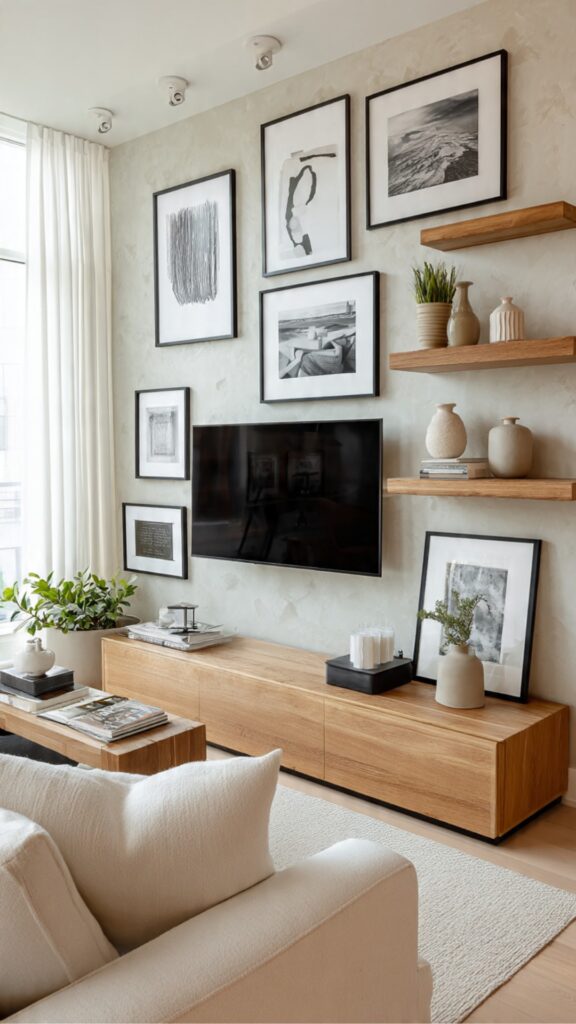
Integrating a television into a gallery wall a curated arrangement of framed art, photographs, mirrors, and decorative objects on the same wall is one of the most creative and personality-driven TV wall design approaches available. Done well, it transforms the television from a dominant technological intrusion into simply one element of a larger, richer visual composition. The TV becomes part of the story rather than the story itself.
The fundamental challenge of incorporating a TV into a gallery wall is scale and visual weight. Televisions are large, dark, and rectangular qualities that can overpower a gallery arrangement if not balanced with artwork of comparable visual weight.
The solution is to treat the television as the largest “frame” in the gallery arrangement and build the surrounding pieces in relationship to it: larger, bolder artwork positioned close to the TV, with smaller pieces extending outward. Maintaining consistent frame finishes all black frames, all natural wood, all gold throughout the gallery wall creates unity that helps the television integrate rather than dominate.
The gallery wall approach works best with televisions that have ambient display capabilities Samsung The Frame being the most widely known example, which displays art or photographs when not in use, essentially removing the black rectangle problem entirely.
When the TV displays a work of art that is visually consistent with the surrounding gallery, the distinction between screen and artwork dissolves completely, and the entire wall reads as a curated art installation. For homeowners pursuing this approach, choosing a TV with an art mode or ambient mode is not optional it is essential to the concept’s success.
Practical installation of a gallery wall around a TV requires advance planning to avoid the common problem of running anchor points or hooks through hidden cable runs or wall mount hardware. Mapping out the gallery arrangement on paper first, then physically laying it out on the floor before any holes are made in the wall, prevents costly and frustrating installation errors.
For the pieces closest to the television, using adhesive-mounted picture hooks rather than nail-driven hooks provides flexibility to adjust positioning without creating additional wall damage if the arrangement needs refinement after installation.
Dark and Moody TV Wall Design:
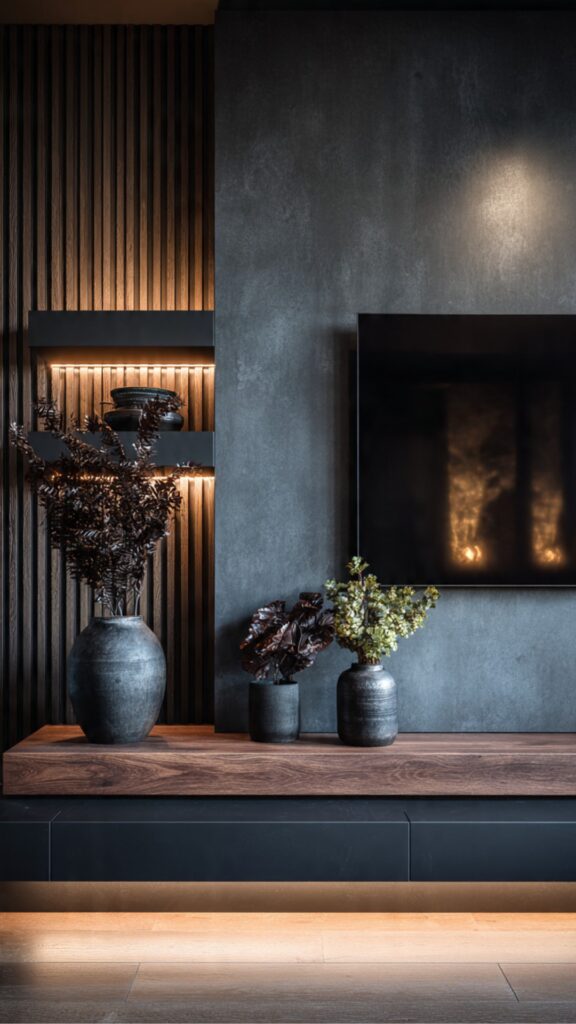
The dark accent wall behind a television in deep charcoal, midnight navy, forest green, or near-black is one of the most cinematically effective TV wall design strategies available. It works on a simple optical principle: a dark wall reduces the contrast differential between the bright television screen and its surrounding environment, significantly improving perceived picture quality and reducing eye strain during viewing, particularly in evening conditions. This is the same principle that drives the use of dark, light-absorbing wall surfaces in professional home theater design.
Deep charcoal gray is the most universally versatile dark TV wall design color. It reads as sophisticated rather than heavy, works with warm and cool accent colors equally, and provides excellent contrast for both the television and any decorative objects placed on or near the wall.
Benjamin Moore Wrought Iron, Farrow & Ball Railings, and Sherwin-Williams Tricorn Black are among the most specifier-recommended near-blacks for TV walls all three have enough warmth or blue undertone to prevent the wall from reading as flat or harsh under artificial lighting.
Dark TV walls work best when the surrounding room elements provide tonal contrast and warmth to prevent the space from feeling oppressive. A dark charcoal TV wall design paired with warm white or cream upholstered furniture, natural wood flooring, and warm brass or gold accent lighting creates a sophisticated jewel-box effect that feels intimate and luxurious rather than heavy or closed. Introducing natural materials a rattan side chair, a jute rug, a live-edge wood console further softens the dark wall and prevents the room from reading as austere.
One insight that most dark TV wall design guides miss entirely: the ceiling color matters enormously in a dark-wall living room. Painting the ceiling the same dark color as the TV accent wall creates a cocooning, immersive effect that is exceptional in dedicated media rooms or smaller living rooms designed for evening use.
In larger, more multi-functional living spaces, keeping the ceiling light while darkening the TV wall design creates the dramatic focal point effect without the cave-like quality that a full dark room can produce. Understanding this ceiling relationship is key to controlling the mood and scale of a dark TV wall design.
Marble and Luxury Stone TV Wall Cladding:
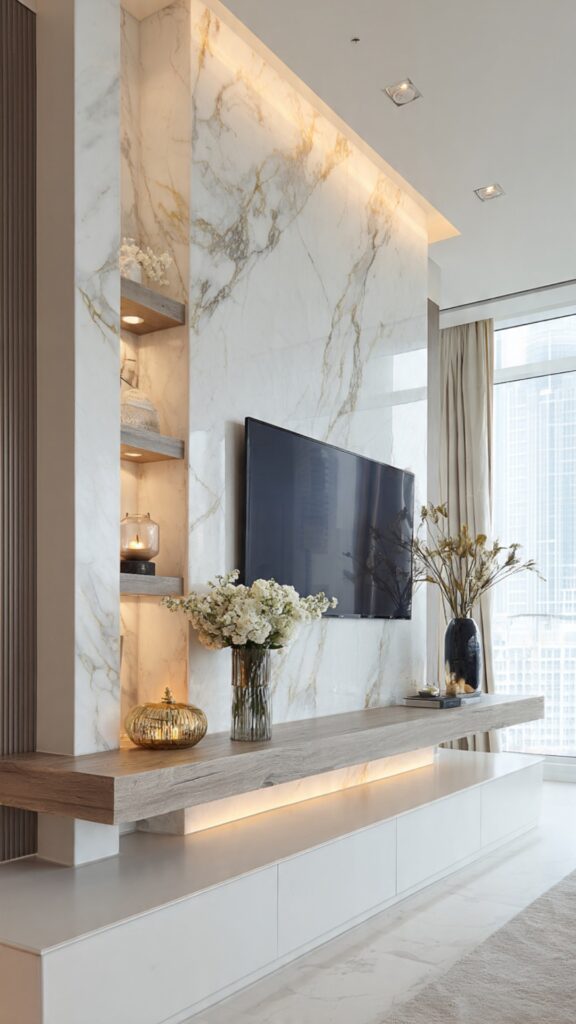
Marble and luxury stone TV wall design cladding represents the highest tier of feature wall design a material choice that communicates genuine quality, craftsmanship, and permanence in a way that no paint, panel, or wallpaper treatment can match. Whether using Calacatta marble, Nero Marquina, travertine, quartzite, or book-matched stone panels, a stone-clad TV wall design creates a room centerpiece of extraordinary beauty and lasting value.
Book-matched stone panels where two consecutive slices of stone are opened like a book and placed side by side, creating a mirror-image pattern from the stone’s natural veining are the most dramatic and visually sophisticated approach to stone TV wall design cladding.
The continuous veining pattern draws the eye across the entire wall surface in a sweeping, organic movement that no manufactured material can replicate. Book-matching requires careful planning and typically means ordering panels as matched sets from the stone supplier, specifying the exact layout and orientation of the veining before cutting begins.
Porcelain slabs that mimic luxury stone large-format slabs in Calacatta, marble, travertine, and concrete effects offer a highly accessible alternative that has improved dramatically in quality and visual authenticity. Current-generation large-format porcelain (120cm x 260cm and larger) printed with high-resolution stone digital imaging is genuinely difficult to distinguish from natural stone at normal viewing distances.
Porcelain offers significant practical advantages over natural stone in living room applications: it requires no sealing, resists staining absolutely, is impervious to water and humidity, and costs significantly less than genuine stone of comparable appearance.
Installation of stone or stone-effect TV wall design cladding requires specific expertise and appropriate materials throughout. Large-format panels require a perfectly flat, well-prepared substrate often a layer of 12mm cement board over the existing wall surface to prevent tile lippage (where adjacent tiles are not perfectly flush).
Large-format tile adhesive systems, expansion joints at regular intervals, and an experienced tile installer who has worked with large-format materials are all non-negotiable requirements. The gap between a beautifully installed stone TV wall design and a poorly installed one is enormous, and the quality of the installation is as important as the quality of the material selected.
Wallpaper as a TV Wall Design Statement:
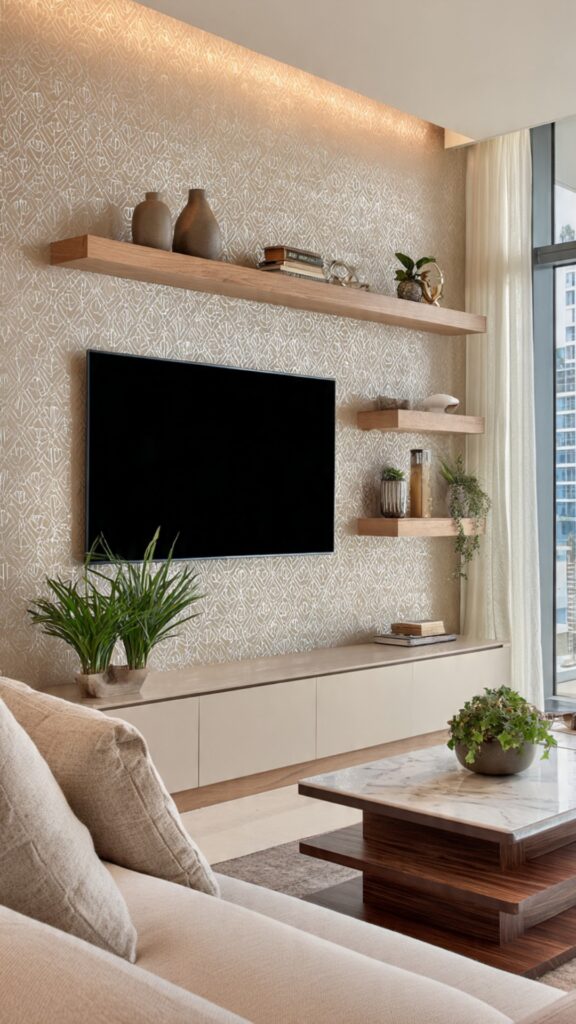
Wallpaper has undergone a remarkable renaissance in interior design over the last five years, and its application as a TV wall treatment is one of the most creative and accessible ways to create a dramatic feature wall without the permanence, cost, or installation complexity of hard materials. A single wall of bold, beautiful wallpaper behind a television can transform a living room’s entire character introducing pattern, color, and visual depth that paint alone cannot provide.
Mural wallpapers large-scale scenic or abstract prints designed to cover an entire wall as a single continuous image are particularly effective as TV wall treatments because they create a backdrop of genuine visual richness that makes the television feel embedded in a curated scene rather than mounted on a blank surface.
Forest scenes, abstract expressionist patterns, architectural photography, and botanical illustrations are among the most popular mural choices for TV walls. The key selection criterion is choosing a mural with enough visual complexity to hold interest from across the room, but enough tonal consistency to prevent it from competing with the screen during viewing.
Textured wallpapers grasscloth, linen-effect, embossed designs, metallic-thread weaves offer a more restrained but equally sophisticated approach. The texture catches light in a way that changes the wall’s appearance throughout the day without introducing the strong pattern of a mural or print wallpaper.
This makes textured wallpaper an excellent choice for homeowners who want the TV wall to feel special and considered without being visually dominant. Natural fiber wallpapers like grasscloth have a particular quality of absorbing and diffusing light that creates a soft, warm backdrop for a television that is particularly effective in the evening.
From a practical standpoint, the area of wall directly behind a wall-mounted television can be wallpapered without concern the TV covers the central section, and only the edges and surrounding area are visible.
However, the quality of the wallpaper installation directly behind the TV still matters: bubbles, misaligned seams, or lifting edges become visible when the TV is removed for servicing or replacement. Always use a professional wallpaper installer for TV wall applications, particularly for mural papers where seam alignment is critical to the integrity of the overall image.
LED Lighting and Bias Lighting for TV Walls:
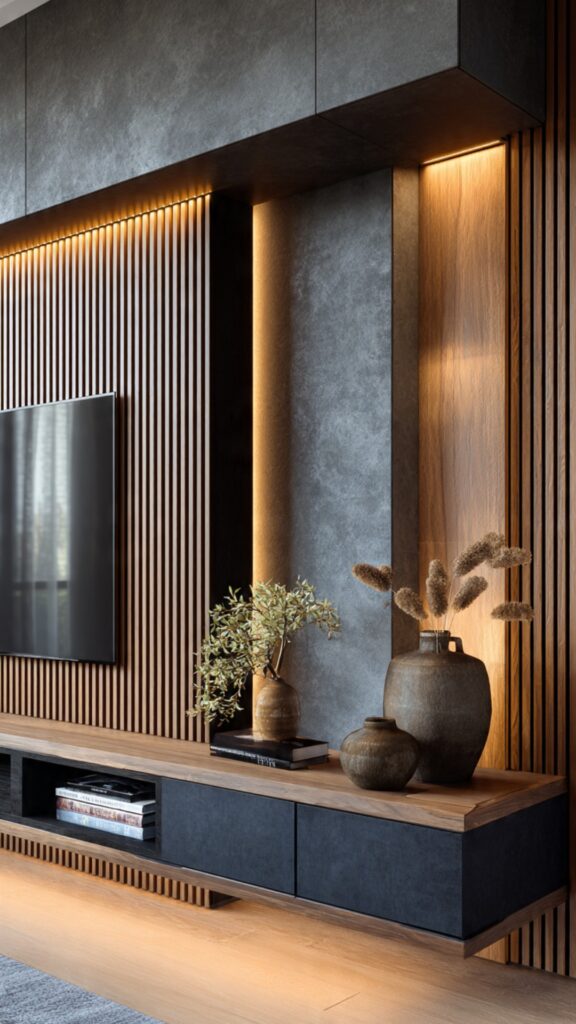
Lighting is the most underused tool in TV wall design and arguably the highest-impact one relative to its cost. The right lighting strategy around a television simultaneously improves the viewing experience, creates atmospheric depth in the room, and showcases the TV wall design during both viewing and non-viewing times.
Yet the majority of homeowners apply the same general room lighting to the TV wall as to every other surface, missing the opportunity to create something genuinely exceptional. Bias lighting a strip of soft, diffused light positioned behind the television at its perimeter is the most direct and immediately impactful TV lighting upgrade available.
The light creates a gentle glow that extends from behind the screen onto the surrounding wall, reducing the contrast between the bright screen and the dark room during evening viewing. This reduction in contrast is medically documented to reduce eye strain and improve the perception of picture depth and color saturation.
Bias lighting products range from inexpensive LED strip kits that adhere to the back of the TV frame to sophisticated systems like Philips Hue Play or Govee that sync the bias light color dynamically to the colors displayed on screen in real time creating an immersive ambient effect that extends the picture’s mood into the room.
Recessed ceiling lighting positioned specifically to wash the TV wall rather than the general room creates a dramatic, gallery-like illumination of the wall treatment and any decorative objects on shelving. This directional wall washing technique is standard in museum and gallery lighting design but is rarely applied in residential settings,
where recessed lights are typically aimed straight down rather than toward walls. Adjustable, aimable recessed fixtures (also called eyeball or directional recessed lights) allow the beam to be directed precisely at the TV wall surface, creating the clean, even illumination that shows off wall treatments, artwork, and decorative objects at their absolute best.
LED strip lighting integrated within built-in shelving running along the underside of shelves or at the back of shelf niches creates what designers call the “glowing shelf” effect, where the shelf contents are warmly backlit and the shelving itself appears to emit light. This transforms ordinary display shelving into a genuinely atmospheric design element, particularly in the evening when general room lighting is dimmed.
The color temperature of this lighting matters: warm white (2700-3000K) creates a cozy, residential quality; cool white (4000K and above) creates a more clinical, commercial feeling that is generally less desirable in a living room context. Always specify warm white for residential TV wall shelf lighting.
TV Wall Design in Small Living Rooms:
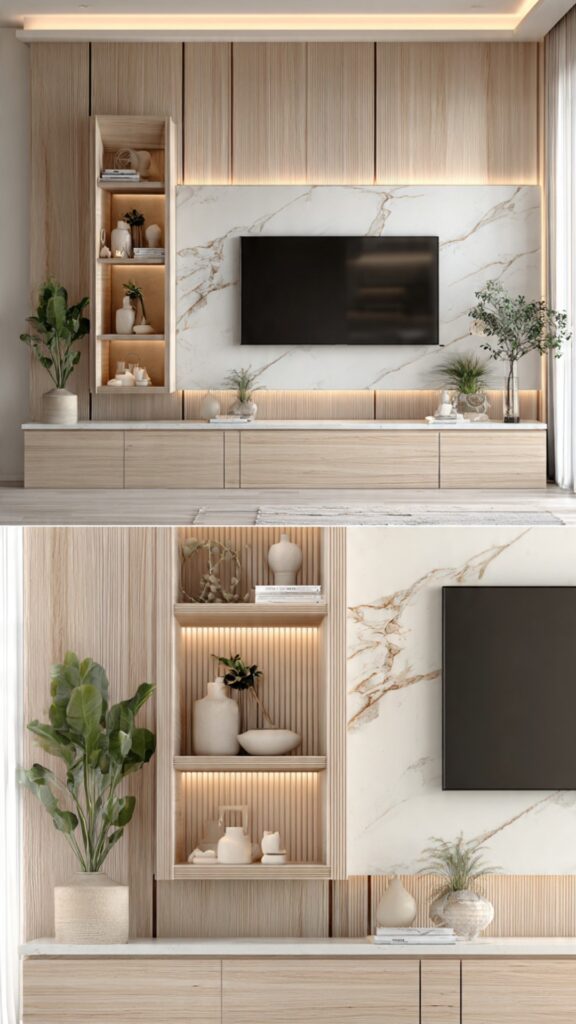
Designing a TV wall in a small living room requires a fundamentally different approach than designing for a larger space. The same treatments that create powerful drama in a spacious room a full wall of dark cladding, an oversized built-in unit, a large-format mural can feel overwhelming and space-compressing in a compact room.
However, the constraint of a small room also focuses the design, and a well-resolved TV wall in a small space often looks more polished and considered than a similar design in a larger room where there is more room to hide errors.
The most effective TV wall strategy for small living rooms is to minimize visual complexity rather than maximizing impact. A single, clean treatment one material, one color, one consistent approach reads better in a small space than a layered combination that works well at larger scale.
A simple floating media console, a wall-mounted TV with clean cable management, and a single accent treatment a panel of textured wallpaper, a band of wood slat paneling, or a carefully chosen paint color creates a focused, considered TV wall that makes the room feel complete without making it feel smaller.
Light colors on the TV wall are particularly important in small living rooms. While a dark TV wall improves viewing conditions from a technical standpoint, it can make a small room feel significantly more enclosed. The compromise solution: use a medium-toned accent wall treatment a warm mid-gray, a soft sage, a warm taupe that provides enough contrast to define the TV wall as a feature without the heavy, space-compressing quality of a very dark surface.
Alternatively, a pale-colored textured treatment natural grasscloth, a subtle embossed wallpaper, a light gray plaster effect creates definition and interest without any color that could diminish the sense of space.
Furniture arrangement is often the most important TV wall design decision in a small living room, and it is entirely independent of what is on the wall itself. Keeping furniture low-profile a low floating media console, a low-slung sofa, a flat coffee table preserves sightlines and prevents the TV wall from feeling crowded from the seating position.
Mounting the television at the correct height (screen center at approximately 42-48 inches from the floor for standard sofa seating) is even more critical in a small room, where an awkward viewing angle has nowhere to hide in a smaller composition.
Do See : LED Lights Ideas That Add a Gorgeous Glow to Your TV Wall Design.
Japandi-Inspired TV Wall Design:
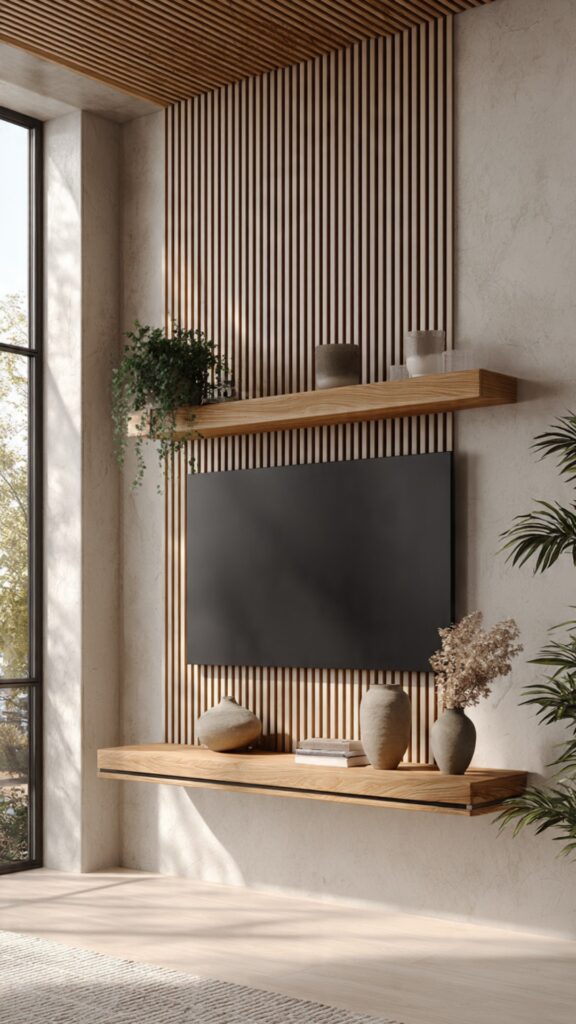
Japandi the design philosophy that merges Japanese minimalism with Scandinavian warmth and functionality has produced some of the most beautiful and livable interior spaces of the last five years, and its principles translate particularly well to TV wall design.
The japandi TV wall is characterized by restraint, natural materials, exceptional craft quality, and a deep appreciation for the beauty of negative space. It is the antithesis of the maximalist gallery wall or the heavily styled built-in unit and it is no less sophisticated for that restraint.
The material palette of a japandi TV wall is narrow but intentionally chosen. Natural wood particularly in lighter species like white oak, maple, or birch is the most common surface material, used either as slat paneling, a solid timber floating console, or both.
The wood’s natural grain and color variation provides all the visual interest the wall needs; no additional pattern, color, or ornamentation is required or desired. In a japandi TV wall, everything that is not contributing to the composition is removed rather than supplemented.
Color in a japandi TV wall scheme is restricted to the natural tones of the materials themselves wood creams, warm grays, soft whites, and muted sage or charcoal as occasional accents. The walls are typically left in a warm white or off-white plaster finish, allowing the wood elements to read clearly against a neutral ground.
The television, in this context, is embraced as a necessary modern object rather than concealed but its presence is minimized by careful proportioning, clean cable management, and the deliberate absence of competing visual elements.
Objects placed on japandi TV wall shelving follow strict curation principles: fewer objects, better objects, more negative space. A single ceramic vase, a small sculptural object, three books arranged horizontally, a trailing plant in a simple vessel each piece is selected for its form quality, material integrity, and relationship to the other pieces on the shelf.
Nothing is placed on a japandi shelf because it needs a home; everything is placed there because it contributes something essential to the composition. This level of object curation is both the most demanding and the most rewarding aspect of the japandi TV wall approach.
Industrial Style TV Wall with Exposed Materials:
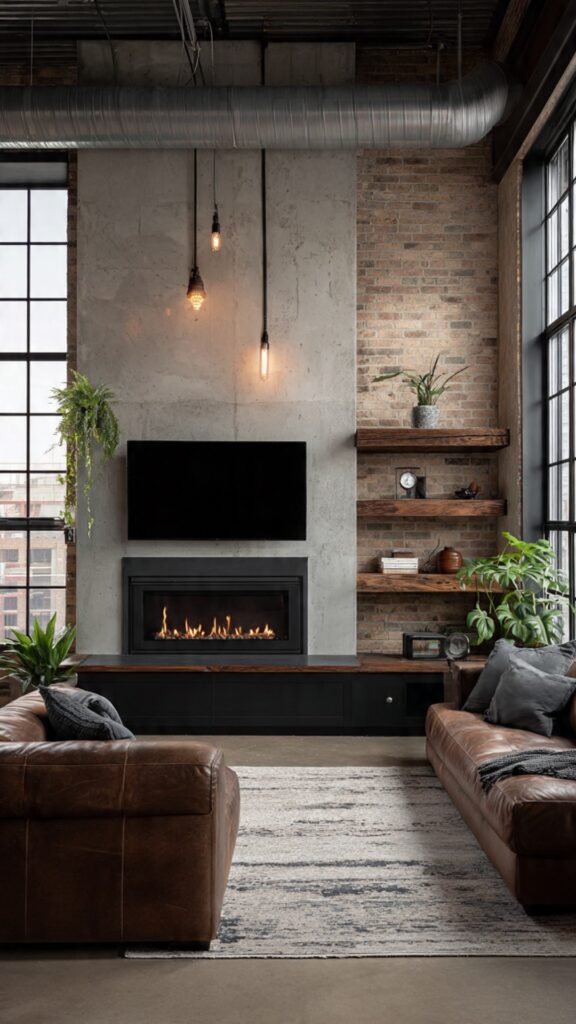
The industrial TV wall draws from the aesthetic vocabulary of converted warehouses, urban lofts, and modernist factories exposed brick or concrete, raw steel, Edison bulb lighting, reclaimed timber, and a general appreciation for materials in their most honest, unfinished state.
It is a powerful and characterful aesthetic that translates exceptionally well to the TV wall, where the combination of hard industrial materials and warm, carefully chosen accent elements creates a space that feels urban, creative, and lived-in.
Exposed concrete is the most architecturally significant industrial TV wall material. Poured in place, applied as a micro-cement overlay, or simulated with large-format concrete-effect porcelain tile, concrete creates a surface of quiet strength and visual depth that improves with every year. Raw, unsealed concrete develops a patina of use that looks increasingly beautiful over time.
Micro-cement a thin overlay system applied by a specialist artisan can transform any existing flat wall surface into a convincing concrete finish, making it accessible in existing homes and apartments without structural intervention.
Steel and metal accents bring the industrial language into the TV wall’s vertical dimension. A floating media console with a steel frame and wood or leather shelf surfaces, wall-mounted steel industrial pipe shelving brackets, or a caged metal pendant hung beside the television all contribute to the industrial atmosphere without overwhelming the space.
The critical balance in industrial TV wall design is ensuring that the metal elements feel purposeful and structural rather than decorative applied industrial details that mimic industrial function without actually serving any structural role look unconvincing and undermine the authenticity that defines this style at its best.
Reclaimed wood brings warmth and history into the industrial TV wall scheme a necessary counterweight to the hardness of concrete and metal. A single wall of reclaimed barn wood planks behind the television creates a surface of extraordinary character: the variations in color, the nail holes, the saw marks, and the weathering patterns are all part of the material’s story.
Reclaimed wood requires proper kiln drying before installation to eliminate moisture content that would cause post-installation movement, and treatment against insects is important for wood sourced from agricultural buildings. A reputable reclaimed wood supplier will address both concerns as standard practice.
Smart TV Wall Design with Technology Integration:
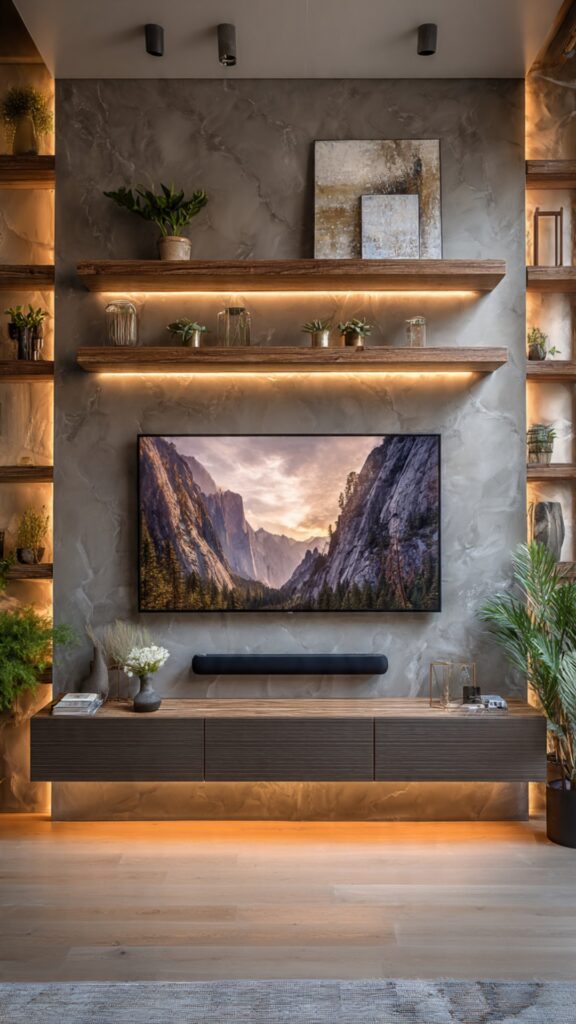
The smart TV wall is a concept that is evolving rapidly, driven by advances in display technology, home automation, and integrated audio-visual systems. A TV wall designed with technology integration in mind rather than having technology retrofitted into an existing design delivers a dramatically superior result in both performance and aesthetics, and represents the future direction of residential entertainment space design.
Frame TV and ambient display technology have fundamentally changed the aesthetics of the TV wall in homes that adopt them. Samsung The Frame, LG Gallery Series, and Sony Bravia XR Art Mode are all current-generation televisions that display curated artwork or personal photographs when not in active use turning what would otherwise be a black rectangle into an active design element.
For TV wall designs where aesthetics are paramount, specifying one of these display technologies from the outset is as important as any material or furniture decision. The visual difference between a powered-off conventional TV and an art-mode display television on an otherwise beautiful wall is enormous.
Integrated audio is the most frequently overlooked component of a thoughtfully planned smart TV wall. A television’s built-in speakers are almost universally inadequate for both music and cinematic audio, yet many homeowners delay the audio upgrade indefinitely because of the complexity and cost of installing a proper speaker system.
Planning for audio at the TV wall design stage whether for a simple soundbar on the floating console, in-wall left and right speaker installations flanking the TV, or a full surround sound system with ceiling-mounted speakers is dramatically easier and less expensive when done during the design and construction phase than when attempted as a retrofit. Routing speaker cable through wall cavities before surfaces are finished costs very little; doing it after surfaces are complete costs significantly more.
Home automation integration at the TV wall is the most forward-looking aspect of this design approach. Voice-controlled or app-controlled systems from platforms like Control4, Savant, Crestron, or more accessible options like Google Home and Amazon Alexa can manage all aspects of the TV wall experience screen on/off, input selection, volume, bias lighting color and intensity, window shade closure, and room lighting scene changes from a single voice command or app touch.
Designing the TV wall with smart home integration in mind, including planning the location of smart switches, hardwired network connections, and control panel mounting points, creates a living room experience that is both beautiful and remarkably convenient to use every day.
Conclusion
A thoughtfully designed TV wall does far more than hold a screen it anchors the room, expresses a design vision, and creates a space that feels intentional and complete. Whether you choose the warmth of built-in shelving, the drama of a dark accent wall, or the quiet refinement of a japandi-inspired approach, the right TV wall design transforms an ordinary living room into one that is genuinely memorable.
Choose one idea from this guide that speaks to your space and style, take the first step a material sample, a paint swatch, or a floor plan sketch and let your TV wall become the design statement your room deserves.

Team TrandyVilla is the passionate home decor team behind Trandy Villa, where style meets comfort in everyday living. The team loves transforming simple spaces into beautiful, functional homes through smart ideas, budget-friendly hacks, and modern design trends. Their content focuses on helping readers create homes that feel both stylish and personal without spending too much.