
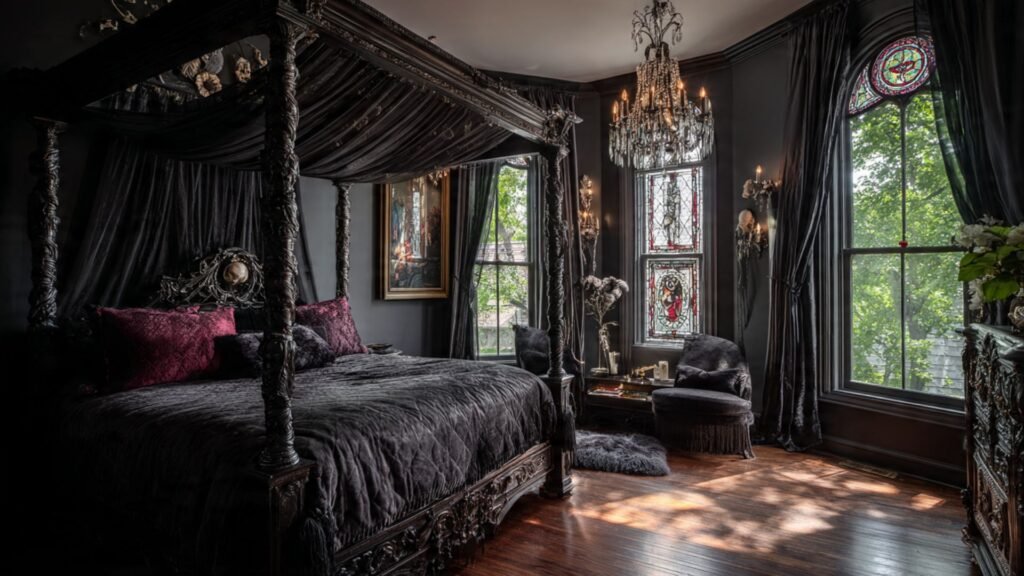
A gothic bedroom is one of the most misunderstood aesthetics in interior design frequently dismissed as theatrical or extreme, yet capable of producing some of the most beautifully atmospheric, deeply personal, and genuinely sophisticated sleeping spaces imaginable.
Gothic bedroom design draws from a rich historical tradition spanning medieval architecture, Victorian romanticism, and the dark romanticism movement of the 19th century, filtered through a modern design sensibility that values depth, texture, and emotional resonance
A gothic bedroom combines dark colors, rich textures, and dramatic decor to create a deeply atmospheric and personal sleeping space. It draws from medieval architecture, Victorian romanticism, and dark naturalist traditions. The design uses deep jewel tones, heavy drapery, carved furniture, and layered textiles. It transforms an ordinary bedroom into a space of beauty, depth, and emotional intensity. Every element serves one unified goal creating an immersive, intentional dark sanctuary.
Few interior styles create as much atmosphere, personality, and quiet drama as a gothic bedroom done right. A dark palette, candlelight, and richly layered textures turn a simple room into something genuinely unforgettable. With the right choices, this aesthetic delivers beauty, warmth, and a deeply personal sense of refuge that no other style can match.
Dark wall colors like charcoal, burgundy, and midnight navy form the foundation of this design. Velvet bedding, brocade cushions, and layered throws add texture and visual richness throughout. Four-poster beds and wrought iron frames create dramatic, architectural focal points. Candelabras, vintage mirrors, and curated shelf displays complete the gothic atmosphere. Scent, seasonal decor, and dark botanical plants bring the entire space to life with depth and intention.
Understanding the Gothic Bedroom Aesthetic:
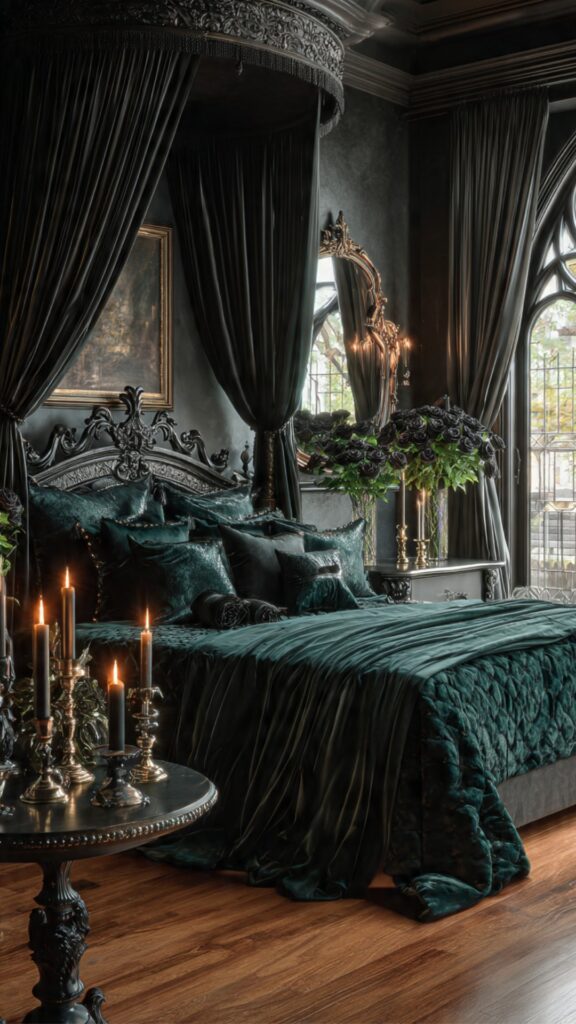
The gothic bedroom aesthetic is rooted in a specific design philosophy: beauty through darkness, richness through contrast, and intimacy through enclosure. Unlike minimalist design, which achieves its effect through removal, gothic bedroom design achieves its effect through deliberate accumulation of texture, of color depth, of symbolic objects, of layered materials that collectively create a space of extraordinary atmosphere.
Understanding this foundational philosophy is essential before making any individual decor decision, because every element in a gothic bedroom should serve the overall atmospheric goal rather than exist as a standalone choice.
Historically, gothic design draws from two primary sources: the Gothic architecture of medieval Europe characterized by pointed arches, ribbed vaults, dark stone, and stained glass and the Victorian gothic revival of the 19th century, which brought these architectural elements into domestic interiors through carved wood furniture, heavy drapery, elaborate wallpapers, and a fascination with mortality, nature, and the sublime.
Contemporary gothic bedroom design distills these influences into a livable, modern idiom that references the historical tradition without requiring literal reproduction of period furniture or architectural features.
The most common misconception about gothic bedroom design is that it requires a large, high-ceilinged room to work effectively. In reality, the gothic aesthetic’s emphasis on enclosure, intimacy, and rich surface texture means it often performs better in smaller, more contained spaces than in large, open rooms where the dark palette and heavy materials can feel lost.
A compact bedroom with low ceilings, dense textile layering, and carefully chosen lighting can achieve a more genuinely gothic atmosphere than a large room with high ceilings but insufficient material depth. This is a crucial insight for apartment dwellers and smaller-home owners who may have dismissed the aesthetic as impractical for their space.
The future of gothic bedroom design is moving toward what designers are calling “refined gothic” or “gothic luxe” a version of the aesthetic that retains the dark palette, rich materials, and symbolic sensibility of traditional gothic but pairs these with higher-quality materials, more restrained object curation, and a greater integration with contemporary furniture forms.
This evolution makes the gothic bedroom increasingly accessible to a broader audience, moving it further from its subculture associations and closer to the mainstream luxury interior design conversation.
Gothic Bedroom Color Palette:
Beyond Basic Black
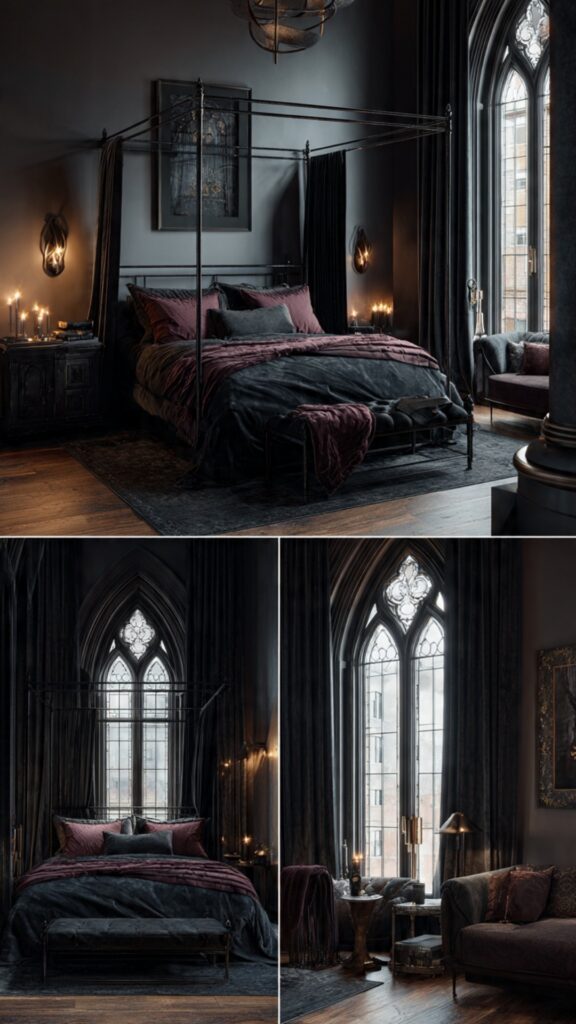
Color is the most foundational decision in gothic bedroom design, and it is also the most frequently oversimplified. The assumption that a gothic bedroom must be predominantly black is both historically inaccurate and practically limiting. While black certainly has a place in the gothic palette, the most sophisticated and livable gothic bedrooms use black as an accent or grounding element within a broader, richer palette of deep, saturated, complex colors.
The most successful gothic bedroom color combinations draw from a palette of jewel-toned darks: deep burgundy and black, midnight navy and antique gold, forest green and charcoal, deep plum and warm copper, and dusty mauve paired with near-black charcoal. These combinations share a quality of visual depth they are colors that appear to shift and change under different lighting conditions, looking warmer in candlelight, cooler in morning light, and richer in the evening.
This dynamic quality is one of the things that makes gothic bedrooms feel most atmospheric and alive. Wall color selection should account for the room’s natural light. A north-facing room with limited daylight can successfully carry a very dark wall color near-black charcoal, deep navy, or rich burgundy without feeling oppressive, because the room’s natural light level is already low.
A south-facing room with strong natural light requires more care: very dark colors in high-light rooms can create jarring contrast during the day that undermines the atmospheric quality you are seeking. In these situations, a deep but not extreme color forest green, dark plum, dusty slate achieves the gothic quality without the visual discomfort of extreme contrast.
Ceiling color in gothic bedrooms is a decision that most design guides overlook but that significantly impacts the room’s atmospheric quality. Painting the ceiling the same dark color as the walls creates the cocooning, enveloping effect that is central to the gothic bedroom experience the room becomes a complete immersive environment rather than a dark-walled room with a standard white ceiling that breaks the spell.
For homeowners who find a fully dark ceiling too extreme, painting just the ceiling slightly darker than the walls a deeper value of the same color family creates a subtle lowering effect that increases intimacy without the full commitment of a completely dark overhead surface.
Gothic Bedroom Furniture:
Carved Wood and Dramatic Silhouettes
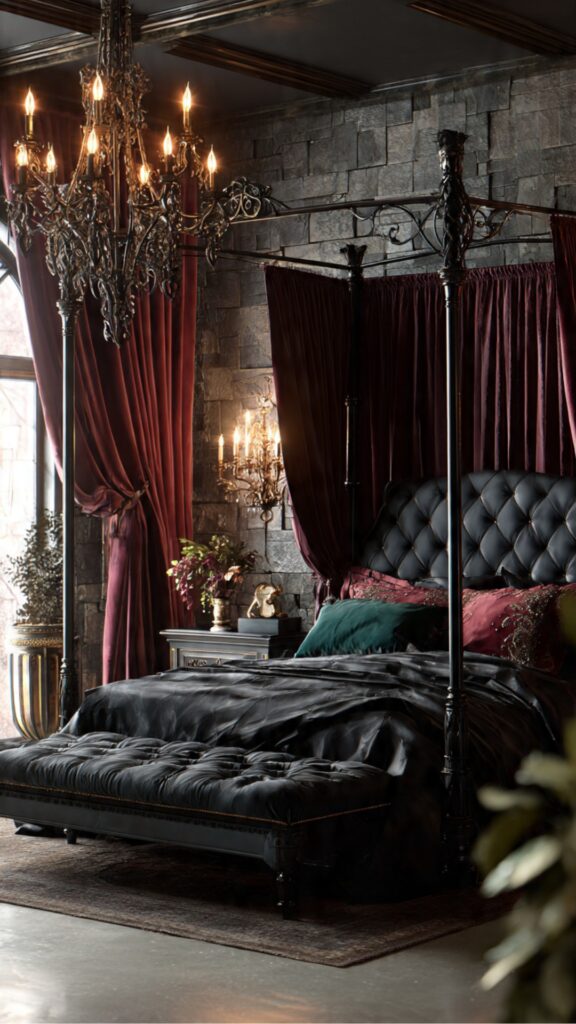
Furniture is where the gothic bedroom makes its most direct historical reference and where the investment in quality pays the most visible dividends. Gothic bedroom furniture is characterized by specific formal qualities: dramatic vertical proportions, carved or detailed surfaces, dark finishes (stained almost to black, deep walnut, or ebonized wood), and architectural references to gothic stonework in the form of pointed arch motifs, trefoil carvings, and elaborate crown moldings.
The bed frame is the most important furniture piece in any bedroom, and in a gothic bedroom it is especially central. Four-poster beds with heavily turned or carved posts create the tent-like enclosure that is fundamental to the gothic bedroom experience. The canopy, whether draped with heavy velvet or left as bare architectural posts, draws the eye upward and creates a room-within-a-room effect that amplifies the intimacy and mystery of the sleeping space.
For those unable to source a genuine antique four-poster, contemporary manufacturers produce high-quality reproductions in dark-stained solid wood, wrought iron, or a combination of both that achieve the same dramatic effect.
Wrought iron bed frames deserve special mention as a more affordable and architecturally refined gothic option. Iron beds with ornate headboards incorporating scrollwork, pointed arch forms, or floral patterns capture the gothic aesthetic with a slightly lighter, more delicate quality than heavy carved wood.
They pair particularly well with dramatic textiles and canopy treatments, where the fine linear silhouette of the iron frame provides a strong structural element without overwhelming the softer layers of drapery and bedding that surround it. Matte black wrought iron is almost always preferable to glossy chrome or bright silver in a gothic context.
Dressers, wardrobes, and nightstands in a gothic bedroom should maintain the dark, richly detailed vocabulary of the bed frame without necessarily matching it exactly. A mix of different dark wood stains ebonized oak, dark walnut, mahogany reads as collected and personal rather than matched and commercial.
Drawer pulls and hardware in aged brass, antique bronze, or black iron complete the furniture’s gothic character. Avoid modern brushed nickel or polished chrome hardware in gothic bedrooms these contemporary finishes create an incongruous technology-era note that immediately breaks the atmospheric spell.
Have a Look : LED Lights Bedroom Ideas That Add a Mysterious Glow to Your Gothic Style.
Gothic Bedroom Bedding and Textile Layering:
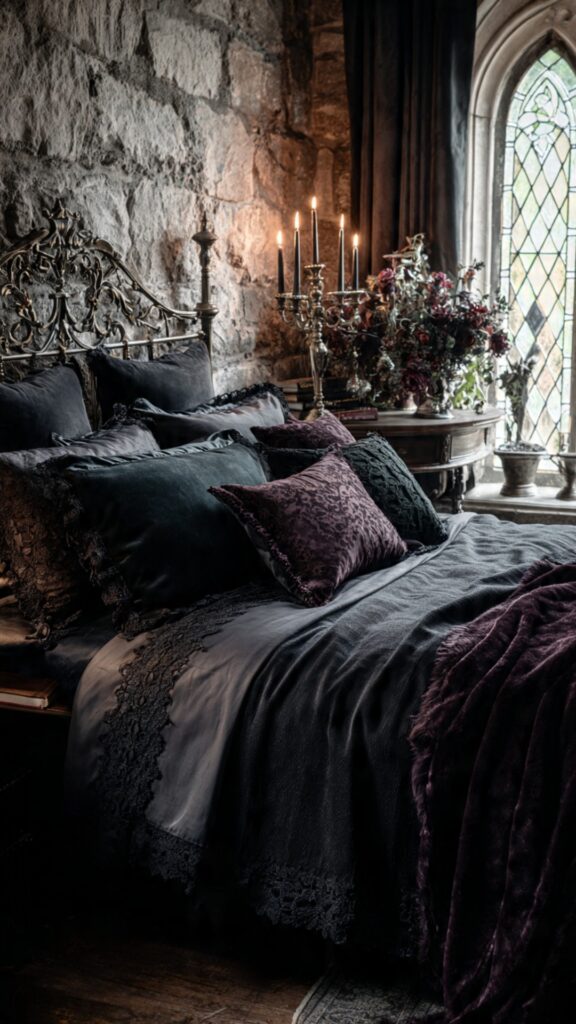
Textiles are the most immediately impactful and most reversible element in gothic bedroom design which makes them the ideal starting point for those new to the aesthetic. The right bedding, throw pillows, and layered blankets can transform even an ordinary bedroom into something approaching a gothic atmosphere without changing a single piece of furniture or painting a single wall.
This is the gothic bedroom’s most accessible entry point, and it rewards thoughtful material selection and generous layering. The gothic bedroom textile palette centers on velvet, silk, brocade, damask, and faux fur materials that are either deeply tactile, visually rich, or both. Velvet, in particular, is the quintessential gothic fabric: its pile depth creates a color that appears to shift from light to dark as the viewing angle changes, creating a living, dynamic surface that no other fabric can replicate.
Deep burgundy velvet, midnight blue velvet, and forest green velvet are among the most effective bedding colors for a gothic bedroom each provides visual depth, warmth, and a sense of luxury that is central to the aesthetic.
Layering is more important than any individual textile choice. A gothic bed should appear abundant, decadent, and carefully composed not sparse or hotel-like. Start with a high-quality dark duvet cover as the base layer. Add a velvet or faux fur throw across the foot of the bed, folded or casually draped rather than precisely tucked.
Layer multiple pillow sizes European square pillows at the back, standard sleeping pillows in the middle, and smaller decorative cushions in contrasting textures (embroidered, tasseled, or brocade-covered) at the front. The visual goal is a bed that looks deeply inviting and deliberately curated rather than hastily assembled.
Pattern selection for gothic bedroom textiles should draw from a specific vocabulary: damask patterns (the interlocked floral and geometric repeat that has been woven into luxury textiles since the Byzantine era), botanical and botanical-gothic patterns (skulls nestled in flowers, ravens among branches, moths and butterflies in dark colorways), and geometric patterns with a historical reference (Moorish tile geometrics, medieval floor tile patterns, stained glass geometrics). These patterns connect the textile choice to the gothic historical tradition while remaining beautiful and livable as bedroom decor.
Gothic Bedroom Lighting:
Creating Atmospheric Darkness
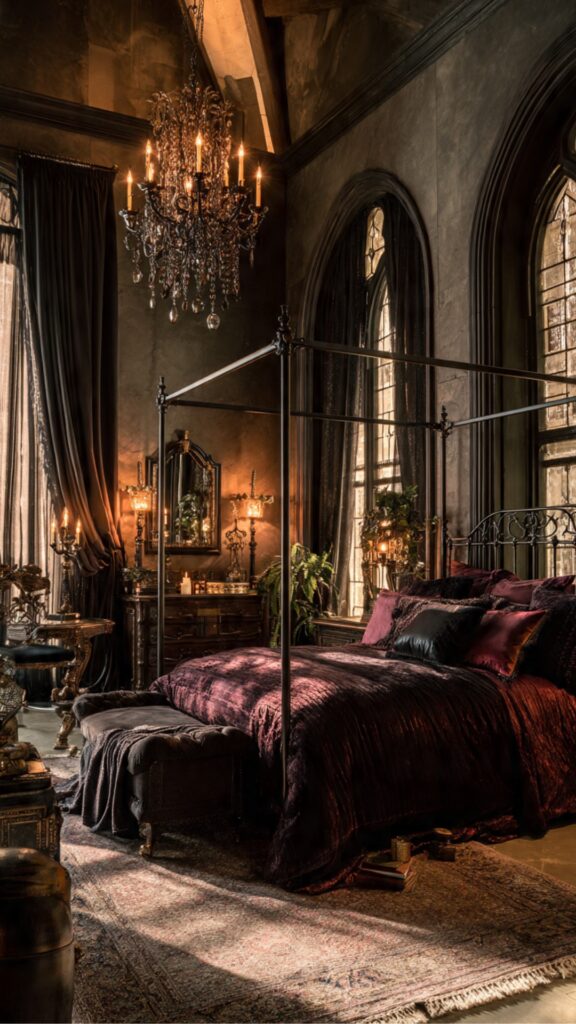
Lighting in a gothic bedroom serves a function that is almost the opposite of conventional bedroom lighting design. Where most bedrooms aim for bright, even, task-friendly illumination, the gothic bedroom seeks to create shadow, drama, and atmospheric pools of warm light that make the room feel intimate, mysterious, and alive. This requires a fundamentally different approach to fixture selection, placement, and control.
Candles real or simulated are the gothic bedroom’s most evocative lighting tool. Real pillar candles in varying heights grouped on a mantelpiece, windowsill, or decorative tray create the warmest, most flickering, most genuinely atmospheric light available.
For safety and practicality, high-quality flameless LED candles have improved dramatically in their simulation of real candlelight the best current-generation products flicker with irregular, realistic movement and emit a warm amber glow that is genuinely convincing at close range. Grouping multiple flameless candles at different heights creates the same massed-light effect as real candles without the fire risk.
Chandeliers are the most architecturally significant lighting choice for a gothic bedroom. A wrought iron chandelier with candelabra-style arms and amber or smoke-tinted glass globes creates an instant centerpiece of extraordinary gothic character. Antler-style chandeliers whether in real shed antler or high-quality resin reproduction add an organic, slightly primitive quality that references both gothic and dark naturalist aesthetics.
Beaded chandeliers in black or smoked crystal catch and scatter light in a way that creates living movement across walls and ceilings, particularly effective in smaller rooms where the reflected light adds apparent depth to the space. Smart bulb technology has added a powerful new tool to gothic bedroom lighting design.
Smart bulbs controlled via smartphone or voice command can shift color temperature from warm amber to deep red to cool blue, allowing the room’s lighting mood to be adjusted for different times of day and different activities.
Waking up to cool, bright white light that gradually shifts to warm candlelight amber as the evening progresses is a practical application of smart lighting that serves both the functional and atmospheric goals of gothic bedroom design simultaneously. Specifying smart bulb-compatible fixtures from the outset future-proofs the lighting design against the rapidly improving capabilities of home automation.
Gothic Bedroom Canopy and Bed Drapery:
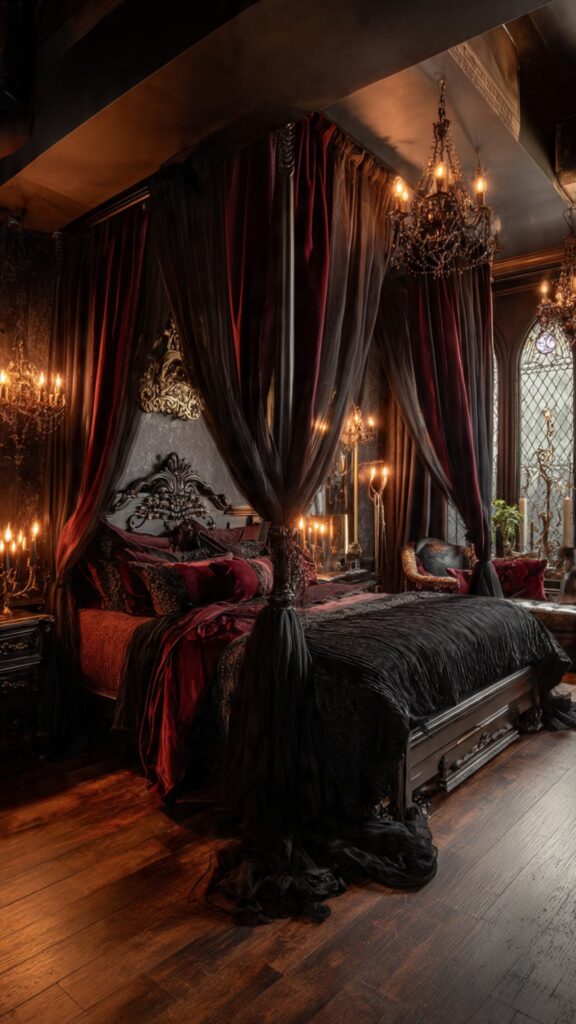
A canopy over the bed is one of the most transformative single additions to a gothic bedroom it creates an architectural enclosure within the room that intensifies the sense of intimacy and sanctuary that is central to the gothic bedroom experience. Whether achieved with a genuine four-poster frame, a ceiling-mounted canopy ring, a wall-mounted half-canopy, or draped fabric panels suspended from a ceiling hook, the canopy immediately elevates a gothic bedroom from decorated to designed.
The most accessible canopy approach for most bedrooms is the ceiling-mounted fabric drape: two or four panels of heavy fabric velvet, voile, or sheer embroidered organza suspended from ceiling hooks positioned above each corner of the bed or from a single central point above the headboard. This approach works in any room with a standard ceiling height, requires no permanent structural modification, and can be removed or changed seasonally.
The fabric chosen for a canopy contributes enormously to the atmosphere: deep velvet panels create a cocooning, weight enclosure; sheer black or dark wine voile creates a more mysterious, veiled effect that diffuses the light differently.
For homeowners with four-poster frames, the bed drapery treatment offers enormous creative latitude. Full enclosure panels on all four sides that can be drawn closed creates the most intensely gothic and intimate sleeping environment, referencing the medieval bed hangings that were both functional (warmth and privacy) and decorative.
However, full enclosure requires a room with sufficient air circulation to be comfortable, and in warm climates may be impractical without air conditioning. A half-treatment panels at the head of the bed only, framing the headboard and falling to the mattress level creates the visual effect of enclosure while maintaining air circulation and is significantly easier to manage in daily bedroom life.
Canopy fabric color and material should connect to the broader textile palette of the bedroom rather than being selected in isolation. If the bedding is deep burgundy velvet, a canopy in the same or a complementary velvet perhaps a slightly deeper wine or a contrasting dark plum creates a cohesive wrapped effect.
If the bedding is dark and heavy, a canopy in a slightly lighter or more diaphanous fabric black voile over dark bedding, for example creates a contrast that adds visual complexity without disrupting the color palette. The goal is always a composed, intentional effect rather than a collection of individually appealing but unrelated choices.
Gothic Bedroom Wallpaper and Wall Treatments:
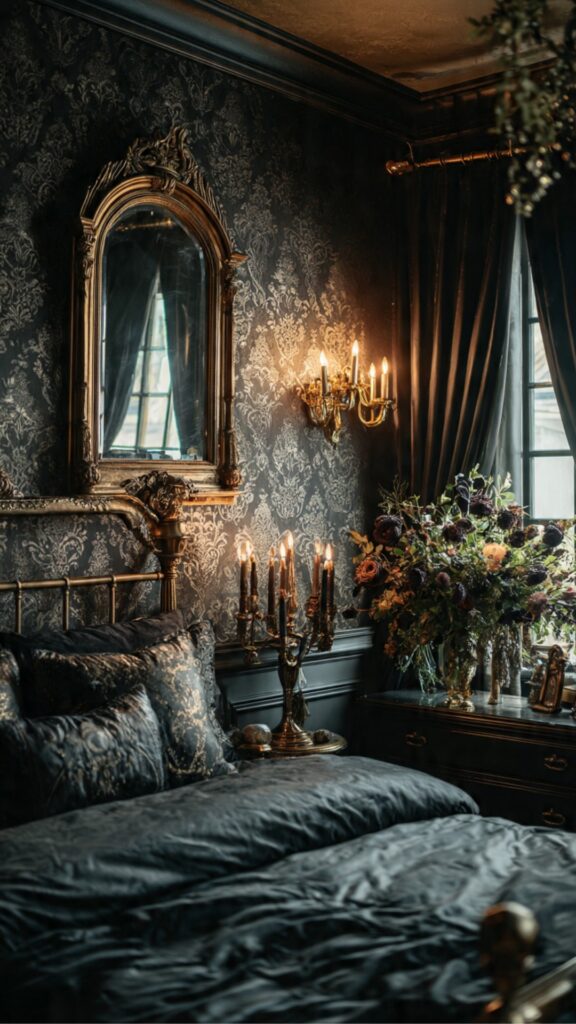
Gothic bedroom wallpaper has undergone an extraordinary renaissance in the last decade, driven by digital printing technology that allows the creation of designs of extraordinary complexity, scale, and visual richness that previous printing methods could not achieve.
Contemporary gothic wallpaper designs range from large-scale damask patterns in charcoal and gold to dramatic botanical gothic illustrations ravens, black roses, night-blooming flowers, moths, and bare winter trees to architectural gothic motifs that simulate the stone tracery and pointed arch patterns of medieval cathedrals.
Mural wallpapers are particularly effective in gothic bedrooms because they allow a single wall to become a complete visual statement of extraordinary power. A full-wall mural of a moonlit forest, a gothic cathedral interior, a dark floral illustration, or an abstract expressionist dark landscape creates an immersive environment that cannot be achieved with any paint technique.
For maximum impact, position the mural on the wall behind the bed the headboard wall so that the first and last visual impression of the room is the mural’s dramatic imagery. The bed frame and canopy, positioned in front of the mural, create a layered foreground-to-background composition of genuine beauty.
Limewash and plaster effect wall treatments are among the most underused options in gothic bedroom design, yet they produce some of the most genuinely beautiful results. Limewash paint applied with a brush in a technique that leaves visible variation, depth, and luminosity in the surface creates a wall texture that appears genuinely ancient and layered, referencing the stone walls of gothic architecture without the weight or expense of actual stone.
Applied in deep charcoal, rich burgundy, or forest green, limewashed walls create a surface of extraordinary depth and beauty that changes appearance throughout the day as natural light moves across its irregular surface. Wainscoting and wall paneling carry gothic design language into the room’s architectural fabric in a more permanent way.
Dark-painted tongue-and-groove paneling on the lower half of the walls, topped with a picture rail and a contrasting wallpaper above, creates the layered wall treatment that was standard in Victorian gothic revival interiors.
Flat-panel wainscoting in a dark painted finish particularly when the panels incorporate gothic arch profiles at their tops introduces architectural detail that elevates the entire room’s design quality and permanence. This treatment works especially well in older homes with existing architectural character, where the paneling complements rather than contrasts with the home’s original features.
Gothic Bedroom Flooring and Rugs:
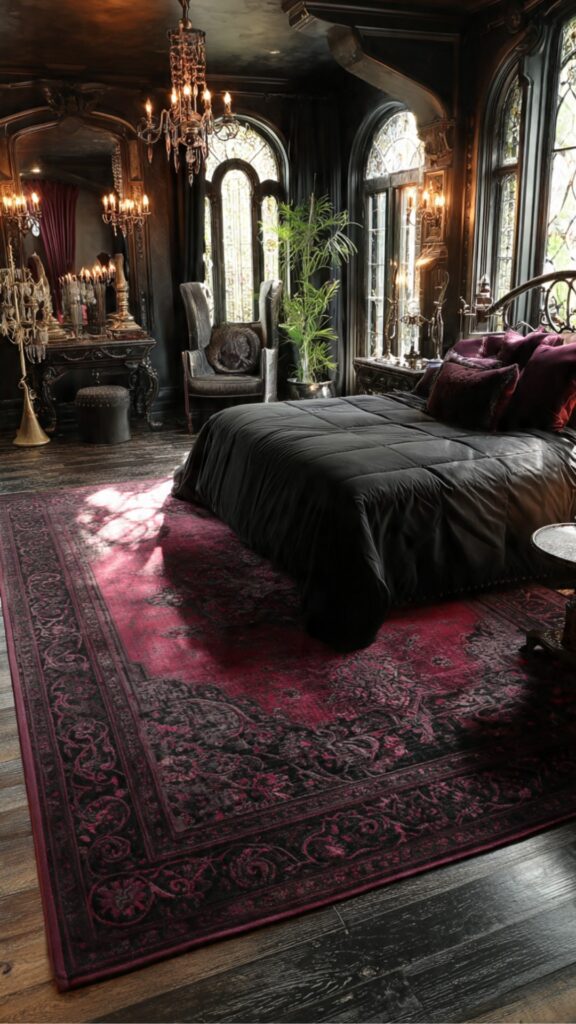
Flooring in a gothic bedroom is often overlooked in favor of walls, furniture, and textiles but it forms the base layer of the entire composition and significantly impacts the room’s atmosphere. The most appropriate gothic bedroom flooring choices are dark-stained hardwood, aged stone or stone-effect tiles, and dark-toned engineered wood — materials that ground the room visually and carry the dark palette down to the floor level.
Dark-stained hardwood flooring in ebony, dark walnut, or jacobean stain creates a rich, warm surface that complements the gothic bedroom’s textile and furniture palette beautifully. The wood’s grain remains visible through the dark stain, providing subtle texture and variation that a solid dark material like stone cannot offer.
Dark hardwood flooring also carries a quality of warmth both visual and physical that is important in a gothic bedroom, where the risk of the palette feeling cold and austere is always present and must be actively counterbalanced with warm materials and warm lighting. Area rugs are essential in gothic bedrooms, both for the warmth and comfort they provide underfoot and for the additional pattern, color, and texture they contribute to the room’s composition.
The most effective gothic bedroom rug choices include: large-scale Persian or Oriental rugs in deep red, navy, and gold colorways (their elaborate patterns and centuries of design tradition make them natural gothic companions); thick sheepskin or faux fur rugs in ivory or charcoal positioned beside the bed for morning comfort; and contemporary rugs in dark geometric or abstract patterns that reference historical gothic motifs in a more modern vocabulary.
Layering two rugs a larger, patterned Oriental beneath a smaller, textural sheepskin creates a richness of surface that is genuinely luxurious. One flooring insight that most gothic bedroom guides miss entirely: the baseboard and floor trim treatment matters significantly. Standard white MDF baseboards against a dark gothic bedroom floor and wall create an incongruous bright line that disrupts the atmospheric continuity of the dark palette.
Painting baseboards, door frames, and window trim in the same dark color as the walls or in a complementary dark tone creates a seamless envelope that allows the floor, walls, and ceiling to read as a continuous dark surface, amplifying the cocooning, immersive quality that defines the gothic bedroom at its best.
Gothic Bedroom Windows and Drapery:
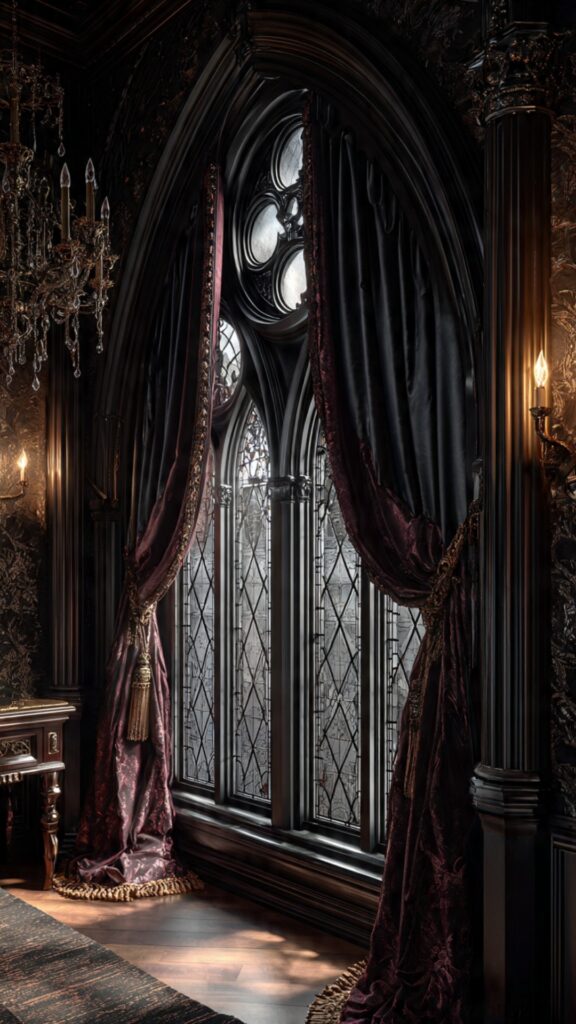
Windows are the gothic bedroom’s most architecturally significant design opportunity and its most practically demanding one. The gothic relationship with windows is complex: on one hand, stained glass windows flooding dark stone interiors with jewel-toned filtered light are among gothic architecture’s most celebrated and beautiful elements.
On the other hand, the gothic bedroom’s atmospheric quality depends on controlling and reducing natural light to create the dim, intimate environment that is central to the aesthetic. Drapery in a gothic bedroom should be generous, dramatic, and deliberately oversized. Floor-to-ceiling panels that pool slightly on the floor create a sense of architectural scale even in rooms with standard ceiling heights.
Width should be generous enough that when the curtains are drawn, the fabric falls in deep, full folds rather than lying flat it is the abundance of fabric that creates the richness and drama of gothic drapery rather than any particular pattern or color. A minimum of 2.5 times the window width in total fabric is the standard for full, theatrical drapery; 3 times is even better for a true gothic effect.
Hardware for gothic bedroom drapery should be as deliberately chosen as the fabric itself. Heavy, dark curtain rods in wrought iron with ornate finials spear points, orbs, fleur-de-lis extend the gothic vocabulary to the window treatment’s structural elements.
Rings in matching wrought iron add movement and a decorative quality when the curtains are drawn back. Holdbacks in aged brass or antique bronze, shaped as gothic shields, trefoil forms, or serpentine curves, keep the drawn curtains in elegant, controlled positions and function as small decorative objects in their own right when visible.
The window glass itself offers a gothic design opportunity that is almost universally missed in bedroom design guides. Adhesive stained glass film available in elaborate gothic cathedral designs, geometric leading patterns, and abstract color compositions can transform ordinary clear window glass into something approaching the jewel-toned cathedral glass of medieval gothic architecture.
Applied to the lower portion of the window (the portion visible from inside the room), this film filters incoming light in colored patterns that shift across the room’s surfaces throughout the day, creating a dynamic, living light effect that is uniquely and unmistakably gothic in character.
Gothic Bedroom with Victorian Antique Accents:
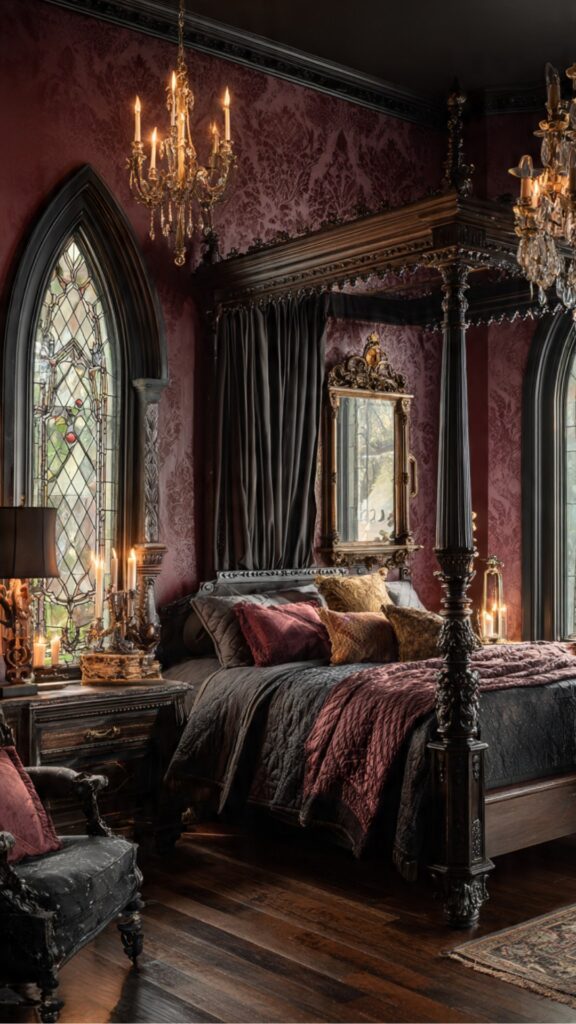
Victorian antique furniture and decorative objects are the most direct and historically authentic route to gothic bedroom design, because the Victorian gothic revival which peaked between 1840 and 1900 was the period when gothic design principles were most systematically applied to domestic interiors.
Victorian antiques carry this design vocabulary in their bones: in the carved wood details, the elaborate textiles, the dark lacquered finishes, and the fascination with nature, mortality, and the decorative arts that characterizes the period. Sourcing Victorian antiques for a gothic bedroom need not be prohibitively expensive. Online auction platforms, estate sales, antique markets, and charity shops in older neighborhoods consistently yield Victorian furniture at prices far below what equivalent contemporary reproductions cost.
Key pieces to prioritize: a Victorian dressing table with an ornate mirror (the combination of dark wood and reflective glass adds both function and drama); a marble-topped washstand repurposed as a nightstand (the cool marble surface against the dark wood frame creates a beautiful material contrast); a Victorian chaise longue in dark tufted velvet (one of the most immediately evocative gothic bedroom additions available at any price point).
Decorative objects from the Victorian era contribute an authentic layer of history and symbolism to the gothic bedroom. Victorian botanical prints in dark frames, taxidermy specimens (ethically sourced antique pieces rather than contemporary), mourning jewelry or hair art displayed under glass domes, collections of Victorian apothecary bottles in amber and cobalt, and stereoscope viewers or optical curiosities on display each of these objects carries both historical authenticity and the gothic sensibility’s appreciation for the beautiful and the strange simultaneously.
One valuable Victorian decorating principle that contemporary interior design has largely abandoned but gothic bedroom design actively embraces: the deliberate grouping of objects in meaningful relationships. Victorians arranged their decorative objects in thematic clusters scientific instruments together, natural specimens together, portraits in a specific geometric arrangement rather than distributing them evenly across surfaces.
Adopting this principle in a gothic bedroom creates a space that feels curated and intellectually coherent rather than randomly decorated, elevating the overall design quality significantly.
Find Out More : Bathroom Wall Decor Ideas That Perfectly Match Your Dark Gothic Bedroom Theme.
Dark Floral and Botanical Gothic Bedroom Decor:
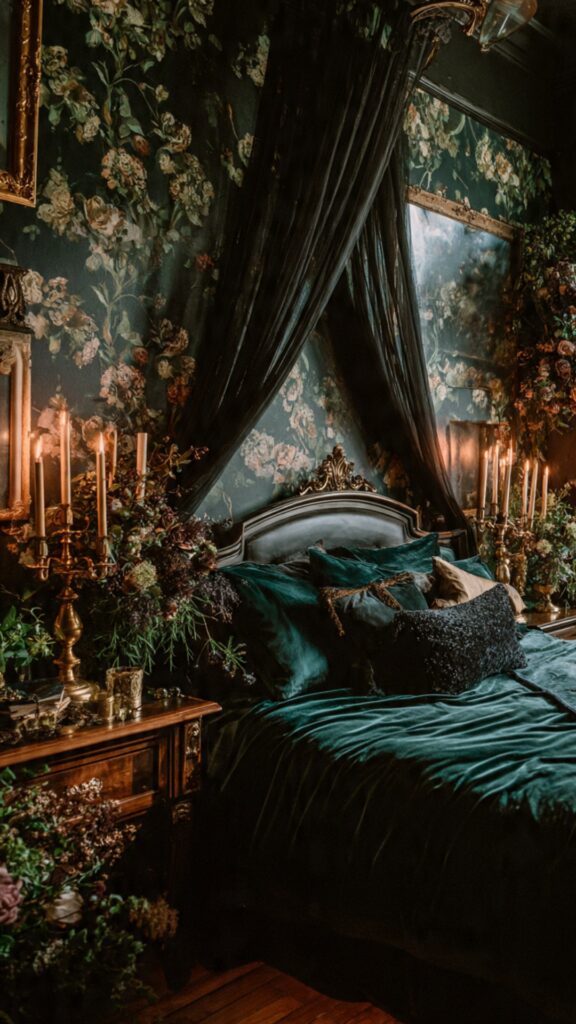
The dark botanical aesthetic sometimes called “gothic garden” or “dark floral” in design circles represents one of the most beautiful and livable expressions of the gothic bedroom aesthetic. It draws from the Victorian fascination with botanical illustration, the gothic love of nature in its darker, more complex expressions, and the contemporary interior design movement toward organic, nature-connected spaces. Dark botanicals bridge the gothic and the natural in a way that feels simultaneously historical and very current.
Dark floral wallpaper is the most immediate and impactful way to introduce gothic botanicals into a bedroom. Designs featuring black roses, dark dahlias, midnight peonies, and other florals in deep, near-dark colorways create walls of extraordinary beauty and visual complexity.
The best designs in this category from brands like Anthropologie, Cole & Son, Graham & Brown, and independent mural artists on platforms like Society6 and Spoonflower treat the dark floral as a genuinely artistic endeavor rather than a simple pattern repeat, creating large-scale compositions that reward close examination. The transition from abstract pattern at distance to detailed botanical illustration up close is characteristic of the best dark floral wallpapers.
Pressed botanical specimens in dark frames bring genuine natural history into the gothic bedroom with a Victorian authenticity that manufactured prints cannot fully replicate. Ferns, large tropical leaves, moth and butterfly specimens, and seed pods all pressed and mounted in deep matte frames create a wall arrangement that references the Victorian naturalist tradition directly.
Arranging these frames in a tight, symmetrical salon-style grouping on a dark wall creates a museum-like vignette of genuine sophistication. For those concerned about using real specimens, high-quality botanical prints in the Victorian illustration style provide a visually equivalent result.
Fresh and dried flowers both contribute to the gothic botanical bedroom, but in different ways. Fresh black roses, dark burgundy dahlias, deep purple anemones, and dark-tipped tulips in simple dark glass or aged brass vases bring life and fragrance to the gothic bedroom’s surface arrangements.
Dried flowers particularly dried roses, dried thistles, dried cotton, and preserved eucalyptus contribute a more permanent, melancholic beauty that suits the gothic aesthetic’s appreciation for things preserved at the moment of their peak beauty. Dried floral arrangements are particularly effective in gothic bedrooms because they last indefinitely and because their slightly faded, preserved quality resonates with the aesthetic’s romantic relationship with time and transience.
Gothic Bedroom Mirrors and Reflective Surfaces:
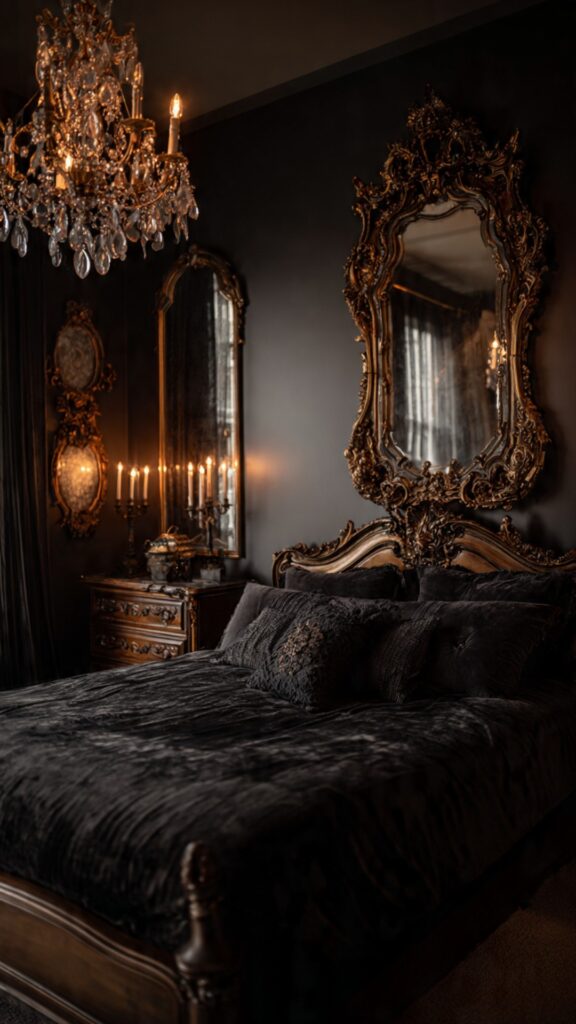
Mirrors occupy a uniquely significant place in gothic bedroom design reflecting and multiplying the room’s candlelight, amplifying the sense of depth and space in a dark room, and carrying a centuries-long symbolic association with mystery, revelation, and the boundary between worlds that makes them perfectly suited to the gothic sensibility. A well-chosen, well-placed mirror can do more for a gothic bedroom’s atmosphere than almost any other single decorative addition.
The most gothic-appropriate mirror styles share specific formal qualities: ornate gilded or dark wood frames with carved or cast detail; unusually large scale relative to conventional bedroom mirrors; aged or antiqued glass that has slight imperfections, cloudiness, or a smoky patina that reduces reflective clarity and creates a sense of depth and mystery rather than a sharp, modern reflection; and architectural references in the frame shape arched tops, gothic tracery details, asymmetrical baroque curves.
These qualities distinguish a genuinely gothic mirror from a simply decorative one. Vintage and antique mirrors found at estate sales, antique markets, or online auctions are almost always preferable to contemporary reproduction mirrors in gothic bedroom design, because authentic age creates surface qualities in the glass foxing, silvering variations, slight waviness that cannot be fully replicated in new products.
An aged mercury glass mirror with a mellow, slightly imperfect reflection creates a genuinely mysterious visual experience that a perfect modern mirror simply cannot produce. The investment in finding and acquiring genuine antique mirrors is consistently repaid in the authenticity and character they bring to the space. Mirrored surfaces beyond the conventional wall mirror also contribute to the gothic bedroom’s atmospheric quality.
A vintage mirrored vanity tray on the dressing table, a mirrored wardrobe door that reflects the candlelit room in amber tones, a small convex mirror (the type associated with Flemish interior paintings) mounted in a corner where it reflects a distorted, fish-eye view of the room each of these applications multiplies light, adds depth, and introduces the reflective surface’s gothic symbolic resonance into a different area of the room. Variety of mirror scale and type within a single room is always more interesting than a collection of identical mirrors.
Gothic Bedroom Shelving and Display Areas:
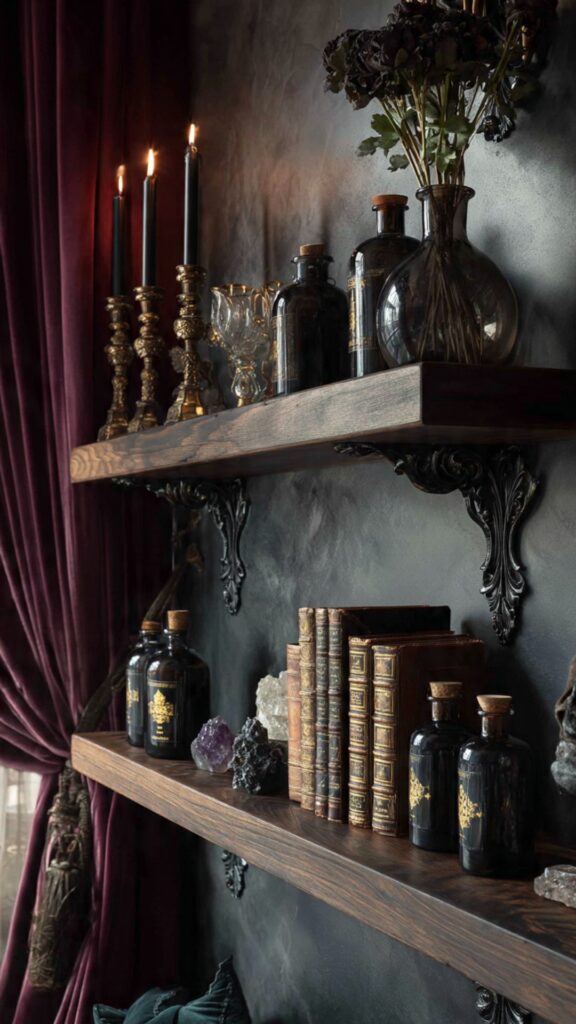
Gothic bedroom shelving transforms functional storage into a curated cabinet of curiosities a term borrowed directly from the Renaissance and Baroque collecting tradition that the Victorians revived with particular enthusiasm.
The gothic bedroom’s display shelves should not simply hold books and objects; they should tell a story, create a mood, and reward the visitor’s close attention with the discovery of unexpected beauty, strange juxtapositions, and carefully chosen objects that collectively define the room’s personality and intellectual character.
Wall-mounted shelving in a gothic bedroom should be executed in dark-stained wood, forged iron, or a combination of both. Industrial pipe shelving brackets in matte black carry a gothic-adjacent quality of raw metalwork that suits the aesthetic while providing an accessible and contemporary installation method.
More historically faithful options include bracket shelves with carved gothic arch supports, or floating shelves in dark stained solid wood with no visible bracket the simplicity of the floating shelf allowing the objects displayed on it to be the visual focus rather than the shelf construction itself. The objects chosen for gothic bedroom shelves should reflect the aesthetic’s core sensibility: an appreciation for beauty in unusual, often marginalized, or overlooked forms.
Antique leather-bound books with gilded spines, collections of dark crystals and minerals (obsidian, onyx, labradorite, and raw amethyst), small sculptural skulls in resin or porcelain, vintage astronomical instruments, apothecary bottles in cobalt and amber, small framed Victorian portraits, dried botanical specimens, and carefully chosen ceramics in dark glazes each of these object categories contributes a specific note to the overall gothic shelf composition.
Lighting the display shelves dramatically increases their visual impact. Small directional LED spotlights positioned above the shelves and aimed down at the objects create gallery-like illumination that makes even modest objects look significant and beautifully presented. LED strip lighting along the underside of upper shelves casts a warm glow onto the objects below, creating the glowing shelf effect that reads as atmospheric and intentional.
In gothic bedrooms where ambient lighting is deliberately low, well-lit shelves of beautiful objects become some of the most visually compelling elements in the entire room, drawing the eye with their warmth and detail.
Gothic Bedroom for Small Spaces:
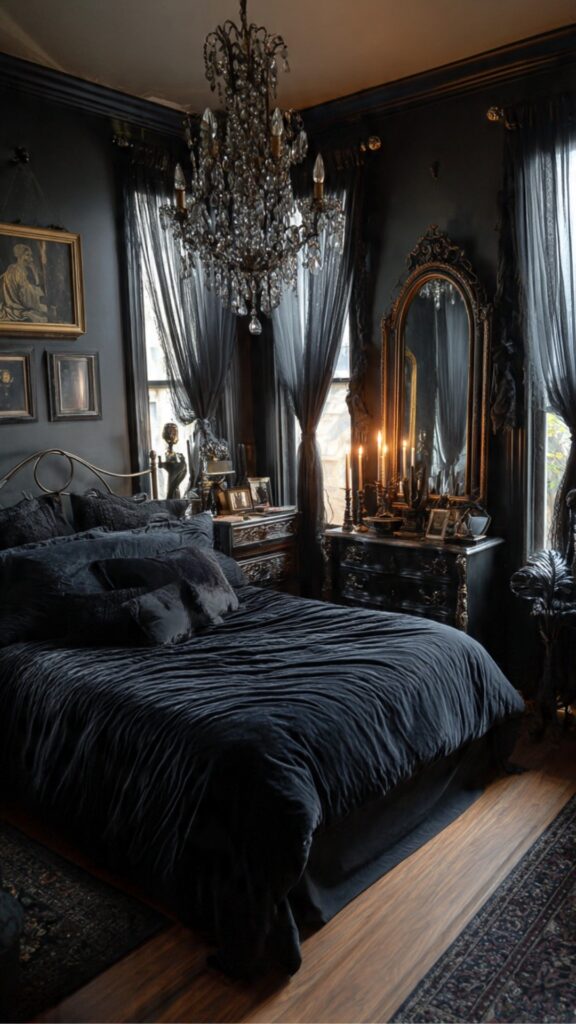
The gothic bedroom aesthetic is, counterintuitively, particularly well-suited to small bedrooms. The gothic emphasis on enclosure, intimacy, and cocooning turns what might be considered a spatial limitation into a genuine design asset a small room is easier to envelop in dark, rich materials and easier to fill with atmospheric candlelight than a large room where the same efforts might be diluted across too much space.
Some of the most beautiful gothic bedrooms ever photographed have been in small urban apartments and compact cottages. In a small gothic bedroom, the key principle is selective investment: choosing three or four design elements that deliver maximum atmospheric impact and executing them at the highest possible quality, rather than attempting to implement every aspect of the gothic aesthetic simultaneously.
For most small rooms, those high-impact elements are: the wall color or wallpaper treatment, the bed frame and drapery, the lighting strategy, and one statement decorative piece a dramatic mirror, a candelabra, or a significant piece of dark furniture. These four categories, done well, create a convincingly gothic space without overwhelming the room’s dimensions.
Vertical emphasis is particularly important in small gothic bedrooms. Tall headboards that approach the ceiling, floor-to-ceiling curtains that make the ceiling appear higher, tall narrow bookcases flanking the bed, and pendant lighting hung at a height that draws the eye upward all of these strategies use the room’s full height to counteract the visual compression that can occur when dark materials are used in a compact space.
The gothic aesthetic’s natural affinity for pointed vertical forms the arch, the spire, the tall window serves the small room particularly well in this regard. Multifunctional furniture with gothic character solves the storage challenge that small bedrooms inevitably present without sacrificing the aesthetic. An ornate blanket chest at the foot of the bed provides both storage and a visual anchor to the bed arrangement.
Gothic-style bed frames with storage drawers beneath the mattress keep the floor clear while maintaining the bed’s dramatic visual character. A tall narrow wardrobe with gothic arch panel detailing provides full-height clothes storage without the floor footprint of a wider fitted wardrobe. Each of these solutions serves both the practical and aesthetic demands of the small gothic bedroom simultaneously.
Gothic Bedroom Art and Wall Decor:
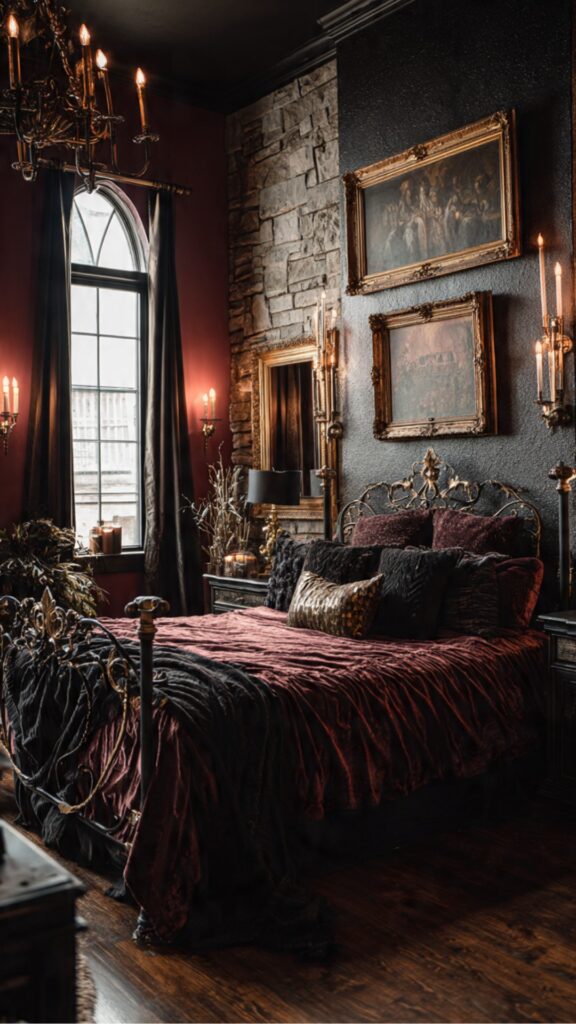
Art selection in a gothic bedroom should reflect the aesthetic’s core sensibilities: a love of beauty in darkness, an appreciation for the dramatic and the sublime, a fascination with nature in its stranger expressions, and a willingness to engage with subjects mortality, mythology, the occult, the romantic that conventional interior design typically avoids. The art on gothic bedroom walls should feel personally meaningful and intellectually considered, not simply dark for darkness’s sake.
The most celebrated gothic bedroom art categories include: Pre-Raphaelite paintings and prints (the Victorian Brotherhood of painters who obsessively depicted scenes of Arthurian legend, mythology, and romantic tragedy in a richly detailed, jewel-toned style that is perfectly congruent with gothic bedroom aesthetics); memento mori imagery in its many historical forms; symbolic still life paintings in the Dutch and Flemish tradition (where every element carries allegorical meaning).
And contemporary dark surrealist or fantastical illustration in the tradition of artists like Zdzisław Beksiński, John Atkinson Grimshaw, and Caspar David Friedrich, whose moonlit romantic landscapes are among the most gothic-in-spirit artworks ever produced.
Frame selection for gothic bedroom art should maintain the dark, ornate vocabulary of the broader design scheme. Wide, heavily carved frames in dark gilded or ebonized finishes make even modest prints look significant and museum-worthy.
Gallery walls in gothic bedrooms should use a consistent frame finish all dark wood, all aged gold, or all ornate black to create unity within what might otherwise be a visually diverse collection of images and sizes. The arrangement itself can follow a formal, symmetrical grid or a more organic salon-style arrangement both suit gothic aesthetics for different reasons.
Photography has emerged as a particularly effective medium for gothic bedroom art in the contemporary context. Fine art photographs of decaying architecture, moonlit forests, fog-covered landscapes, dramatic storm clouds, ancient ruins, and dark portraiture all carry the gothic sensibility in a contemporary idiom that feels fresh rather than nostalgic.
Many independent photographers sell high-quality prints through platforms like Etsy, Society6, and their own websites making it possible to source deeply personal, unusual, and genuinely artistic gothic bedroom photography at accessible price points that mass-market art retail cannot match.
Gothic Bedroom Scent and Atmosphere:
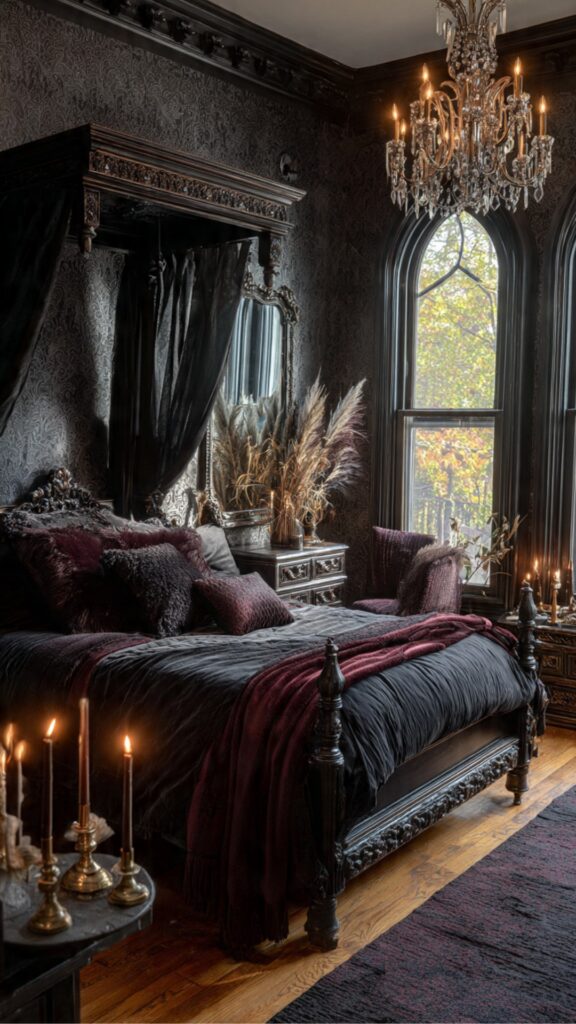
Scent is the most emotionally direct sensory experience in any interior space and in a gothic bedroom, where atmospheric immersion is the primary design goal, fragrance deserves the same level of intentional curation as color, material, and lighting. The right scent can complete the gothic bedroom experience in a way that no visual element can replicate, triggering memory, emotion, and physical response simultaneously.
The gothic bedroom scent palette draws from a specific aromatic vocabulary: dark woods (oud, sandalwood, vetiver, patchouli), deep florals (black rose, dark iris, aged violet, tuberose), spices (clove, cardamom, cinnamon, black pepper), resins (frankincense, myrrh, labdanum, benzoin), and smoky or incense-adjacent notes (tobacco, burning wood, charred wood, incense).
These fragrance families share a quality of depth, warmth, and slight mystery that mirrors the visual qualities of the gothic aesthetic itself. Avoid bright, fresh, or aquatic scents in a gothic bedroom they create an incongruous sensory note that disrupts the atmospheric continuity.
Delivery method for gothic bedroom fragrance matters almost as much as the fragrance itself. Reed diffusers provide continuous, low-level background scent that maintains a constant aromatic presence without requiring attention. Incense burned from cone, stick, or resin form on a dedicated burner creates a more intense, ritual quality of scent that is particularly appropriate in the gothic bedroom context, where the smoke itself adds to the visual atmosphere.
Wax candles in dark, heavily scented varieties combine the visual warmth of candlelight with fragrance, doubling their atmospheric contribution. High-quality fragrance oils burned in an oil diffuser provide the most controllable and consistent scent experience.
A future-focused insight for gothic bedroom scent design: the luxury home fragrance market is currently investing heavily in “dark” and “gothic” fragrance categories, with specialist brands like Black Phoenix Alchemy Lab, Lush’s Gothic range, and luxury perfumers including dark incense and resin-heavy compositions in their home fragrance collections.
As the gothic aesthetic continues its mainstream evolution, these fragrance options will become more widely available and more refined. Currently, the most sophisticated gothic bedroom fragrances come from niche perfume houses and independent artisan candle makers rather than mass-market home fragrance brands.
Get Inspired : Bedroom Bench Ideas That Add a Dramatic Touch to Your Gothic Bedroom Look.
Gothic Bedroom Plants and Dark Botanicals:
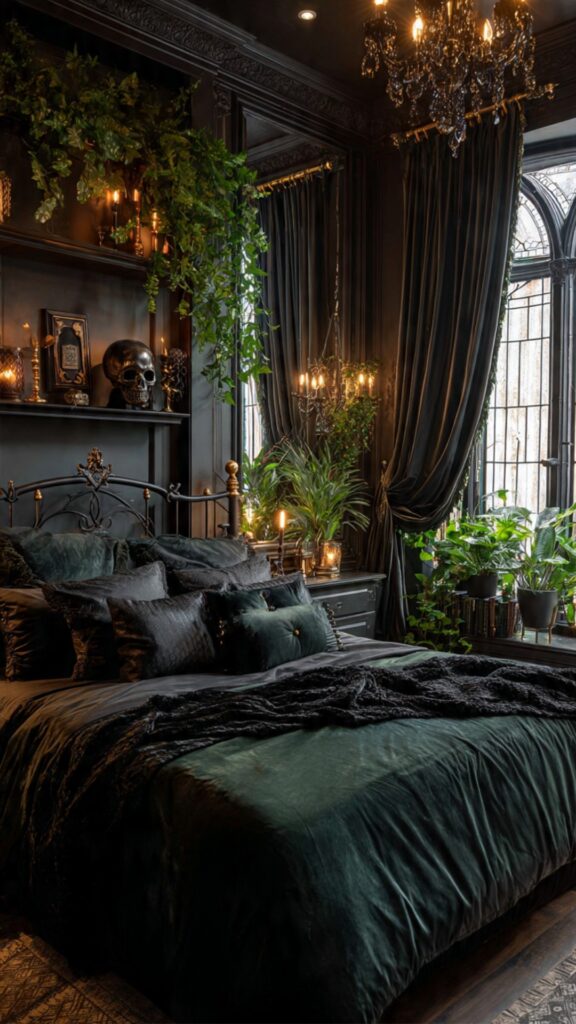
Plants are an unexpected but genuinely powerful element in gothic bedroom design, connecting the aesthetic’s love of dark nature to a living, breathing presence that no manufactured object can replicate. The gothic tradition’s deep engagement with nature particularly in its more dramatic, shadowed, and mysterious expressions makes plant life a natural (in every sense) component of a fully realized gothic bedroom.
Plant species selection for gothic bedrooms should prioritize varieties with dramatic, architectural, or unusual forms: the snake plant (Sansevieria) with its tall, sharply pointed leaves; the ZZ plant with its deep green, almost lacquered surface; the black bat flower (Tacca chantrieri), one of the most genuinely gothic-looking plants available; the Chinese money plant (Pilea peperomioides) for its unusual circular leaves.
And the Monstera deliciosa for its dramatically split leaves that create bold shadow patterns when backlit; and black-leafed varieties of plants like the Black Velvet Alocasia or the Black Burgundy Rubber Plant.
Dark-colored or near-black flowering plants are relatively rare in the plant world, which makes them particularly prized in gothic botanical design. The Hollyhock ‘Nigra’ with its near-black flowers, the Black Petunia ‘Black Velvet’, black violas, and the Chocolate Cosmos (Cosmos atrosanguineus).
Which produces deep, near-black flowers with a faint chocolate scent, are all flowering varieties that contribute dark botanical color to a gothic bedroom setting. For indoor use, these varieties typically require sunny window positions which creates a beautiful contrast of light and dark when the sun illuminates the dark flowers from behind.
Planters for gothic bedroom plants should reflect the room’s material vocabulary. Dark glazed ceramic pots in near-black, deep navy, or forest green maintain the color palette while providing the necessary drainage and material quality. Concrete or cement planters carry an industrial gothic quality that suits darker plant specimens particularly well.
Aged terracotta naturally weathered or artificially aged with yogurt or buttermilk has a beautiful organic quality that connects to the botanical and historical dimensions of gothic design. Avoid bright, primary-colored planters or overly contemporary minimalist white pots these create visual dissonance in a gothic bedroom where every material choice should serve the overarching atmospheric goal.
Modern Gothic Bedroom Design:
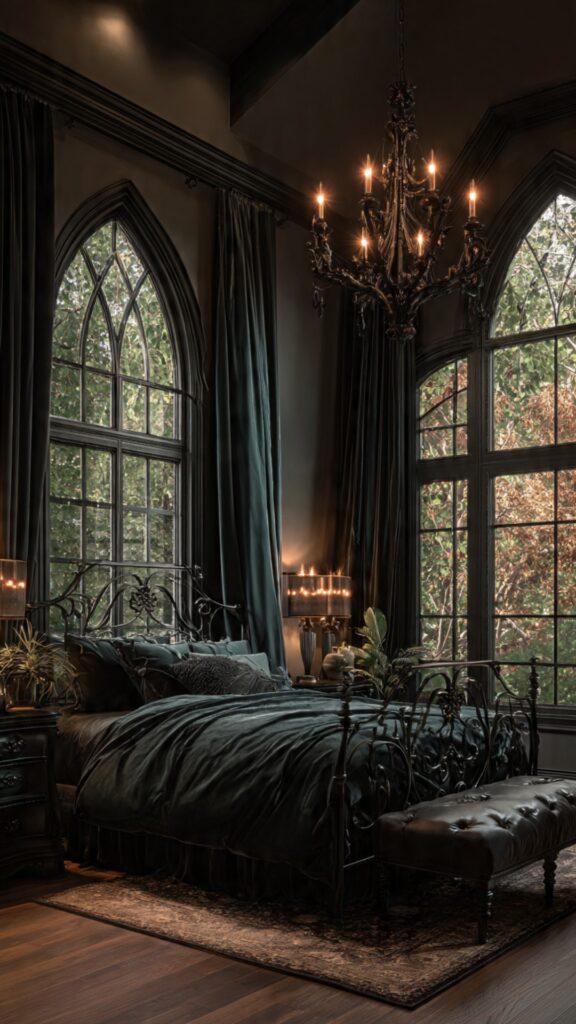
Modern gothic bedroom design sometimes called “contemporary gothic” or “gothic luxe” strips away the maximal accumulation of Victorian gothic and distills the aesthetic to its essential qualities: depth of color, richness of material, atmospheric lighting, and careful object curation. The result is a gothic bedroom that can appeal to a significantly broader audience than traditional gothic design, including those who appreciate the atmospheric quality but find heavily ornate Victorian furniture or theatrical maximalism too extreme for daily living.
The modern gothic bedroom palette shifts from the near-black and deep jewel tones of traditional gothic toward a slightly lighter, more nuanced version of darkness: deep charcoal rather than black, dusty plum rather than deep burgundy, slate gray rather than gothic black.
These colors carry the gothic’s depth and atmospheric quality while being slightly more livable and versatile across different lighting conditions. They also pair more easily with contemporary furniture forms clean-lined beds, simple geometric nightstands, minimal lighting fixtures that bring the gothic palette into a recognizably 21st-century interior context.
Material quality is even more important in modern gothic than in traditional gothic, because the relative restraint of the modern approach means that each material choice carries more weight in the overall composition. A single beautiful object a genuine piece of cast iron sculpture, a hand-thrown ceramic vessel in a complex dark glaze.
A large-format art photograph in a perfectly proportioned dark frame contributes more to a modern gothic bedroom’s quality than a dozen lesser objects ever could. The modern gothic maxim is fewer things, better things, presented with greater care and more deliberate intention.
Contemporary furniture brands producing modern gothic-adjacent pieces include Anthropologie (whose detailed, romantic furniture bridges bohemian and gothic), CB2 (for darker, more architectural pieces), and various independent furniture makers on platforms like Etsy who produce custom dark-stained and hand-forged pieces in small quantities.
The independent maker market is particularly valuable for modern gothic bedroom design because it provides access to genuinely singular pieces a custom wrought iron bed frame, a hand-carved walnut shelf, a one-of-a-kind dark glazed ceramic pendant light that distinguish a bedroom from one furnished entirely through mass retail channels.
Gothic Bedroom on a Budget:
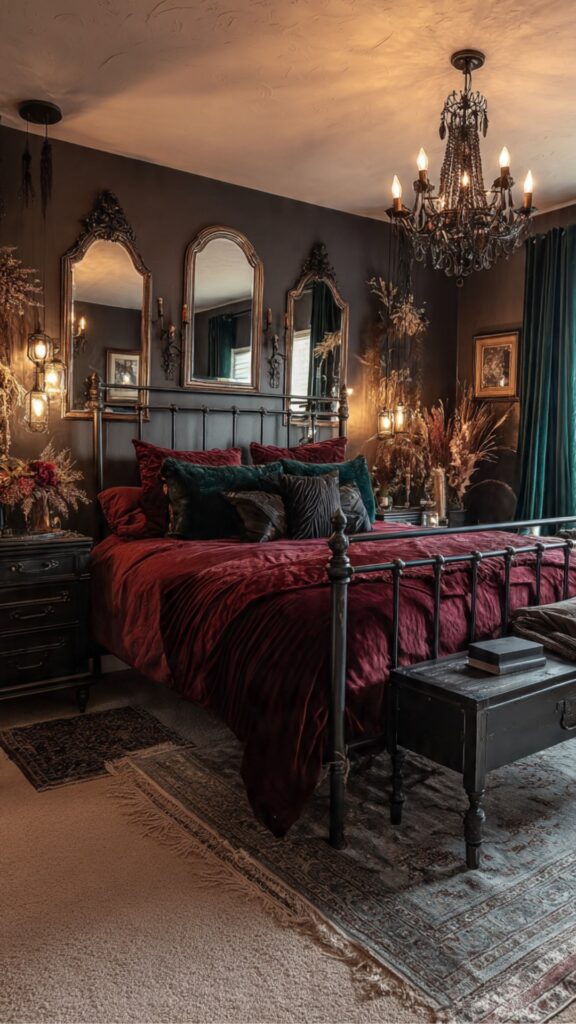
A genuinely atmospheric gothic bedroom does not require a significant financial investment it requires creative thinking, patience, and a willingness to engage with secondhand markets and DIY techniques that most conventional interior design advice ignores. Some of the most beautiful and authentic gothic bedrooms have been created on very modest budgets by people who understood which elements create the most atmospheric impact for the least cost.
Paint is the highest-impact, lowest-cost gothic bedroom transformation available. A gallon of deep, dark paint in charcoal, burgundy, or navy costs between $30 and $60 and transforms the room’s entire atmospheric quality immediately. Painting all four walls and ideally the ceiling in the same dark color is the fastest route to gothic atmosphere and the most dramatically effective use of this modest investment.
The quality of the paint matters: a higher-quality paint in a flat or eggshell finish covers more consistently, creates a richer surface, and shows less brushing and rolling marks than cheap alternatives. Charity shops, thrift stores, estate sales, and online marketplaces are extraordinary sources of gothic bedroom components at a fraction of retail cost.
Dark wood furniture that has been painted over in white or cream can be stripped and re-stained to reveal beautiful grain in a dark finish. Ornate picture frames in damaged gold can be repainted in dark matte colors and used to display art prints printed at home or purchased inexpensively online. Heavy velvet curtains from estate sales even if faded or slightly worn can be freshened with a fabric steamer and rehung to create immediate gothic drapery impact.
Victorian and early 20th century furniture at estate sales consistently costs less than equivalent contemporary reproduction pieces. DIY techniques expand the gothic bedroom budget significantly. Limewash paint application is a learnable skill that dramatically transforms wall surfaces at relatively low material cost the technique requires practice but is achievable by a determined amateur with the help of video tutorials and a few practice sessions on a test board.
Canopy installations using tension rods, ceiling hooks, and purchased fabric from a fabric store are straightforward DIY projects that create an enormous atmospheric impact for very modest material costs. Repainting existing furniture in dark matte chalk paint is one of the most consistently effective gothic bedroom budget transformations, instantly converting a tired pine dresser or bedside table into something that reads as genuinely gothic with a single afternoon’s work.
Gothic Bedroom Seasonal and Holiday Decor:
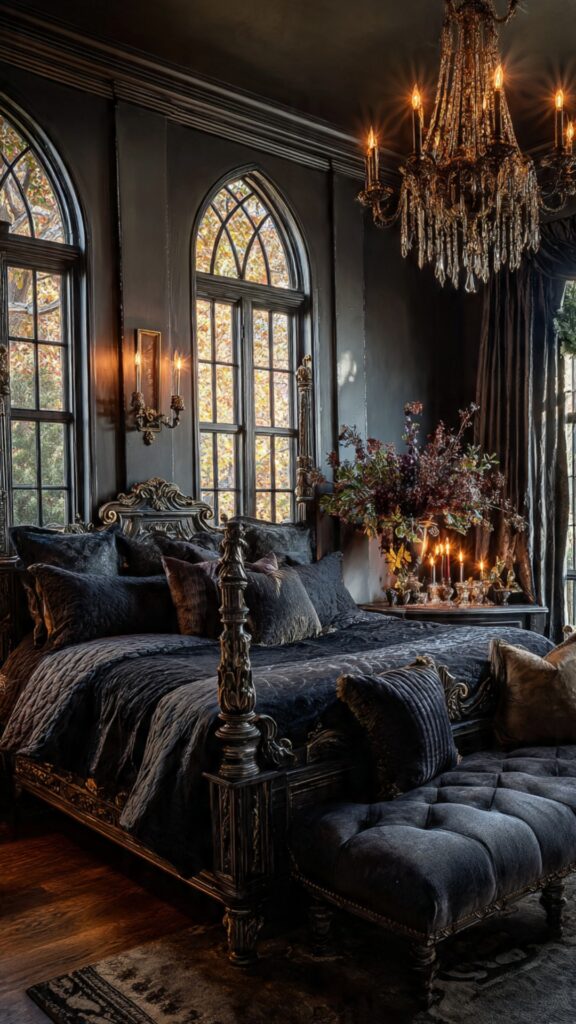
The gothic bedroom’s aesthetic is uniquely positioned to celebrate seasonal transitions particularly those that align with the aesthetic’s core sensibilities in ways that feel natural and unforced rather than decoratively imposed. Halloween, Samhain, the winter solstice, and the darker months of the year all provide opportunities to amplify the gothic bedroom’s atmosphere with seasonal additions that feel like genuine expressions of the room’s character rather than temporary decorations placed in an otherwise unrelated space.
Autumn is the gothic bedroom’s natural season the time when the outside world shifts into the palette of deep reds, burnt oranges, dark greens, and bare branches that the gothic bedroom has maintained year-round. Autumn additions to the gothic bedroom might include: real pumpkins in matte black or deep plum glazed ceramic vases, dried autumn leaves in dark frames as temporary seasonal art.
A new throw in deep amber or burnt orange velvet that introduces the season’s color into the bedding arrangement, and an autumn-specific fragrance a candle or diffuser in a blend of clove, cinnamon, amber, and dark wood that changes the room’s scent profile to match the seasonal shift. Winter seasonal additions to the gothic bedroom build on the existing dark palette with elements of silver, midnight blue, and the cold clarity of frost.
Black and silver ornaments displayed on the shelf arrangement, sprigs of dark-berried holly and cypress in a simple black vase, deep navy or midnight blue additions to the bedding layers, and the intensified use of candlelight and fire real or simulated during the short dark days of winter all contribute seasonal resonance without requiring the room’s decor to be wholesale changed. The gothic bedroom is the only bedroom aesthetic that looks more beautiful in winter than in any other season the season simply amplifies qualities that were already there.
Spring in the gothic bedroom is the season of the most interesting design tension the outside world brightens and flowers while the room maintains its dark atmospheric core. Rather than fighting this tension, embrace it: bring in small bunches of dark florals that acknowledge the season black roses from a florist, dark sweet peas, deep purple lilacs as a gothic response to spring’s botanical abundance.
Change the bedding to a slightly lighter, more breathable dark fabric a dark linen duvet cover rather than velvet that maintains the palette while accommodating the season’s warmer temperatures. This approach allows the gothic bedroom to participate in seasonal transitions without ever abandoning the essential qualities that make it what it is.
Conclusion
A gothic bedroom is ultimately an act of personal expression a space that celebrates beauty in darkness, richness in depth, and atmosphere in every carefully chosen detail. Whether you begin with a bold wall color, a dramatic four-poster bed, or simply a set of velvet cushions and a candelabra, each step toward a gothic bedroom brings you closer to a sleeping space of extraordinary character and genuine individuality.
Start with one idea from this guide the one that resonates most deeply with your aesthetic sensibility and let your gothic bedroom evolve from there, one beautiful, deliberate choice at a time.

Team TrandyVilla is the passionate home decor team behind Trandy Villa, where style meets comfort in everyday living. The team loves transforming simple spaces into beautiful, functional homes through smart ideas, budget-friendly hacks, and modern design trends. Their content focuses on helping readers create homes that feel both stylish and personal without spending too much.