
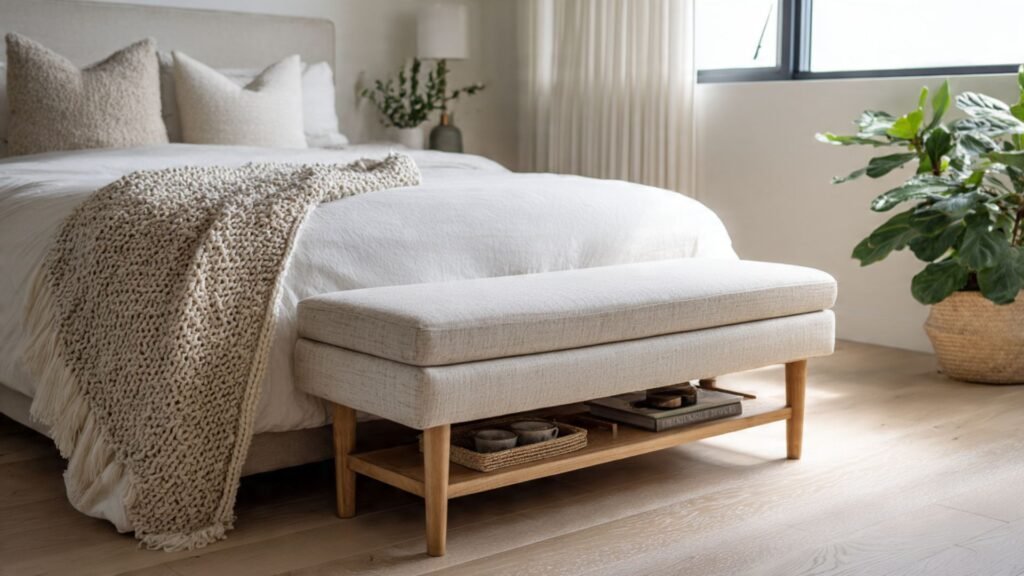
A bedroom bench is one of the most underrated pieces of furniture in home design. It serves multiple roles at once seating, storage, styling, and structure. Whether placed at the foot of the bed, beside a window, or along a wall, the right bench transforms how a bedroom looks and functions.
A bedroom bench is a compact, multi-purpose furniture piece placed in a bedroom to add seating, storage, and style. It serves a clear set of motives: it organizes the room, fills empty floor space purposefully, supports daily dressing routines, and elevates the overall bedroom aesthetic. Bedroom bench ideas range from upholstered foot-of-bed designs to storage-rich drawer benches, window seat benches, rustic wooden styles, and tufted statement pieces. Each idea targets a specific need comfort, storage, or visual impact making the bench one of the most practical bedroom furniture investments available today.
A well-chosen bedroom bench instantly upgrades the look and function of any sleeping space. It fills the gap between a beautiful bed and a bare floor with purpose and personality. Smart homeowners use a bedroom bench to create a finished, hotel-quality bedroom atmosphere one that feels complete, organized, and thoughtfully designed from every angle of the room.
Bedroom bench ideas cover a wide variety of styles, materials, and functions suitable for every room size and design preference. Upholstered benches add softness and texture to the room. Storage benches conceal clutter and maximize limited space efficiently. Wooden benches bring natural warmth to modern and rustic interiors alike. Tufted designs introduce elegance and visual depth at the foot of the bed. Each style serves the bedroom with both form and function, making every choice a worthwhile and lasting design decision.
The Classic Foot-of-Bed Bench:
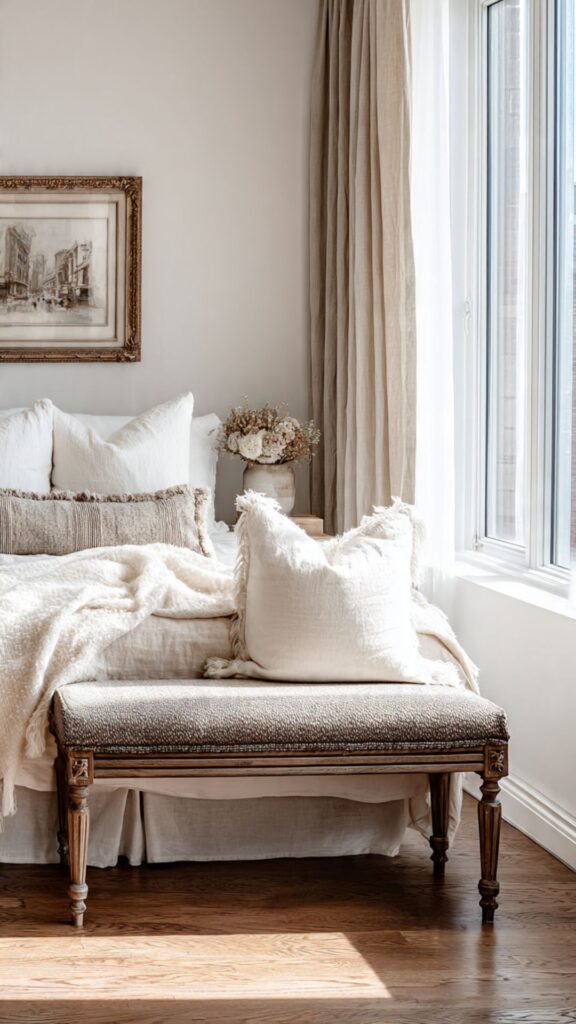
The foot-of-bed bench is the most traditional and widely used bedroom bench placement in interior design. It anchors the bed visually, frames the room’s focal point, and adds a layer of intentional styling that bare floors simply cannot provide. For centuries, this placement appeared in manor houses and grand hotels because it solved a practical problem elegantly: where does one sit to put on shoes, lay out tomorrow’s outfit, or rest for a moment before sleep? That function remains entirely relevant in modern bedrooms of every size.
Choosing the right bench for this position requires attention to proportion. The bench should be roughly two-thirds the width of the bed for a king-size bed, aim for 54 to 60 inches; for a queen, 48 to 54 inches. A bench that is too narrow looks out of scale and floating; one that is too wide crowds the room and blocks movement. Height also matters: the bench top should sit level with or slightly below the mattress top typically 18 to 20 inches so it reads as an intentional companion piece rather than an afterthought.
Upholstery selection for foot-of-bed benches is where personality enters. Velvet benches in jewel tones (emerald, sapphire, dusty rose) introduce color drama without overwhelming the room. Linen and cotton upholstered benches suit casual, airy bedroom aesthetics. Leather or faux-leather benches offer easy cleaning an often-missed practical consideration for households with children or pets. For a transitional or contemporary bedroom, a bench with a tufted top and tapered wooden legs hits the intersection of classic and current with confident style.
Unique Insight: Most buyers overlook bench depth. A depth of 16–18 inches provides comfortable seated use; anything under 14 inches is decorative only. If you intend to actually sit on the bench daily to dress, read, or rest prioritize depth alongside length and height.
Storage Bench for the Bedroom:
Function Meets Form
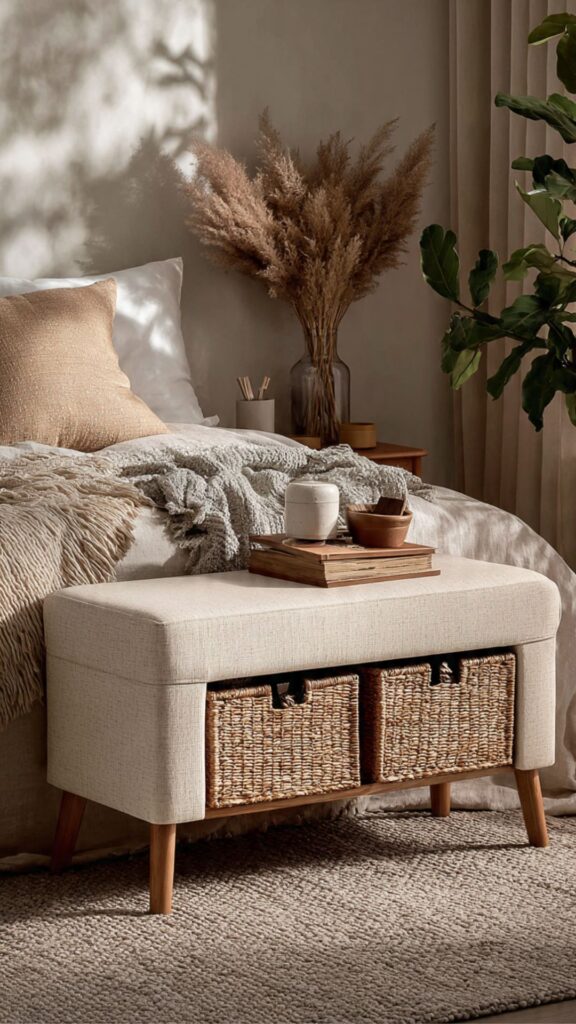
A bedroom storage bench is one of the most efficient pieces of furniture available for any room. It performs two jobs simultaneously: it provides seating or surface area on top, while concealing clutter, linens, seasonal clothing, or accessories inside. In smaller bedrooms especially, where every square foot carries significant weight, a storage bench at the foot of the bed effectively adds a chest of drawers worth of concealed capacity without occupying additional floor space.
The two primary storage bench configurations are lift-top and drawer-based. Lift-top benches offer a single large cavity ideal for bulky items extra pillows, throw blankets, off-season duvet covers. They are simple in construction and generally more affordable. Drawer-based benches provide organized, divided storage with the convenience of individual access pulling one drawer rather than lifting the entire lid.
For bedrooms where organization is a priority, drawer benches are the superior functional choice, though they typically cost more and weigh significantly more. Material quality inside the storage cavity is something most buyers never think to examine, but it is worth attention. Unlined interiors with rough particleboard edges can snag delicate fabrics.
Quality storage benches use smooth plywood or MDF interiors, sometimes cedar-lined particularly valuable for wool blanket and seasonal clothing storage, as cedar naturally deters moths. When evaluating a storage bench online, check whether the hinge mechanism has a soft-close or safety feature; a heavy lid without one can close abruptly on fingers, which is a meaningful concern in households with children.
Unique Insight: A storage bench can entirely replace a hope chest or blanket chest in a bedroom at a fraction of the cost and with the addition of a usable seated surface. Many homeowners don’t realize this until years after purchasing both pieces separately.
Wait — Is Your Hallway Killing Your Home’s First Impression? Fix It Here.
Upholstered Bedroom Bench:
Comfort as a Design Priority
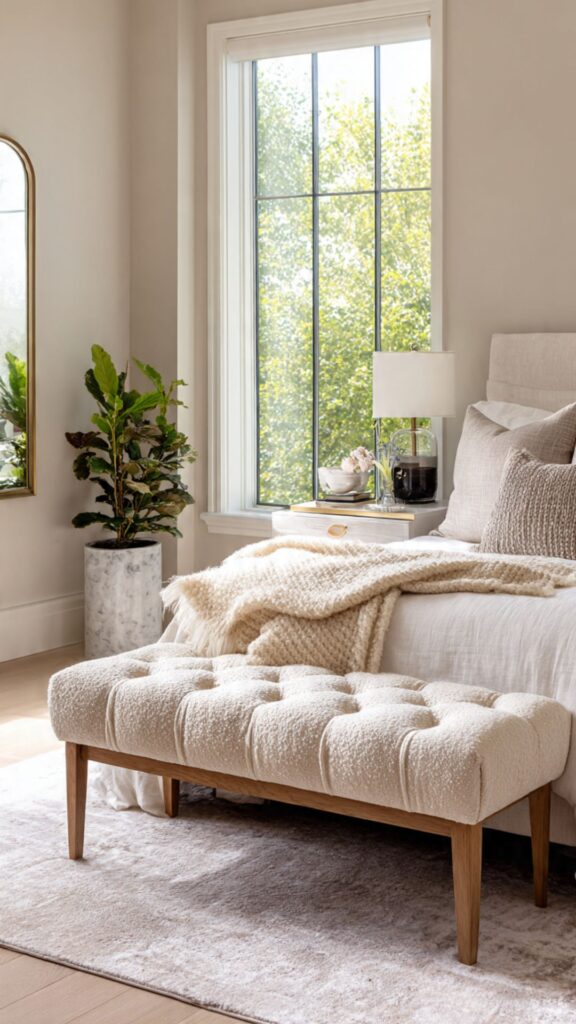
The upholstered bedroom bench prioritizes seated comfort while contributing the soft, layered texture that makes a bedroom feel genuinely inviting rather than simply decorated. Unlike hard-topped wooden benches, an upholstered bench introduces fabric into the room’s material mix complementing bedding, curtains, and rugs while providing a genuinely comfortable place to sit.
In bedrooms where the design goal is warmth and sensory richness, the upholstered bench is the most valuable single piece of furniture to add. Foam density is the hidden variable in upholstered bench comfort. High-density foam (2.0 lb/cubic foot or above) holds its shape under regular use and resists compression over time. Low-density foam (under 1.5 lb) feels comfortable initially but degrades noticeably within one to two years of regular use flattening, developing dips, and losing the plush appearance that made the piece attractive.
When purchasing an upholstered bench, ask the retailer for foam density specifications. If unavailable, press firmly on the seated surface: quality foam should compress slightly but spring back immediately and fully. Fabric choice has both aesthetic and practical dimensions. Performance fabrics including Crypton, Sunbrella indoor fabrics, and stain-treated polyester blends offer the look of premium upholstery with dramatically improved resistance to spills, pet hair, and everyday wear.
These are no longer the utilitarian, plasticky fabrics of the past; modern performance textiles convincingly mimic velvet, boucle, and linen at a visual level while outperforming natural fibers in durability. For a bedroom bench that will see daily use, performance fabric is the expert recommendation regardless of budget tier.
Unique Insight: Tufting style affects how the bench ages visually. Button tufting creates deep indentations that collect dust and lint requiring more frequent vacuuming. Channel tufting (vertical ridges) is easier to maintain and reads as more contemporary, making it the better choice for low-maintenance bedroom styling.
Window Seat Bench:
Capturing the Best Spot in the Room
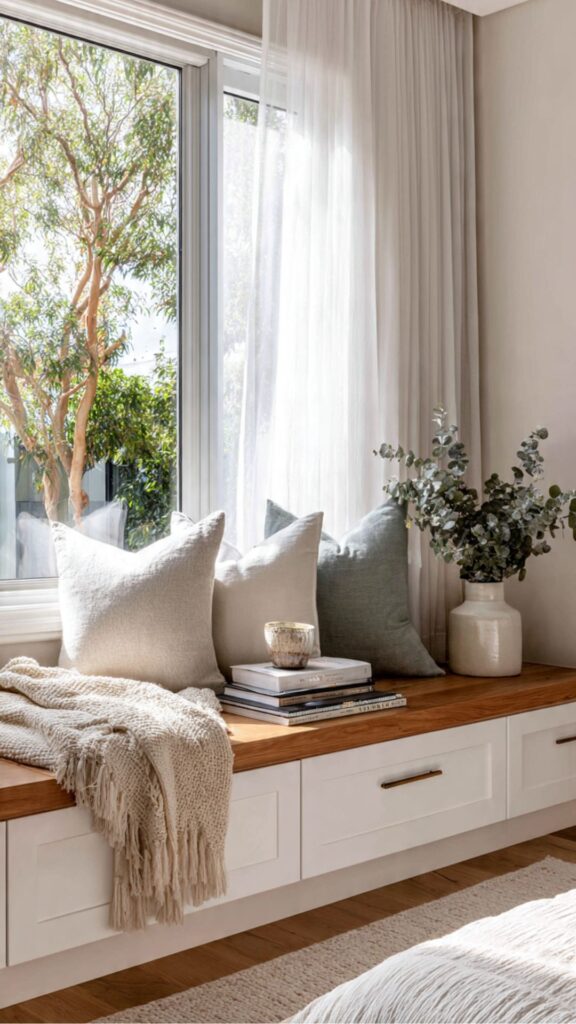
A window seat bench turns an underused architectural zone the wall beneath a window into the most desirable spot in the bedroom. It creates a dedicated reading nook, a morning coffee perch, a place to sit and observe the garden, or simply an invitation to pause. In rooms with bay windows, dormer windows, or deep sills, a built-in window seat bench is one of the highest-value design additions possible, adding both storage (beneath the seat) and square footage of usable living space that a standard furniture arrangement cannot replicate.
For rooms without architectural window features, a freestanding bench positioned perpendicular to the window wall achieves a similar effect with far less investment. The bench should be long enough to lie on comfortably at minimum 60 inches and positioned so the seated person faces the window rather than having it to the side.
Adding a bolster pillow against the adjacent wall and a small side table for a lamp or drink transforms a standard bench into a genuinely functional reading or relaxation zone. This “nook without walls” approach works effectively even in bedrooms with standard window configurations.
Cushion thickness for window seat benches deserves specific attention. Unlike foot-of-bed benches where a 2–3 inch pad is sufficient, window seat benches used for extended sitting or lying require cushions of 4–6 inches in thickness. Custom cushion fabricators (widely available online) can produce bench-specific cushions in any dimension, typically for $80–$200 depending on size and fabric a modest investment that dramatically improves comfort and the visual weight of the window seat arrangement. Washable cushion covers are strongly advisable for this position, as window seat cushions accumulate sunlight exposure, dust, and frequent contact.
Unique Insight: East-facing window seat benches receive morning light and are ideal for reading and starting the day. West-facing window seats receive strong afternoon sun that can fade fabric quickly UV-protective window film or sunlight-resistant fabric selection is worth considering at the planning stage.
Here is Idea 5 completely rewritten with a fresh concept, new depth, and original insights:
Bedroom Bench as a Vanity Seat:
Beauty Meets Daily Ritual
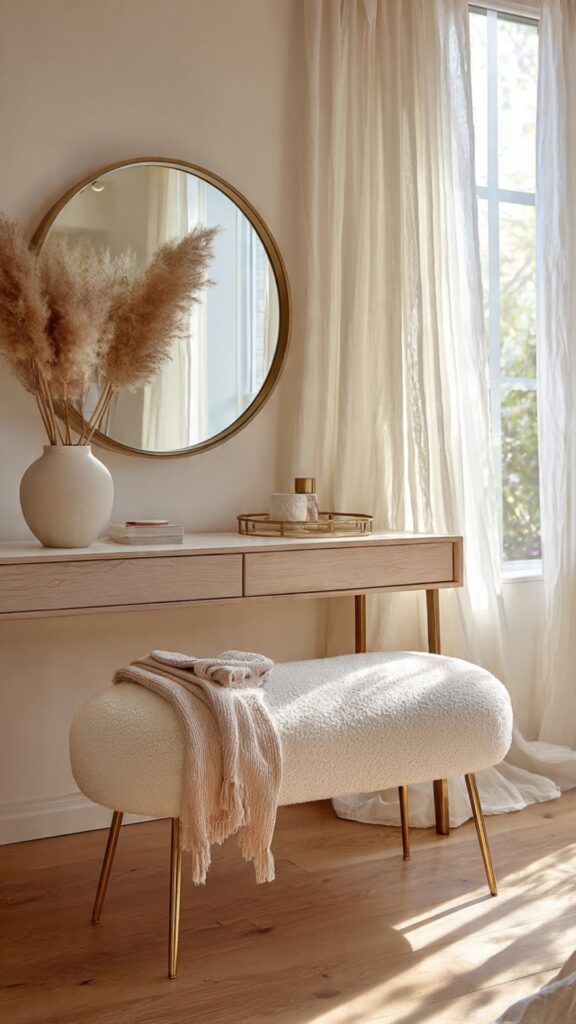
A bedroom bench used as a vanity seat is one of the most practical and often overlooked applications in bedroom design. It replaces the standard vanity chair or stool with a longer, more versatile piece that serves double duty throughout the day. In the morning, it anchors the grooming and makeup routine.
In the evening, it holds the day’s clothing, accessories, or tomorrow’s outfit. This dual-use quality makes it one of the most hardworking bench placements in any bedroom layout, regardless of room size or style direction.
The ideal vanity bench sits at a height of 17 to 19 inches matching standard vanity and dressing table heights for comfortable, ergonomic seated use. Width matters equally: a bench of 36 to 48 inches provides generous surface area for spreading out accessories, a handbag, or grooming tools without the restriction of a narrow stool.
Unlike a fixed vanity chair, a bench can slide fully under the vanity table when not in use, preserving precious floor space in smaller bedrooms. This retractable quality is a genuine spatial advantage that most buyers only appreciate after experiencing it daily.
Material selection for a vanity bench should balance beauty with easy maintenance. Velvet and boucle upholstered benches look stunning at a vanity but attract makeup powder, hairspray residue, and product spills over time. Performance fabric stain-treated polyester or microfiber delivers a comparable aesthetic with significantly better resistance to the cosmetic products regularly used in this zone.
A bench with a removable, washable seat cover is an especially practical choice for a vanity placement. Mirrored or metallic-legged benches complement the reflective surfaces of vanity mirrors and glass perfume bottles, creating a cohesive, light-filled grooming vignette.
Unique Insight: Most vanity benches sold specifically as “vanity stools” are circular and narrow designed for looks rather than comfort. A rectangular bedroom bench at the vanity provides far superior seated support for extended grooming sessions, distributes weight more evenly, and offers side surface area that a round stool cannot. Switching from a stool to a bench at the vanity is one of the simplest comfort upgrades available in bedroom furniture.
Wooden Bedroom Bench:
Timeless Material, Modern Versatility
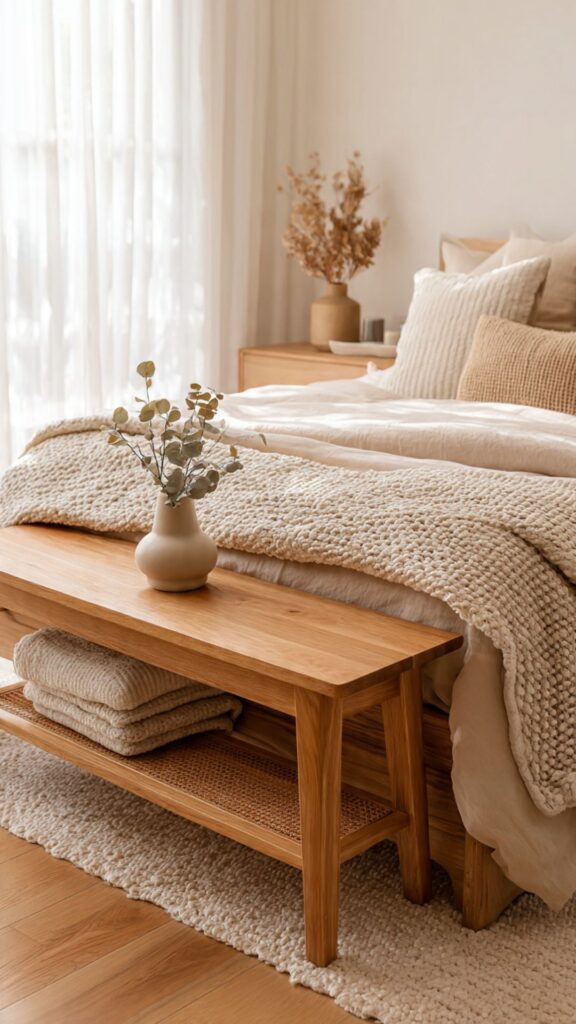
A wooden bedroom bench is the most versatile bench material available it suits farmhouse, Scandinavian, mid-century modern, rustic, and contemporary bedroom aesthetics with equal credibility. Unlike upholstered benches, which anchor the room to a particular textile color or texture, a wooden bench shifts its personality based on surrounding elements.
Pair it with linen bedding and rattan accessories for a coastal bedroom; add a sheepskin throw and dark metal accents for industrial modern; combine with a geometric rug and brass hardware for mid-century style. The wooden bench adapts rather than dictates.
Wood species determines both the aesthetic and the durability of the bench. Solid oak is the premium choice for bedroom benches dense, durable, and available in a range of finish tones from pale blonde to deep walnut-stained brown. Pine is softer, less expensive, and more prone to denting, but its warmth and grain pattern suit rustic and farmhouse bedrooms authentically.
Teak, though primarily associated with outdoor furniture, makes exceptional indoor benches: its natural oils provide moisture resistance and a rich honey tone that ages beautifully. Bamboo benches, increasingly popular in eco-conscious design, offer surprising structural strength alongside a distinctive light, linear grain.
Finish quality on a wooden bedroom bench is as important as species selection. A poorly applied finish thin, streaky, or incomplete chips at edges, darkens at contact points, and dulls over time. Quality benches use multiple coats of oil-based or water-based polyurethane, or a hand-applied oil finish (linseed, tung, or Danish oil) that penetrates the wood rather than sitting on its surface.
Oil-finished benches are easier to spot-repair than polyurethane-finished ones a small area can be re-oiled without refinishing the entire piece. This repairability is a meaningful long-term advantage that most buyers discover only after years of ownership.
Unique Insight: Joining method is a reliable indicator of wooden bench quality. Mortise-and-tenon joinery where the leg fits into a carved cavity in the seat frame is far stronger than dowel-and-glue or bracket construction. Quality wooden benches list joinery type in their product specifications; if unspecified, it is typically the weaker construction method.
Entryway-Style Bench Repurposed for the Bedroom:
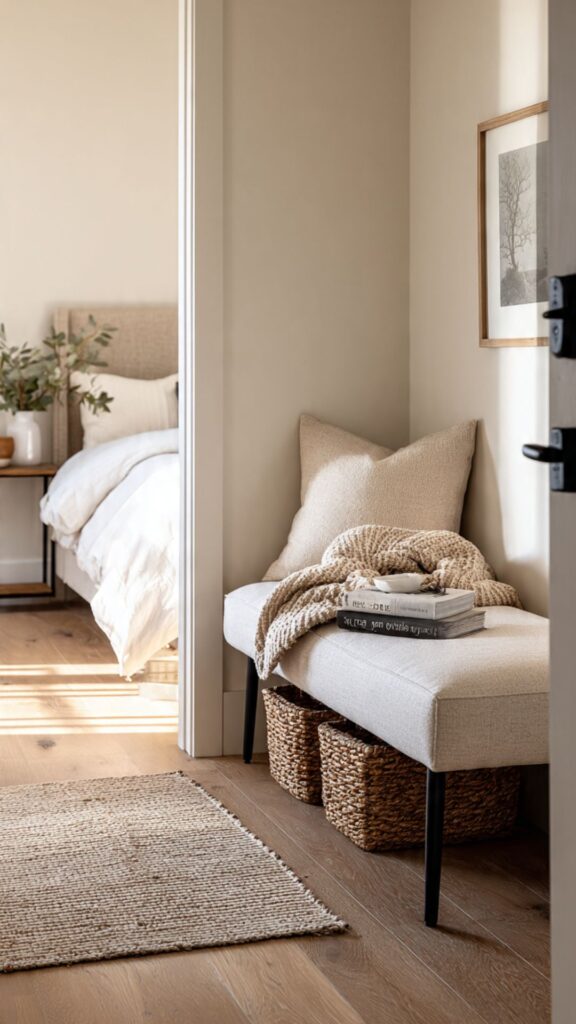
Entryway benches designed for mudrooms and hallways translate remarkably well into bedroom applications. They are typically built at a practical seated height (17–19 inches), constructed for durability, and often incorporate under-seat shelf space or hooks for organization. Repurposing an entryway bench for the bedroom at the foot of the bed, beside the closet, or along a wall creates a functional seating and storage zone that purpose-built bedroom benches sometimes lack, at a lower price point.
The most useful entryway-to-bedroom bench transfers are those with open lower shelves. In a bedroom context, this shelf becomes a display or storage tier holding a basket of accessories, a pair of frequently worn shoes, stacked books, or folded throws.
This configuration works particularly well in bedrooms without adequate built-in storage, where the bench effectively functions as a narrow console or low bookcase with a bonus seating surface. Styling the lower shelf with a mix of functional and decorative items (a woven basket plus a small plant, for example) transforms a utilitarian piece into an intentional design moment.
For a cohesive look, the bench finish should connect to existing bedroom furniture through either matching or intentional contrast. A natural wood entryway bench placed beside dark-stained bedroom furniture works through contrast; a bench painted the same color as the room’s accent wall creates a built-in effect that elevates the overall design without additional cost.
The bench does not need to match existing furniture precisely in fact, a deliberate material or finish difference (wood bench in a room with upholstered bed) adds textural layering that interior designers actively seek.
Unique Insight: Entryway benches are typically subjected to heavier daily use than bedroom furniture, meaning they are often engineered to a higher structural standard than comparably priced bedroom-specific benches. This durability advantage makes the cross-category purchase a legitimate quality-for-value strategy.
Everyone is Obsessed with This Sunroom Trend — See Why.
Tufted Bench for the Bedroom:
Elegance in Every Detail
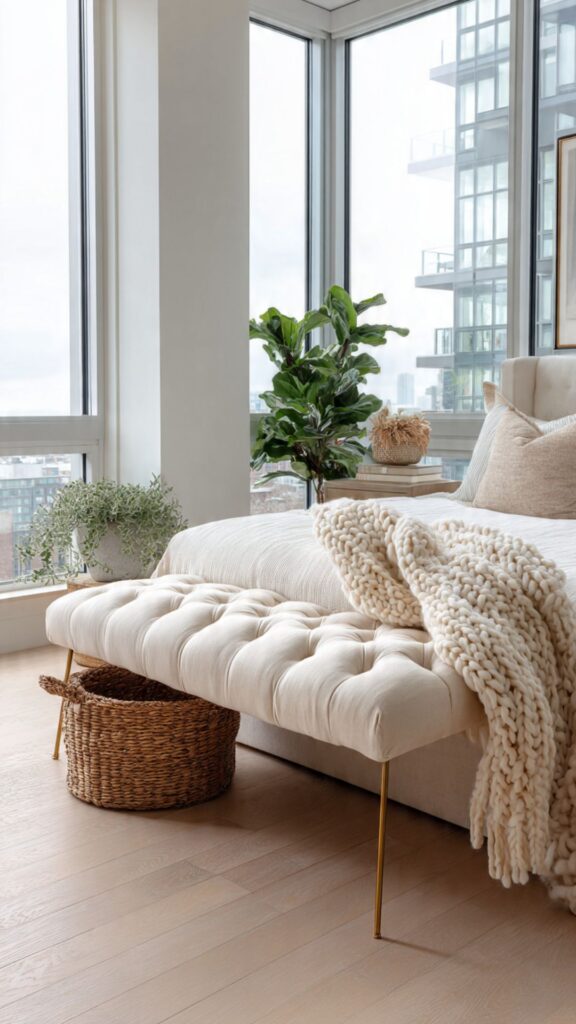
The tufted bedroom bench is the quintessential choice for traditional, glamorous, and Hollywood Regency-inspired interiors. Its signature look fabric pulled into decorative indentations by buttons or stitching communicates craftsmanship, softness, and deliberate luxury.
A tufted bench at the foot of a canopy or upholstered bed creates a layered, hotel-suite aesthetic that elevates the entire room without requiring additional furniture or accessories. It is one of the highest-impact single pieces available in bedroom furniture at every price point.
Diamond tufting (buttons arranged in a diagonal grid) is the most recognizable form and suits formal or glamorous bedroom aesthetics. Biscuit tufting (square or rectangular tufting pattern) is softer in character and works well in transitional spaces that balance traditional and contemporary elements.
Channel tufting, as noted earlier, runs in straight vertical or horizontal ridges and is the most modern interpretation cleanest in line and lowest in maintenance. Each tufting style works best in specific contexts, and choosing deliberately rather than defaulting to the most common option elevates the final result.
Velvet is the most popular fabric for tufted bedroom benches, and with good reason: its pile creates a light-responsive surface that shifts from deep to bright depending on viewing angle and lighting, making the piece visually dynamic throughout the day. Jewel-tone velvet tufted benches in emerald, cognac, sapphire, or burgundy are among the most searched bedroom furniture items currently trending, appearing prominently in aspirational interior design content.
For bedrooms with a neutral base palette (whites, grays, warm taupes), a velvet tufted bench in a saturated color introduces a focal accent without requiring wall paint changes or significant redecorating.
Unique Insight: Tufted benches with gold-finished legs are among the most versatile glamour pieces available because the warm metallic base harmonizes with virtually every upholstery color warm or cool making it a safer investment than silver or chrome-legged alternatives when color direction might shift over time.
Bedroom Bench with Drawers:
Maximum Organization Potential
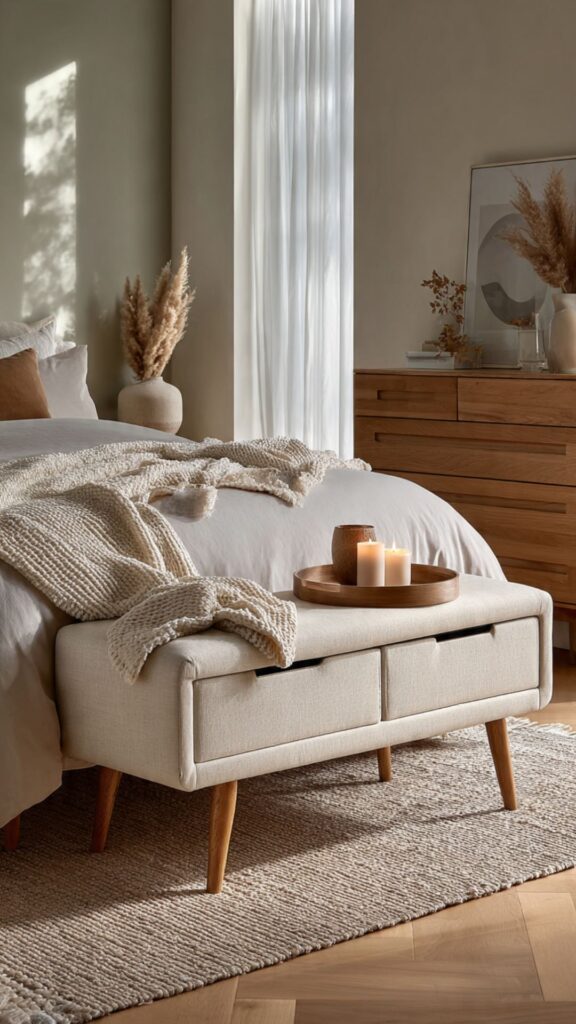
A bedroom bench with built-in drawers is the most functionally sophisticated bench configuration available. It combines the seating and aesthetic contributions of any bedroom bench with organized, divided internal storage accessed without lifting a lid. For bedrooms where organization is a daily challenge particularly in households where closet space is limited or shared a drawer bench at the foot of the bed can genuinely transform the room’s daily functionality, reducing the visual clutter that makes even well-decorated bedrooms feel chaotic.
Drawer configuration varies significantly across products. Two-drawer benches divide the storage into left-right sections, ideal for separating two users’ belongings or different categories of items (accessories on one side, folded clothing on the other). Three-drawer benches provide finer organization but reduce individual drawer capacity.
For a bedroom bench used primarily by one person, two larger drawers outperform three smaller ones in practical daily use. Drawer height also matters: shallow drawers (3–4 inches) suit jewelry, accessories, or documents; deeper drawers (6–8 inches) accommodate folded clothing or thick blankets.
Hardware on drawer benches functions both practically and decoratively. Soft-close drawer slides prevent slamming and extend the mechanism’s lifespan considerably a feature worth seeking out specifically. Drawer pulls and knobs should complement other metal finishes in the bedroom: nightstand hardware, light fixtures, and curtain rod finials.
A brushed gold drawer bench pull beside polished chrome nightstand hardware creates an unresolved tension that trained eyes notice immediately. Choosing bench hardware that either matches or intentionally complements existing metallic finishes demonstrates the level of design cohesion that distinguishes a curated room from a merely furnished one.
Unique Insight: Full-extension drawer slides which allow the drawer to open completely, revealing the full depth of the interior are meaningfully superior to standard partial-extension slides for bedroom storage. Items stored at the back of a standard drawer are effectively invisible and inaccessible in practice, defeating the organizational purpose entirely.
Modern Bedroom Bench:
Clean Lines for Contemporary Spaces
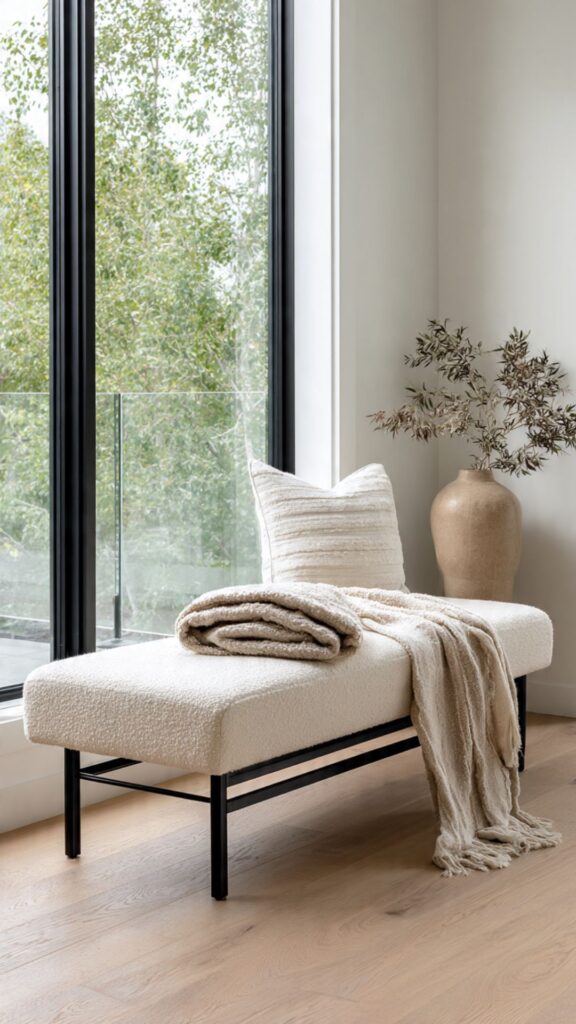
The modern bedroom bench is defined by restraint: clean geometric silhouettes, minimal ornamentation, materials expressed honestly, and a form that follows function without apology. In contemporary bedrooms characterized by low-profile platform beds, large-format tile or hardwood floors, and monochromatic palettes, the modern bench completes the aesthetic without competing with it.
Its design vocabulary is the opposite of the tufted, carved, and gilded traditional bench and executed well, it is equally compelling. Materials that read as definitively modern in bedroom bench design include powder-coated steel frames with upholstered seats, solid concrete or stone tops on minimal bases, Lucite or acrylic legs supporting upholstered platforms, and solid wood in monolithic single-piece forms.
The Parsons bench four equal legs continuing the profile of the seat without interruption is one of the most enduringly modern silhouettes and suits a remarkable range of contemporary bedroom aesthetics from Japandi to urban loft. Its proportional simplicity makes it one of the most difficult bench designs to execute poorly, which is a meaningful purchasing advantage.
Color in modern bedroom benches typically serves a specific role: either disappearing into the room’s neutral base (a white or light gray bench against white walls) or providing a deliberate accent moment (a matte black bench in an otherwise all-white room).
The modern design principle of deliberate restraint applies directly here one strong material or color choice made confidently outperforms several competing choices made tentatively. A bench in a single bold material (raw brass legs, charcoal boucle top) reads as a considered design decision; the same bench in multiple competing finishes reads as indecision.
Unique Insight: Modern bedroom benches often lack visible legs entirely the floating bench, which appears to hover above the floor through recessed hardware or a wall-mounted bracket is an increasingly popular option in contemporary bedrooms. It adds to the weightless, uncluttered aesthetic that defines the best modern interiors and also simplifies floor cleaning.
Rustic Bedroom Bench:
Raw Beauty With Purpose
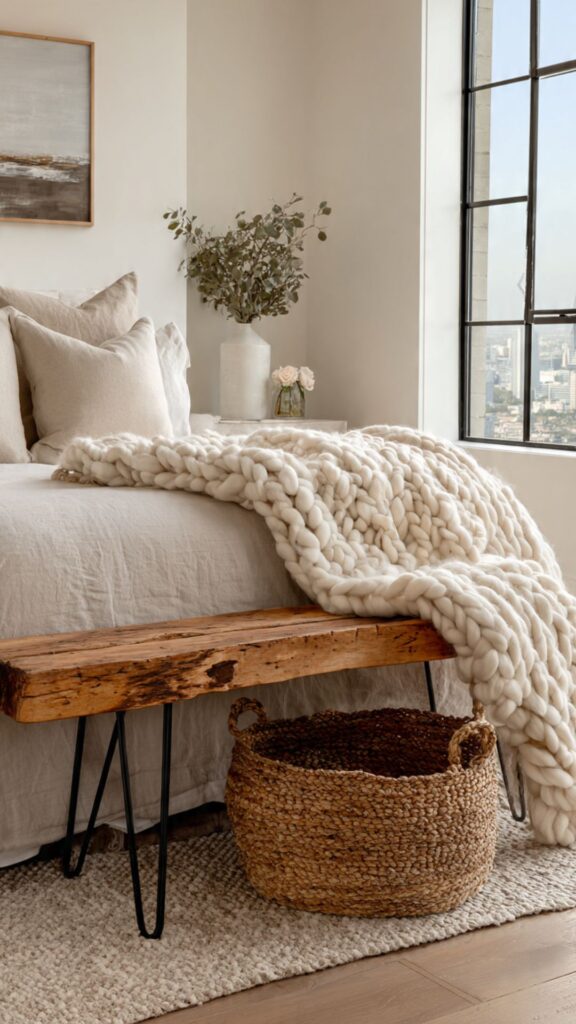
A rustic bedroom bench introduces natural, unrefined material character into the room celebrating wood grain, material imperfection, and the beauty of age in a way that polished, manufactured furniture explicitly avoids. In farmhouse bedrooms, cabin retreats, and nature-inspired interior schemes, a rustic bench grounds the space in materiality and provides a visual counterweight to soft bedding and delicate textiles. The contrast between rough and smooth, hard and soft, is a design principle that skilled interior designers use deliberately and the rustic bench is one of its most accessible applications.
Live-edge benches where one or both edges of the seat retain the natural profile of the tree trunk represent the premium expression of rustic bench design. Each live-edge bench is inherently unique; no two pieces share an identical outline, grain pattern, or natural void configuration. This individuality makes live-edge pieces simultaneously more valuable and more meaningful than manufactured alternatives they carry a material story that mass-produced furniture cannot replicate.
Live-edge benches in walnut, oak, maple, or black locust are readily available from local woodworkers and online artisan marketplaces at price points ranging from $300 to several thousand dollars depending on slab size and species.
Finishing a rustic bench correctly is as important as selecting the right wood. Over-finishing a rustic piece applying too many coats of high-gloss polyurethane strips away the textural authenticity that makes it compelling. The appropriate finish for most rustic bedroom benches is a penetrating oil or matte-sheen water-based topcoat that protects the wood while allowing its natural texture to remain visible and tactile.
A bench that looks untouched but is properly sealed represents the ideal outcome: the warmth and character of raw material with the durability required for daily bedroom use.
Unique Insight: Reclaimed wood benches built from salvaged barn wood, railway timber, or factory flooring carry embedded history in their material. The nail holes, saw marks, and weathering patterns visible in reclaimed wood are evidence of prior use that adds narrative depth no new material can replicate, making them the most characterful rustic bench option available.
Bedroom Bench for Small Spaces:
Scale-Smart Solutions
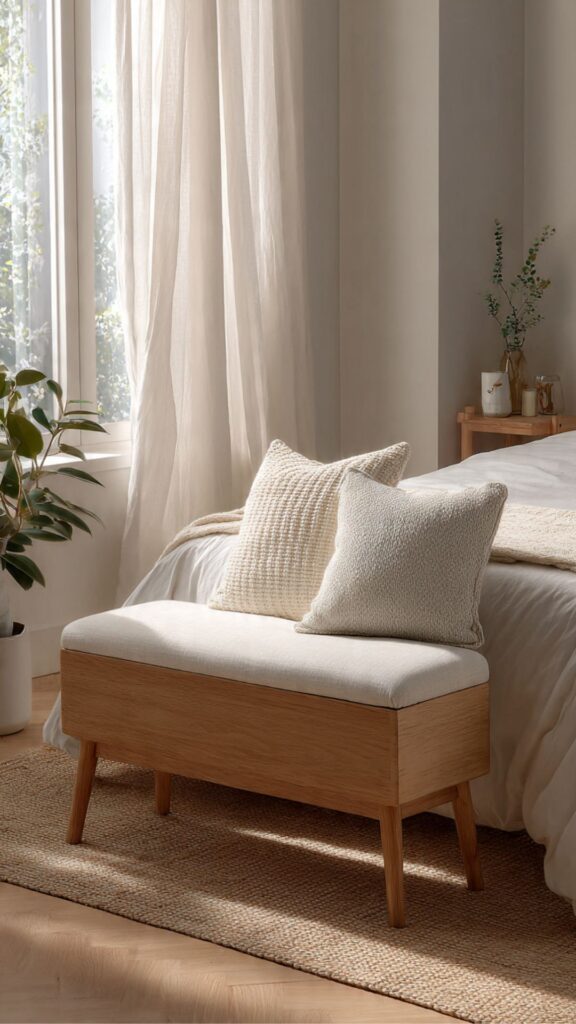
In compact bedrooms studios, guest rooms, children’s rooms, and urban apartments where square footage is carefully allocated the bedroom bench must justify its footprint through dual or triple functionality. A bench that only sits without contributing storage, organizing capacity, or visual space-extension is a luxury a small bedroom cannot afford. Fortunately, the furniture market has responded to small-space living with bench designs specifically engineered for efficiency without aesthetic sacrifice.
Slim-profile benches those with a depth of 12–14 inches rather than the standard 16–18 suit small bedrooms by reducing the floor footprint while maintaining a useful surface length. At the foot of a full or queen bed, a 36–42 inch slim bench provides a practical surface for daily dressing rituals without projecting deeply into the walking path. This reduction in depth matters most in bedrooms where the space between the bed foot and the opposite wall or door is under 48 inches the minimum comfortable clearance for a standard-depth bench placement.
Bench doubling as a nightstand is an emerging micro-bedroom design strategy gaining traction in small-space design communities. A narrow bench (10–12 inches deep, 24–30 inches long) placed perpendicular to the bed beside the sleeping zone serves as an extended nightstand surface holding a lamp, book, phone, and glass of water while providing occasional seating at a fraction of the space cost of a chair. This approach works best in rooms where the standard nightstand feels overly bulky or where the bed placement against a wall prevents conventional nightstand use.
Unique Insight: Transparent or lucite-legged benches in small bedrooms create the visual illusion of more floor space because the eye reads the floor beneath the bench as continuous rather than interrupted. This “negative space” effect is a professional trick used in small-space interior design that costs nothing more than a deliberate material choice.
DIY Bedroom Bench:
Build Exactly What You Need
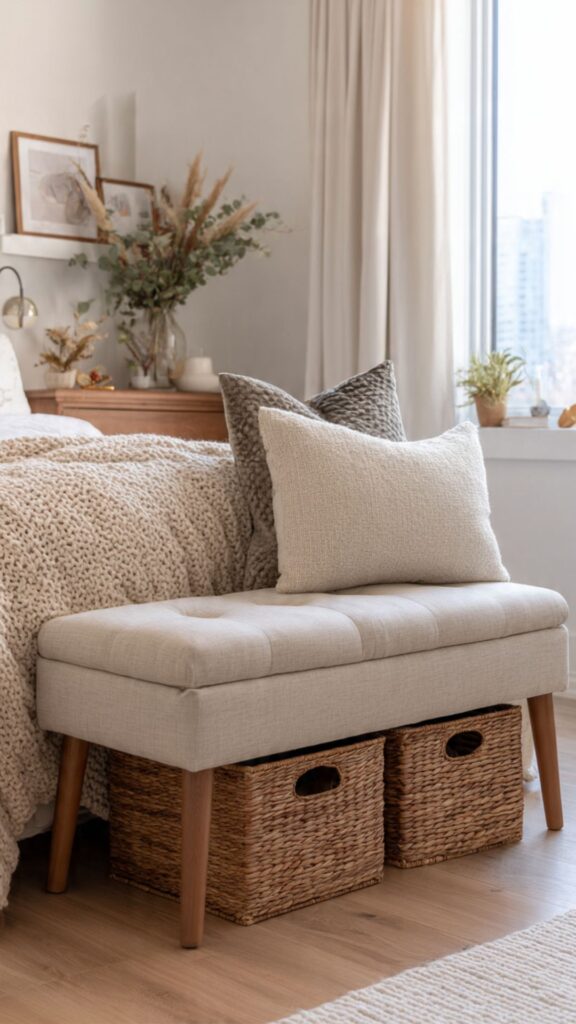
A DIY bedroom bench offers a compelling combination of benefits unavailable in retail furniture: exact dimension customization, complete material selection, significant cost savings, and the personal satisfaction of building a functional piece for a room you care about.
For homeowners whose bedroom has non-standard dimensions a very wide bed, an unusual wall length, a specific height requirement a custom-built bench is often the only route to a truly fitting piece. Many furniture retailers offer benches in two or three standard sizes; a DIY approach provides infinite dimensional flexibility.
The most approachable DIY bedroom bench for a beginner woodworker uses a simple box construction: two side panels, a front and back rail, and a top surface, all cut from 3/4-inch plywood and joined with pocket screws. This construction method requires no specialized joinery skills, no special tools beyond a circular saw and a drill, and produces a structurally sound bench that can be upholstered, painted, or stained to match any bedroom aesthetic. Detailed plans for this construction type are widely available through woodworking content platforms, with material costs typically ranging from $60–$120 for a standard bedroom bench size.
Upholstering a DIY bench is far more accessible than most non-crafters assume. The process involves cutting foam to the top panel dimensions, wrapping it in polyester batting for softness, laying the fabric over the top, and stapling the underside of the seat panel at consistent tension.
A standard electric staple gun, a yard to a yard and a half of upholstery fabric, a 3-inch foam sheet, and one hour of careful work produces a bench indistinguishable from a retail upholstered piece. Choosing a patterned fabric requires pattern-matching attention; a solid or textured fabric eliminates this complexity and suits most bedroom aesthetics equally well.
Unique Insight: DIY bench builders consistently underestimate the value of the legs as a design element. After construction, swapping standard wooden legs for hairpin legs, tapered mid-century legs, or bun feet from hardware suppliers (typically $20–$60 per set of four) completely transforms the bench’s stylistic identity without any structural modification.
Bedroom Bench for Kids’ Rooms:
Safe, Durable & Fun
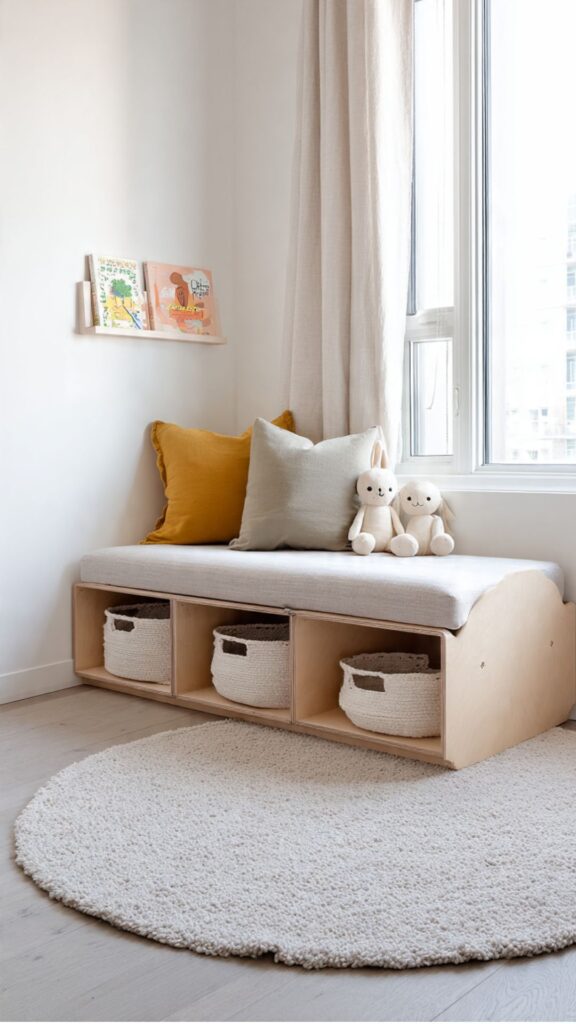
A bedroom bench in a child’s room serves a dramatically different set of functional priorities than one in an adult bedroom. Safety is the primary consideration: sharp corners, unstable construction, heavy lift-top lids without safety hinges, and toxic finishes are disqualifying features regardless of how attractive or affordable the piece appears.
Beyond safety, a children’s bedroom bench must withstand significantly more physical abuse than adult furniture jumping, climbing, pushing, and the general enthusiasm with which children inhabit their spaces requiring robust construction that outlasts both the child’s growth phases and shifting preferences.
Round-cornered or cushioned-edge benches are the appropriate choice for young children’s rooms (under age 6), where falls and collisions with furniture edges are a realistic daily occurrence. For school-age children, a storage bench offers particular value: it provides an accessible location for frequently used toys, sports equipment, art supplies, or books reducing the bedroom floor clutter that is a universal source of household friction.
A bench with a labeled or color-coded storage interior can actively support organizational habits that benefit children into adulthood, making it a functionally developmental piece rather than merely a decorative one.
Material finishes on children’s bedroom benches should be verified as non-toxic specifically GREENGUARD Gold certified or ASTM F963 compliant. These certifications confirm that the piece meets children’s product safety standards for chemical emissions and material safety, which is meaningful in a space where a child sleeps and spends concentrated daily time.
Avoid high-gloss lacquer finishes on children’s furniture as they show scratches and scuffs extremely visibly, creating a perpetually worn appearance within months of use. Matte or satin paint finishes and fabric upholstery age with far more visual grace in a child’s active environment.
Unique Insight: A bench with a chalkboard-painted front panel serves double duty in a child’s room: storage bench above, creative drawing surface below. This combination is rarely offered as a retail product but is straightforwardly achievable as a DIY modification simply paint the front panel with chalkboard paint after construction, adding a functional creative surface that children find genuinely engaging.
Don’t Miss: Bring Sunroom Warmth into Your Farmhouse Kitchen Design,
Bedroom Bench Styling Tips:
Making It Look Intentional
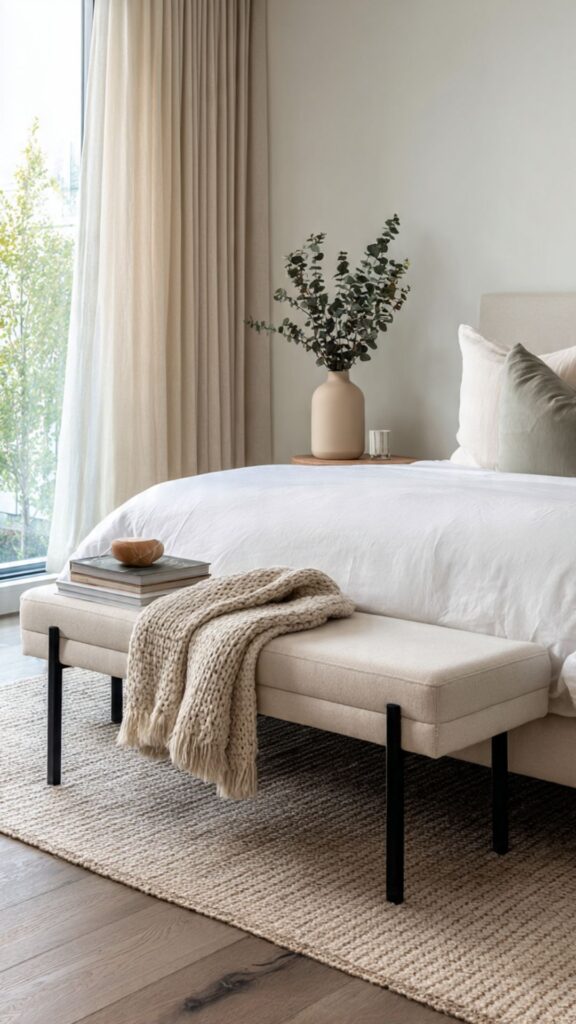
A bedroom bench can be perfectly proportioned, impeccably constructed, and exactly the right piece for the space and still look like an afterthought if it is not styled with intention. The difference between a bench that reads as a deliberate design decision and one that simply occupies space lies in the layering of objects, textiles, and accessories that give the piece context and visual weight. Understanding how to style a bedroom bench is the final skill that transforms a furniture purchase into a completed design moment.
The most effective bedroom bench styling approach uses the rule of three: place three elements on or around the bench, varying in height, texture, and material. For example, a folded throw blanket draped over one end (height and texture), a stack of two books placed flat on the seat (horizontal contrast), and a small ceramic or woven object placed on the books (accent and height variation).
This arrangement creates visual interest without congestion it signals that the bench is part of a considered space rather than a storage surface waiting to be cleared. Resist the temptation to add more; restraint is what separates styled from cluttered.
Textile layering on and around the bench amplifies the bedroom’s sense of warmth and comfort. A textured throw in a complementary or contrasting color draped asymmetrically over the bench back or end introduces pattern and softness.
A small runner rug placed beneath the bench extending 6 inches on either side defines the bench as an intentional zone within the room, adds color or pattern at floor level, and protects the flooring from leg marks. These two additions throw and rug cost relatively little but produce a disproportionate visual improvement that most before-and-after styled bedrooms demonstrate clearly.
Unique Insight: Seasonal bench restyling is one of the fastest and least expensive ways to refresh a bedroom’s atmosphere. Swapping the throw (lightweight linen in summer, chunky knit in winter), changing the small decorative object (fresh botanicals in spring, pinecones in autumn), and rotating the books for current reading creates four distinct seasonal vignettes from a single bench investment keeping the room feeling current year-round without any furniture changes.
Conclusion
A bedroom bench is far more than a decorative addition it is a functional, space-defining investment that improves how you use and experience your bedroom every day. From storage-rich drawer benches to elegant tufted ottomans, each of the 15 ideas in this guide serves a specific need and aesthetic goal.
Choose the bedroom bench that fits your space, your style, and your daily habits then style it with intention and watch it become the most useful piece in the room. Start with one idea today and transform your bedroom from simply furnished to genuinely designed.

Team TrandyVilla is the passionate home decor team behind Trandy Villa, where style meets comfort in everyday living. The team loves transforming simple spaces into beautiful, functional homes through smart ideas, budget-friendly hacks, and modern design trends. Their content focuses on helping readers create homes that feel both stylish and personal without spending too much.