
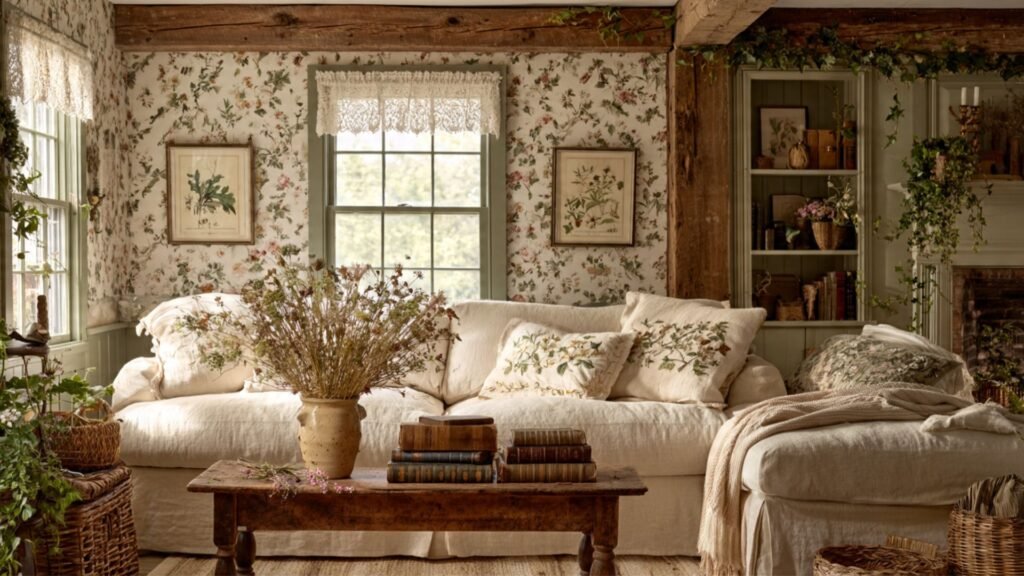
A cottagecore living room creates a warm, peaceful, and nature-inspired space. It blends vintage furniture, soft colors, handmade decor, and cozy textures. These cottagecore living room ideas focus on comfort, natural beauty, simple styling, and a relaxed atmosphere for everyday living.
A cottagecore living room brings comfort, warmth, and timeless charm into the home. This style mixes vintage details, earthy colors, floral patterns, and soft lighting to create a calm retreat. It turns ordinary spaces into cozy, welcoming rooms filled with personality and natural character.
These cottagecore living room ideas use soft textures, antique furniture, layered fabrics, and botanical decor to create a cozy interior. The style supports slow living, peaceful surroundings, and comfortable daily life. It adds warmth, charm, and a natural feeling to modern homes in a simple way.
Start with an Earthy, Nature-Inspired Color Palette:
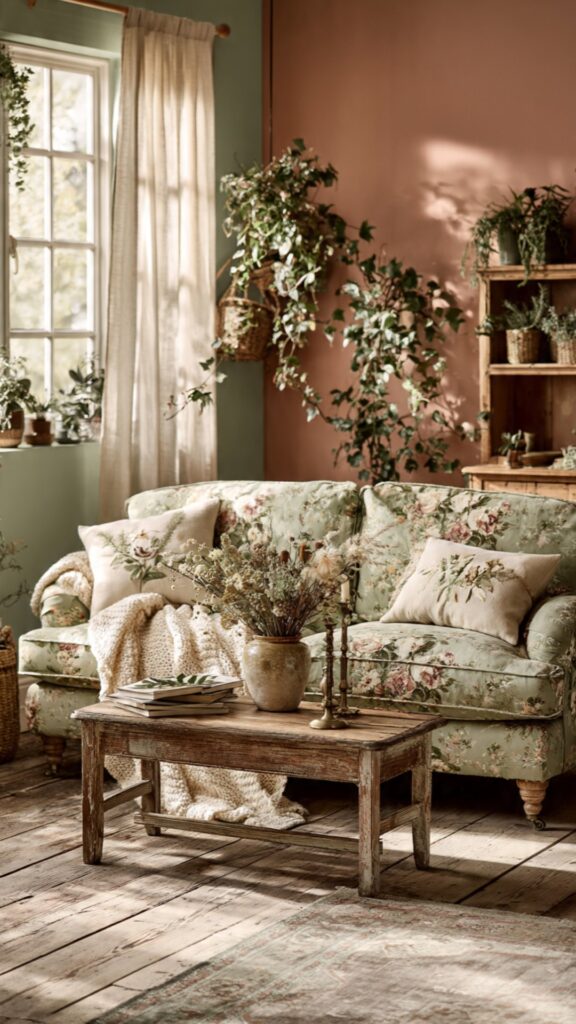
The foundation of any successful cottagecore living room is its color story. Unlike maximalist palettes, cottagecore leans into nature’s own tones: warm sage green, dusky rose, cream, warm taupe, muted terracotta, soft lavender, and the deep, rich brown of turned soil.
These colors feel familiar because they echo the outdoors a mossy forest floor, a wildflower meadow at dusk, or a sunlit kitchen garden in late summer. When choosing your base wall color, warm whites and aged creams are the most versatile. They reflect light beautifully while making the room feel airy without feeling sterile.
Sage green has become the signature accent shade of the aesthetic, often used on cabinetry, single feature walls, or as the dominant tone in smaller cottagecore living rooms where it wraps the entire space in a botanical embrace. If you want something slightly more unusual, dusty blue-green (sometimes called “duck egg blue”) adds a similarly grounded calm.
Avoid sharp contrasts and bright, saturated tones. Cottagecore palettes are deliberately desaturated they have a kind of faded, sun-bleached quality, as if the colors have been there for a long time and settled into themselves. A good practical test: if the color could appear in an 18th-century botanical illustration, it likely belongs in a cottagecore living room.
Paint brands like Farrow & Ball (Mizzle, Mole’s Breath), Benjamin Moore (Pale Smoke, Camouflage), and Earthborn Paints offer excellent options that hit that gentle, historic note. One often-overlooked insight: your ceiling and trim colors matter enormously in this aesthetic.
Don’t default to flat white. Instead, try painting the ceiling in a slightly warmer version of your wall color, or using a creamy antique white. Painting trim in the same color as walls rather than leaving it stark white creates a softly cocooning effect that feels genuinely cottage-like, as if the room grew rather than was constructed.
Choose Vintage or Antique Furniture:
That Tells a Story
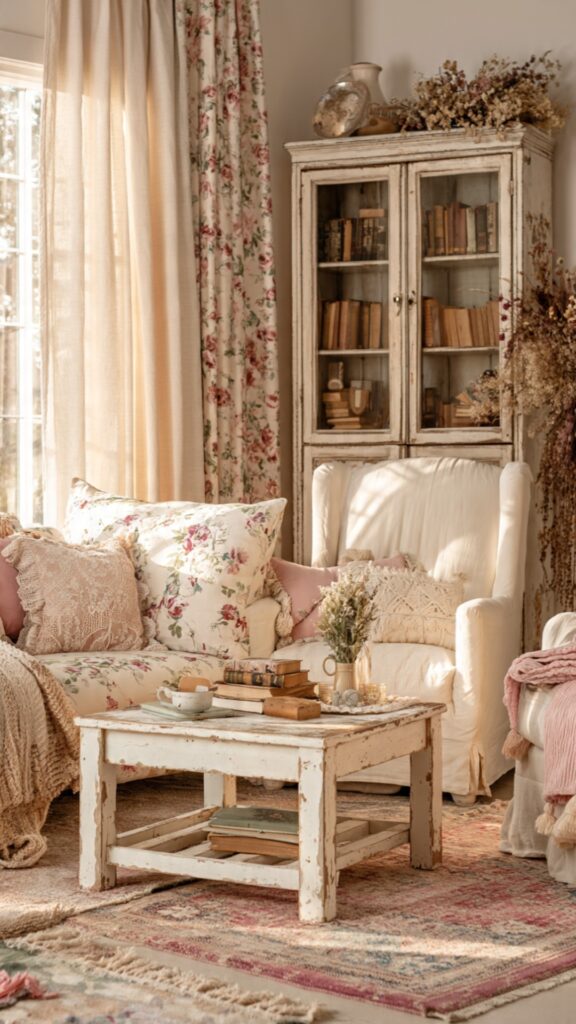
Furniture in a cottagecore living room should feel inherited rather than purchased. The goal isn’t “antique” in the precious, don’t-touch-it sense, but rather pieces that carry visible history slight wear on the armrests, a well-worn patina on a wooden coffee table, upholstery that has clearly been re-covered at least once. This sense of biography is what gives cottagecore spaces their emotional weight.
The most essential pieces are a generously cushioned sofa or loveseat (preferably upholstered in linen, cotton velvet, or a floral chintz), one or two mismatched armchairs, and a wooden coffee table with storage perhaps a blanket chest repurposed as a table.
Avoid perfectly matched furniture “sets” from big-box retailers. Instead, source your sofa second-hand, reupholster a vintage armchair in a complementary fabric, and find your coffee table at a flea market or estate sale. Key furniture styles that align with the cottagecore aesthetic include: Victorian parlor chairs with carved wooden frames, Arts and Crafts movement pieces (clean lines, honest joinery, natural wood),
Windsor chairs, Welsh dressers, and farm-style settle benches. These are all widely available second-hand and often surprisingly affordable compared to their new-retail equivalents. Shopping via Chairish, Vinterior, Facebook Marketplace, or local auction houses consistently yields better finds than any high-street furniture store.
One insight that competitors rarely mention: don’t try to match the wood tones of your furniture. A golden oak side table next to a darker walnut bookshelf creates exactly the kind of organic, collected-over-time layering that defines this aesthetic. Matching wood tones is what interior design tried to enforce in the early 2000s cottagecore deliberately moves past that convention, embracing a room that feels assembled by life rather than a decorator.
Read This First: Japandi Living Room Ideas That Inspire the Same Cozy and Natural Feel as Your Cottagecore Living Room
Layer Natural Textures:
For Depth and Warmth
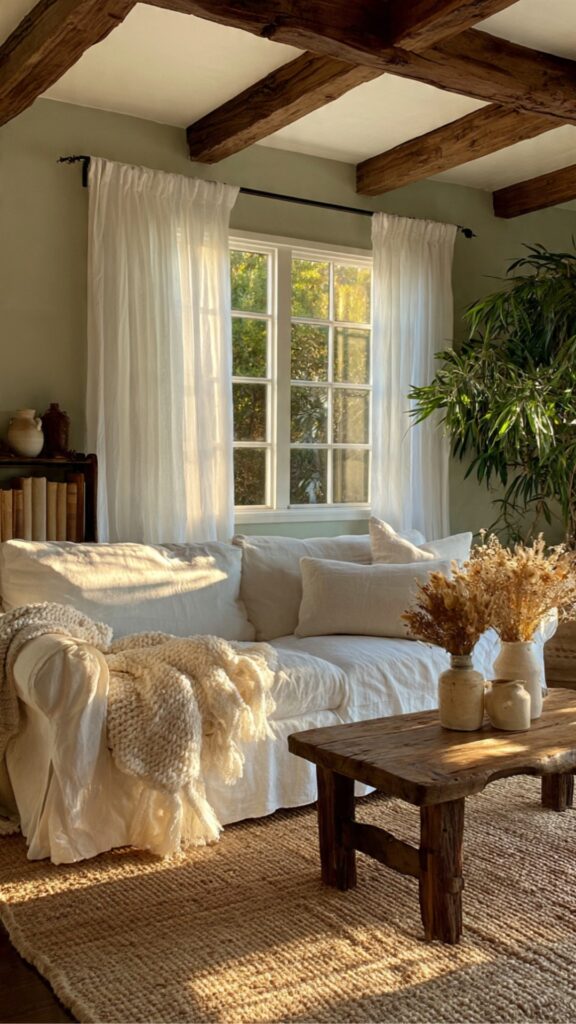
Texture is arguably the most important element in a cottagecore living room more important even than color or furniture. The right layering of natural textures is what makes a room feel physically warm and visually rich, rather than flat and staged. Without texture, even the most carefully chosen cottagecore color palette will feel inert and interior-design-catalogue rather than genuinely homey.
The core textures to prioritize are: woven wool throws, linen cushion covers, cotton quilts, jute or braided wool rugs, raw wood surfaces, wicker and rattan accents, aged leather, and handmade ceramics. Each of these materials has a tactile quality and visual irregularity that industrial materials simply cannot replicate.
They also age beautifully a linen cushion softens and wrinkles; a jute rug develops character; a wooden tray acquires patina. The space actually improves with use and time. Layering technique matters. Start with your largest texture (usually the rug ideally a patterned wool rug, a faded Persian, or a natural fiber rug), then build upward through furniture upholstery, throw cushions, and finally small accent pieces.
Cushions are the fastest and cheapest way to add texture variety: try combining a smooth linen cushion with a chunky knit, an embroidered cotton, and a faded floral print, all in tones that share a common color family. This “collect, don’t match” approach is the textural version of the furniture philosophy described above.
A nuance worth understanding: natural textures also improve the acoustic quality of a living room, making the space feel quieter and more sheltered. This isn’t just aesthetic psychology hard surfaces reflect sound, while woven fabrics, rugs, and wood absorb it. A well-layered cottagecore living room genuinely sounds different from a sparse, minimalist one. That subtle acoustic warmth reinforces the emotional sense of shelter and refuge that makes the aesthetic so compelling.
Bring Nature Indoors with Plants and Botanicals:
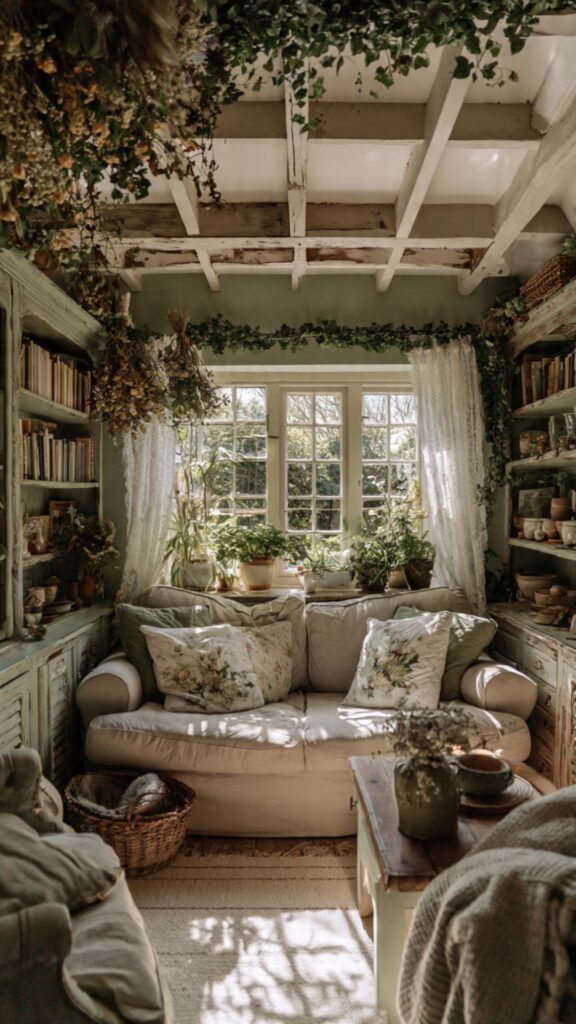
Plants are non-negotiable in a cottagecore living room. The aesthetic is built on a love of the natural world, and the fastest way to anchor that feeling in an interior space is through living greenery. However, the way plants are displayed in a cottagecore setting matters as much as which plants you choose. Forget the graphic, architectural plant-as-sculpture approach of Scandinavian minimalism cottagecore plants spill, trail, and cluster.
Ideal plants for the cottagecore living room include: trailing ivy (especially in antique terracotta pots or hanging wicker baskets), ferns in all their varieties, white-flowering jasmine trained around a window, geraniums on a windowsill, a sprawling pothos, herbs in mismatched ceramic pots, and dried flower arrangements in vintage bottles and vases.
The dried flower trend bundles of lavender, dried roses, eucalyptus, and pampas grass hung from ceiling beams or arranged in stoneware jugs perfectly suits cottagecore because it preserves the beauty of nature past its seasonal peak. Botanical illustrations and pressed-flower artwork serve as the 2D equivalent of living plants.
A gallery wall of antique botanical prints (widely available as affordable reproductions, or even as free downloadable vintage prints) adds enormous visual richness and signals the aesthetic’s deep connection to the natural sciences of the 18th and 19th centuries. Similarly, vintage naturalist field guides, flower-pressing kits displayed on shelves, and plant-dyed textiles all reinforce the botanical theme without requiring a green thumb.
One forward-looking insight: as biophilic design becomes increasingly mainstream in 2026 and beyond, the cottagecore emphasis on living plants and natural materials is being validated by emerging research on interior wellbeing.
Studies suggest that spaces with visible greenery and natural materials reduce cortisol levels and improve cognitive performance. The cottagecore living room was ahead of this curve what began as an aesthetic preference is increasingly supported by the science of how spaces affect human health.
Incorporate Floral and Folk-Art Patterns:
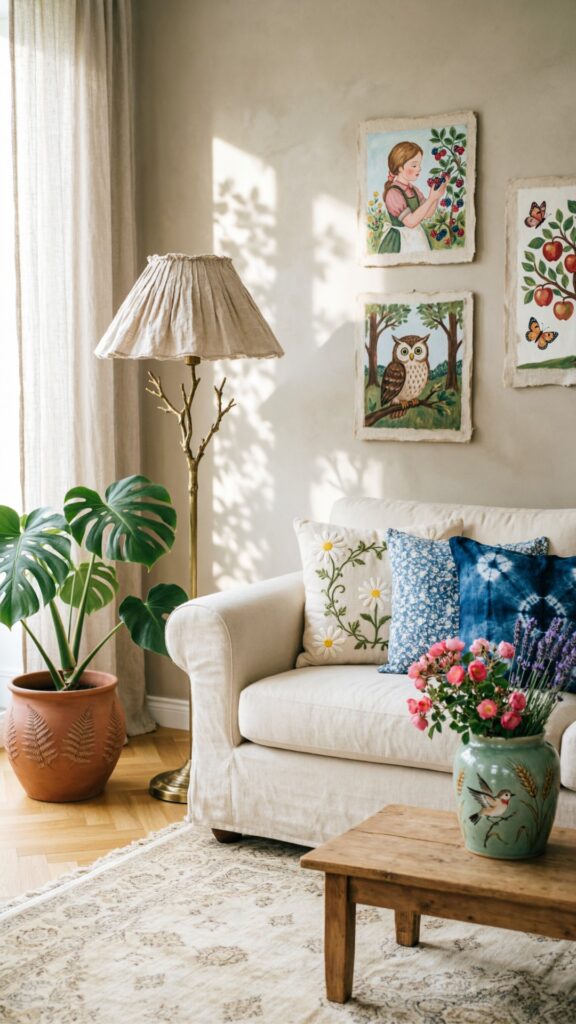
Pattern is where cottagecore gets its personality, and the two dominant languages are florals and folk art. Floral patterns whether on wallpaper, upholstery, curtains, or cushions are the visual signature of the cottagecore aesthetic. But the florals that work best are not bright, graphic ones.
They should feel slightly faded, painterly, and small-scale: the kind of pattern you’d find on a vintage Liberty of London fabric or a William Morris design from the 1880s. The key to using florals successfully is scale variation. Pair a large-scale floral wallpaper (or a feature wall with botanical print wallpaper) with smaller-scale floral cushion fabrics and a near-plain linen sofa.
Too many competing floral scales creates visual chaos; the right combination creates layered depth. A useful trick: choose florals that share two or three common colors, even if the overall design differs significantly. This creates visual harmony without uniformity.
Folk art patterns Scandinavian rosemaling, Eastern European cross-stitch embroidery, English Toile de Jouy prints, and Welsh tapestry patterns add cultural depth to the cottagecore aesthetic. These traditions share cottagecore’s emphasis on handcraft, nature imagery, and the beauty of everyday domestic life.
Incorporating a piece of genuine folk craft (a hand-embroidered cushion cover, a painted wooden tray in a Nordic style, or a piece of traditional hand-block-printed fabric) grounds the aesthetic in real cultural history rather than Pinterest fantasy.
One thing many cottagecore guides miss: pattern mixing works best when you respect the “60-30-10” principle adapted for this aesthetic. Approximately 60% of your visual field should be your base tone/neutral texture, 30% should be one dominant pattern (usually the largest floral), and 10% should be accent patterns (folk-art or geometric details). This proportion keeps the room feeling rich but not overwhelming, and prevents the space from looking like a fabric sample room.
Use Soft, Warm Lighting to Create Atmosphere:
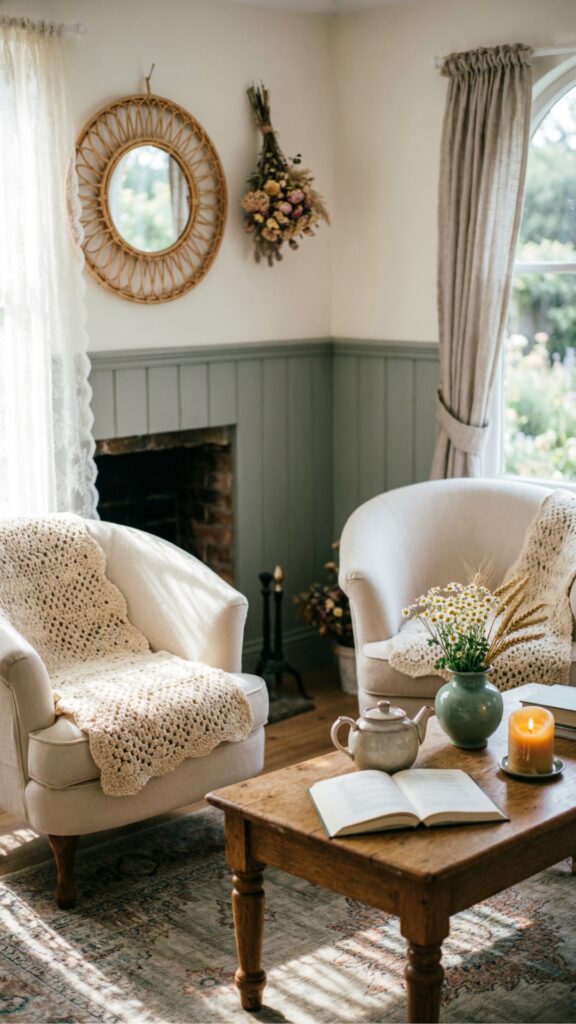
Lighting is perhaps the most transformative and most underestimated element of a cottagecore living room. The entire aesthetic depends on warm, soft, layered light. Overhead fluorescent or cool-white LEDs are the enemy of cottagecore; they flatten texture, bleach color, and strip atmosphere. The right lighting makes every other element of the room come alive.
The ideal cottagecore lighting scheme relies on multiple low-level light sources rather than one dominant overhead fixture. Think: table lamps with warm-toned bulbs (2700K or below) on side tables and shelving, a standing lamp in the reading corner with a fabric shade (linen or pleated cotton in a warm tone), strings of fairy lights woven through dried-flower arrangements or along bookshelves, and most powerfully candles.
Beeswax candles, in particular, cast a golden light with a slight honey warmth that is unmatched by any electric equivalent. For pendant or ceiling fixtures, cottagecore living rooms favor: wicker or rattan pendant shades, aged brass or copper fittings, glass oil-lamp style pendants, and ceramic pendant lights in earthy tones.
Avoid chrome, brushed nickel, or anything that reads as industrial or contemporary. The fixture should look as if it could plausibly have been made by hand even if it wasn’t. Vintage lamp bases (converted oil lamps, ceramic bases, wooden-turned lamps) give the space that sense of accumulated history.
A practical note on bulbs: the color temperature of your lightbulbs has a dramatic effect on how your wall colors read in the evening. A sage green wall that looks balanced in natural daylight can appear either beautifully warm or slightly murky under artificial light depending on bulb temperature.
Always test your wall color under the actual bulbs you intend to use at 2700K, warm tones sing, cool tones deepen, and the whole room acquires the golden quality that makes cottagecore spaces so photographable and emotionally inviting after dark.
Display Collections and Curios with Intention:
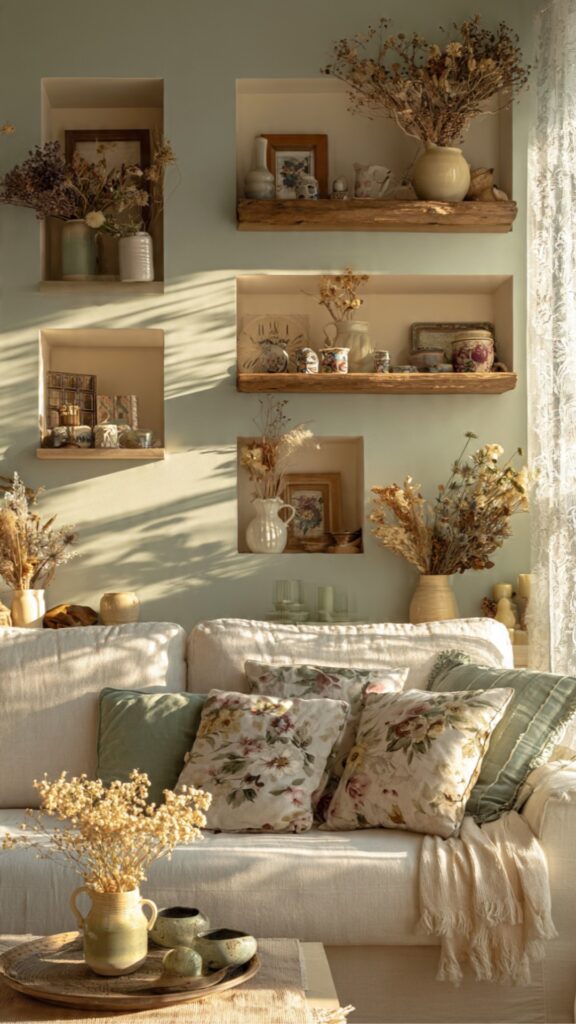
Cottagecore living rooms celebrate the collector’s instinct but there’s an important distinction between thoughtful display and clutter. The difference lies in curation and organization. A collection of vintage pressed-glass inkwells arranged on a wooden shelf, graduated by size, is curated. Dozens of random knick-knacks covering every surface is clutter. Both involve many objects, but only one creates visual interest rather than visual anxiety.
The most characterful cottagecore collections tend to center on: vintage books (especially natural history, poetry, and cookery), antique botanical prints or watercolors, handmade ceramic pieces (studio pottery, in particular, has enormous cottagecore alignment), vintage glassware (milk glass, pressed glass, apothecary bottles), shells and natural specimens, and folk-art objects with a clear cultural origin.
The connecting thread is always nature, craft, and history objects that carry a sense of being made by human hands or collected from the natural world. Display surfaces matter enormously. A wooden floating shelf, a vintage Welsh dresser, or an antique armoire with open shelving are all ideal.
Group objects in odd numbers (threes and fives are the most visually stable), vary the height of objects within each grouping, and leave some breathing space between groups. Books displayed both upright and stacked horizontally, with small objects resting on top of the stacks, is a classic cottagecore shelf styling technique that creates the right sense of relaxed abundance.
A future-oriented thought: in 2026, the “collected display” aesthetic is increasingly informed by sustainability consciousness. More cottagecore enthusiasts are deliberately choosing to display objects with a provenance — things found, inherited, or locally made rather than decorative objects manufactured for the sole purpose of looking good on a shelf.
This shift makes the aesthetic more authentic and more defensible from an environmental standpoint. It also makes each collection uniquely personal, which is ultimately what distinguishes a cottagecore living room from a mere cottagecore-inspired one.
Add a Reading Nook or Cozy Corner:
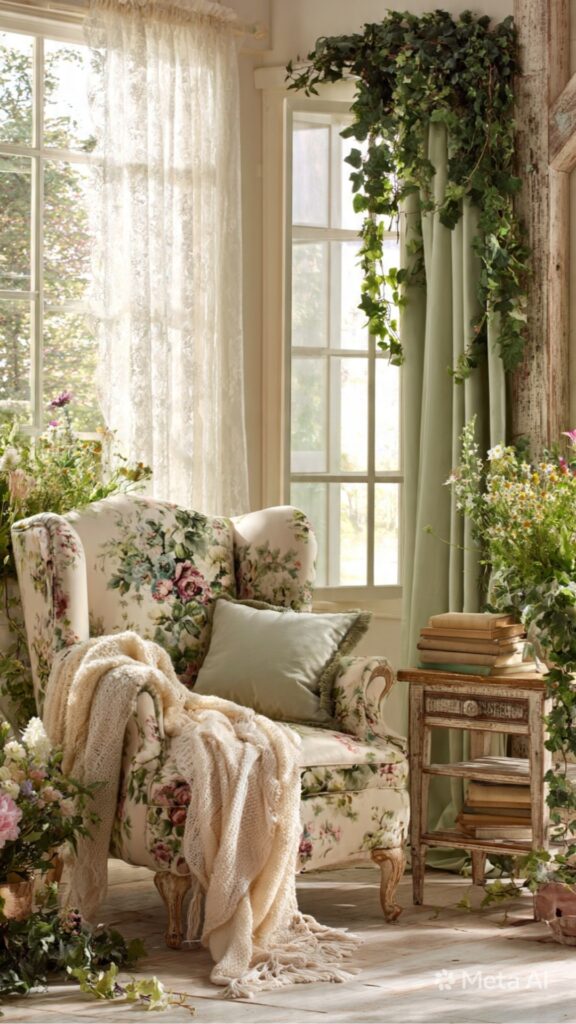
A cottagecore living room is incomplete without a dedicated space for quiet retreat typically a reading nook or cosy corner that functions as a room-within-a-room. This doesn’t require a separate architectural space; it’s a zone created through furniture arrangement, layered textiles, and focused lighting. Even in an open-plan living room, the right arrangement can carve out a corner that feels enclosed, private, and specifically welcoming.
The essential components of a cottagecore reading nook: one generously proportioned armchair (ideally wing-backed, for a sense of enclosure), a small side table within arm’s reach for a cup of tea, a floor lamp positioned over the left or right shoulder, a footstool or small ottoman, a stack of books on the floor or a nearby shelf, and at least one throw blanket draped within easy reach.
This configuration is deliberately specific because each element serves a purpose it isn’t just decoration, it’s the infrastructure of comfort. If your living room has a bay window, a window alcove, or even a slightly recessed wall, these architectural features naturally frame a reading nook without additional effort.
A built-in window seat with cushioned upholstery and storage drawers beneath is one of the most desirable cottagecore living room features, both for its function and its visual charm. If your space doesn’t have one, a simple upholstered bench pushed into a corner, backed by a fabric wall hanging, achieves a surprisingly similar effect.
The psychological importance of a reading corner in a cottagecore living room is worth reflecting on. In a culture of screens and perpetual digital connectivity, a physical space dedicated to reading, handwork, or quiet contemplation represents something genuinely countercultural.
Cottagecore, at its philosophical core, is about slowing down and finding richness in simple, sensory pleasures. A reading nook embodies that philosophy in concrete form it gives the inhabitant a spatial permission to be still.
You Might Thank Us Later: Indoor Plants Styling Ideas That Bring the Perfect Cottagecore Touch to Your Living Room
Use Handmade and DIY Decor Elements:
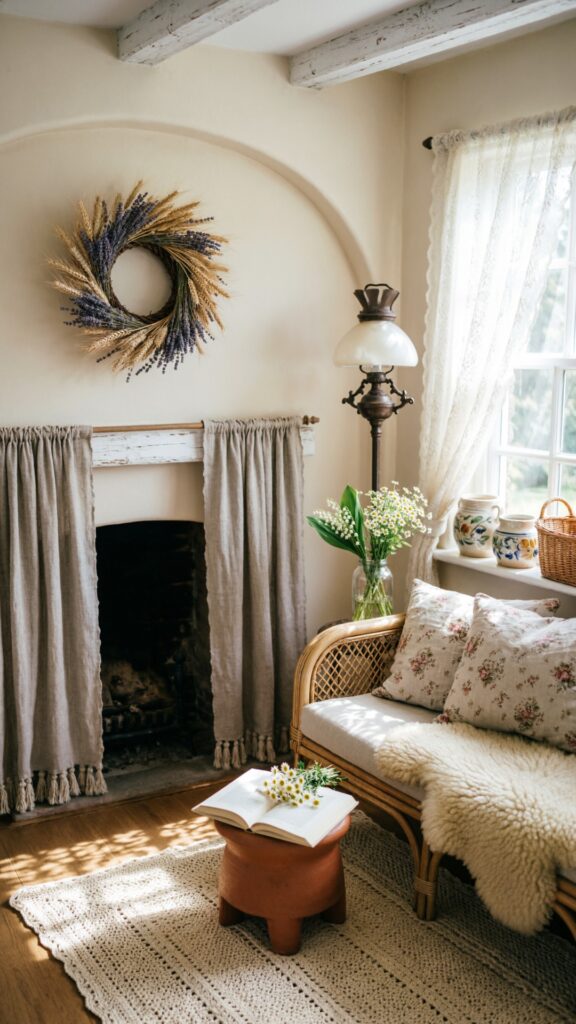
Handmade objects are the soul of cottagecore. The aesthetic’s fundamental premise that beauty is found in imperfection, craft, and human touch can only be fully realized when some of the objects in the space were made by hand. This doesn’t require advanced skills. Even the most basic hand-crafted elements add authenticity and warmth that no manufactured product can replicate.
The most accessible DIY cottagecore projects include: hand-embroidered cushion covers (embroidery kits for beginners are widely available and produce beautiful results), macramé wall hangings, dried flower wreaths, hand-painted terracotta pots, decoupage trays covered with vintage botanical illustrations, and beeswax candles poured into antique vessels.
Each of these can be completed in an afternoon with inexpensive materials and requires no prior crafting experience. The visible human touch slight irregularities, uneven edges, personal embellishments is the point. Buying handmade from independent makers and small craft businesses is the next best option for those with limited time for DIY. Platforms like Etsy,
Not on the High Street, and local craft fairs are rich with cottagecore-aligned handmade pieces: hand-thrown ceramics, hand-woven textiles, illustrated prints, wooden-turned bowls, and hand-dyed linen. Prioritizing makers who can tell you about their process and materials connects your home to the broader crafts economy and aligns with the ethical consumption values that underpin the modern cottagecore philosophy.
A point that most guides don’t make clearly enough: the presence of genuinely handmade objects in a living room fundamentally changes how the space feels to visitors. Mass-produced perfection creates a kind of emotional distance you can admire it but not relate to it.
Handmade imperfection is approachable, conversation-starting, and identity-expressing. A visitor who notices an embroidered cushion and asks “did you make that?” opens a far more interesting conversation than one who notices a perfect velvet cushion from a high-street homeware brand.
Incorporate a Fireplace or Candle Display:
As a Focal Point
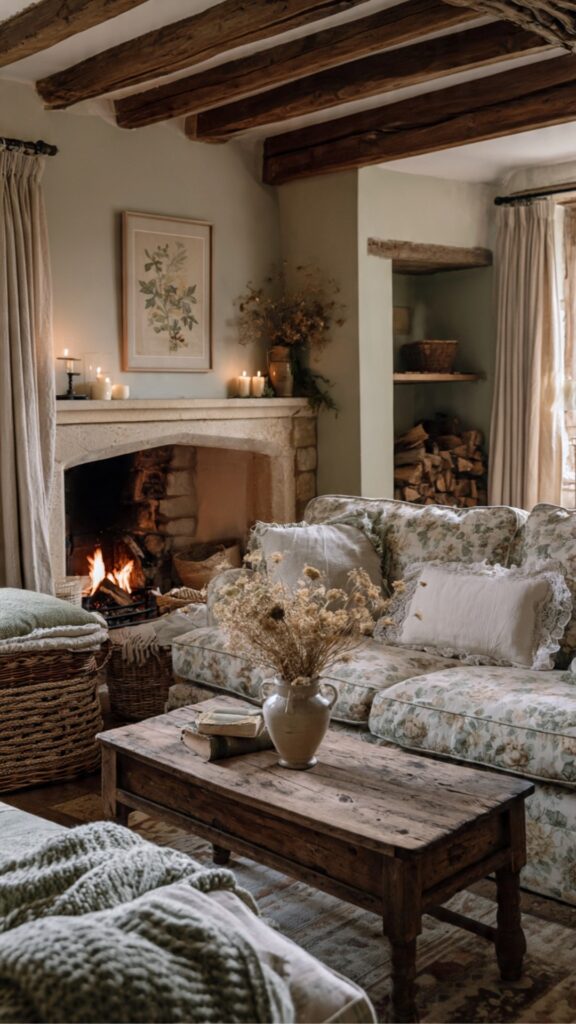
Every great living room needs a focal point, and in a cottagecore living room, nothing achieves this more effectively than a fireplace. The combination of warmth, movement, light, and sound makes a real fire the ultimate cottagecore element it engages all the senses simultaneously and creates exactly the cocooning atmosphere that defines the aesthetic.
If you’re fortunate enough to have a working fireplace, making it the visual and functional heart of your cottagecore living room is the single highest-return design decision you can make. Even a non-working fireplace either decorative or with a wood-burning stove insert provides an architectural focal point around which the room can organize itself.
A mantelpiece is one of the most versatile display surfaces in a cottagecore living room: arrange it with a mix of candles in varying heights, a small vase of seasonal flowers, a framed botanical print or antique mirror, and perhaps a few meaningful objects (a ceramic bird, a collection of smooth river stones, a vintage clock). The mantelpiece display should feel loose and changeable with the seasons.
For living rooms without a fireplace, a dedicated candle vignette can achieve a similar (if more modest) focal effect. A large, flat wooden tray or a slate hearth tile arranged with a collection of pillar candles in varying heights, surrounded by seasonal natural materials (dried seedheads, pine cones, moss), creates a visual anchor for the room.
When lit in the evening, even a modest candle arrangement transforms the atmosphere of the space entirely. Always choose unscented or naturally scented candles synthetic fragrance is antithetical to the cottagecore sensibility. The fireplace or candle focal point also solves one of the most common challenges in cottagecore living room design: where to put the television.
The honest answer is that the TV is philosophically awkward in a cottagecore space, which emphasizes analog pleasures and sensory engagement. Many cottagecore enthusiasts either hide the TV within a media cabinet, relocate it to a separate room, or significantly reduce its prominence by refusing to make it the room’s focal point. The fireplace or candle display offers a beautiful alternative center of gravity one that invites gathering rather than passive viewing.
Choose Curtains and Window Treatments:
That Filter Light Beautifully
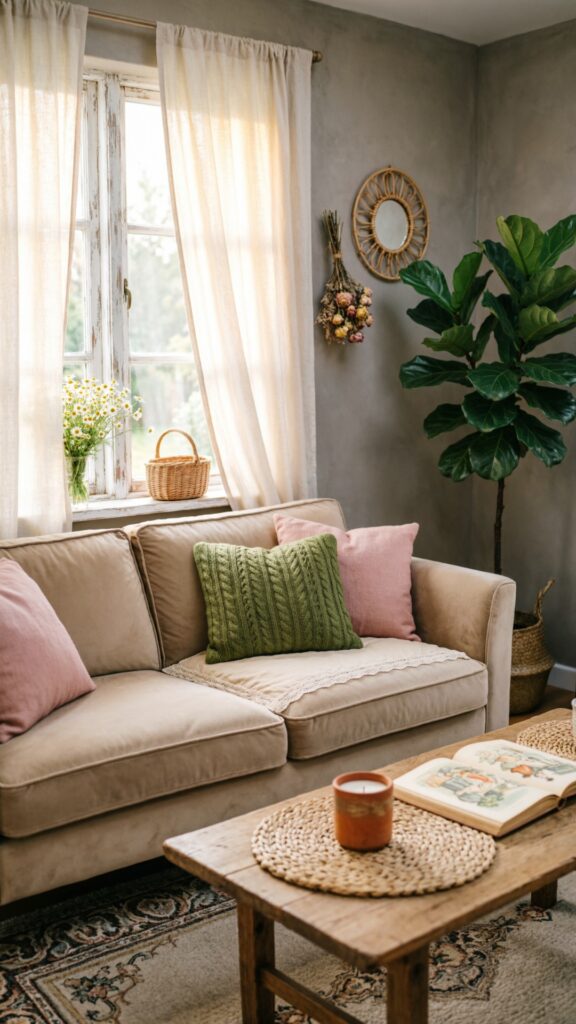
Windows in a cottagecore living room should frame the outside world like a painting and filter light as beautifully as possible. Heavy, room-darkening curtains that block natural light are incompatible with the aesthetic natural daylight is one of the most important atmospheric tools in the cottagecore toolkit. The goal is curtains that soften and warm the light while maintaining connection to the outdoors.
The ideal cottagecore curtain fabrics are: unlined or lightly lined linen (which diffuses light into a warm, honeyed glow), sheer cotton voile in cream or soft white (which filters light while remaining nearly transparent), and heavier linen or cotton-velvet for evening warmth and insulation.
Avoid synthetic fabrics entirely polyester curtains have a sheen and a drape that reads as immediately modern and mass-produced, which is entirely at odds with the aesthetic. The natural irregularity of linen or cotton weave is part of its visual appeal.
Patterns on curtains should be chosen carefully, because curtains represent a large surface area of the room. In a space that already has patterned cushions and upholstery, plain or subtly textured curtains (a simple stripe, a small-scale botanical print, or a tone-on-tone texture) prevent visual overwhelm.
If your furniture is mostly in plain fabrics, a gorgeous floral or botanical print curtain can serve as the room’s primary pattern statement. The curtain rod or track itself should be in a natural material a wooden pole or an aged-brass rod, with simple ring-top curtain headings that gather softly.
Layering window treatments adds the most visual interest and the greatest functional flexibility. A sheer panel close to the glass for daytime light-filtering, with a heavier linen or printed cotton curtain on the outer track for evening privacy and warmth, gives you complete control over the light and creates a beautifully layered visual effect. This double-layer approach is common in country houses and historic interiors, which makes it feel authentically connected to the cottagecore living room aesthetic’s historical roots in pre-industrial domestic life.
Incorporate Secondhand and Sustainable Finds:
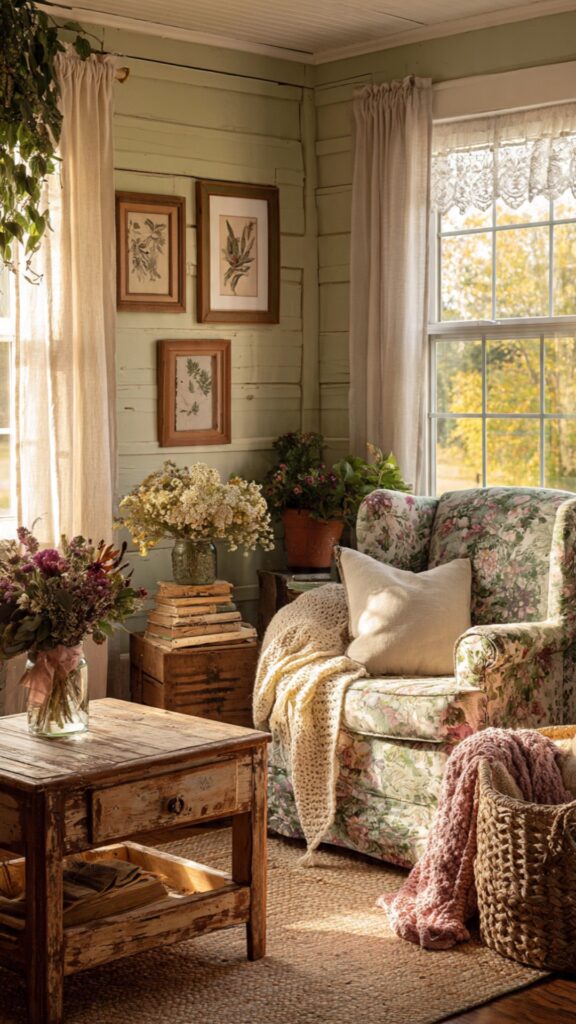
Sustainability is no longer a sub-theme of cottagecore in 2026, it’s a central pillar. The original cottagecore aesthetic was implicitly sustainable (it celebrated old things, reused materials, and slow living), but the modern iteration is making that sustainability explicit and intentional.
Choosing secondhand, vintage, and locally sourced items isn’t just aesthetically coherent with cottagecore; it’s the ethical position that the most thoughtful practitioners of the aesthetic are actively advocating. Secondhand sourcing is also, practically speaking, the best way to build a genuinely characterful cottagecore living room on a realistic budget.
Estate sales, charity shops, car boot sales, and online secondhand platforms consistently yield higher-quality, more characterful pieces than new-retail equivalents at a fraction of the price. A Victorian parlor chair found at a charity shop, reupholstered in a hand-printed fabric, will be more beautiful, more durable, and more distinctively yours than any new “vintage-style” armchair from a homeware chain.
Key sustainable practices that enhance rather than compromise the cottagecore aesthetic include: natural beeswax or soy candles over paraffin, natural-fiber textiles (wool, cotton, linen, jute) over synthetic equivalents, plant-based dyes in textile purchases where possible, locally made ceramics over imported fast-decor, and natural cleaning products (white vinegar, beeswax wood polish) that align with the cottagecore living room ethos of whole-home intentionality.
Each of these choices has both an aesthetic and an ethical rationale, which is the definition of values-aligned interior design. One area where this intersects with interior design’s future direction: major sustainability certifications and “circular design” principles are increasingly influencing how furniture and decor are made and marketed.
Brands that offer repair services, take-back programs, or furniture designed for long-term repair rather than replacement are inherently more cottagecore in philosophy than fast-furniture equivalents. As these business models become more mainstream, the cottagecore living room will become not just aesthetically desirable but economically and environmentally forward-looking.
Arrange Your Living Room:
To Encourage Conversation and Connection
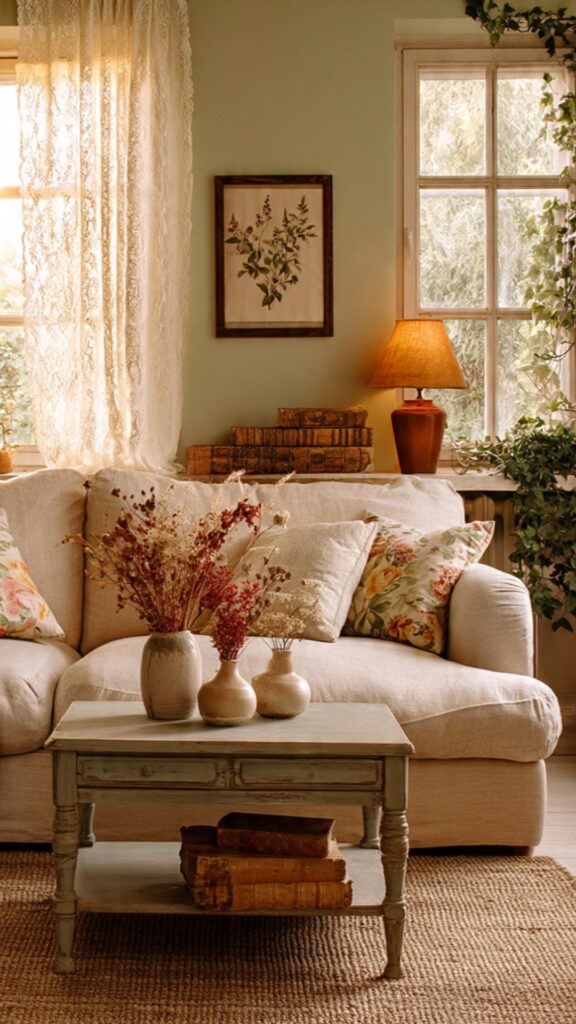
Cottagecore is, at its heart, an aesthetic of togetherness it evokes farmhouse kitchens, village parlors, and the kind of domestic spaces where people gathered for conversation, shared meals, and communal craft rather than passive individual consumption. The furniture arrangement in a cottagecore living room should actively support and encourage that gathering quality, drawing people toward each other rather than toward a screen.
The classic cottagecore seating arrangement places the sofa and chairs in a roughly circular or U-shaped configuration around a central coffee table, with the focal point (fireplace, candle display, or botanical vignette) as the backdrop rather than the television.
This arrangement means that when multiple people are in the room, they naturally face each other rather than a single screen. It’s a small spatial decision with a significant social effect spaces arranged for conversation tend to generate more conversation.
Scale and proportion matter enormously in this arrangement. The seating should feel gathered rather than spread out chairs positioned within comfortable conversational distance (roughly 2–3 meters from the sofa, closer for smaller rooms). A large, low coffee table gives everyone within the seating group a surface within reach.
Adding a side table between the sofa and a chair bridges the two seats visually and functionally, creating a sense that the seating group belongs together even though the pieces don’t match. One underappreciated element of the social cottagecore living room is the presence of “activity anchors” surfaces and areas that support doing things together, not just sitting.
A side table set up permanently with a jigsaw puzzle, a basket of wool and knitting needles beside an armchair, a board games cabinet within easy reach these elements turn the living room into a space for active shared time rather than parallel passive time. They embody the cottagecore living room philosophy of slowing down and finding pleasure in simple, shared, analog activities.
Must Read: Whimsical Garden Ideas That Share the Same Dreamy and Magical Vibe as Your Cottagecore Living Room
Decorate Seasonally:
To Keep Your Cottagecore Living Room Feeling Fresh
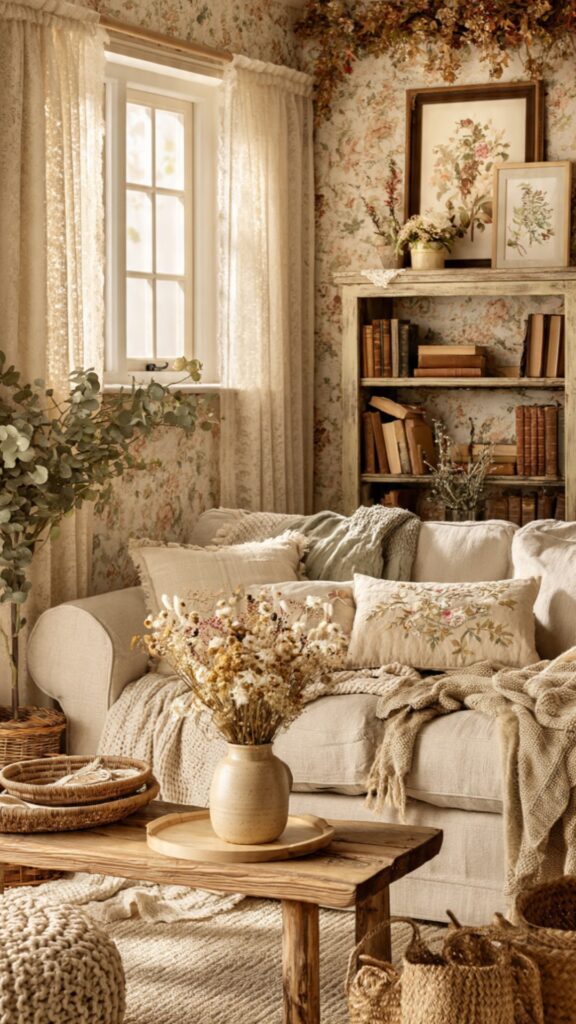
One of the most distinctive and most rewarding aspects of cottagecore living room design is its deep attunement to the seasons. Rather than treating the living room as a static, finished space that looks the same in January as it does in July, cottagecore encourages a constantly evolving room that reflects the natural world outside. This seasonal approach is both aesthetically dynamic and psychologically grounding, connecting the inhabitants to the rhythm of the year.
In practice, seasonal decoration is simpler than it sounds. The main elements that change are: flowers and plants (fresh spring blooms, summer wildflowers, autumn dried arrangements, winter evergreen and berry branches), textiles (lighter linen throws in summer, heavier wool blankets in winter), and the mantelpiece or focal-point display (seasonal natural materials pine cones and holly in December, pussy willow and daffodils in March, berries and seedheads in October).
These swaps take perhaps an hour and cost very little, especially if you’re gathering seasonal materials from gardens or countryside walks. Autumn is widely considered the peak season for cottagecore living room aesthetics the warm color palette of turning leaves, the comfort-seeking instinct, the abundance of harvest imagery, and the drawing-in of indoor life all align perfectly with the aesthetic’s values.
However, cottagecore in spring has its own particular magic: fresh green growth, flowering bulbs, blossom branches arranged in ceramic jugs, and the reopening of windows to natural sounds creates a version of the aesthetic that is lighter, more hopeful, and equally beautiful.
A forward-looking observation: the practice of seasonal decoration is increasingly being recognized as a meaningful mental health practice, not just an aesthetic choice. Marking the passage of seasons through intentional domestic rituals changing the living room to reflect the time of year gives a sense of time’s texture that the homogenized indoor environments of modern urban life tend to erase.
A cottagecore living room that changes with the seasons creates a sense of being embedded in natural time, which many people find deeply satisfying in a world that often feels relentlessly the same.
Conclusion
A cottagecore living room is more than a trend it’s a deeply considered philosophy of domestic life that prioritizes warmth, craft, nature, and human connection over perfection and trend-chasing. From earthy color palettes and vintage furniture to handmade textiles and seasonal displays, every element works together to create a space that feels genuinely alive and deeply personal.
The best cottagecore living rooms are never “finished” they grow, change, and deepen with time, just like the best-loved homes always have. Start with one idea from this guide, trust your instincts, and let your space evolve at its own pace.

Team TrandyVilla is the passionate home decor team behind Trandy Villa, where style meets comfort in everyday living. The team loves transforming simple spaces into beautiful, functional homes through smart ideas, budget-friendly hacks, and modern design trends. Their content focuses on helping readers create homes that feel both stylish and personal without spending too much.