
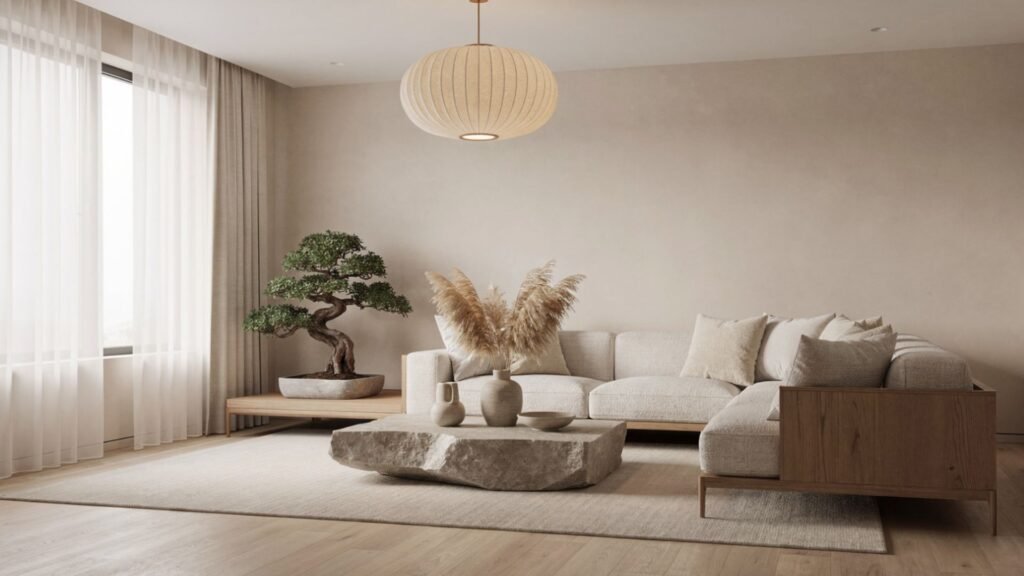
The Japandi living room has become one of the most sought-after interior design styles of the decade and for excellent reasons. Combining the mindful minimalism of Japanese aesthetics with the cosy functionality of Scandinavian design, it creates living spaces that are simultaneously beautiful, practical, and deeply calming.
Japandi living room design blends Japanese minimalism with Scandinavian functionality. It creates calm, clutter-free spaces using natural materials, warm neutrals, and purposeful furniture. The style follows two core principles: wabi-sabi (embracing imperfection) and hygge (cosy warmth).
Together, they produce interiors that feel both serene and liveable. Japandi suits modern homes, small apartments, and anyone seeking peace through thoughtful design.
A Japandi living room transforms your home into a sanctuary of stillness and style. This fusion aesthetic delivers timeless beauty without excess proving that true elegance lies in simplicity, intention, and the quiet confidence of choosing less.
Japandi living room ideas focus on low-profile furniture, earthy colour palettes, and handcrafted décor. Natural wood, linen textiles, ceramic accents, and indoor plants define the look. Every element serves a purpose. Warm lighting and hidden storage keep the space open and breathable. The result is a living room that feels grounded, refined, and deeply comfortable every day.
The Core Colour Palette of a Japandi Living Room:
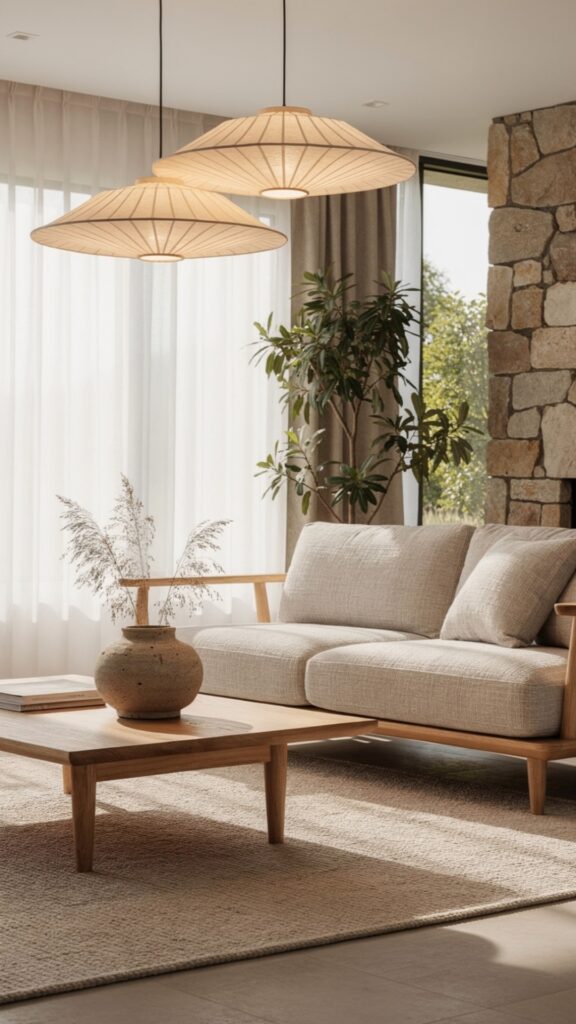
Colour is the foundation of any Japandi living room, and getting it right sets the tone for everything else. The palette is deliberately muted and earthy think warm whites, soft beiges, dusty sage greens, clay terracottas, and deep charcoals. These tones are inspired by nature and have an inherent ability to calm the nervous system, which is why Japandi spaces feel so restful.
Unlike pure Scandinavian interiors that lean heavily into bright whites, Japandi incorporates the warmth of Japanese earth tones. A muddy olive green on one accent wall, paired with a warm linen sofa and a dark walnut coffee table, is a perfect Japandi combination. The contrast is subtle never jarring and always harmonious.
One overlooked insight: Japandi colours work best when they are layered, not matched. Instead of picking one neutral and repeating it across every surface, mix three or four tones within the same family. For example, a sage green cushion against a warm white sofa on a caramel jute rug creates visual depth without breaking the palette’s tranquillity.
Future-forward interior colour forecasting consistently shows earthy, biophilic palettes gaining momentum. As sustainability becomes a design priority, colours that reference natural materials raw clay, stone, driftwood are predicted to dominate living room design well into the next decade. Japandi is ahead of this curve, not chasing it.
Furniture Selection:
Choosing Pieces That Define a Japandi Living Room
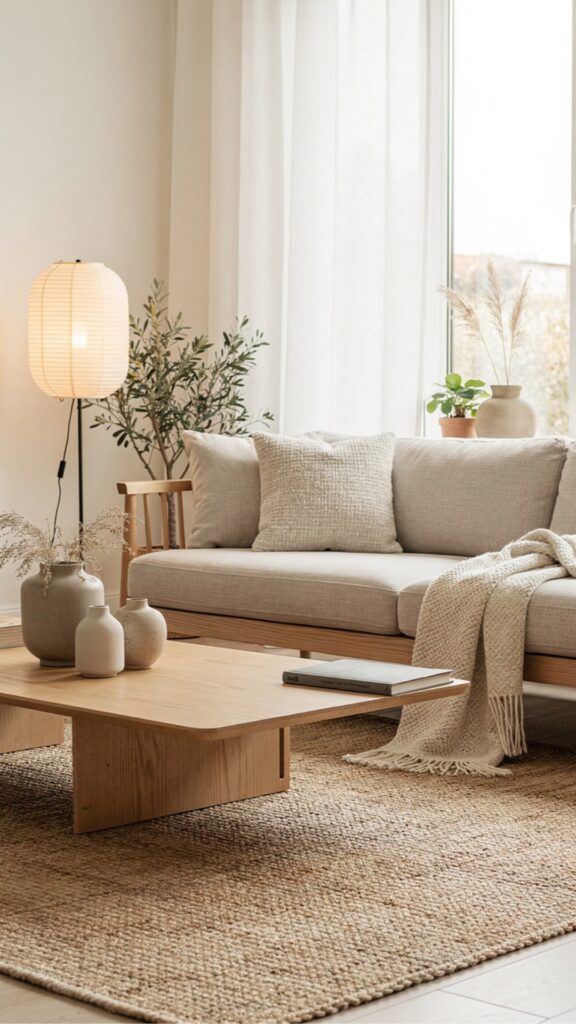
Furniture in a Japandi living room must earn its place. Every piece serves a function, but it also needs to contribute to the aesthetic low silhouettes, natural materials, and clean geometric forms. The most iconic Japandi furniture choices include low-slung sofas, platform coffee tables, and slatted wooden shelving.
Avoid anything with ornate carvings, chrome finishes, or excessive cushioning. Japanese furniture design traditionally emphasises closeness to the ground, which makes spaces feel grounded and serene. When you layer this with the Scandinavian preference for solid, enduring craftsmanship, you get pieces built to last decades both physically and stylistically. This is the anti-trend living room: furniture that will never feel dated.
A practical tip many design guides miss: scale matters enormously in Japandi. Oversized sectional sofas even in neutral colours disrupt the visual calm of the space. Instead, opt for a medium-sized two or three-seater sofa with tapered legs in natural wood. This raises the sofa slightly off the floor, creates an airy feel, and allows light to flow beneath the furniture.
When shopping for Japandi furniture on a budget, focus on second-hand or vintage Scandinavian pieces from the 1960s and 70s. Mid-century modern design shares many of Japandi’s values clean lines, functional beauty, quality materials and pieces from this era are often beautifully aged, perfectly embodying wabi-sabi aesthetics.
Natural Materials:
The Soul of Japandi Living Room Design
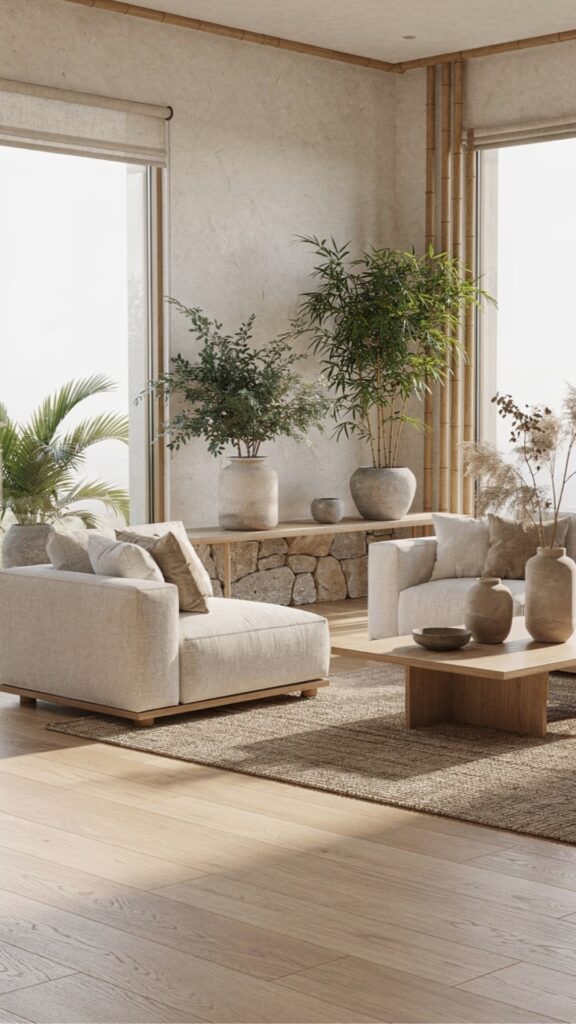
If Japandi has a non-negotiable rule, it is this: prioritise natural materials above everything else. Wood, stone, linen, wool, ceramic, bamboo, rattan, and natural cotton are the building blocks of this aesthetic. Synthetic or plastic materials disrupt the organic energy that Japandi is designed to create. Even small substitutions swapping polyester cushion covers for linen make a significant difference.
In the living room, natural materials should appear across multiple layers. The floor might be pale oak or bamboo. The sofa upholstery in oatmeal linen. The coffee table in solid walnut or stone. The throws in chunky wool or woven cotton. The planters in raw terracotta or matte stoneware.
This layering of textures adds visual richness without pattern or colour complexity. What competitors rarely discuss is the sensory dimension of natural materials in Japandi spaces. Running your hand across a rough linen cushion, hearing the soft sound of bare feet on wooden floors, or smelling the faint earthiness of a beeswax-finished table these sensory details are central to the Japandi philosophy of mindful living.
The space is designed to be felt, not just photographed. Sustainability is another reason to embrace natural materials in your Japandi living room. Responsibly sourced timber, organic linen, and hand-thrown ceramics from local artisans support both the environment and the local economy.
In 2026 and beyond, consumers are increasingly choosing design that aligns with their values, and Japandi sits at the intersection of beauty and conscience.
See these ideas: Luxury Living Room Ideas That Perfectly Blend with Your Japandi Style.
Lighting Design in a Japandi Living Room:
Warm, Layered, and Intentional
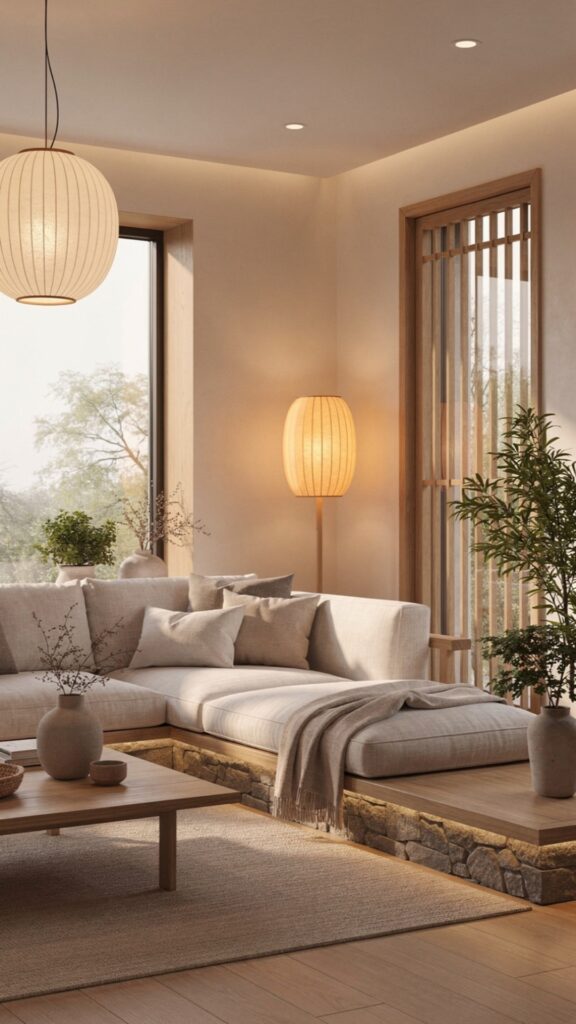
Lighting in a Japandi living room is never an afterthought it is a design element as important as the furniture. The goal is warm, diffused light that mimics the quality of natural daylight and eliminates harsh shadows. Cold white or blue-toned LEDs are the enemy of Japandi ambience. Always choose bulbs with a colour temperature between 2700K and 3000K for a golden, cosy glow.
Layering light sources is essential. A combination of pendant lights, floor lamps, table lamps, and candles creates depth and allows you to shift the mood of the room throughout the day. In the morning, natural light through unlined linen curtains fills the space softly.
By evening, a single low-hanging pendant over the coffee table and a candle cluster on the windowsill creates a deeply intimate atmosphere. Paper pendant lamps particularly those inspired by Japanese washi or Nordic paper lantern traditions are an iconic Japandi lighting choice.
They diffuse light beautifully, have an organic sculptural quality, and are remarkably affordable. Brands like HAY, Muuto, and Japanese craft studios produce stunning options, but handmade alternatives from small artisan markets carry an even stronger wabi-sabi spirit.
One advanced tip: Use dimmer switches throughout your Japandi living room. The ability to gradually reduce light levels as evening progresses is deeply aligned with the Japanese concept of twilight living the idea that our environment should respond to our biological rhythms.
This is one of those details that dramatically improves daily quality of life, yet is rarely mentioned in standard design guides.
Textiles and Soft Furnishings in a Japandi Living Room:
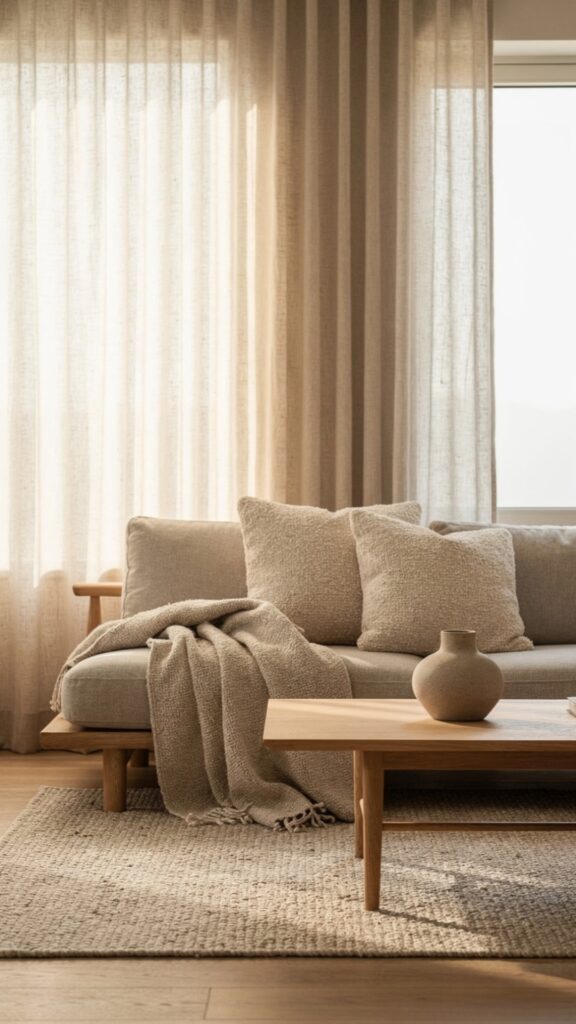
Textiles bring warmth and humanity to what could otherwise feel like a cold minimalist space. In a Japandi living room, the right soft furnishings act as emotional anchors a chunky wool throw draped over a sofa arm, a hand-woven cushion in dusty blush, or a sheepskin rug layered over a natural sisal base. These pieces invite touch and signal that the space is lived in, not just displayed.
The key principle for Japandi textiles is texture over pattern. While subtle geometric prints or natural woven textures are acceptable, bold patterns disrupt the visual calm.
Stick to solids, tone-on-tone weaves, or very quiet textures think herringbone in warm grey, waffle-weave in oatmeal, or a heavy linen in undyed natural. The interest comes from the material itself, not a printed design.
Layering rugs is a technique borrowed from Scandinavian interiors that translates beautifully into Japandi. Try a flat-woven natural fibre rug as the base, then layer a smaller, softer hand-knotted rug on top. This adds visual depth and warmth while maintaining the understated aesthetic. It also helps define the seating area in open-plan living rooms a practical and aesthetic win simultaneously.
From a health and wellbeing perspective, natural textiles like organic cotton, linen, and wool are also free from synthetic chemical treatments that off-gas into indoor air.
In the context of Japandi’s philosophy of mindful, intentional living, choosing materials that are genuinely safe and sustainable is not just an aesthetic decision it is an ethical one.
Decluttering and Storage:
The Invisible Architecture of Japandi Spaces
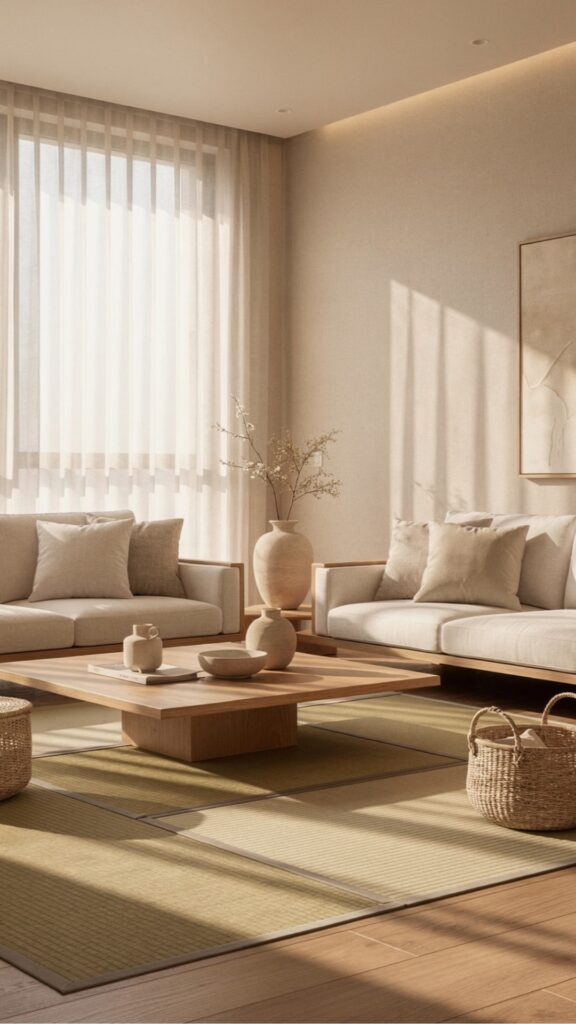
One of the most transformative and misunderstood aspects of Japandi design is storage. The serene emptiness of a Japandi living room is not accidental; it is engineered through intelligent, concealed storage solutions. Everything that does not contribute to the visual calm of the room needs a place to disappear. This is where many people attempt Japandi and fail: they reduce clutter visually but do not solve the underlying storage problem.
Built-in cabinetry is the gold standard for Japandi living room storage. Floor-to-ceiling joinery in natural wood or matte white paint, with push-to-open mechanisms that eliminate the need for handles, creates a seamless wall of storage that virtually disappears into the room.
If built-ins are not possible, low sideboards in solid oak or walnut with sliding doors achieve a similar effect while staying true to Japandi proportions. Interestingly, Japandi does not demand complete minimalism. It allows for curated display a small cluster of ceramics on a shelf, a stack of three carefully chosen books, a single branch of dried botanicals in a tall vase.
The difference between Japandi display and clutter is intention. Every visible object should have a reason to be there, whether functional, sentimental, or simply beautiful. For households with children or multiple residents, Japandi’s storage philosophy is actually its greatest practical strength.
When everything has a place and the rule of intentionality governs what enters the space, tidying becomes faster and easier. The living room resets to its calm baseline with minimal effort a significant quality of life improvement that extends well beyond aesthetics.
Indoor Plants and Biophilic Elements in a Japandi Living Room:
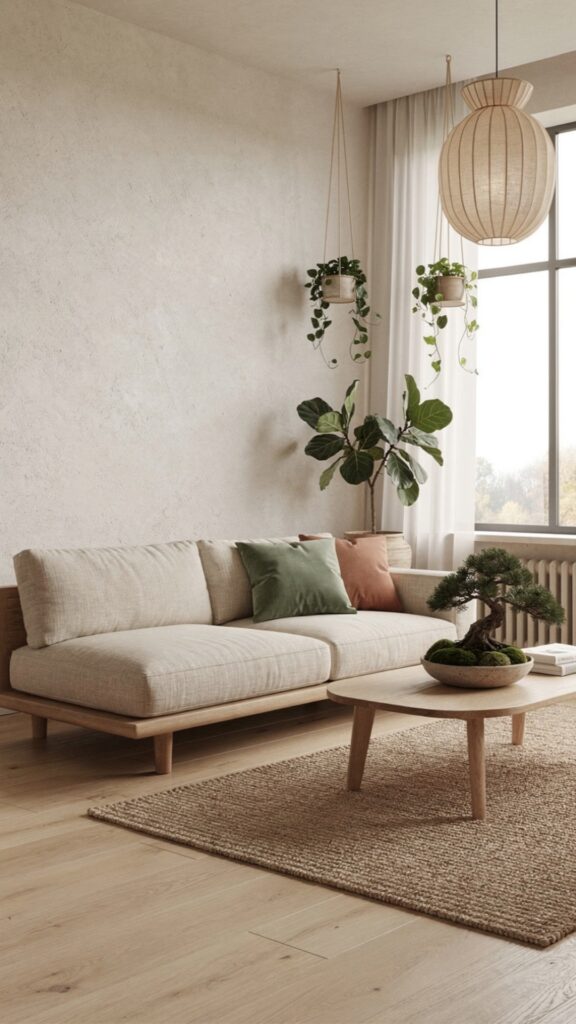
Nature is not optional in a Japandi living room it is structural. Both Japanese and Scandinavian design traditions are deeply connected to the natural world, and bringing natural life into the interior space is a key way to honour that connection.
Indoor plants do more than look beautiful; research consistently shows that they reduce stress, improve air quality, and increase feelings of wellbeing all of which align perfectly with Japandi’s wellness-centred philosophy.
Plant selection for Japandi should be as intentional as furniture selection. Avoid artificially shaped or heavily manicured plants. Instead, choose species with an organic, sculptural quality: a tall fiddle leaf fig in a raw terracotta pot, a cluster of bonsai on a low shelf, trailing pothos from a simple hanging planter, or a single structural snake plant in a matte stoneware vessel. The container matters as much as the plant.
Beyond plants, consider other biophilic elements: a smooth river stone used as a paperweight, a piece of raw driftwood as a sculptural display piece, a bowl of dried seed pods on the coffee table, or branches of preserved eucalyptus in a tall ceramic vase.
These items bring the textures and forms of the natural world indoors without requiring ongoing maintenance perfect for the realistic, functional side of Japandi design.
An insight rarely covered in standard guides: consider the seasonality of your biophilic elements. Japanese design has a profound relationship with seasonal change the concept of mono no aware, or the bittersweet transience of beautiful things, is central to Japanese aesthetics.
Changing your plant selection or botanical arrangements with the seasons adds a living, evolving quality to your Japandi living room that keeps it feeling fresh and deeply connected to the world outside.
Creating a Japandi Living Room in a Small Space:
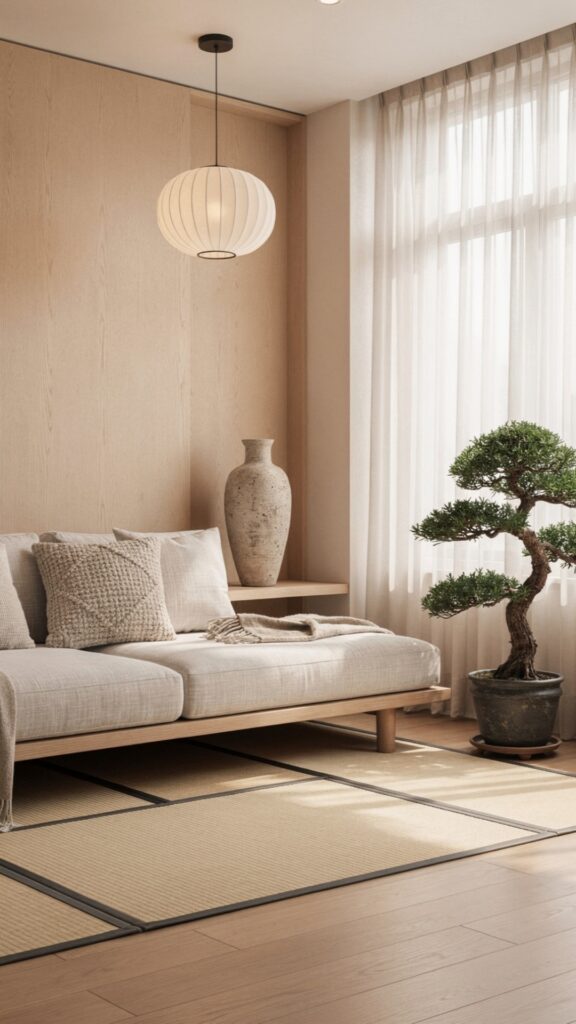
One of Japandi’s greatest strengths is its scalability it works exceptionally well in small apartments and compact living rooms where other styles quickly feel overwhelming. In fact, the constraints of a small space often push Japandi’s core principles naturally: every piece must be justified, storage must be intelligent, and visual simplicity becomes a necessity rather than a choice.
For small Japandi living rooms, furniture scale is everything. Choose a loveseat instead of a full sofa, a round coffee table instead of a rectangular one (round tables take up less visual and physical space), and a single armchair rather than a matching set.
Keep the floor as visible as possible by choosing furniture with legs this creates the illusion of more floor space and keeps the room feeling open. Mirrors are a classically Scandinavian trick that also has precedent in Japanese design philosophy.
A large, simply framed mirror ideally in a natural wood, bamboo, or brushed metal frame placed on the wall opposite a window can effectively double the sense of depth and light in a small living room. Avoid ornate or vintage frames, which belong to other design traditions.
Vertical space is an underused resource in small Japandi living rooms. Floating shelves in natural wood positioned at varying heights draw the eye upward, creating a sense of height. Used for displaying a carefully curated selection of objects ceramics, a single plant, a few books they provide both storage and visual interest without consuming any floor space at all.
You Will Love This : Coffee Table Decor Ideas That Look Absolutely Beautiful in a Japandi Living Room.
The Japandi Living Room Coffee Table:
Functional Sculpture
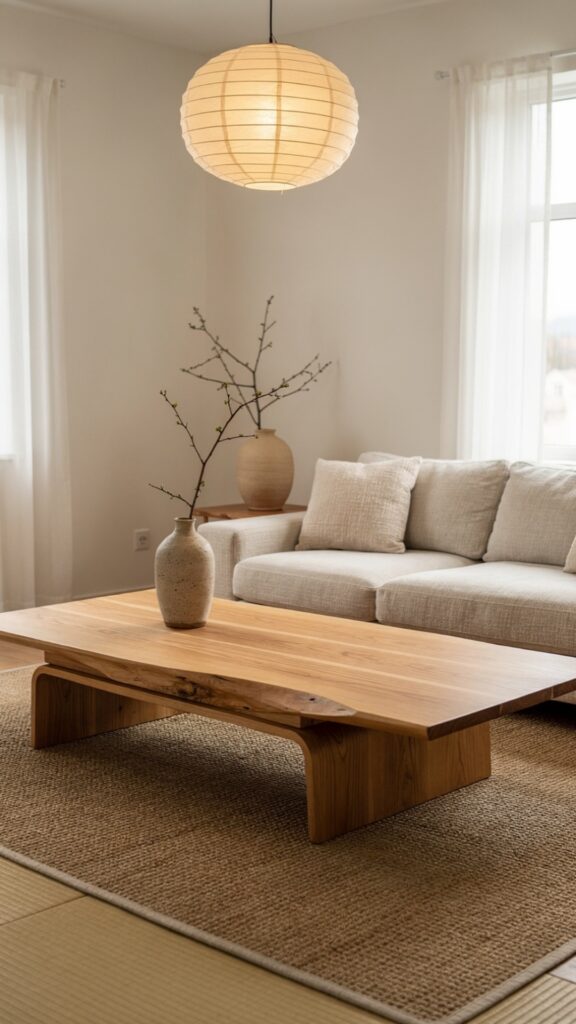
In a Japandi living room, the coffee table is often the centrepiece the piece around which the seating arrangement orbits. It should be chosen with the same care and intention as the sofa. The most authentic Japandi coffee tables sit low to the ground, reference Japanese tatami culture, and are made from a single natural material: solid wood, stone, rattan, or a combination thereof. Glass is generally avoided for its reflective, industrial quality.
Round and oval coffee tables have surged in popularity within Japandi interiors for good reason: they soften the geometry of the room, are more practical in social settings, and avoid the harsh corners that angular tables impose.
A round solid walnut coffee table with tapered legs is perhaps the single most versatile Japandi furniture purchase you can make it works in nearly any size room and pairs with almost any seating.
Styling the coffee table is an art form in itself. The Japandi approach is to style in odd numbers and keep negative space as an intentional element. A trio of objects for example, a small ceramic bowl, a single candle, and a stack of two design books is the ideal grouping.
The empty space around these objects is not waste; it is a deliberate compositional choice that gives the objects room to breathe and be appreciated.
For 2026 and beyond, the trend in Japandi coffee tables is moving toward organic shapes tables with live-edge wood surfaces, irregular stone tops, or imperfectly round forms that reference natural objects rather than manufactured geometry.
This evolution perfectly encapsulates wabi-sabi: embracing the beautiful asymmetry of natural things rather than pursuing manufactured perfection.
Japandi Living Room Walls:
Less Is Genuinely More
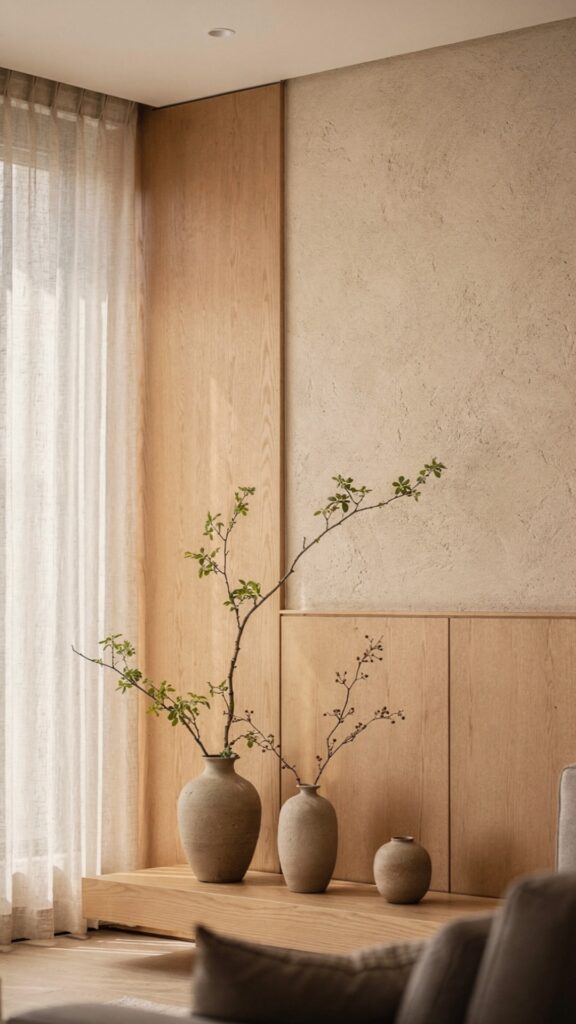
Wall décor in a Japandi living room requires genuine restraint perhaps more than any other element of the style. The walls themselves, in their calm, muted paint colour or natural plaster finish, are part of the composition. Filling them with too many pictures or objects destroys the sense of breathing space that is central to Japandi’s appeal. The rule of thumb is: if in doubt, leave it out.
When wall art is chosen, it should be simple, abstract, or nature-inspired. A single large-format print of a Japanese ink landscape, a framed piece of calligraphy, a simple abstract in earthy watercolour tones, or an unframed canvas with a quiet geometric composition these are the kinds of pieces that enhance rather than disrupt a Japandi living room.
Avoid gallery walls, which are fundamentally at odds with the aesthetic’s minimalist values. Woven wall hangings in natural fibres macramé in undyed cotton, a simple grass-weave panel, or a hand-loomed textile piece are an increasingly popular choice in Japandi interiors.
They add texture to what might otherwise feel like a flat wall surface, while maintaining the commitment to natural materials. When sized correctly and placed with care, they function as both art and texture simultaneously.
One advanced technique: consider using the texture of the wall itself as a decorative element. Japanese washi plaster a natural clay and paper fibre plaster finish applied to a single feature wall creates an extraordinary visual and tactile surface without the need for any additional decoration.
It is expensive to apply professionally, but several manufacturers now offer DIY washi-effect textured paints that approximate the effect at a fraction of the cost.
Mixing Japanese and Scandinavian Décor Objects Without Clashing:
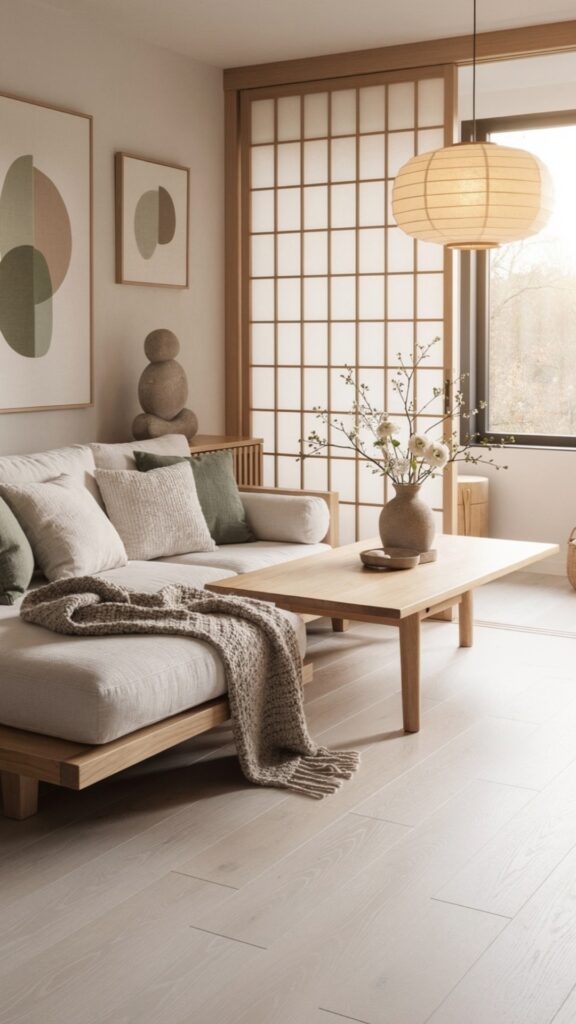
The secret to making Japandi feel cohesive rather than confused lies in understanding which objects from each tradition can coexist. The good news is that Japanese and Scandinavian decorative traditions share so many values restraint, craftsmanship, natural materials, functional beauty that their objects naturally harmonise.
The challenge is avoiding pieces that are too culturally specific to translate across traditions. Japanese ceramics in particular, rough-textured stoneware in earthy glazes, yunomi tea cups, or irregular-form ikebana vases integrate seamlessly into Scandinavian-influenced spaces.
Similarly, Scandinavian wooden objects simple turned bowls, minimalist candle holders, or slatted wooden trays sit comfortably alongside Japanese aesthetic sensibilities. The bridge is always the material and the simplicity of form.
Avoid objects that are too culturally specific: traditional Scandinavian folk art patterns, red and white rosemaling, or heavily ornate Japanese lacquerware from the decorative tradition sit awkwardly in a Japandi space.
Think of it this way: the objects that work best are those from each culture’s modernist tradition the Scandinavian design movement of the 20th century and the Japanese mingei craft revival of the same era.
A practical mixing strategy: designate one surface a shelf, a tray, a window ledge as your curated display area. Gather objects from both traditions and arrange them together until they feel balanced. Step back and remove anything that draws too much attention to itself.
The group should feel like a collected whole, not like competing individual statements. This editing process is itself a meditative practice very much in the spirit of Japandi.
Japandi Living Room on a Budget:
Achieving the Look Without Overspending
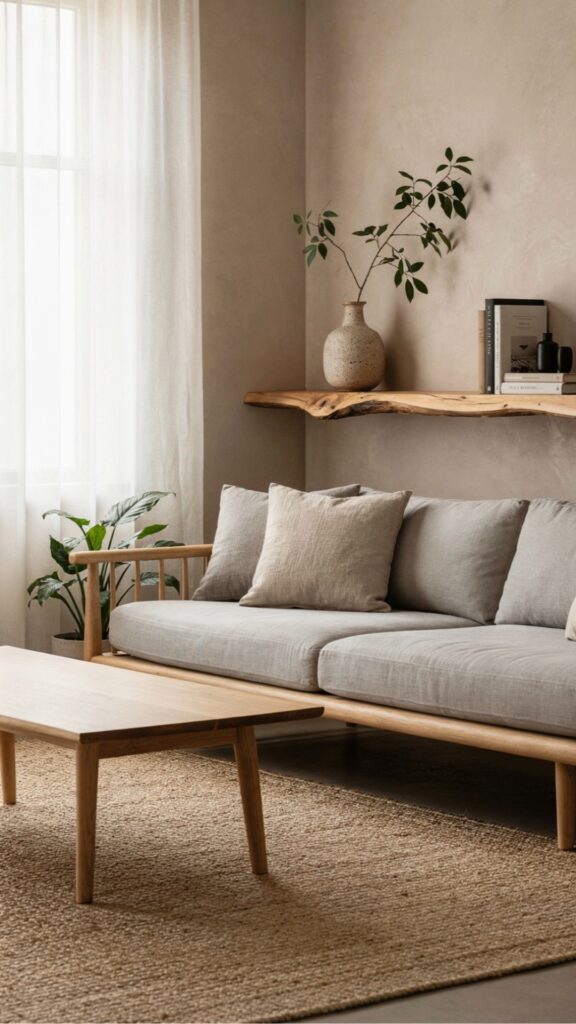
Contrary to the impression created by luxury interior design magazines, a beautiful Japandi living room does not require an enormous budget. The style’s emphasis on restraint and quality over quantity actually makes it more accessible than many other design aesthetics.
You need fewer pieces, but each piece should be chosen carefully. That said, where you choose to invest and where you choose to save is a strategic decision worth thinking through.
The highest-value investment in a Japandi living room is the sofa both because it is the largest visual presence and because it is the piece you interact with most. Spending more here pays dividends in both aesthetics and daily comfort.
Look for sofas with removable, washable linen covers in warm neutral tones. Brands like IKEA’s SÖDERHAMN with custom linen covers from Bemz or similar aftermarket suppliers offer excellent Japandi results at reasonable prices.
For savings, focus on accessories and textiles, which can be sourced affordably from a wide range of retailers. A simple terracotta pot costs very little. A linen throw from a discount homeware store costs a fraction of designer alternatives.
Candles, driftwood, stones, and dried botanicals are essentially free if you are willing to look for them in the natural world. The décor objects that make a Japandi living room special are often the least expensive elements of the entire design.
Thrifting and upcycling are philosophically aligned with Japandi values. A second-hand solid wood sideboard, repainted in matte charcoal, becomes a genuinely beautiful Japandi piece. A vintage rattan chair with a new cushion cover in oatmeal linen perfectly embodies wabi-sabi’s appreciation for objects with history. Shopping this way is not just budget-conscious it is environmentally responsible and aesthetically richer than buying new.
Japandi Living Room Flooring:
Grounding the Space Naturally
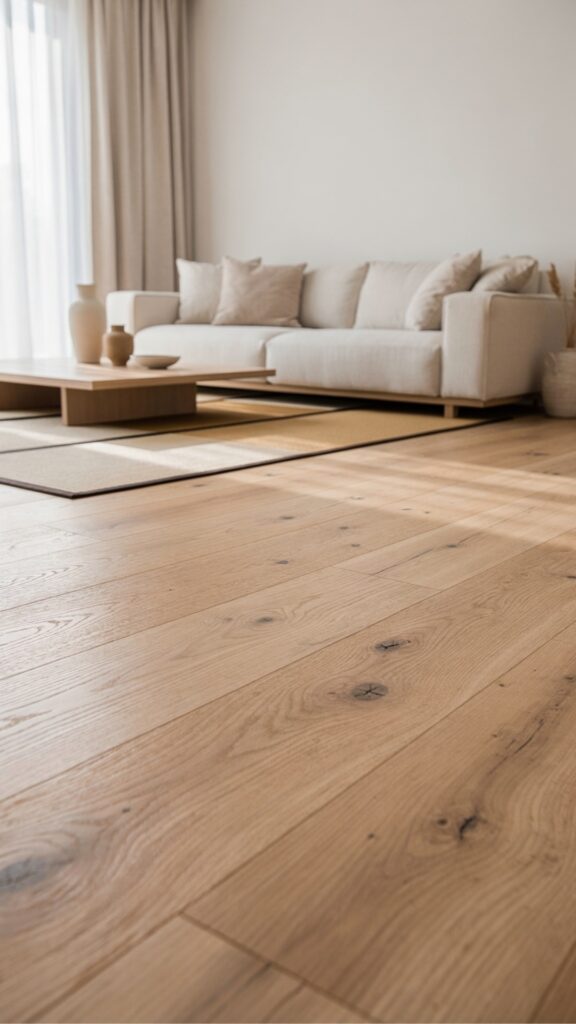
Flooring is one of the most impactful decisions in any interior design scheme, and in a Japandi living room, it needs to be both beautiful and natural. Light to mid-toned hardwood floors in oak, ash, or maple are the quintessential Japandi foundation they reference both Scandinavian timber interiors and Japanese wooden home construction. The grain should be visible but understated, and finishes should be matte or satin rather than high-gloss.
Bamboo flooring is an increasingly popular Japandi choice that is worth serious consideration. Bamboo grows rapidly and is classified as a grass rather than a hardwood, making it a genuinely sustainable flooring material.
Modern strand-woven bamboo flooring is extremely durable often harder than oak and has a subtle natural texture that ages beautifully. Its Japanese associations make it a particularly fitting Japandi choice. For those who cannot change their existing flooring particularly renters with unappealing carpet or tile layering rugs is the solution.
A large natural fibre rug in sisal, jute, or seagrass placed over existing flooring immediately grounds the space in Japandi aesthetics and conceals unwanted surfaces. Sized to anchor the entire seating arrangement, with all furniture legs resting on the rug, it transforms the reading of the room completely.
Underfloor heating, where budget allows, is a deeply Japandi upgrade not just for comfort, but for aesthetic reasons. It eliminates the need for visible radiators, which are difficult to style around, and allows furniture to be arranged freely without heating constraints. The warmth rising from below also encourages the Japanese tradition of sitting and living closer to floor level, which changes the entire feeling of a room.
Tap to Explore : Indoor Plants Styling Ideas That Bring the Perfect Natural Touch to Your Japandi Living Room.
The Future of Japandi Living Room Design:
Where Is It Heading?
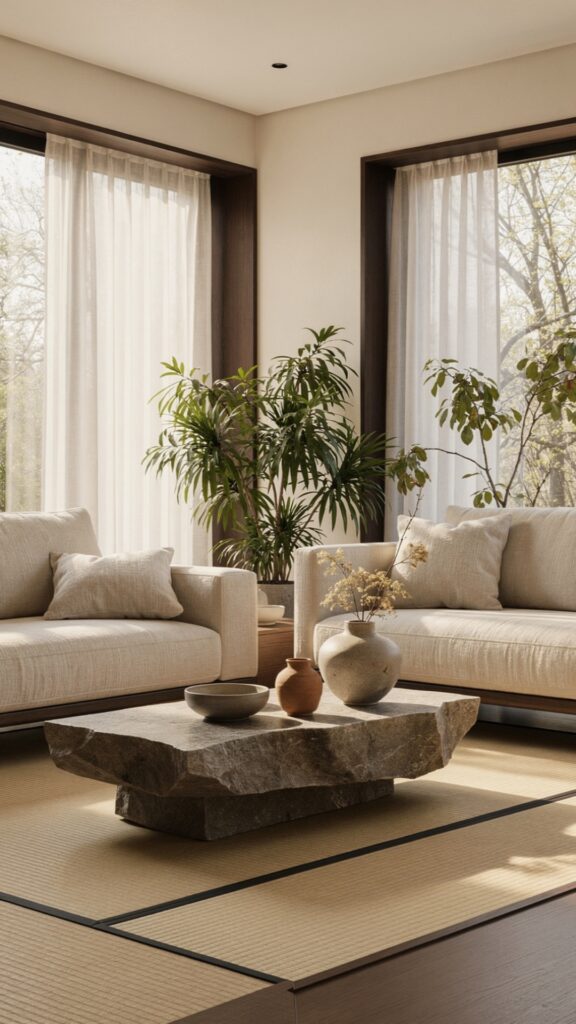
Japandi is not a trend in the traditional sense it will not be replaced by the next wave of Pinterest aesthetics. Its roots in genuine philosophical traditions and its alignment with the growing consumer desire for simplicity, sustainability, and meaningful spaces give it exceptional longevity. If anything, Japandi is evolving rather than fading, becoming more nuanced and personalised as it matures.
The most notable direction in contemporary Japandi design is the integration of handcraft. Machine-made uniformity is giving way to hand-thrown ceramics with irregular rims, hand-stitched linen with visible seams, hand-planed wood with natural tool marks.
This is deeply aligned with wabi-sabi and reflects a broader cultural reaction to the sterile perfection of mass production. Expect this emphasis on the handmade to intensify over the next five years.
Technology integration is another emerging dimension of Japandi design that most guides overlook. As smart home technology becomes increasingly embedded in everyday life, the challenge is to integrate it without disrupting the visual calm of Japandi spaces.
The best Japandi interiors are beginning to develop sophisticated responses to this: invisible speakers built into walls, smart lighting controlled by simple unmarked switches, and charging points concealed within furniture joinery.
Finally, the line between Japandi and adjacent philosophies such as slow living, intentional consumption, and biophilic design is blurring productively. The Japandi living room of the future will not just look calm; it will be designed to actively support the mental and physical wellbeing of its occupants.
This shift from aesthetic movement to lifestyle philosophy is what separates Japandi from every other interior design trend of the past decade.
Conclusion
A Japandi living room is more than a design style it is a commitment to living with intention, surrounding yourself with beauty that is also functional, and honouring the natural world in the materials and objects you choose. By blending the best of Japanese and Scandinavian design traditions, you create a space that feels genuinely restorative a rare quality in modern interiors.
Whether you start with a new colour palette, a single piece of handcrafted furniture, or simply a commitment to decluttering, the Japandi living room philosophy rewards every step you take toward it. Begin with one change today, and let the rest follow naturally.

Team TrandyVilla is the passionate home decor team behind Trandy Villa, where style meets comfort in everyday living. The team loves transforming simple spaces into beautiful, functional homes through smart ideas, budget-friendly hacks, and modern design trends. Their content focuses on helping readers create homes that feel both stylish and personal without spending too much.