
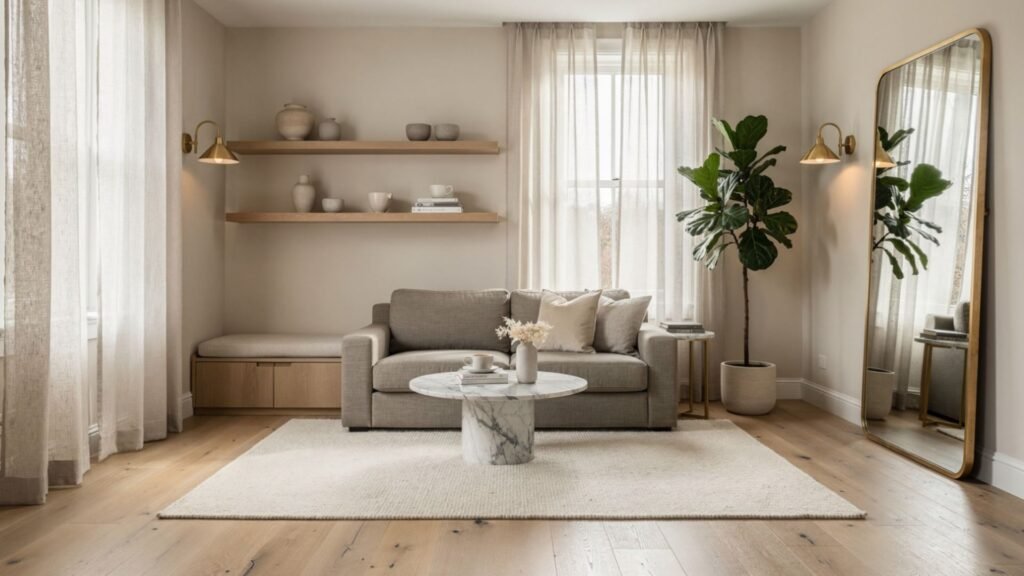
Small living room ideas are one of the most common design challenges homeowners and renters face worldwide. Whether you’re working with a studio apartment, a compact flat, or a modest family home, the pressure to make a limited space feel livable, stylish, and functional can feel overwhelming.
Small living room ideas are smart design strategies that help homeowners make the most of limited space. They focus on furniture placement, color choice, lighting, and storage to create a room that feels open, stylish, and functional.
A small living room ideas does not have to feel cramped or dull. With the right approach, even the tiniest space can become a comfortable and beautiful retreat. These ideas work for apartments, compact homes, and any room where space is a challenge.
Many people struggle with small living room ideas and feel frustrated by the lack of space. The good news is that thoughtful design can completely transform how a room looks and feels. Small living room ideas give homeowners practical tools to maximize every square foot without spending a fortune.
A well-designed small space feels intentional, cozy, and surprisingly spacious. These strategies help anyone renters, first-time homeowners, or experienced decorators create a living room they genuinely love to spend time in.
Small living room decor ideas cover a wide range of simple yet powerful techniques. Choosing the right furniture scale, using mirrors, layering lighting, and keeping a consistent color palette all make a significant difference. Light colors on walls create an open, airy feel. Multi-functional furniture saves floor space and reduces clutter.
Vertical storage draws the eye upward and adds useful capacity. Natural light, when maximized properly, transforms the entire atmosphere of a room. These ideas are practical, budget-friendly, and proven to work in real homes.
Use Mirrors Strategically:
To Double Your Visual Space
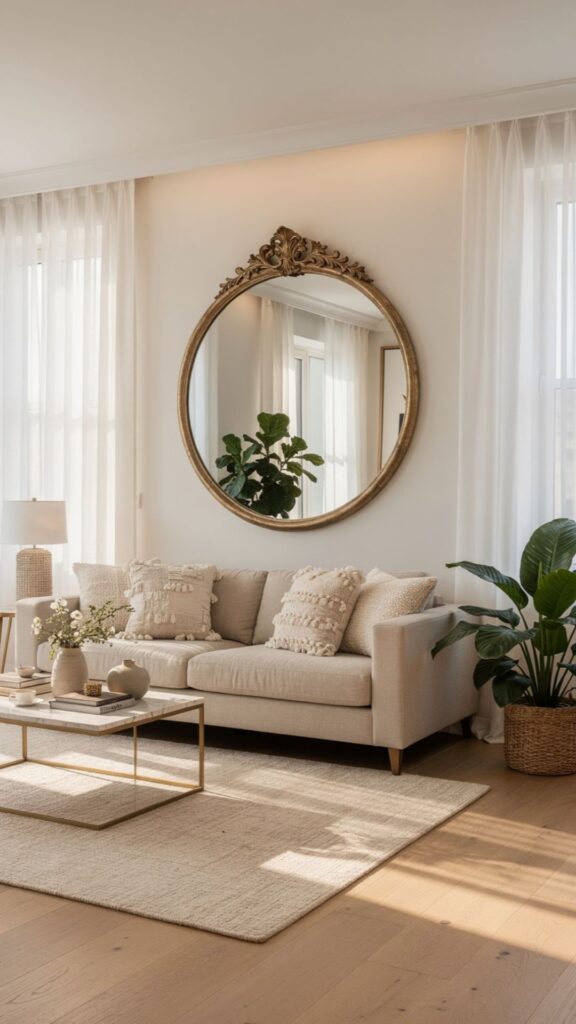
Mirrors are the single most powerful and affordable tool in a small living room ideas designer’s arsenal yet most people underuse them. Placing a large mirror on the wall opposite a window doesn’t just reflect light; it creates a visual portal that effectively doubles the perceived depth of the room. The brain reads the reflection as additional space, which reduces that closed-in, claustrophobic feeling that many compact living rooms suffer from.
The key word here is “strategic.” A mirror placed randomly on a dark wall achieves very little. Instead, identify your room’s best asset a window with natural light, a styled bookshelf, a beautiful piece of furniture and position the mirror to reflect and amplify it. A tall, lean floor mirror leaned casually against a wall can also make low ceilings feel higher, tricking the eye into reading vertical space that isn’t technically there.
In 2026, mirrored furniture is making a strong comeback mirrored coffee tables, side tables, and console units blur the line between reflective décor and functional furniture. This layered approach to mirrors means you’re gaining storage or surface area without adding visual bulk. For renters who can’t mount large wall fixtures, leaner floor mirrors and mirrored trays offer the same light-multiplying effect without a single nail hole.
Pro Tip: Avoid placing mirrors directly facing the entrance door, as this can create a psychologically unwelcoming effect. Instead, angle your mirror at 45 degrees from the main window to capture the maximum spread of natural light across the room.
Choose Multi-Functional Furniture:
That Works Twice as Hard
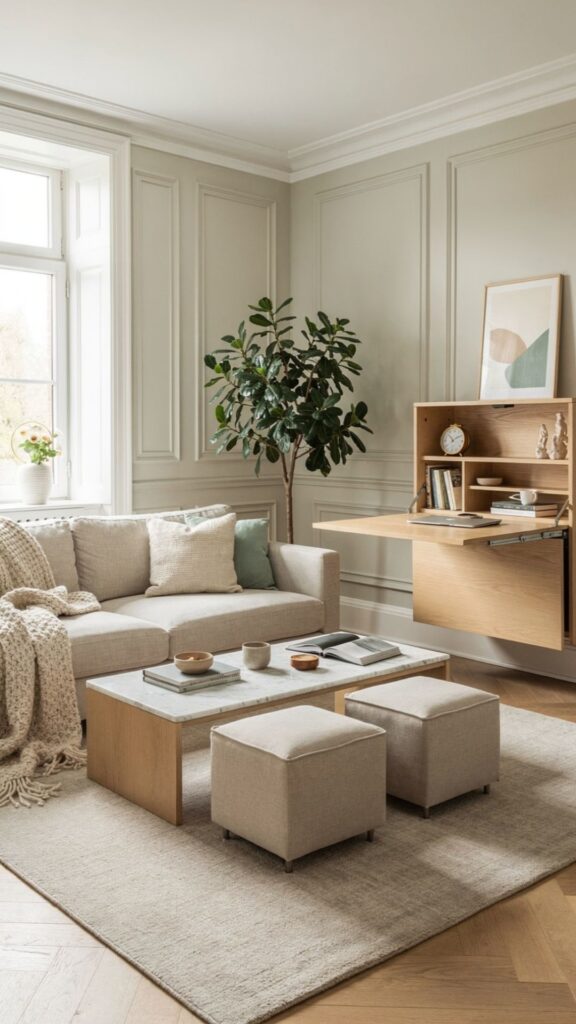
In a small living room ideas, every piece of furniture must justify its presence by doing more than one job. A standard sofa occupies the same floor space as a sofa bed but one of them can accommodate overnight guests, eliminating the need for a separate guest room. An ottoman with internal storage replaces both a coffee table and a linen chest. A bench at the end of a sofa doubles as extra seating when you have guests and a place to rest your feet when you don’t.
What separates truly clever multi-functional furniture from gimmicky versions is build quality and seamless design. The best pieces don’t look like they’re trying to be two things at once. A well-designed storage ottoman in a rich fabric looks luxurious and intentional.
A nesting coffee table set looks like a considered design choice until guests arrive and you pull out the extra surfaces effortlessly. Look for pieces that are indistinguishable from single-purpose furniture at a glance.
Future-focused design in 2026 leans heavily into “furniture as architecture.” Wall-mounted drop-leaf desks that fold flat, Murphy beds disguised as wall panels, and modular sofas that rearrange into different configurations are increasingly accessible at mainstream price points. The best investment you can make in a small living room ideas is choosing furniture that adapts to your changing needs rather than furniture that simply fills the space.
Step Inside: Japandi Living Room Ideas That Make Your Small Living Room Look Bigger and More Elegant.
Go Vertical with Storage:
And Draw the Eye Upward
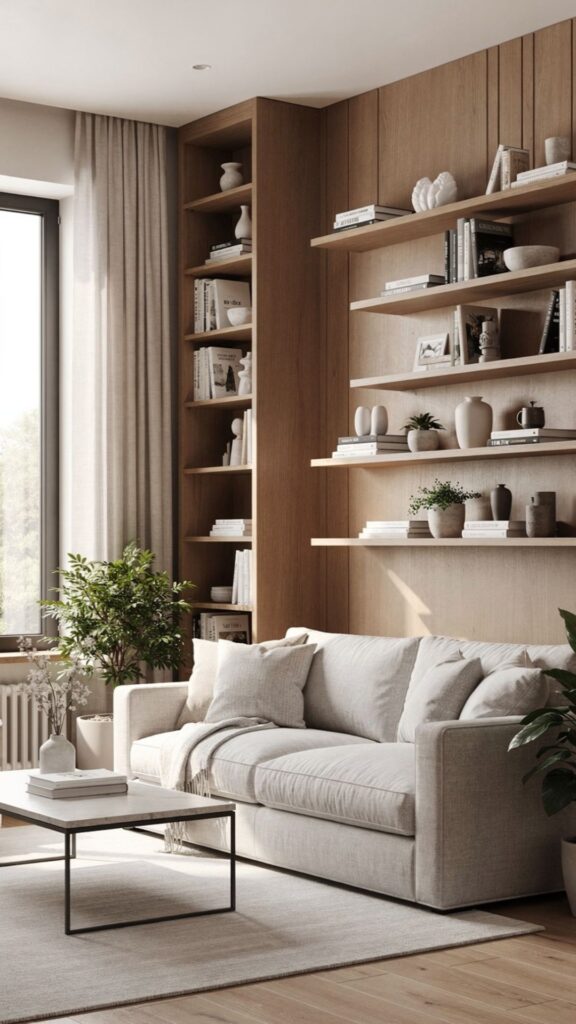
Most people think about floor space when they think about a small room. Interior designers think about cubic footage the full volume of a room, including the often-ignored vertical space between the top of your furniture and the ceiling.
In a typical room with 9-foot ceilings, there may be 3–4 feet of completely unused vertical space above your shelving, cabinets, and furniture. Going vertical means claiming that space and using it to store, display, and define the room’s character.
Floor-to-ceiling bookshelves are the most effective way to go vertical, and they serve multiple purposes simultaneously. They provide enormous storage capacity, create a strong focal point, add architectural character to what might be a bland wall, and crucially draw the eye upward, making the ceiling feel higher.
This optical effect is one of the reasons why libraries and grand studies feel so dramatically spacious despite sometimes being quite small rooms.
However, going vertical requires careful curation. Shelves packed with random objects create chaos and visual noise that makes a small room feel smaller, not larger. The 60/40 rule works well: fill 60% of your shelf space with books and functional items, and leave 40% for curated display items with deliberate empty space around them. Negative space on shelving is not wasted space it is breathing room that makes everything around it look more intentional.
Design Insight: Paint the inside backs of tall shelving units in a deep, moody color (deep navy, forest green, charcoal). This creates visual depth the shelf appears to recede into the wall, making your room feel wider than it is.
Float Your Furniture:
Away From the Walls
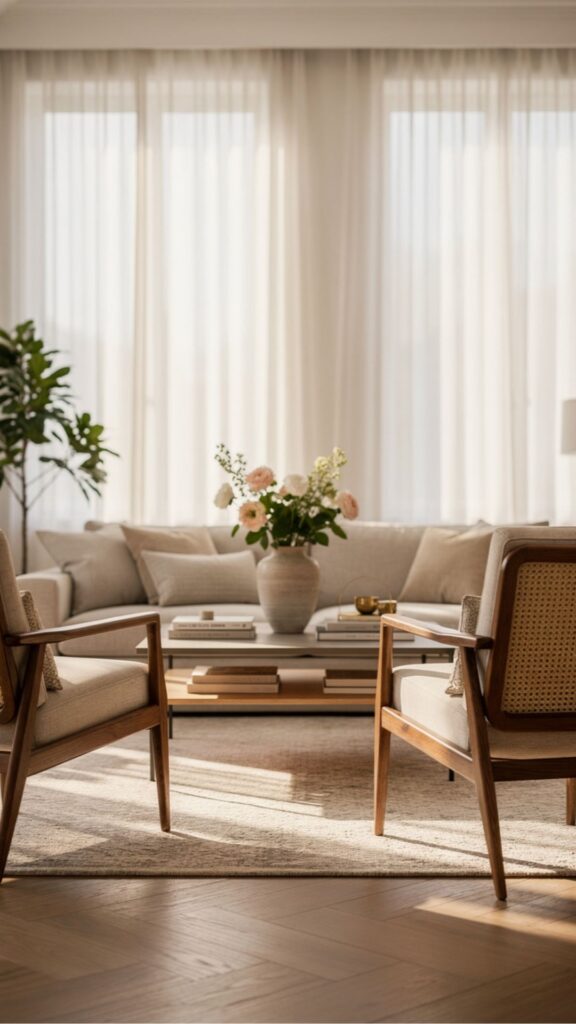
It sounds counterintuitive in a small room, shouldn’t everything be pushed against the walls to maximize open floor space in the center? In reality, this approach almost always makes a room feel smaller, not larger. When all furniture is pressed against the perimeter, the room’s center becomes an empty void, and the eye reads the space as awkward and unresolved. The furniture looks like it’s hiding along the edges rather than confidently occupying the room.
Floating your sofa and chairs even just 6–12 inches from the wall creates something remarkable: the illusion of depth behind the furniture. Suddenly, the room appears to have more space than it does, because the eye can see floor extending behind the sofa. This technique is used in virtually every high-end interior design project, from boutique hotel lobbies to luxury apartments, regardless of their size.
When floating furniture, anchoring with a well-chosen area rug becomes even more important. The rug defines the “floating island” of your seating area and gives the arrangement visual logic. Without it, floated furniture can look unmoored and accidental. With it, the grouping feels like a deliberate, designed conversation area that happens to exist within a larger room even if that “larger room” is only 12 by 14 feet.
Try This: Pull your sofa 8 inches from the wall and place a narrow console table behind it. Use the console for a lamp, books, and a small plant. You’ve created a functional vignette, added depth, and surprisingly made your room feel more open in the process.
Use a Monochromatic or Tonal Palette:
For Visual Continuity
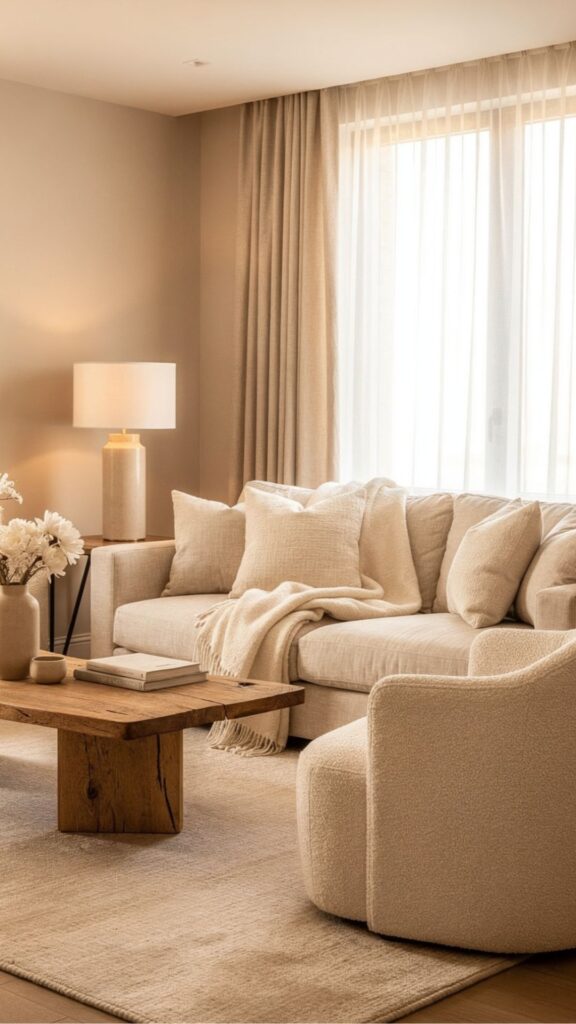
Color contrast is the enemy of perceived space. When a small living room ideas features a dark sofa, a brightly colored accent wall, a patterned rug in entirely different tones, and several mismatched cushion colors, the eye has to work hard to process each separate element.
This cognitive load translates directly into a feeling of busyness and compression the room feels smaller because it contains more visual “events” than a compact space can comfortably handle. A monochromatic or tonal palette solves this by creating visual continuity.
When your walls, sofa, curtains, and major accessories exist within the same color family even with variation in shade, texture, and finish the room reads as a single unified composition rather than a collection of competing objects. The eye moves smoothly through the space rather than jumping between contrasting elements, and the room feels calmer, larger, and more cohesive.
This doesn’t mean your small living room ideas must be entirely beige or all-white. “Tonal” simply means variations of the same hue. A rich terracotta-toned room with warm rust walls, a burnt-sienna velvet sofa, a dusty brick-colored rug, and copper accent metals can be dramatic and deeply stylish while still feeling spacious because all the tones belong to the same visual family. Texture becomes the primary design variable, which rewards the eye without creating spatial compression.
Color Psychology Note: Cool tonal palettes (blues, greens, grey-whites) make walls appear to recede, adding perceived depth. Warm tonal palettes (creams, taupes, warm terracottas) create intimacy and comfort. Choose based on the feeling you want your room to evoke, not just on aesthetics.
Layer Your Lighting:
For Depth, Mood, and Spatial Illusion
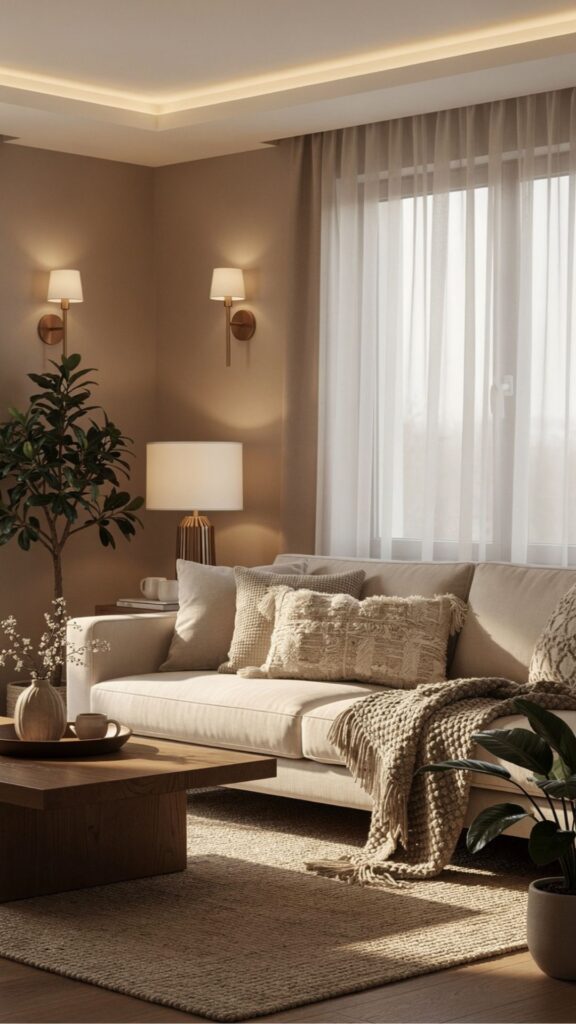
Lighting is the most underutilized element in small living room ideas design, yet it has arguably the most dramatic impact on how a space feels. A small room lit only by a single overhead light looks flat, institutional, and small. The harsh downlight illuminates every corner evenly, revealing the room’s dimensions with blunt clarity.
Layered lighting using multiple light sources at different heights and intensities transforms the same room into something that feels deeply atmospheric and spatially generous. The three-layer approach is the professional standard: ambient light (the overall base illumination from ceiling fixtures or recessed lights).
Task lighting (targeted light for reading, working, or specific activities from floor or table lamps), and accent lighting (decorative lighting that highlights architecture, artwork, or features wall sconces, LED strip lights, picture lights). Each layer operates at a different visual plane, creating depth that makes the room feel three-dimensional rather than flat.
For small living room ideas specifically, placing lighting low table lamps at sofa height, floor lamps behind chairs creates pools of warm light that make the room feel intimate and drawn inward. This is especially effective in evenings.
Meanwhile, uplighting plants or architectural features draws attention upward, reinforcing the perception of height. Warm-toned bulbs (2700K–3000K) make materials and skin tones look richer, which contributes to an overall sense of warmth and generosity that cold daylight bulbs cannot replicate.
Smart Upgrade: Install dimmer switches on all your light circuits. The ability to adjust lighting levels throughout the day bright and energizing in the morning, warm and low in the evening costs very little but transforms how your small living room ideas feels at every hour.
Embrace Transparent Furniture:
To Reduce Visual Weight
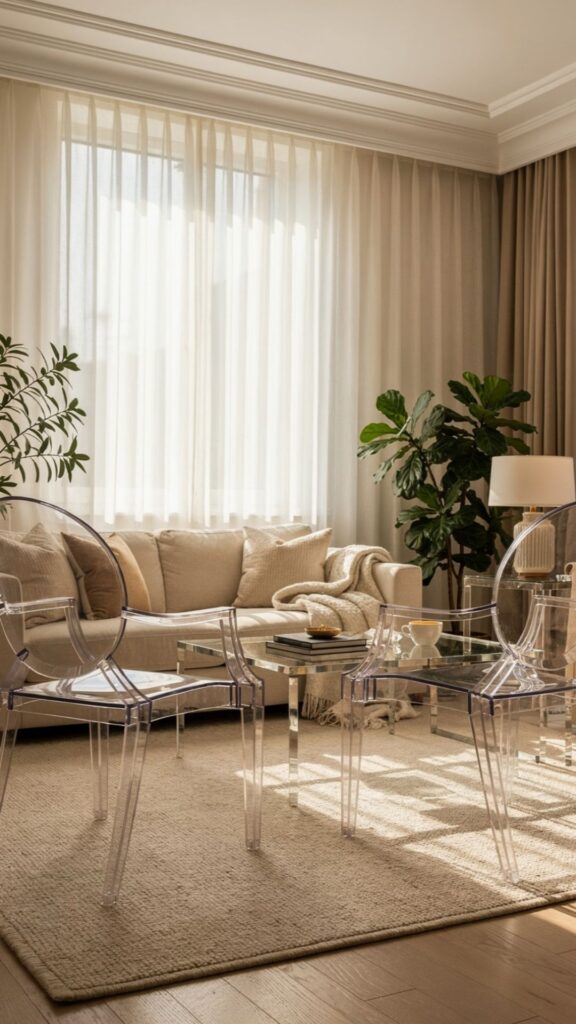
Visual weight is a concept that’s rarely discussed outside professional design circles, but it has an enormous impact on how a small living room ideas feels. Every piece of furniture has visual weight the optical heaviness it carries based on its color, material, opacity, and form.
A solid oak coffee table has high visual weight. A glass-topped coffee table on thin metal legs has very low visual weight. Both may occupy the same physical footprint, but in a small room, only one of them disappears into the space rather than dominating it.
Acrylic, glass, and lucite furniture pieces coffee tables, side tables, nesting tables, dining chairs have become increasingly popular in small space design precisely because they allow the eye to travel through rather than stopping at the furniture’s surface.
This creates an illusion of more open floor space even when the room is fully furnished. A pair of acrylic ghost chairs at a small dining table within a living room makes the dining setup almost invisible when viewed from the sofa, which dramatically reduces the feeling of the room being overcrowded.
Transparent furniture pairs especially well with tonal, light-based design schemes. In a room with pale walls and neutral upholstery, a glass or acrylic table seems to vanish entirely, functioning more like an architectural idea than a physical object.
Even furniture with just transparent elements glass table tops on wooden or metal bases, or chairs with open cutout backs can provide meaningful visual relief in a space where every square foot counts.
See The Magic: Coffee Table Decor Ideas That Perfectly Fit and Enhance Your Small Living Room Space.
Define Zones with Area Rugs:
To Create the Illusion of More Rooms
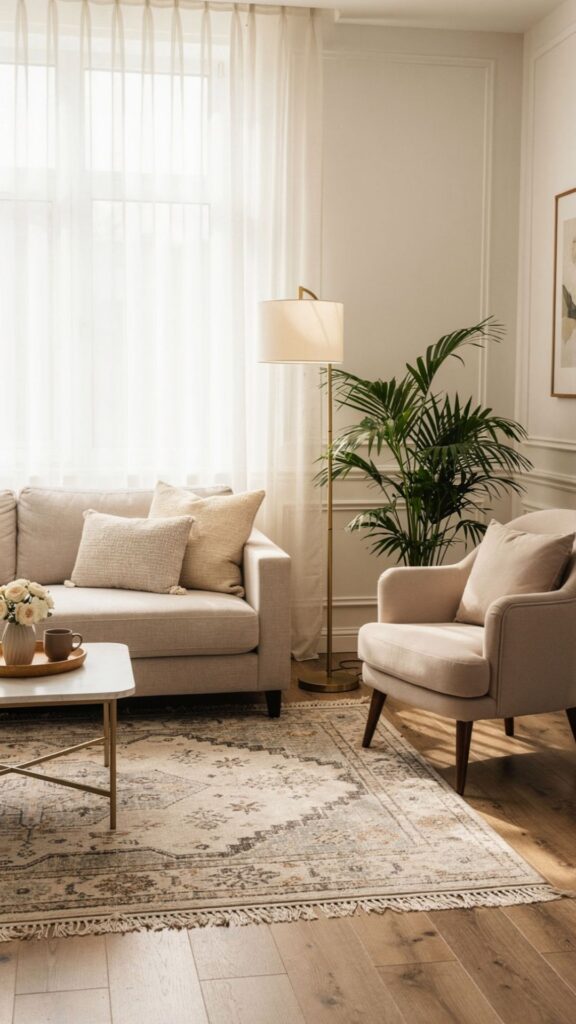
In open-plan spaces or multipurpose small living room ideas that need to function as both a lounge and a workspace or dining area, the absence of physical walls creates a challenge: how do you make the space feel organized and purposeful without dividing it with partitions that reduce it further? The answer, most of the time, is the area rug. A well-placed rug acts as a “visual room within a room,” anchoring a seating arrangement and giving it psychological definition without adding any physical mass.
The most common rug mistake in small living room ideas is choosing one that is too small. A rug that only sits under the coffee table, with sofa legs floating off it on bare floor, looks like a postage stamp in a large envelope. The room immediately looks incomplete and, paradoxically, smaller.
The correct approach is to choose a rug large enough that at least the front two legs of all seating pieces rest on it. This creates a unified “floor plane” for the conversation area that tells the brain: this is a defined, purposeful space.
For multi-zone small living room ideas, use two distinct rugs to create two separate “rooms.” A larger rug under the seating area and a smaller, contrasting rug under a small dining or desk area creates instant visual separation.
The zones feel like separate environments even though they share air, walls, and ceiling. This technique is used extensively in boutique hotel suites where an entire living-dining space must exist within what is essentially one modest-sized room.
Sizing Rule: In a small living room ideas, your rug should never be smaller than 5×8 feet. A 6×9 or 8×10 is almost always the right size range, even when it feels “too large” when you first unroll it. Trust the scale it will make your room feel bigger, not smaller.
Hang Curtains Floor:
To Ceiling for Dramatic Height
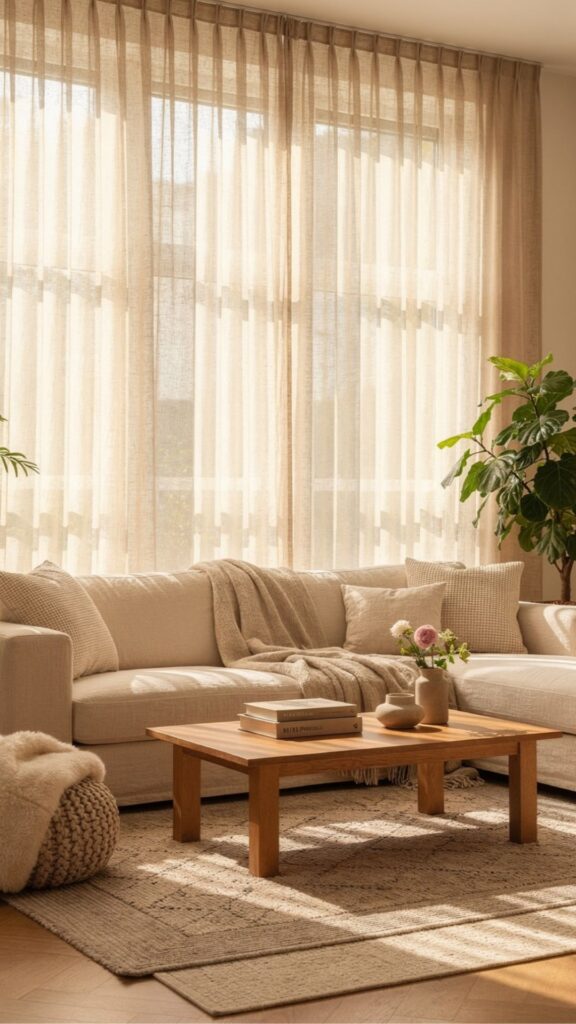
Where you hang your curtain rod matters far more than most people realize. The standard approach mounting the rod just a few inches above the window frame is one of the most common design mistakes in small living room ideas. It does the exact opposite of what you want: it draws attention to the gap between the window and the ceiling, making ceilings look lower and windows look smaller.
Instead, mounting the curtain rod as close to the ceiling as possible (or at ceiling height if you have crown molding) makes the window appear dramatically taller and the ceiling dramatically higher. Extending the curtain rod 6–12 inches beyond the window frame on each side is equally important. This allows the curtain to clear the window entirely when drawn open, rather than partially covering the glass and blocking light.
The result is that the window looks wider than it actually is, more light enters the room, and the curtains frame the window like architectural elements rather than hanging as an awkward afterthought. Combined with ceiling-height mounting, this turns an average window into a grand design statement.
For small living room ideas, curtain fabric choice is equally strategic. Lightweight, semi-sheer fabrics in light, neutral tones allow natural light to filter through even when curtains are closed, maintaining brightness. Heavier, denser fabrics in the same wall color create a seamless flow the curtain and wall read as one continuous surface, which expands the perceived width of the room. Both approaches work; the choice depends on whether your priority is maximizing light or maximizing the sense of horizontal space.
Quick Upgrade: If you can’t repaint, simply rehang your existing curtains at ceiling height. This single change which takes 20 minutes and costs nothing beyond a new curtain rod is often reported as the most visually transformative small room update homeowners make.
Edit Ruthlessly:
Declutter as a Design Strategy
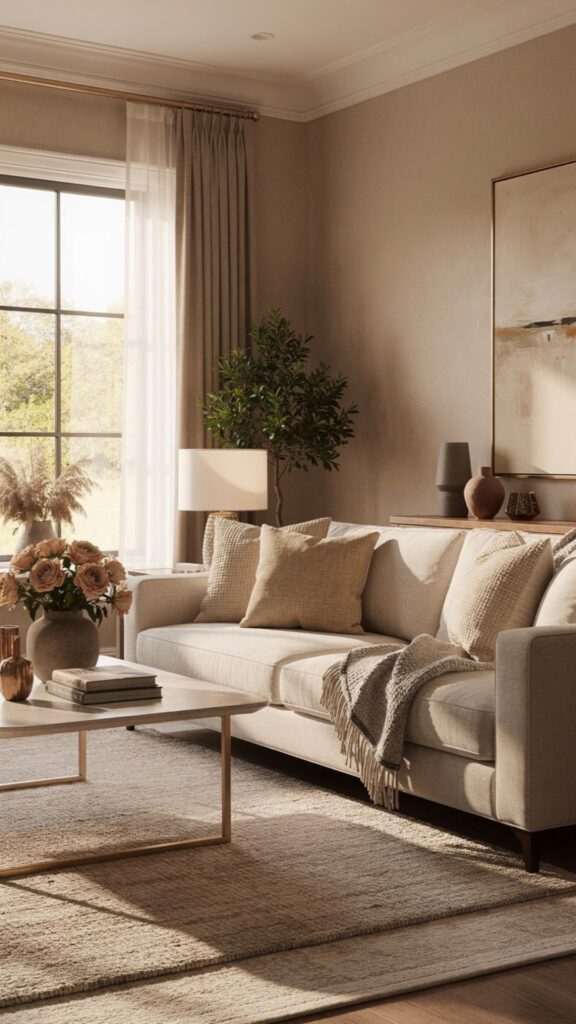
Decluttering is not simply a cleaning task. In small living room ideas design, it is an active design strategy one that is, paradoxically, harder and more impactful than adding anything new. The Japanese concept of “ma” (negative space or emptiness) is deeply relevant here: the space between objects is as important as the objects themselves.
A small living room ideas with 15 carefully chosen items will feel more spacious, calm, and beautiful than a room three times its size that is filled with 150 mediocre things. The editing process requires asking a specific question about each item in your living room: does this earn its place? Not just in terms of function, but in terms of visual value.
A beautiful lamp that you love, that provides excellent light, and that suits your aesthetic earns its place with flying colors. A collection of dusty ornaments that you neither love nor use doesn’t earn anything it only costs you space, visual calm, and cleaning time. The standard for what “earns its place” should be high, especially in compact spaces.
Once you’ve edited down to essentials, the arrangement of what remains becomes powerful. Grouped objects three vases of different heights, a stack of books with a candle on top, a lamp beside a framed print create cohesive visual vignettes that feel curated rather than random. This is the difference between a small living room ideas that looks like it has too little in it and one that looks like every single decision was made with intention.
Bring in Biophilic Elements:
To Create Depth and Vitality
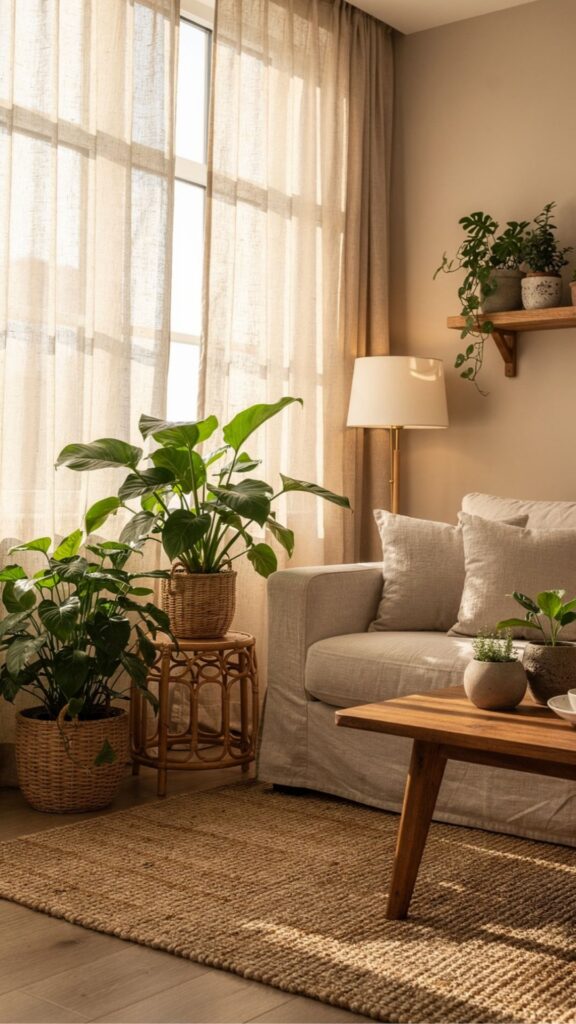
Biophilic design incorporating natural elements like plants, natural materials, organic textures, and views of the outdoors has moved firmly from trend to design principle over the last decade. In small living room ideas, plants and natural elements serve a dual purpose.
They add layers of visual depth and organic texture that make a room feel alive and dimensional, and they provide documented psychological benefits including reduced stress, improved focus, and an increased sense of calm that makes smaller spaces feel more tolerable and even enjoyable.
The choice of plant matters in a small space. Tall, vertical plants like fiddle leaf figs, snake plants, and tall monstera specimens draw the eye upward reinforcing the sense of height we’ve already discussed in other ideas. Trailing plants like pothos or string of pearls hanging from a shelf or ceiling hook add vertical movement and draw attention to the space’s volume without consuming floor space.
Small clustered plants on a windowsill or side table add texture at a lower scale without overwhelming the space. Beyond plants, natural materials in furniture and textiles add a dimension that synthetic materials simply cannot replicate.
A linen-covered sofa, a jute rug, a rattan side table, a wooden shelf these materials have inherent textural variation that catches light differently throughout the day, making the room feel alive and dynamic rather than static. In a small living room ideas, where stimulation must be carefully curated, natural materials provide exactly the right level of visual interest without the chaos that patterns and excessive color can introduce.
Low-Maintenance Pick: If you struggle to keep plants alive, a large snake plant (Sansevieria) is virtually indestructible, tolerates low light beautifully, and grows tall enough to create a genuine architectural statement in the corner of a small living room ideas.
Choose Your Sofa Scale Wisely:
Bigger Isn’t Always Worse
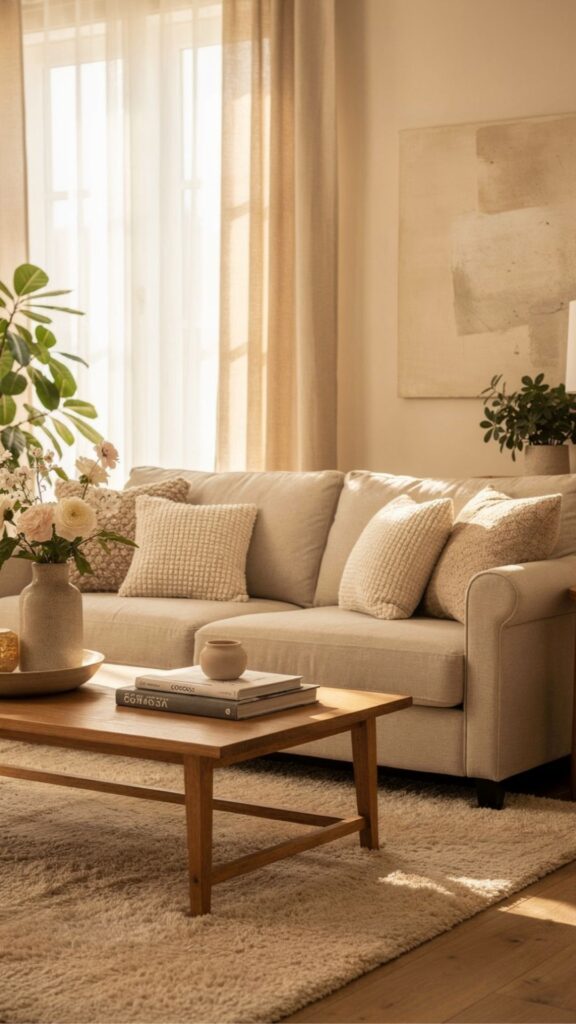
The most common advice given to people with small living room ideas is to choose small furniture and while this has merit when taken thoughtfully, it is regularly misapplied in ways that actually make rooms look worse. A room full of tiny, delicate furniture looks timid and unresolved.
It can also be deeply uncomfortable which is a problem in a room whose primary function is relaxation. A single large, well-proportioned sofa in a small room can actually make the room feel more grounded and purposeful than two undersized loveseats that leave ambiguous dead zones between them.
The correct principle is not “small furniture for small rooms” but rather “appropriately scaled furniture with intentional negative space.” This means choosing one anchor piece typically the sofa that is generously sized but fits within the room’s dimensions without blocking pathways, and then keeping all secondary furniture (side tables, accent chairs, coffee tables) slim, light, and lower-profile.
The contrast between a solid sofa and visually lighter supporting pieces creates a hierarchy that makes the room feel designed rather than assembled. Sofa depth and arm height are often overlooked but critically important dimensions. Deep sofas with low arms feel casual and welcoming but consume more visual space. High-armed, higher-backed sofas create a more formal silhouette that can overwhelm a small room.
The sweet spot for most small living room ideas is a sofa with track arms (straight, low arms with no roll or flare), moderate depth (around 36–38 inches), and legs raised sofas on visible legs allow light and visual flow beneath them, which reduces visual bulk dramatically compared to sofas that sit directly on the floor.
Rule of Thumb: Your sofa should occupy no more than two-thirds of the wall it faces. If your room is 12 feet wide and you’re choosing a sofa for the long wall, a sofa up to 8 feet long is proportionally appropriate and may actually look better than a 6-footer that looks lost.
Use Built-In Shelving to Reclaim Dead Wall Space:
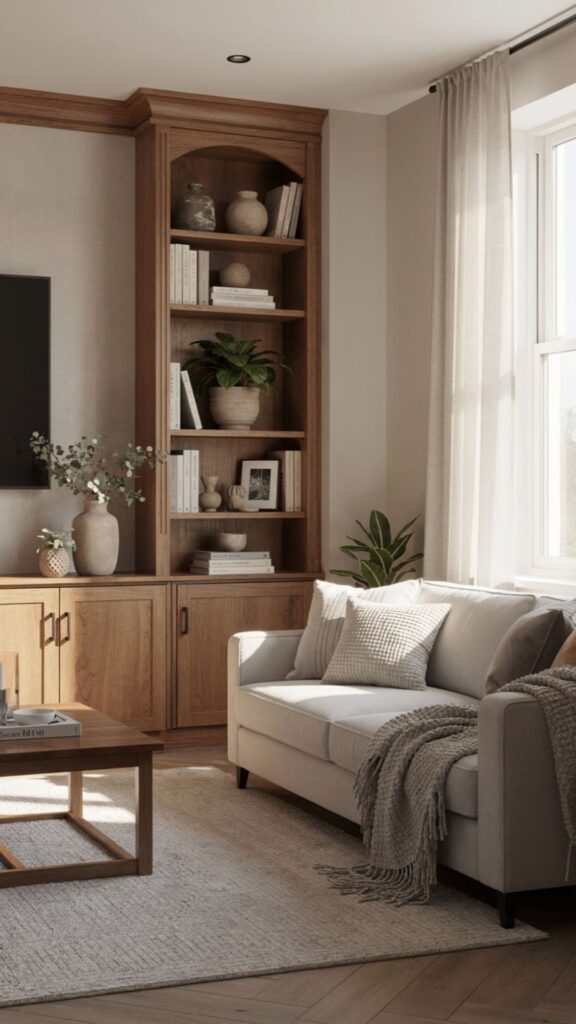
Every small living room ideas has at least one wall that is doing nothing. No window, no door, no focal point just a blank surface that furniture is shoved against by default. Built-in shelving transforms this dead space into one of the room’s most valuable and characterful features.
A set of floor-to-ceiling built-in shelves doesn’t just provide storage it gives the room architecture, personality, and a focal point that wasn’t there before, all without consuming any additional floor space.
The great misunderstanding about built-ins is that they require a significant renovation budget. In reality, IKEA BILLY bookcase hacks customized with plinth bases, crown molding at the top, and uniform paint can produce a result virtually indistinguishable from bespoke joinery at a fraction of the cost.
The critical elements are the base, the top detail, and the paint: once a freestanding bookcase has a plinth at the bottom and crown molding connecting it to the ceiling, and is painted the same color as the wall behind it, it reads as intentional architecture rather than a piece of furniture.
When styling built-in shelves, the alcove space created beside or between them presents an additional opportunity. A deep niche can house a compact armchair or a reading lamp, creating an intimate corner that feels purposefully designed. This kind of architectural thinking treating the room’s fixed features as design opportunities rather than obstacles is what distinguishes rooms that feel thoughtfully conceived from those that simply look furnished.
Explore This: TV Stand Decor Ideas That Save Space and Add Style to Your Small Living Room.
Maximize Natural Light:
The Most Underrated Space-Expander
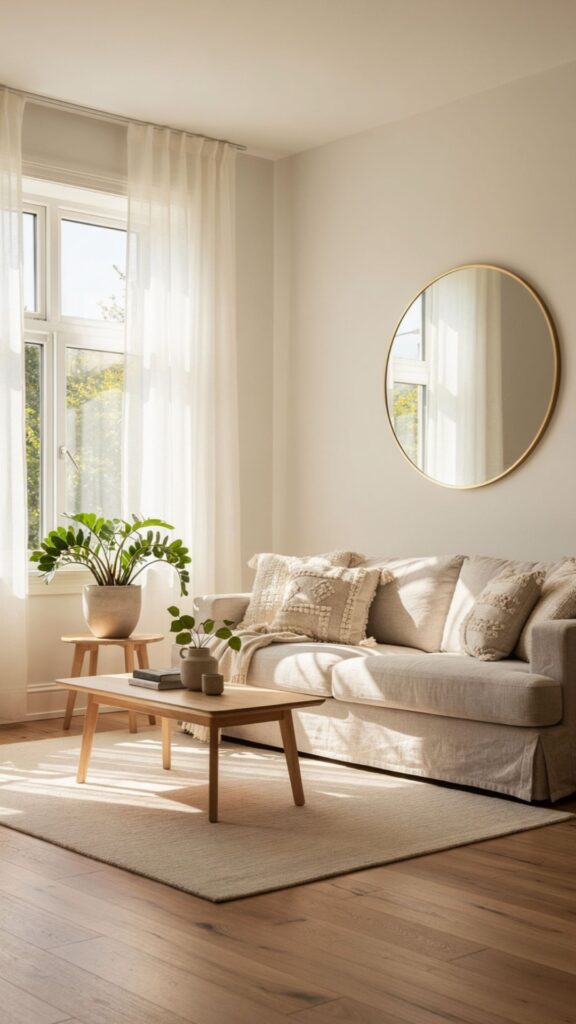
Natural light is not merely a pleasant bonus in a small living room ideas it is a primary spatial tool. A well-lit small room consistently feels larger, cleaner, healthier, and more welcoming than a large room with poor natural light. This is a function of biology: our brains are hardwired to associate bright, open light with outdoor space and safety, while dim, enclosed light is processed as a sign of constraint and enclosure.
Working with and maximizing whatever natural light your room receives is therefore one of the highest-impact changes you can make. Maximizing natural light begins with identifying what is blocking it. Heavy curtains, furniture placed in front of windows, window sills cluttered with objects, exterior obstructions like overgrown plants all of these reduce the amount of light entering the room.
Start by clearing all of these obstacles before spending money on anything else. Switch heavy curtains to sheer panels. Move furniture away from window sills. Clean your windows a properly cleaned window can let in measurably more light than a dusty one, and this simple step costs nothing.
Beyond simply unblocking light, you can amplify it. Light-colored walls and ceilings reflect natural light around the room, bouncing it into darker corners. Glossy or satin paint finishes (on ceilings especially) reflect light better than matte finishes.
Mirrors positioned to catch and redirect window light (as discussed in Idea 1) can effectively double the range of natural illumination in a room. And furniture upholstered in lighter colors reflects rather than absorbs light, contributing to the room’s overall brightness.
Paint Insight: Painting your ceiling one shade lighter than your walls (rather than bright white) creates a soft, gentle gradient that makes ceilings feel higher and the room more luminous without the harsh contrast that a stark white ceiling can create against colorful walls.
Final Thought: Small Living Room Ideas
A small living room ideas is not a limitation it’s a focused design opportunity. The 14 ideas in this guide share a common thread: intentionality. Every strategic mirror placement, every transparent coffee table, every ceiling-height curtain rod is a decision that communicates care, thought, and confidence. That’s what turns a small space into a memorable one.
You don’t need to implement all 14 ideas at once. Start with one or two that feel most accessible perhaps rehang your curtains, or float your sofa away from the wall, or remove the things from your shelves that don’t earn their place. Notice the difference. Then go further.

Team TrandyVilla is the passionate home decor team behind Trandy Villa, where style meets comfort in everyday living. The team loves transforming simple spaces into beautiful, functional homes through smart ideas, budget-friendly hacks, and modern design trends. Their content focuses on helping readers create homes that feel both stylish and personal without spending too much.