
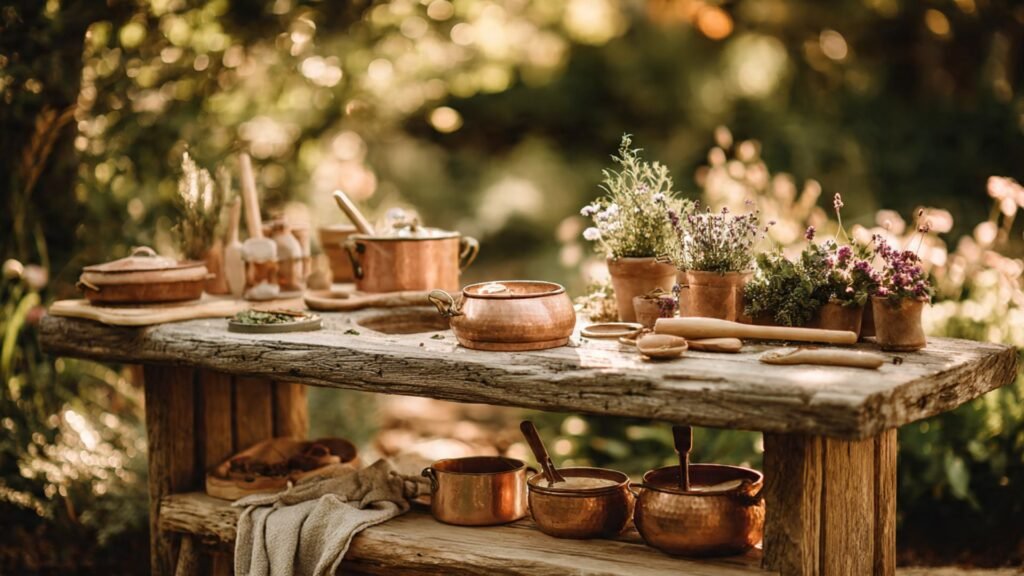
A mud kitchen is one of those rare outdoor play setups that every child instinctively loves and every parent eventually regrets not building sooner. Equal parts sensory lab, imaginative restaurant, and creative workshop, the humble mud kitchen transforms a patch of outdoor space into an engine of child development. Unlike screen time or structured toys, mud play engages the whole body, fires up the imagination, and connects children to the natural world in a way that nothing else quite replicates.
A mud kitchen is an outdoor play structure that lets children cook, mix, and create using mud, water, and natural materials. It builds creativity, sensory skills, and confidence. Parents and educators use mud kitchens to support hands-on learning. These simple setups turn outdoor spaces into powerful play environments. They work for all ages, budgets, and garden sizes.
Every child deserves a space to explore, create, and get wonderfully messy a mud kitchen gives them exactly that, sparking imagination, building real-world skills, and turning ordinary outdoor time into extraordinary learning moments every single day.
Mud kitchen ideas range from simple pallet builds to themed outdoor setups. They include water stations, seasonal ingredient trays, and sensory play tools. Each idea supports a different age group or learning goal. Parents choose designs based on space, budget, and child development needs. Schools use them to encourage cooperative and nature-based learning. The right setup makes outdoor play richer, longer, and more purposeful.
DIY Mud Kitchen from Pallets:
Build It for Almost Nothing
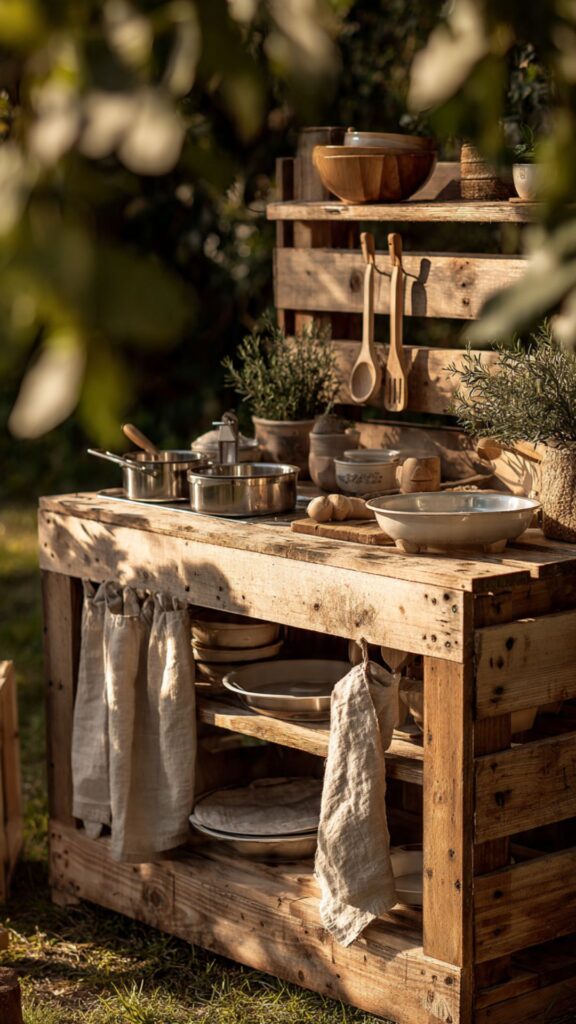
One of the most popular and cost-effective ways to build a mud kitchen is using reclaimed wooden pallets. Free or very cheap from hardware stores, warehouses, or online marketplaces, pallets provide a sturdy, modular structure that can be customised endlessly. A basic single-pallet mud kitchen can be built in an afternoon with basic tools a saw, drill, sandpaper, and some screws. Stand a pallet upright for the back wall, lay another flat as the work surface, and you have an instant structure ready for embellishment.
The key to a great pallet mud kitchen is the finishing work. Sand all edges thoroughly to eliminate splinters this is non-negotiable for children’s safety. Apply a child-safe outdoor wood stain or sealant to protect against moisture and extend the life of the structure significantly. Many parents add a metal or enamel bowl as the “sink,” install wooden dowels as hooks for hanging utensils, and attach a small shelf at the back using a plank of scrap wood. The result looks intentional, beautiful, and professional for a fraction of the cost of a commercial set.
For parents who want to level up their pallet build, consider adding a hinged lid that opens to reveal a “hidden” compartment for storing ingredients a feature children find thrillingly magical. Another popular upgrade is adding a small chalkboard panel to the front of the kitchen, allowing children to write their “menu,” practise letters, or keep score during play. These small additions transform a basic structure into a rich, multi-functional play environment that grows with your child’s development.
Build Tip: Always check pallet markings before use. Look for pallets stamped “HT” (heat-treated) avoid any stamped “MB” (methyl bromide), which indicates chemical treatment unsafe for children’s play.
Small-Space Mud Kitchen Ideas:
Even Tiny Gardens Work
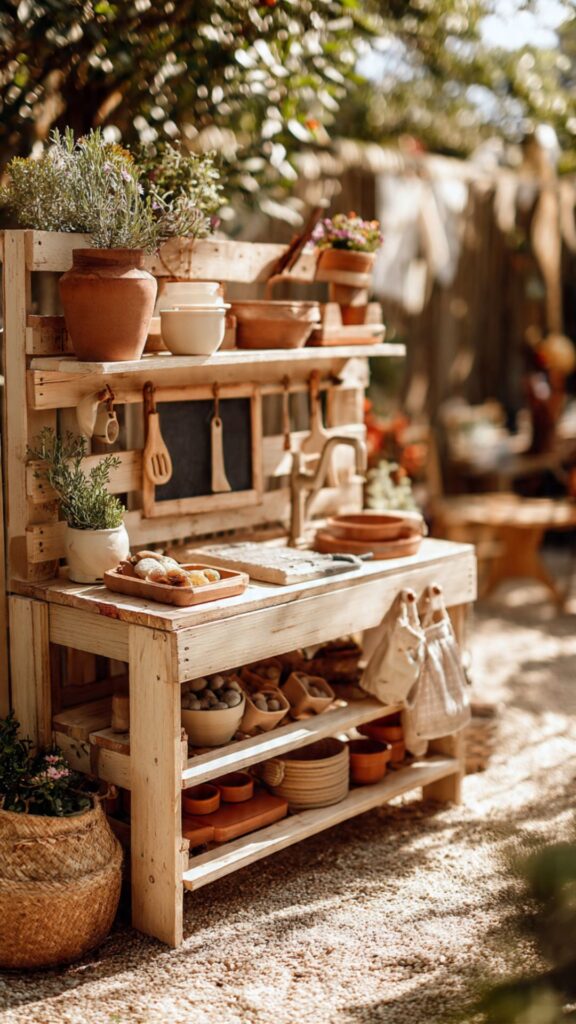
A common misconception is that mud kitchens require a large garden or yard. In reality, some of the most creative and well-loved mud kitchens are built in very small outdoor spaces balconies, narrow side passages, small patios, and even large covered porches. The key is thinking vertically and keeping the footprint compact.
A wall-mounted mud kitchen, for instance, folds flat against a fence when not in use and swings out to become a fully functional play surface in seconds. For balconies and patio spaces, consider a standalone unit on wheels (a “mud kitchen trolley”) that can be moved indoors or into a shed when not in use.
These work beautifully for families who want the benefits of mud play without a permanent outdoor installation. Paired with a designated mud tray or tote bin filled with pre-prepared mud or kinetic sand, this setup allows for full mud kitchen play experiences in surprisingly small areas without the risk of muddying the entire space.
Vertical storage is your best friend in small-space mud kitchens. Install a pegboard or series of hooks at child height on a fence panel to hang pots, spoons, and tools. Add a small shelf unit above the work surface for “ingredient” containers small jars of sand, dried herbs, pine cones, pebbles, and flower petals all double as wonderful mud kitchen additions. The result is a rich, organised play space that uses every inch of available area wisely and looks visually appealing even to adult eyes.
Mud Kitchen for Toddlers:
Age-Appropriate Setup Tips
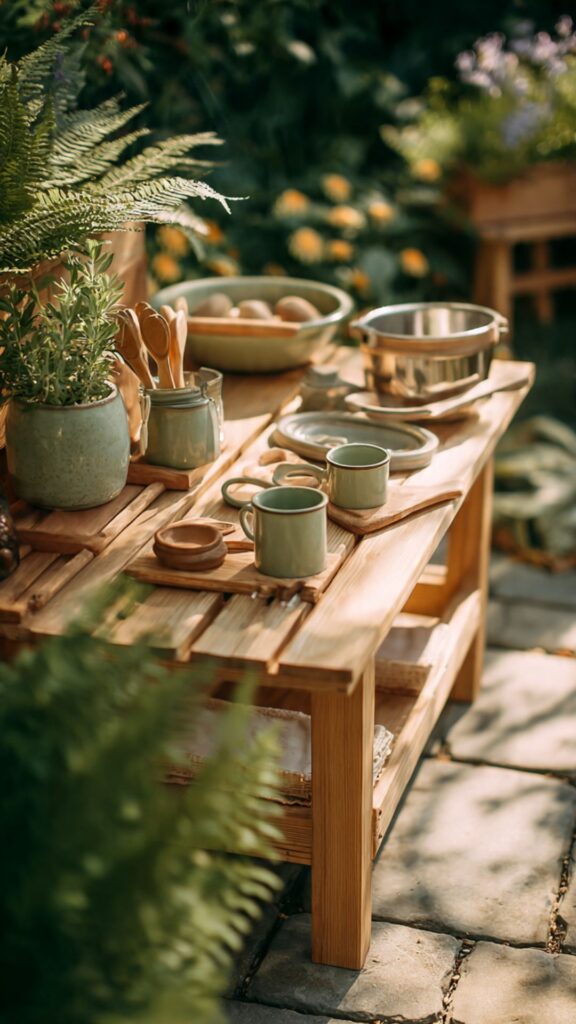
Toddlers between 18 months and 3 years can absolutely enjoy mud kitchen play, but the setup needs thoughtful adaptation. The primary consideration is height a mud kitchen designed for a 6-year-old will frustrate a toddler who cannot reach the work surface. The ideal worktop height for toddlers is roughly hip height, which means building or purchasing a structure that sits around 45–50 cm from the ground. This allows them to stand comfortably and engage with the surface without straining or leaning.
For toddlers, simplicity is key. Resist the urge to fill the space with too many accessories or “ingredients.” Instead, start with just two or three items: a large bowl, a spoon, and a small jug of water. Toddlers at this age are in the “heuristic play” phase they are primarily interested in what materials do, how they feel, and what happens when things are combined.
Overwhelming the space dilutes focus rather than enhancing it. As the child grows, you can gradually introduce more complexity. Safety is paramount with toddlers in mud kitchens. Ensure there are no sharp edges, no small parts that could be swallowed, and that the mud itself doesn’t contain any added elements like sand with sharp edges, large stones, or materials that could be harmful if tasted.
A good rule of thumb: assume everything in the toddler mud kitchen will end up in someone’s mouth at some point. Natural soil (free from pesticides), plain water, and untreated natural materials like leaves, petals, and grass are all perfectly safe for this age group.
For very young toddlers, consider replacing real mud with pre-mixed “moon sand” (8 parts play sand, 1 part cornflour) for a gentler, less messy introduction to sensory kitchen play before transitioning to real outdoor mud.
If You Love Outdoor Spaces, You Will Absolutely Adore These Rooftop Garden Ideas Too.
Best Mud Kitchen Tools & Accessories:
The Essential Kit
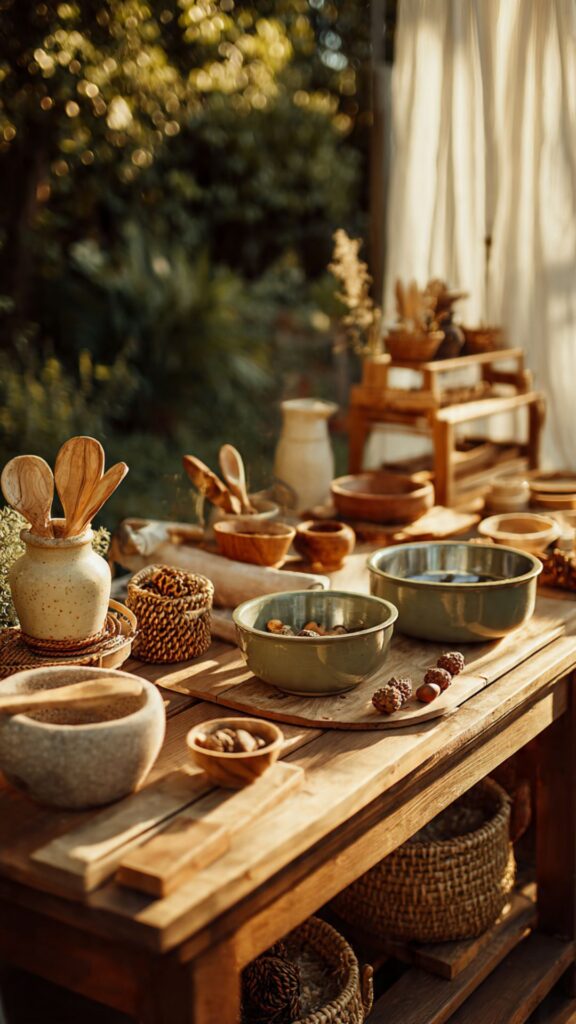
The right tools transform a mud kitchen from a simple muddy surface into a dynamic play laboratory. The essentials are inexpensive and often already in your kitchen cupboards: old saucepans, baking trays, wooden spoons, ladles, measuring cups, muffin tins, and colanders.
These real-world cooking tools give children a sense of authenticity that plastic toy versions simply cannot replicate. When children use real utensils, they engage more seriously and imaginatively with the play, often sustaining it for far longer.
Beyond basic utensils, consider building a “mud kitchen pantry” of natural ingredients that children can use as recipe components. This might include small labelled containers of bark chips, dried lavender, sand, pebbles, dried pasta (for texture), dried herbs, food colouring (for “magic potions”), and seasonal items like conkers, pine cones, and seed pods. Rotate these seasonally to keep the play fresh and introduce children to the changing natural world around them. This simple strategy dramatically extends the lifespan of the mud kitchen’s appeal.
For a premium setup, invest in a few specialist tools: a small hand pump or gravity-fed water dispenser, a balance scale for weighing ingredients, a set of measuring spoons, a small sieve and colander set, and a magnifying glass for examining soil creatures and textures.
These additions bring a scientific, exploratory dimension to mud kitchen play that appeals especially to children aged 5–8 who are beginning to engage more analytically with their environment. They also bridge beautifully into science and maths learning at home or school.
Mud Kitchen Recipes for Kids:
Inspiring Creative Play
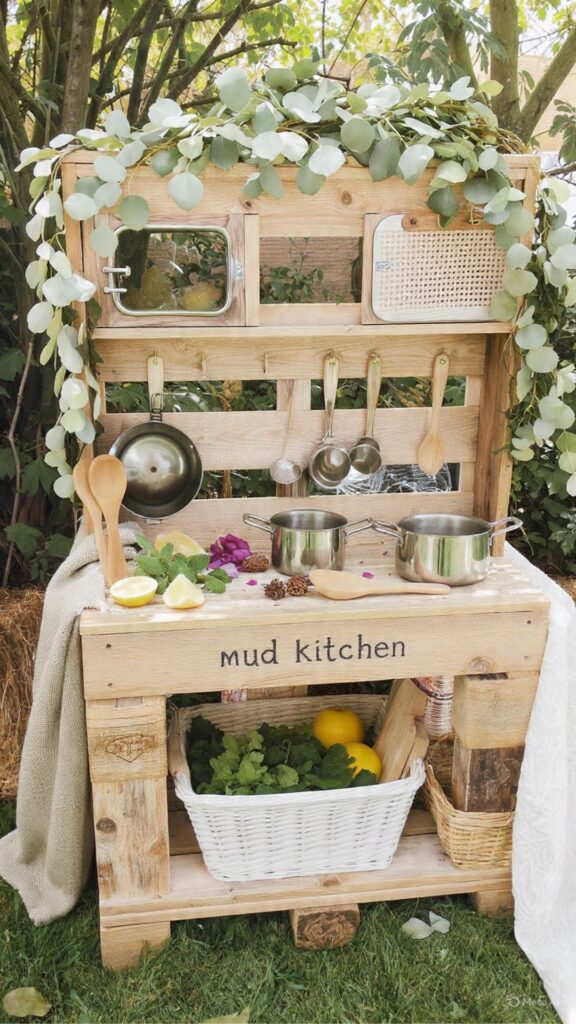
One of the most underrated strategies for sustaining mud kitchen engagement is introducing the concept of “mud recipes.” Writing simple, illustrated recipe cards that children can follow in their mud kitchen gives them a structured starting point while leaving plenty of room for creative deviation.
A “Chocolate Mud Cake” recipe might call for 2 cups of mud, 1 spoonful of sand, a handful of grass, and 3 flower petals decorated with a pine cone on top. These recipes are not just fun; they introduce early literacy (reading cards), numeracy (counting and measuring), and scientific thinking (following a process).
Seasonal recipes keep the mud kitchen relevant year-round. In spring, children can make “Flower Soup” using petals and rainwater. In summer, “Sunshine Smoothies” with herbs and berries. In autumn, “Conker Stew” with fallen leaves and bark. In winter, frost and ice can be incorporated into “Frozen Potion” play.
Framing the changing natural environment as new “ingredients” teaches children to observe the seasons with curiosity and attention a habit that supports both scientific literacy and emotional wellbeing throughout childhood.
Laminating recipe cards makes them weather-proof and extends their life considerably. Store them in a small weatherproof recipe box or folder hung on the mud kitchen itself, so children can access them independently without adult facilitation.
This autonomy is important: one of the core values of mud kitchen play is that children direct their own experience. Having a self-accessible resource library empowers them to initiate rich, complex play sequences without waiting for an adult to set things up, which is precisely the kind of independent thinking we want to cultivate.
Seasonal Mud Kitchen Play:
Keeping It Fresh All Year
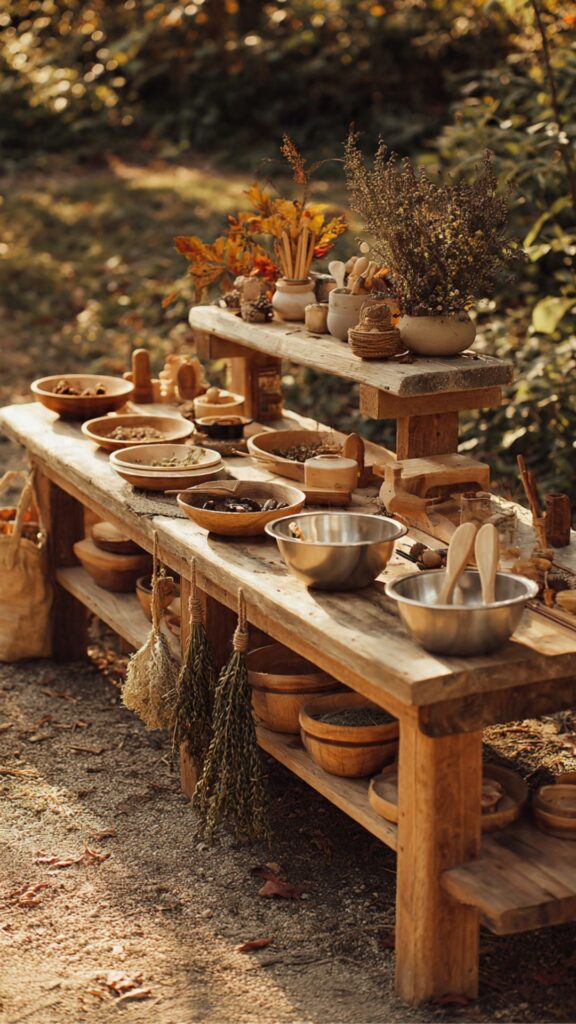
One of the mud kitchen’s greatest strengths is that it can be used in every season not despite the weather, but because of it. Rainy days transform the mud kitchen into a puddle-splashing paradise where children explore how water drains, collects, and combines with soil.
Frosty mornings introduce ice and frozen mud as entirely new sensory textures to experiment with. Snowy days mean “snow soup” and “ice cream” made from real snow often the most magical mud kitchen experience of the year for children.
Summer brings its own set of mud kitchen delights. The addition of fresh herbs from a nearby pot mint, rosemary, basil gives “cooking” an authentic aromatic dimension that children find deeply satisfying. Adding food colouring to water creates “magic potions” that are particularly popular during long summer holidays.
Encouraging children to collect petals, berries (check for toxicity first), seeds, and grasses from the garden introduces them naturally to botany and foraging awareness. Autumn is arguably the richest season for mud kitchen play. The abundance of fallen leaves, conkers, acorns, seed pods, and fungi creates a natural pantry that changes week by week.
This ephemeral quality teaches children something profound: the world is dynamic, not static, and paying close attention reveals constant change and beauty. A child who learns to notice the difference between a fresh conker and a weathered one has developed a quality of attention that will serve them in school, relationships, and creative pursuits throughout their life.
Mud Kitchen in Schools & Early Years Settings:
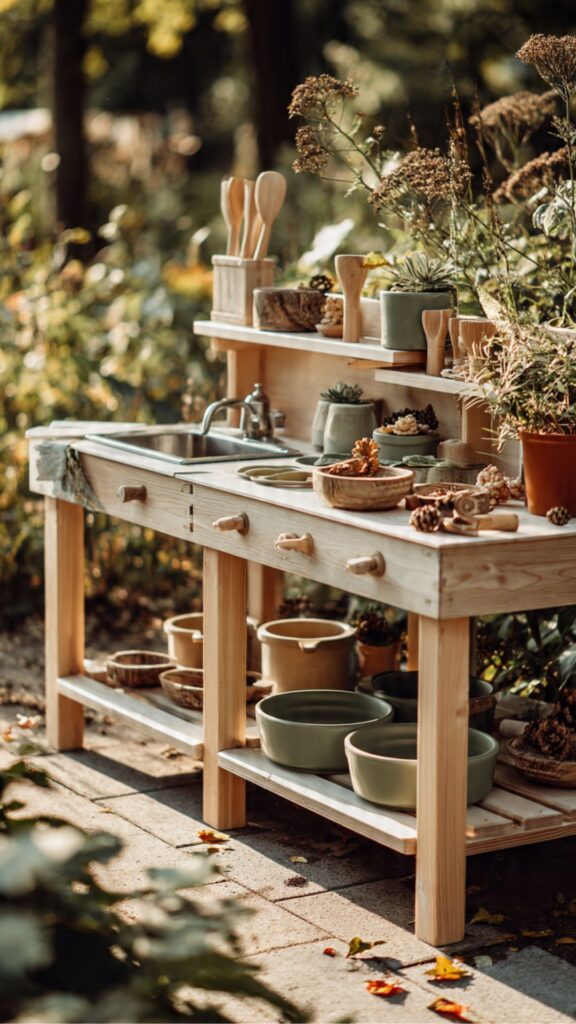
Mud kitchens have become a staple of the best early years classrooms and school outdoor areas worldwide. In the UK, the EYFS (Early Years Foundation Stage) framework explicitly values outdoor play and nature-based learning, and mud kitchens align perfectly with its physical development, communication and language, and understanding the world strands. Schools that install mud kitchens in their outdoor areas consistently report improvements in pupil engagement, social interaction, and gross and fine motor skill development.
For school settings, scale and durability are key considerations. Commercial mud kitchen units designed for schools are typically built from treated hardwood or recycled plastic and can withstand heavy use by multiple children simultaneously. Look for units with multiple work stations, integrated water systems (ideally connected to a tap or rainwater harvesting system), and ample storage. The investment is significant, but schools report that well-designed outdoor mud kitchens are among the most-used and most-valued outdoor equipment they own.
Teacher facilitation matters enormously in school mud kitchen settings. Rather than directing play, skilled educators “wonder aloud” asking open questions like “I wonder what would happen if you added more water?” or “What do you think this mixture smells like?”
These Socratic prompts extend play, introduce vocabulary, and develop scientific thinking without diminishing the child’s sense of ownership and agency. Training staff in this style of loose-parts and outdoor play facilitation is as important as the physical installation itself.
Educator Tip: Photograph children’s mud kitchen creations and display them in the classroom alongside their verbal descriptions. This validates outdoor play as “real” learning and builds literacy naturally through dictation and display.
Budget-Friendly Mud Kitchen Setup Tips:
Great Play, Low Cost
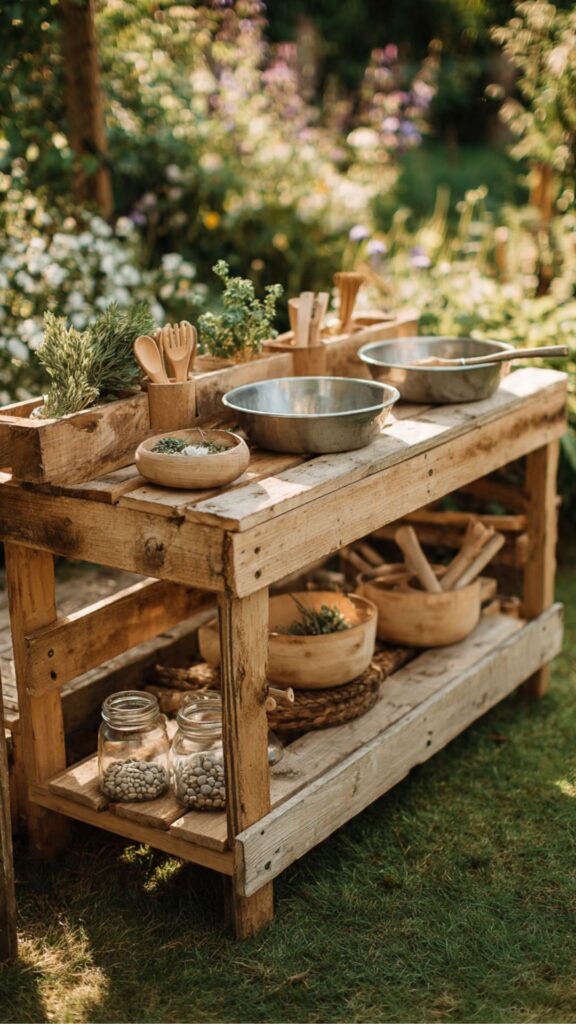
You do not need to spend hundreds of pounds or dollars to create a wonderful mud kitchen. Some of the most beloved children’s mud kitchens are assembled almost entirely from donated, reclaimed, or charity shop materials. Start by raiding your own kitchen for retired pots, pans, wooden spoons, and measuring cups.
Post a request in a local parent Facebook group or Nextdoor community most families have a cupboard full of battered kitchenware that they’d happily donate to a children’s mud kitchen. The response is usually overwhelming and immediate.
For the structure itself, beyond pallets (discussed above), consider repurposing an old wooden bookshelf laid on its side, a disused potting bench, an old dresser frame stripped of its drawers, or even a sturdy plastic storage unit.
The key structural requirements are: a flat work surface at child height, some form of raised backing to prevent ingredients flying off the back, and ideally one or two shelves or storage areas for equipment. Almost any wooden piece of outdoor furniture can be adapted to serve these functions with a little creativity.
The “mud” itself is free. Rather than buying specialist materials, create a simple mud pit adjacent to the kitchen using a patch of garden soil mixed with water or use a builder’s trug filled with garden compost. Supplement this with free natural loose parts collected on walks: stones, sticks, leaves, seed pods, and pine cones.
A single afternoon’s foraging can yield enough “ingredients” to fuel weeks of imaginative mud kitchen play. This foraging process itself is valuable: it gets children outdoors, develops their observational skills, and builds a sense of connection to the local natural environment.
Mud Kitchen Safety Guide:
What Every Parent Must Know
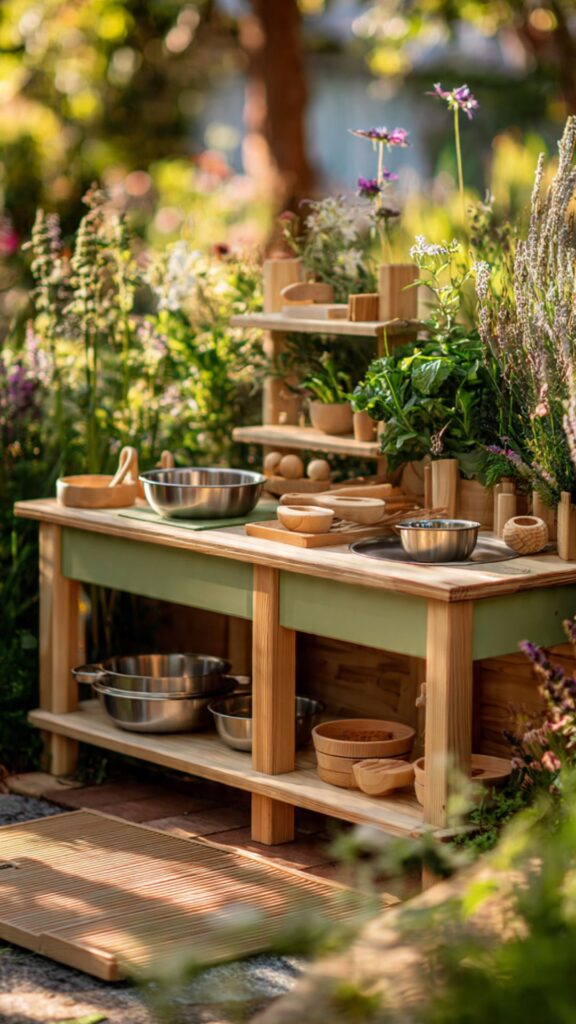
Mud kitchen play is extremely safe when set up with a few basic precautions in mind. The first priority is the structure itself: check all wooden elements regularly for splinters, cracks, and loose joints. Sand rough areas whenever they appear and reapply wood sealant annually if you’re using untreated or lightly treated wood. Ensure the structure is stable and won’t tip if a child leans against it or climbs on it anchor it to a fence or wall if in doubt.
The mud and materials used deserve careful consideration. If you have any doubt about the safety of your garden soil for instance, if the area was previously used for industrial purposes or was treated with chemicals use commercial potting compost or purchased play sand as a safer alternative.
Avoid adding any materials that could be harmful if ingested: certain berries and seeds are toxic, as are fungi. Teach children that mud kitchen food is pretend food and is not for eating. For children under 3 who are still in the oral exploration phase, supervise closely and keep ingredients age-appropriately simple and safe.
Hygiene after mud play is important and easily managed. Establish a simple post-play routine: brushing off boots at the door, rinsing hands (and sometimes more!) with an outdoor hose before coming inside, and removing outer layers before entering the house.
This routine, established consistently from the start, prevents mud kitchen play from becoming a source of household conflict. It also teaches children responsibility and respect for shared spaces valuable lessons that extend well beyond the garden.
Post a simple laminated “After Play” routine card near the mud kitchen door exit: 1) Tap boots, 2) Rinse hands, 3) Take off muddy clothes outside. Children as young as 3 can follow picture-based routines independently.
A Beautiful Mud Kitchen Pairs Perfectly with These Charming Farmhouse Kitchen Ideas!
Sensory Learning Benefits:
How Mud Kitchens Develop the Whole Child
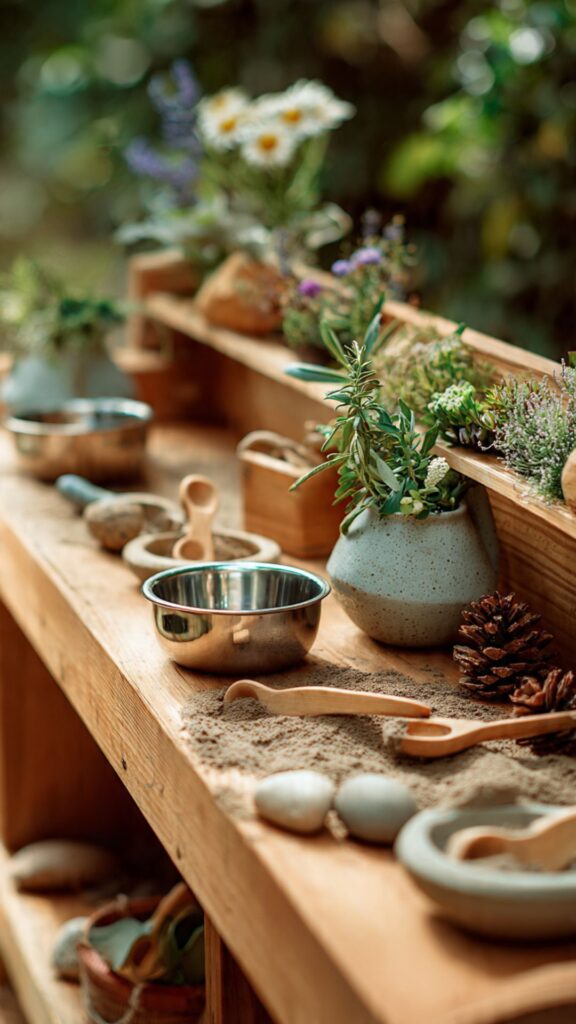
Mud kitchen play engages all seven senses not just the familiar five. In addition to sight, sound, smell, taste (handled safely), and touch, mud play develops the proprioceptive sense (awareness of body position and pressure through the hands and arms while mixing, pressing, and scooping) and the vestibular sense (balance and spatial awareness as children move around the kitchen space).
This multi-sensory engagement is deeply regulating for the nervous system, which is why children often appear calmer and more focused after sustained outdoor mud play.
For children with sensory processing differences including those on the autism spectrum, those with ADHD, and children with sensory integration challenges mud kitchens can serve as powerful therapeutic tools. The predictable, controllable texture of mud (unlike unpredictable social situations) provides a sensory experience that children can regulate at their own pace.
Occupational therapists increasingly recommend mud and water play as a component of sensory integration therapy, and parents often report significant improvements in sensory tolerance when mud kitchen play is incorporated into daily routine.
The language development benefits of mud kitchen play are frequently underestimated. The rich narrative that naturally emerges “I’m making a birthday cake,” “this potion is magic,” “you need to add more water” is packed with vocabulary acquisition, sentence formation, and social communication practice.
Children playing together at a mud kitchen negotiate, instruct, describe, question, and storytell in ways that are rare in more passive or structured play contexts. This language-rich environment is especially valuable for children developing English as an additional language or those with speech and language development needs.
Mud Kitchen with Water Station:
The Game-Changing Addition
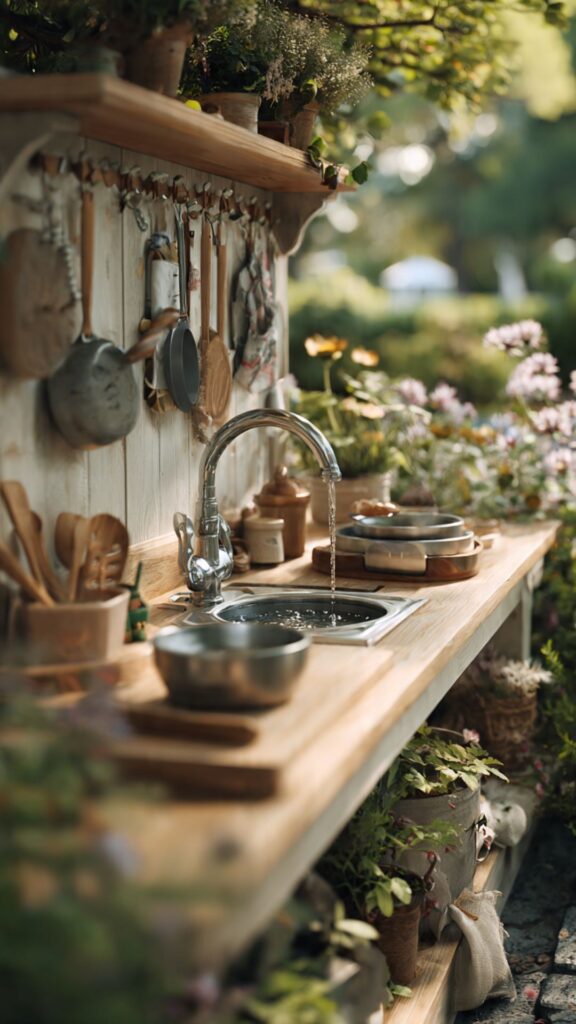
If there is one upgrade that transforms a mud kitchen from good to extraordinary, it is adding a dedicated water station. Access to running water even just a gravity-fed container mounted at child height adds an entirely new dimension to mud kitchen play.
Children can regulate the consistency of their mud, create different textures, experiment with absorption and flow, and engage in water-specific play alongside their cooking activities. The combination of mud and water activates a level of engagement and creative exploration that neither element achieves alone.
The simplest water station option is a repurposed large plastic water container (like a drinks dispenser or camp water jug) mounted on a shelf or bracket above the kitchen surface, fitted with a simple tap that children can operate independently.
The water collects in a bowl below and can be recycled back into the container, making it both self-contained and eco-conscious. More permanent setups can include plumbing connected to an outdoor garden tap, or a rainwater harvesting barrel with a child-accessible tap the latter being particularly popular in eco-conscious schools and family homes.
Water safety with young children in outdoor settings deserves attention. Ensure any standing water containers are covered when not in use to prevent insect breeding and accidental drowning risk (any container holding more than a few inches of water poses a drowning risk for toddlers).
Establish clear water play rules: water stays at the kitchen, we use the containers and not the hose unsupervised, and we help each other clean up spills. These boundaries preserve both safety and the quality of the play environment without killing the joy of water play.
Themed Mud Kitchen Designs:
From Rustic to Fantasy
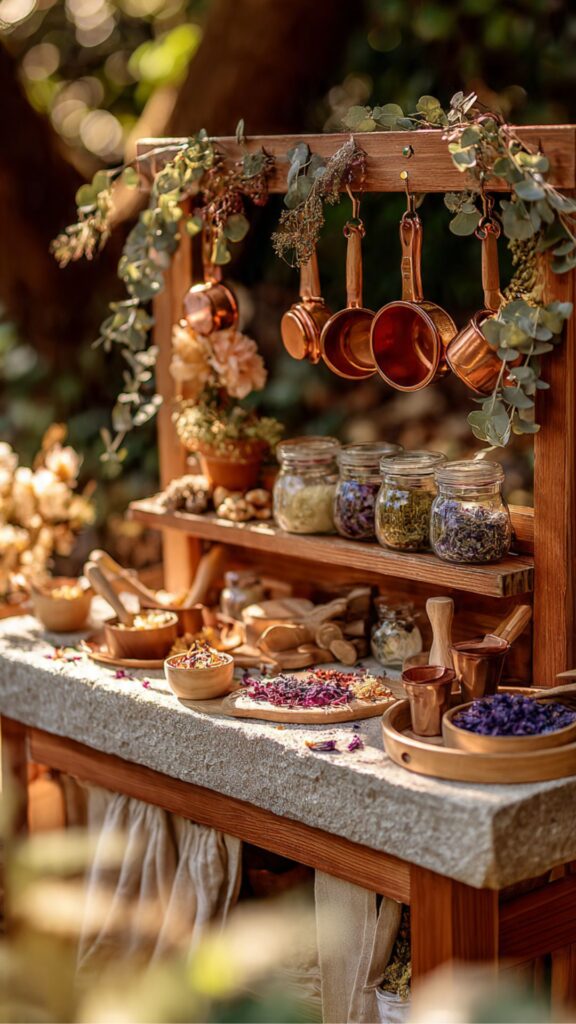
One of the most exciting aspects of building a custom mud kitchen is the opportunity to create a truly unique, themed environment that captures a child’s specific imagination. Themes transform a functional structure into a world and children respond to world-building with extraordinary creative energy.
Popular themes include a woodland café (with moss-covered surfaces, twig utensils, and a forest colour palette), a potions laboratory (dark, mysterious, with bottles and cauldrons), a seaside fish and chip shop (with shells, sand, and maritime colours), or a space station kitchen (silver finishes, metallic utensils, moon dust).
A fantasy or fairy-tale theme is perennially popular with children aged 3–7. Think a “Witches’ Kitchen” with dark wood, cauldron-style pots, and dried herbs hanging overhead. Or a “Fairy Bakery” with pastel colours, flower-shaped moulds, and sparkling mica powder as “fairy dust.”
These themes don’t require structural changes to the basic kitchen they’re achieved through colour, accessories, and carefully curated loose-parts materials that match the narrative world. A small sign or hand-painted name (“The Enchanted Kitchen”) makes it official in a child’s eyes.
For families who want their mud kitchen to grow and change, consider a “blank slate” base design that can be re-themed seasonally or annually. A simple, natural wood structure with a pegboard back allows you to swap out accessories, colours, and decorations as the child’s interests evolve.
What begins as a woodland café at age 4 might become a science lab at age 6 and a proper restaurant at age 8. This adaptability makes the investment go further and keeps the play environment genuinely fresh and exciting for years.
Mud Kitchen Storage & Organisation:
Tidy Setup, Better Play
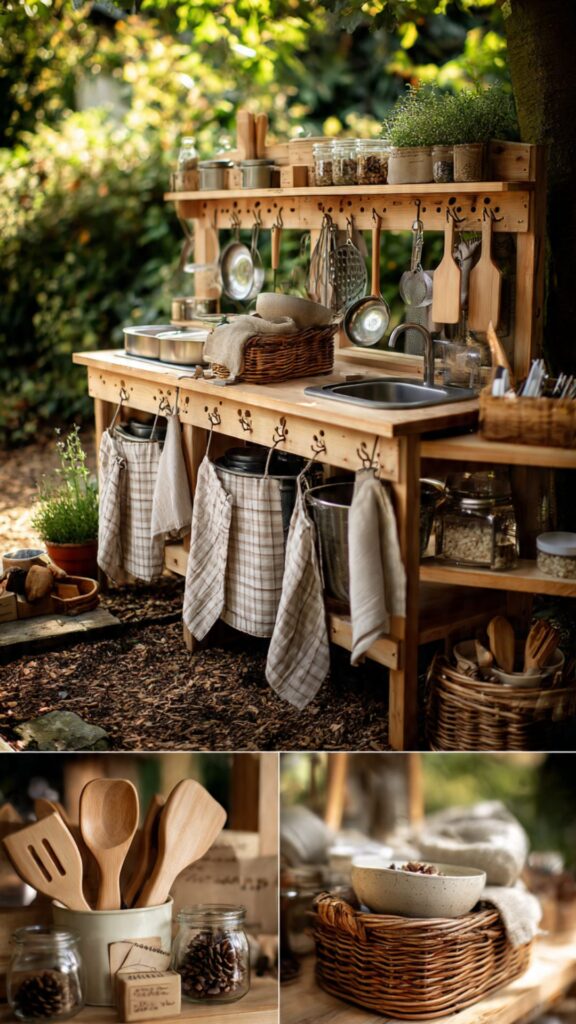
Organisation in a mud kitchen might seem counterintuitive this is, after all, a space dedicated to glorious mess. But there is strong evidence from play research that an organised, well-maintained play environment invites deeper and more sustained engagement than a chaotic one.
When children can easily find what they need, they spend less time rummaging and more time creating. Clear, accessible storage also builds responsibility and independence: children who know where things live are far more likely to tidy up after play.
The best mud kitchen storage systems use visual cues rather than labels, especially for pre-readers. Hooks with silhouettes or pictures above them, colour-coded containers for different material types, and open shelves where everything is visible at a glance are all highly effective.
Consider attaching a pegboard to the back of the kitchen structure fitted with hooks sized appropriately for your tool collection. This “tool shadow board” approach (borrowed from professional workshop design) makes it instantly clear if anything is missing and reduces the time spent hunting for the ladle.
Weatherproof storage for smaller accessories and ingredients is worth investing in. Individual airtight containers (old jam jars with lids, plastic food containers, or small metal tins) keep dried herbs, sand, bark chips, and other loose-parts materials usable across multiple sessions and protected from rain.
Storing these inside a small waterproof cabinet or box mounted to the fence near the mud kitchen adds a pantry element that children find genuinely delightful opening the “ingredient store” and selecting what they need is part of the ritual and the joy of mud kitchen play.
Love a Bold Kitchen Style? These Black Kitchen Cabinet Ideas Will Inspire You Too
Mud Kitchen for Multiple Children:
Design for Social Play
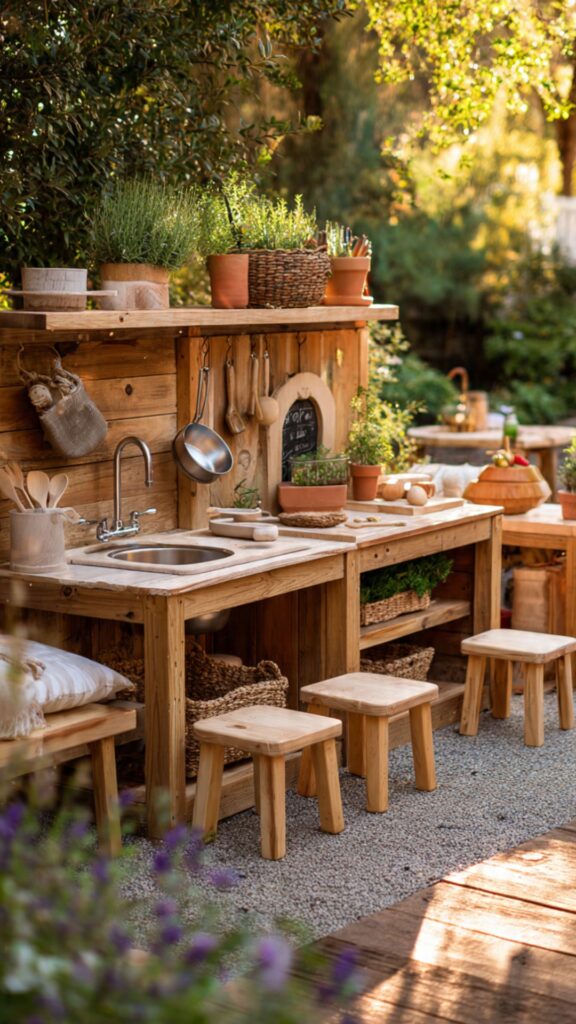
A mud kitchen that works for one child needs deliberate redesign to work well for multiple children simultaneously. Conflict is the most common issue when several children share a single small workstation disputes over tools, space, and “who is chef” can derail play quickly.
The solution is not complex: simply double the workspace. A longer work surface, two sets of primary tools, and multiple “ingredient stations” allow children to engage in parallel or cooperative play without constant territorial friction.
Role differentiation is another powerful strategy for multi-child mud kitchens. Introducing explicit role props a chef’s hat, a waiter’s notepad, an apron for the baker allows children to occupy distinct but complementary positions within the play narrative.
This mirrors real-world restaurant or kitchen dynamics and introduces concepts of teamwork, division of labour, and communication. Children who might struggle with unstructured social play often thrive within this kind of clear role-based framework.
For schools, nurseries, and families with three or more children, a “mud kitchen village” concept works beautifully. Rather than one large structure, several smaller kitchen stations arranged in a horseshoe or circle configuration create a market or street-food village atmosphere.
Children can specialise (“I make the soup, you make the cakes”), trade with each other, and develop a rich shared narrative economy within the play space. This model common in the best Scandinavian outdoor nurseries produces some of the most complex, sustained, and developmentally rich play that early educators observe.
Social Learning Insight: Studies of outdoor play dynamics show that children in mud kitchen settings demonstrate 40% more cooperative language (turn-taking, sharing, negotiating) compared to indoor structured play activities.
Upgrading Your Mud Kitchen:
Next-Level Features Worth Adding
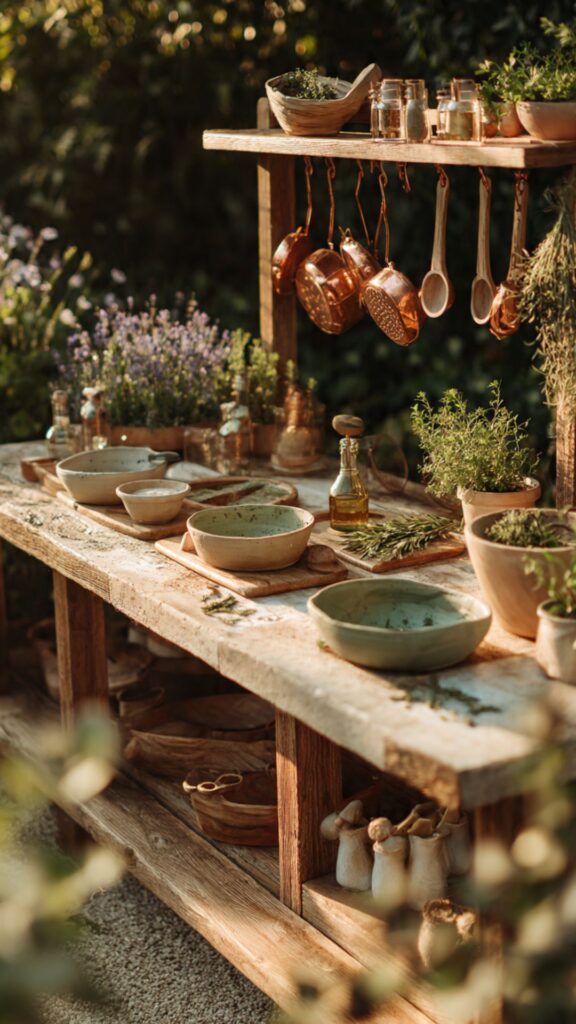
Once your basic mud kitchen is established and well-loved, a series of exciting upgrades can refresh the play environment and extend its relevance as children grow. One of the most impactful additions is a growing area immediately adjacent to the kitchen: a small raised bed, container garden, or herb spiral where children grow their own “ingredients.”
Being able to cut fresh herbs, pick edible flowers, or harvest cherry tomatoes to bring to the mud kitchen creates a farm-to-table play experience that is deeply engaging and introduces genuine concepts of gardening, nutrition, and seasonal food.
A dedicated “potions shelf” or “science station” can be added as children reach school age and begin to engage more analytically with materials. This might include a set of transparent bottles, a balance scale, pH testing strips, a magnifying glass, and a notebook for recording “experiments.”
Framing mud kitchen play in the language of science “hypothesis,” “experiment,” “result” bridges the gap between outdoor play and classroom learning in a way that makes both more enjoyable. Children begin to carry their natural curiosity from the mud kitchen into formal science education.
Finally, consider adding evening or twilight play potential through safe outdoor lighting. Fairy lights strung over the mud kitchen structure, a small solar-powered lantern on the worktop, or even a simple headlamp station transforms the mud kitchen into a magical evening play destination during the long summer months.
Children who are used to daytime outdoor play are often deeply enchanted by the opportunity to use their mud kitchen as dusk falls the familiar space takes on an entirely new character, and the play that emerges is often the most creative and imaginative of all.
The single most impactful upgrade for any mud kitchen is simply ensuring it’s always “ready to play” with water available, ingredients stocked, and tools accessible. A mud kitchen that requires 10 minutes of adult setup before each use will be used far less than one that invites immediate, independent play.
Final Thoughts
Build the Mud Kitchen, Build the Child
A mud kitchen is one of the most valuable, versatile, and developmentally powerful outdoor investments you can make for any child. From sensory development and language acquisition to social skills and scientific thinking, the humble mud kitchen delivers benefits that far outweigh its simple materials and modest cost. Whether you build one from reclaimed pallets this weekend or invest in a premium school installation, the impact on children’s play, learning, and wellbeing will be immediate and lasting.
The ideas in this guide cover every aspect from toddler-safe setups and budget builds to themed designs and multi-child configurations. Pick the ideas that resonate with your space, your child, and your budget, and know that there is no wrong way to begin. The best mud kitchen is the one that gets built and used, not the perfect one that stays a Pinterest idea forever.

Team TrandyVilla is the passionate home decor team behind Trandy Villa, where style meets comfort in everyday living. The team loves transforming simple spaces into beautiful, functional homes through smart ideas, budget-friendly hacks, and modern design trends. Their content focuses on helping readers create homes that feel both stylish and personal without spending too much.