
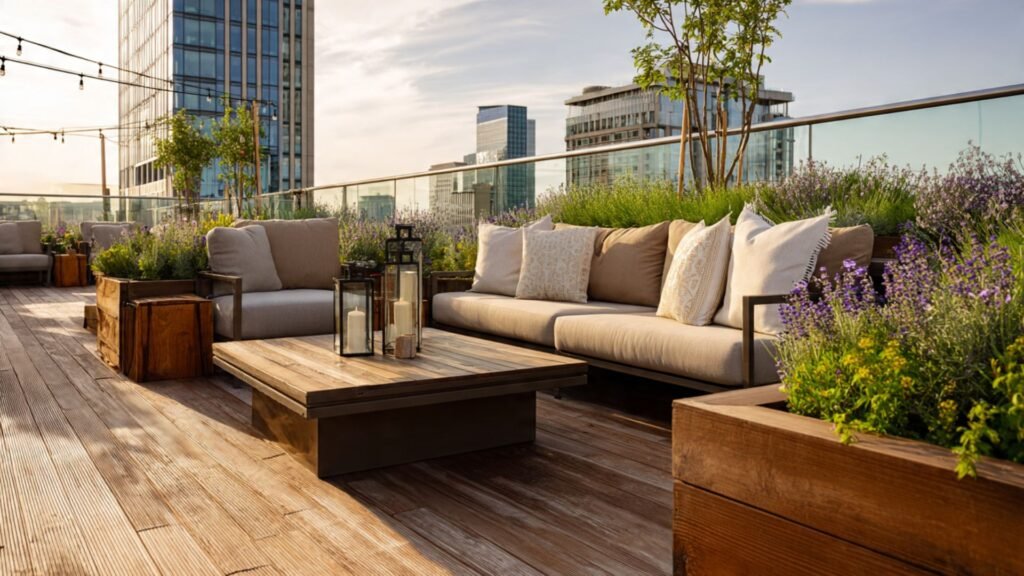
A rooftop garden is one of the most rewarding investments a homeowner or building owner can make. It reclaims unused space, reduces urban heat, improves air quality, and creates a private outdoor retreat above the city. Whether you have a large flat rooftop or a compact terrace, thoughtful rooftop garden design turns dead square footage into a thriving, living environment.
A rooftop garden is a planted space built on top of a building. It turns unused roof area into a green, functional environment. Rooftop garden ideas cover container planting, green roofs, herb gardens, and outdoor living spaces. Each idea serves a clear purpose whether for food, beauty, privacy, or relaxation. These spaces improve air quality, reduce heat, and bring nature into urban settings.
A rooftop garden transforms a bare, forgotten surface into a thriving green retreat where city noise fades, fresh air fills the space, and every visit feels like a quiet escape above the urban world below.
Rooftop garden ideas suit buildings of all sizes and styles. Container gardens offer flexibility with minimal structural impact. Herb gardens deliver daily harvests in compact spaces. Green roof systems provide insulation and support local biodiversity. Pergolas and seating areas extend outdoor living above the roofline.
Smart irrigation systems reduce maintenance and conserve water. Pollinator-friendly planting supports urban wildlife in a meaningful way. Each idea creates a more livable, sustainable, and beautiful rooftop space.
Container Garden Rooftop:
The Smartest Starting Point for Any Building
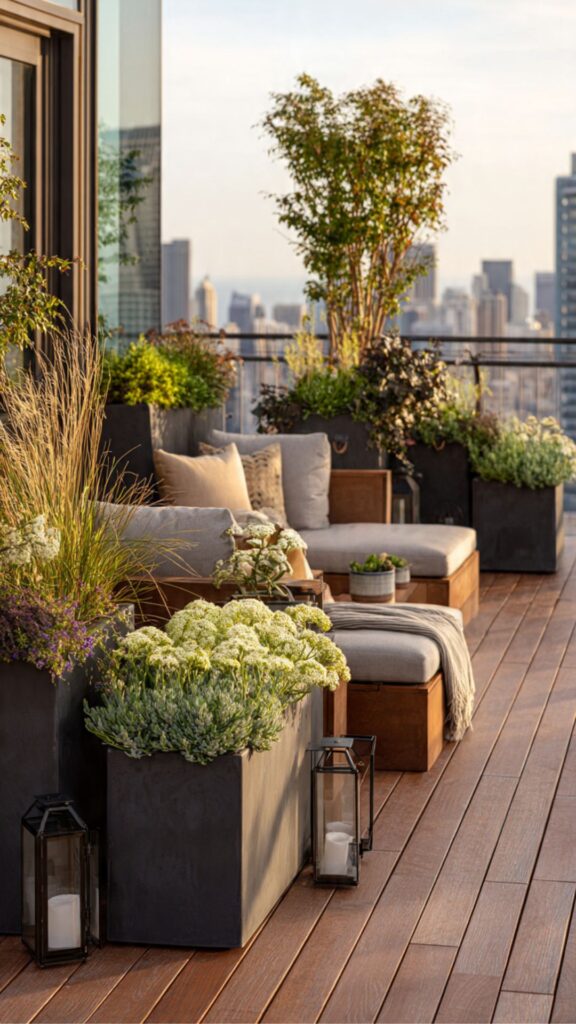
Container gardening is the most accessible entry point into rooftop gardening, and it’s far more versatile than most people realize. Unlike in-ground planting, containers allow you to control soil quality, manage drainage precisely, and reposition your garden as your needs evolve. For rooftops with structural load restrictions, which is the majority of residential and commercial buildings, containers distribute weight in manageable, predictable units rather than placing a continuous heavy load across the entire roof surface.
Weight management is the most critical factor in any rooftop garden project, and containers make this significantly easier to calculate and control. Lightweight growing media, a blend of perlite, vermiculite, coir, and a small proportion of compost can weigh as little as 30–40% of standard garden soil while delivering equivalent plant performance.
Pair this with fiberglass, resin, or fabric grow bags rather than heavy terracotta or concrete pots, and your rooftop load remains well within safe structural limits for most buildings. Always consult a structural engineer before installing any rooftop garden. This step is non-negotiable and legally important in many jurisdictions.
Container arrangement is where design creativity comes in. Group containers in clusters of varying heights to create a layered, naturalistic feel rather than a regimented row. Use tall planters for architectural specimens olive trees, ornamental grasses, columnar bamboo in root barriers to create vertical interest and privacy screening simultaneously. Mid-height containers handle herbs, perennial flowers, and compact vegetables. Low, wide troughs at ground level fill in with trailing plants and ground-cover species.
This tiered approach mimics how plants grow in nature and creates a garden that feels lush and intentional from every angle. One underrated advantage of container rooftop gardens: seasonal flexibility. Unlike permanent planting beds, containers allow you to completely reinvent your rooftop garden’s planting palette with the seasons.
Spring bulbs give way to summer annuals, which transition to autumn-toned perennials and winter evergreens. This seasonal rotation keeps the rooftop garden visually dynamic throughout the year and gives you a horticultural education that static planting schemes simply cannot provide. Many experienced rooftop gardeners describe this seasonal rhythm as one of the most satisfying aspects of container gardening at height.
Rooftop Vegetable Garden:
Growing Your Own Food Above the City
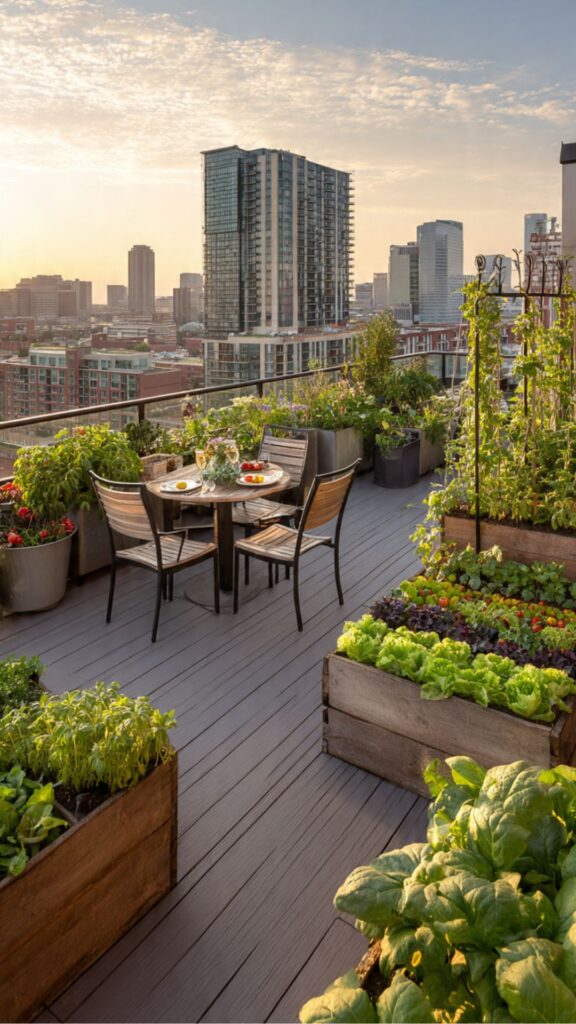
A productive rooftop vegetable garden is one of the most meaningful uses of urban rooftop space. Growing food in the city reduces food miles, provides genuinely fresh produce, reconnects urban residents with natural growing cycles, and delivers a sense of productive satisfaction that ornamental gardening alone cannot match. In cities worldwide from Tokyo rooftop farms to Brooklyn community gardens productive rooftop growing is rapidly transitioning from niche experiment to mainstream urban agriculture.
Crop selection is the most important decision in a rooftop vegetable garden, and it must account for the rooftop’s unique microclimate. Rooftops typically receive more sunlight and experience higher wind speeds than ground-level gardens conditions that suit some crops excellently and challenge others significantly. Tomatoes, peppers, courgettes, beans, cucumbers, herbs, and salad leaves all thrive in rooftop conditions given adequate container depth and consistent watering. Root vegetables like carrots and parsnips need deep containers but are certainly achievable. Brassicas broccoli, kale, cabbage perform well but may require wind protection in exposed locations.
Irrigation is the make-or-break factor in rooftop vegetable growing. Rooftop containers dry out significantly faster than ground-level beds due to elevated wind exposure and sun intensity. Manual watering is feasible for small rooftop gardens but quickly becomes onerous for larger productive spaces, particularly during summer heat.
A drip irrigation system connected to a programmable timer is the single most valuable infrastructure investment in a rooftop vegetable garden — it maintains consistent soil moisture, reduces water consumption by 30–50% compared to hand watering, and protects crops during the owner’s absence. Install the irrigation infrastructure before planting, not as an afterthought when drought stress is already evident.
For urban apartment buildings with shared rooftop access, a community rooftop vegetable garden model creates social value alongside edible productivity. Allocating individual growing plots to residents, establishing shared composting systems, and organizing seasonal planting days builds community while maximizing the garden’s productive capacity. Several progressive housing developments in European cities particularly in the Netherlands and Denmark have demonstrated that community rooftop gardens improve resident wellbeing metrics, reduce building energy consumption through added insulation, and increase property values measurably. This model is likely to become standard in urban residential development within the next decade.
You may like: Hallway Decor Ideas for a Stylish and Welcoming Entrance.
Green Roof System:
Living Architecture with Measurable Benefits
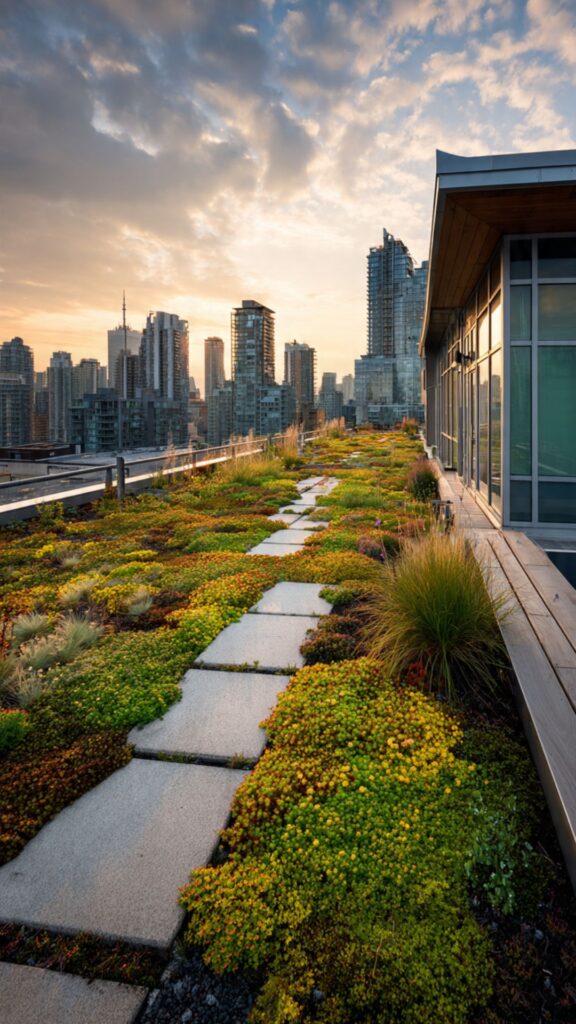
A green roof also called a living roof or vegetated roof is a permanent layer of growing medium and plants installed directly onto a building’s roof structure. Unlike a container garden, a green roof integrates with the building itself and delivers benefits at an architectural scale: stormwater management, thermal insulation, urban heat island reduction, biodiversity support, and extended roof membrane lifespan. It represents the most committed and structurally significant form of rooftop garden, and increasingly, it is being mandated by city planning authorities in progressive urban environments.
Green roofs are categorized into two primary types: extensive and intensive. Extensive green roofs use a shallow growing medium typically 60–150mm deep planted with drought-tolerant, low-maintenance species such as sedums, mosses, and native wildflowers. They are lightweight, require minimal maintenance, and are suitable for a wide range of roof structures including those with load-bearing limitations. Intensive green roofs use deeper growing media 150mm to over 1,000mm and can support a much wider range of plants including shrubs, perennials, and even small trees.
They function essentially as elevated gardens accessible for regular use but require significantly stronger roof structures and greater maintenance investment. The thermal performance benefits of green roofs are significant and measurable. A well-established extensive green roof reduces heat gain into the building below by up to 75% in summer, according to research published by the US Environmental Protection Agency, while also providing meaningful insulation value in winter.
For urban buildings where cooling costs represent a substantial operational expense, this performance improvement translates directly into energy savings that contribute to the green roof’s return on investment calculation. The roof membrane beneath the growing medium also lasts two to three times longer than an exposed membrane because it is protected from UV radiation and thermal cycling a financial benefit often overlooked in green roof cost analyses.
Biodiversity is one of the most compelling and most underappreciated benefits of urban green roofs. Planted with native wildflowers, grasses, and flowering sedums, a green roof becomes a refuge for pollinators, birds, and invertebrates in an urban environment otherwise hostile to wildlife. Research in several European cities has documented over 50 invertebrate species, including rare bee species, establishing on well-planted urban green roofs.
At a time when global pollinator populations face significant decline, every green roof installed represents a meaningful contribution to urban ecological resilience. For building owners seeking environmental credentials or sustainability certifications, documented green roof biodiversity provides tangible evidence of positive environmental impact.
Rooftop Herb Garden:
Flavor, Fragrance, and Function in One Space
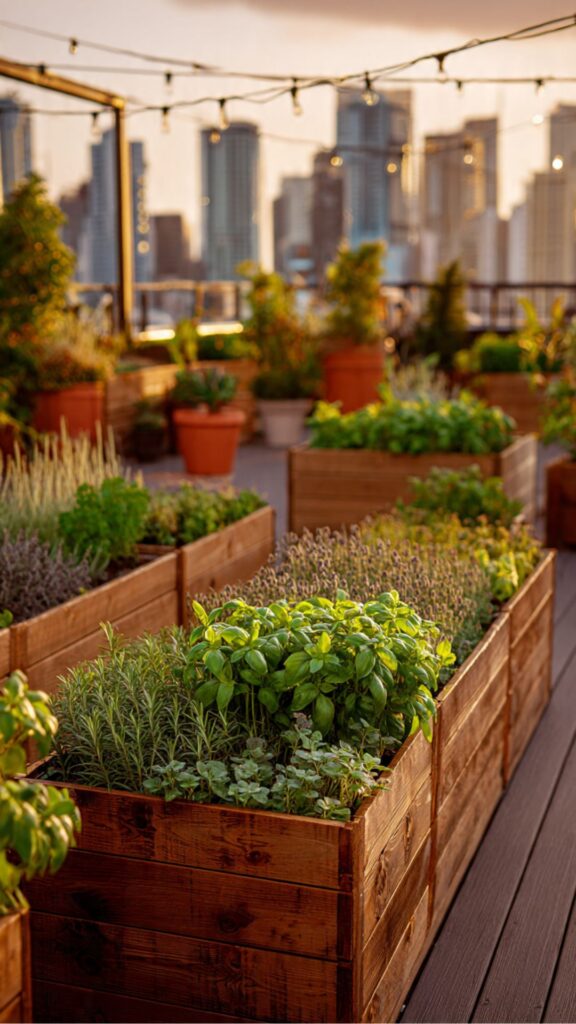
A rooftop herb garden is perhaps the most immediately rewarding productive garden you can establish in an urban setting. Herbs are compact, fast-growing, highly productive in containers, and usable every single day in the kitchen. The sensory experience of a well-planted herb rooftop the fragrance of rosemary, lavender, and thyme warmed by afternoon sun transforms the rooftop into a genuinely pleasurable destination rather than simply a productive one.
Mediterranean herbs are the ideal foundation for any rooftop herb garden, and their suitability is no coincidence they evolved in conditions that closely mimic typical rooftop environments: intense sun, well-drained soil, and periodic drought stress. Rosemary, thyme, sage, oregano, and lavender thrive in shallow containers with gritty, free-draining growing media and minimal irrigation once established.
These perennial herbs return reliably each year, develop increasingly attractive woody structure over time, and provide year-round harvests in all but the coldest climates. They are, in every sense, the backbone of a rooftop herb garden.
Tender and annual herbs require more attention but deliver the most culinary impact for regular cooks. Basil is the most coveted and most demanding it needs warmth, consistent moisture, and protection from strong winds, all of which require more careful management on an exposed rooftop.
Position basil and other tender herbs like coriander and dill in sheltered microspots behind taller planters, near parapet walls, or within a windbreak of robust perennial herbs. Mint, though vigorous and easy, must always be grown in containers rather than in shared growing media, as its spreading rhizomes will colonize and outcompete neighboring plants aggressively.
The design potential of a rooftop herb garden extends well beyond productivity. An herb garden arranged by sensory category culinary herbs nearest the dining area, fragrant herbs near seating, architectural herbs as structural anchors creates a garden that serves multiple functions simultaneously. Lavender and rosemary in tall planters flank a rooftop dining table as both a scent experience and a privacy screen.
Tiered herb towers along a parapet wall create a kitchen garden aesthetic that is both beautiful and eminently photographable. In 2026, the rooftop herb garden has become one of the most sought-after features in luxury urban residential developments valued not just for its produce but for the lifestyle quality it represents.
Rooftop Garden with Pergola:
Shade, Structure, and Style Combined
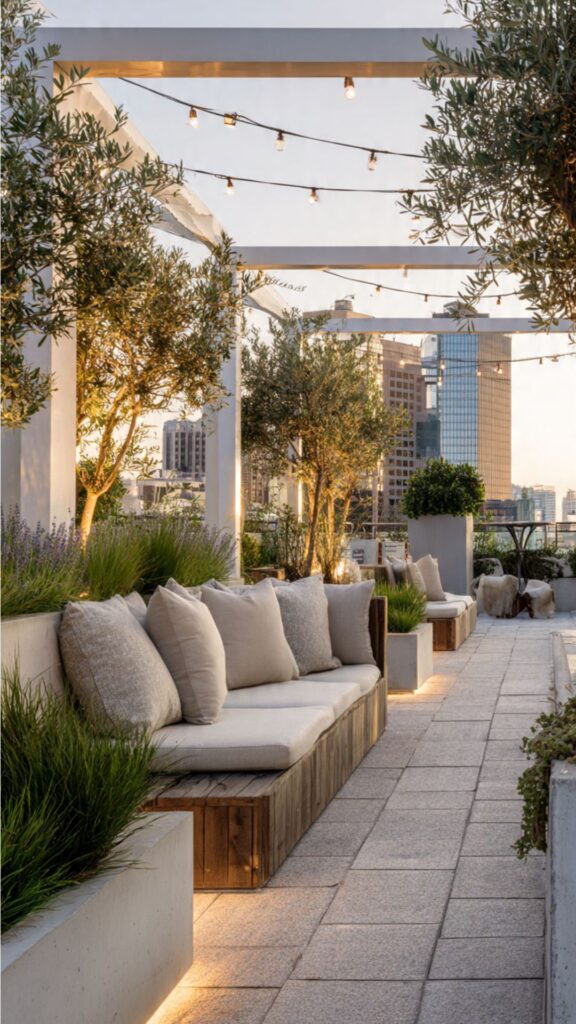
A pergola transforms a rooftop garden from an open space into an outdoor room. It provides shade, defines the living area, creates a vertical structure for climbing plants, and adds architectural character that elevates the entire rooftop garden design from pleasant to spectacular. In climates with intense summer sun or unpredictable rainfall, a rooftop pergola extends usable hours and seasons dramatically making the rooftop a genuinely habitable outdoor space rather than an occasional destination. Material choice for a rooftop pergola requires careful consideration of both aesthetics and the demands of the rooftop environment.
Powder-coated aluminum is the most practical choice for most installations: it is lightweight, critical for roof load management, completely rust-resistant, maintenance-free, and available in a wide range of colors and profiles. Natural timber creates a warmer, more organic aesthetic but requires annual treatment to resist the elevated UV exposure and moisture experienced on rooftops, and adds significantly more weight to the structure. Composite decking-style materials offer a middle ground the appearance of timber with dramatically reduced maintenance requirements.
Climbing plants soften the pergola’s structure and complete the garden aesthetic. Wisteria, star jasmine, grapevines, and climbing roses all perform beautifully on rooftop pergolas in suitable climates, creating a canopy of foliage and flower that makes the space feel simultaneously sheltered and natural. For year-round greenery, evergreen climbers like Trachelospermum Jasminoides (star jasmine) or Hydrangea anomala provide consistent coverage without the bare winter framework that deciduous climbers leave behind. Grow bags at the pergola’s base and train stems upward with horizontal wires secured to the structure this system combines portability with the visual effect of permanent planting.
Integrated technology makes a rooftop pergola significantly more functional as a living space. Outdoor-rated LED strip lighting woven through the pergola structure creates atmospheric evening illumination. Retractable motorized shade sails or louvered roof systems provide on-demand sun and rain protection without the permanent commitment of a fixed canopy.
Outdoor speakers connected to a smart home system complete the transformation of the rooftop garden into a genuine outdoor entertaining room. These technology integrations are increasingly standard in premium rooftop garden projects and represent the direction in which urban outdoor living design is heading broadly.
Related Read : Farmhouse Kitchen Ideas for a Charming and Cozy Cooking Space.
Rooftop Water Feature:
Sound, Serenity, and Sensory Design
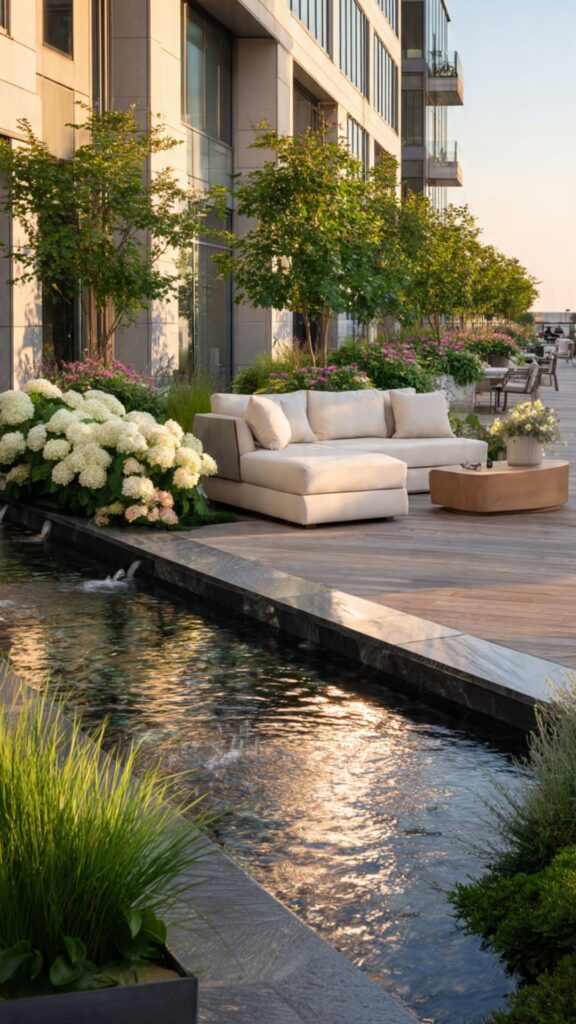
A water feature adds a dimension to rooftop garden design that no plant or furniture can replicate. The sound of moving water masks urban noise pollution-traffic, construction, crowds and creates an acoustic environment that makes the rooftop feel removed from the city below, even when that city is directly beneath your feet. This psychological effect is deeply rooted in biophilic design principles and explains why water features consistently appear in the highest-quality urban rooftop garden projects worldwide.
The choice of water feature style must balance visual ambition with the practical constraints of the rooftop environment. Self-contained fountain units where the pump, reservoir, and display are all integrated into a single unit are the most straightforward rooftop water feature solution. They require no permanent plumbing connections, sit on existing surfaces without structural modification, and can be repositioned as the garden design evolves.
Contemporary self-contained water features range from minimalist slate or concrete wall fountains to large-scale decorative urns with cascading overflow the aesthetic range is genuinely wide, and there is an appropriate option for every rooftop garden style.
For more ambitious rooftop garden projects, a custom-designed reflecting pool or raised water garden becomes a central design feature around which the entire rooftop is organized. A rectangular reflecting pool even at modest dimensions creates a mirror surface that visually expands the rooftop and reflects sky and surrounding architecture in a way that dramatically amplifies the sense of space.
Water plants, water lilies, lotus, aquatic marginals add color and ecological interest. Small fish provide natural mosquito control in warmer climates. However, these installations require careful structural engineering to account for the substantial weight of water — a cubic meter of water weighs exactly 1,000kg and waterproofing that integrates with rather than compromises the roof membrane.
Maintenance planning is the aspect of rooftop water features most frequently underestimated in the planning stage. Algae growth, pump maintenance, winter draining in cold climates, and water quality management in warmer ones all require regular attention. Self-contained fountain units with UV sterilizers and biological filtration significantly reduce the maintenance burden compared to unfiltered open water.
For rooftop gardens where regular maintenance is not feasible — holiday lets, commercial buildings, or part-time-use residential rooftops a simple recirculating wall fountain with a timer is a more realistic and ultimately more satisfying choice than an ambitious water garden that quickly deteriorates without consistent care.
Rooftop Garden Seating and Outdoor Living Areas:
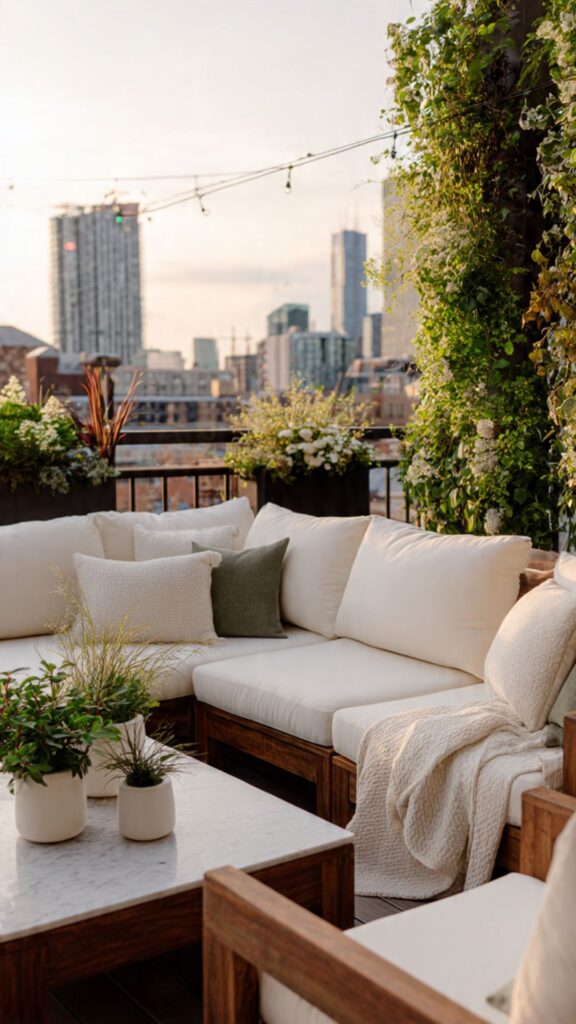
A rooftop garden without comfortable, well-designed seating is like a beautifully planted garden viewed only through a window the experience is incomplete. Outdoor seating transforms the rooftop garden from a visual amenity into a genuinely habitable space used daily through the warmer months and, in well-designed four-season setups, throughout the year. The seating area is where the rooftop garden earns its place in daily life.
Material selection for rooftop outdoor furniture must account for the specific conditions of the rooftop environment. Standard outdoor furniture designed for sheltered garden use frequently underperforms on rooftops, where UV intensity, wind exposure, and temperature fluctuation are all higher than at ground level.
Marine-grade teak, powder-coated aluminum, and high-quality resin wicker specifically tested for UV resistance are the materials that maintain their appearance and structural integrity in rooftop conditions. Cushion fabrics should be Sunbrella or an equivalent performance outdoor fabric with a rating of 1,000+ hours UV resistance; cheaper alternatives fade and deteriorate visibly within a single season.
Layout planning for the rooftop seating area should establish distinct zones for different activities a dining zone, a lounging zone, and ideally a contemplative zone separated by planting, level changes, or simply sufficient spatial distance to feel psychologically separate.
This zone approach is borrowed from landscape architecture and makes even a modestly sized rooftop feel generous and multi-dimensional. A dining table positioned to take advantage of the best view, with a lower lounging area behind it facing a different aspect, creates two completely different experiential destinations within the same rooftop garden.
Wind management is the most practically significant design challenge in rooftop seating areas, and it’s one that many rooftop garden projects address too late or too superficially. Glass balustrades provide transparent wind protection without blocking views or light an important quality consideration on a rooftop where both views and light are primary assets.
Strategic dense planting in tall containers creates a living windbreak that filters rather than blocks wind, reducing its force without creating the turbulence that solid walls can generate at their edges. For dining areas, a retractable wind screen or sail installed as part of the pergola structure provides flexible, on-demand protection that can be deployed when needed and stored when conditions are calm.
Pollinator-Friendly Rooftop Garden:
Designing for Bees and Butterflies
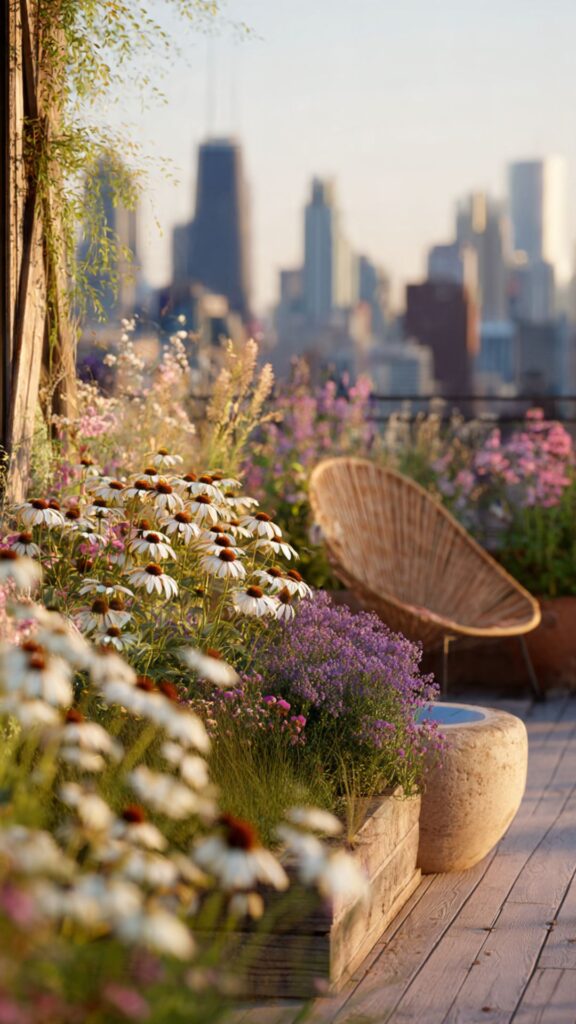
A pollinator-focused rooftop garden serves a purpose that extends well beyond the personal enjoyment of its owner. Urban pollinators bees, butterflies, hoverflies, and moths face significant habitat loss as cities expand and traditional gardens are paved or converted. A thoughtfully planted rooftop pollinator garden provides an elevated refuge that these insects can locate and return to reliably, contributing meaningfully to urban ecological networks that span entire city districts.
Plant selection is the foundation of a successful pollinator rooftop garden, and the research on which plants are most valuable is increasingly precise. Single-flowered varieties are consistently more accessible to pollinators than complex double-flowered cultivars, whose modified petals often prevent insects from reaching nectar and pollen. Native wildflower species are generally more valuable to native pollinator populations than exotic ornamentals, though many garden plants of Mediterranean origin lavender, catmint, salvias, echinacea are also highly productive for generalist bee species.
A planting palette that provides continuous bloom from early spring through late autumn ensures that the rooftop supports pollinators through their entire active season rather than just during peak summer. Habitat structure matters as much as planting diversity. Many solitary bee species which account for the majority of bee diversity and provide substantial pollination services nest in dry, hollow stems, loose soil, or pre-formed tunnels.
Incorporating a bee hotel, a patch of bare gravelly substrate, or bundles of hollow bamboo canes into the rooftop garden design provides nesting opportunities that a pure planting approach cannot. These features are simple to include during the garden’s design phase and represent negligible additional cost or space, yet they meaningfully expand the ecological value of the rooftop garden beyond what ornamental planting alone achieves.
Avoiding pesticides is a principle so fundamental to pollinator gardening that it barely needs stating yet it’s violated frequently in urban rooftop gardens where pest pressure from aphids, whitefly, and vine weevils tempts gardeners toward chemical solutions. The better approach is biological control: encouraging aphid predators (ladybirds, lacewings, parasitic wasps) through appropriate planting; using nematode soil drenches for vine weevil control; deploying sticky traps for fungus gnats.
These methods are as effective as chemical pesticides in most situations, carry no risk to beneficial insects, and over time create a garden ecosystem with its own natural balance that reduces pest pressure progressively rather than perpetuating the cycle of chemical dependency.
Explore More : Sunroom Ideas for a Nature Inspired and Relaxing Retreat.
Rooftop Garden Lighting:
Extending the Evening into the Garden
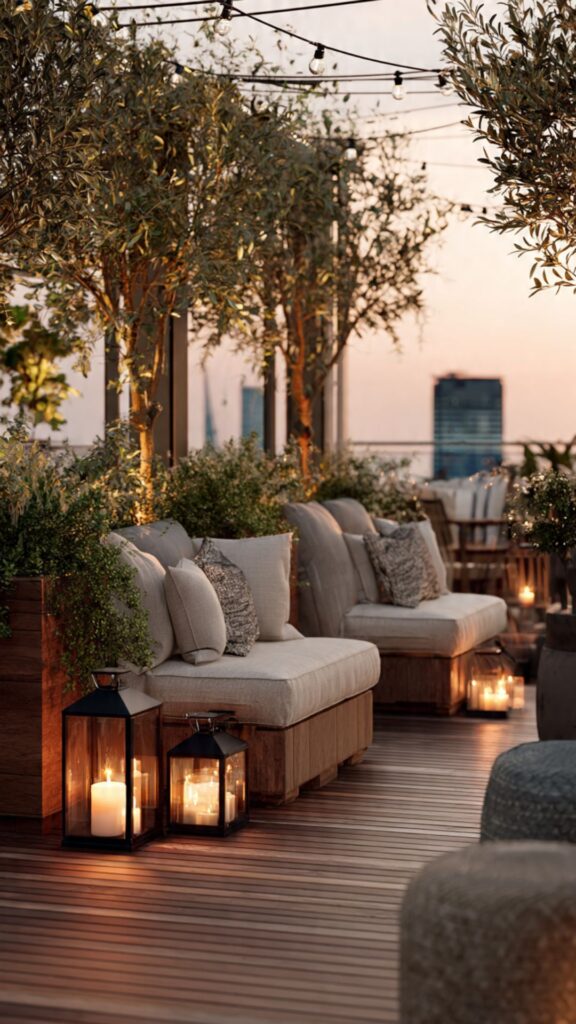
Rooftop garden lighting extends usable hours into the evening and transforms the garden’s aesthetic entirely after dark. A well-lit rooftop garden at night is a completely different environment from the daytime version more intimate, more atmospheric, and in many ways more beautiful. Yet lighting is the element most frequently added as an afterthought in rooftop garden projects, resulting in inadequate performance and wasted potential.
A layered lighting approach the same principle that works indoors creates the most successful rooftop garden lighting schemes. Ambient lighting establishes the overall light level and ensures safe navigation across the rooftop surface. Accent lighting picks out specific features: a specimen plant, a water feature, a section of decorative wall.
Decorative lighting festoon bulbs, lanterns, candle lighting adds warmth and atmosphere at human scale. Each layer contributes something distinct, and the combination creates a richness and depth that any single lighting type alone cannot approach.
Solar lighting technology has advanced considerably and now represents a genuinely viable option for rooftop garden applications, particularly for gardens where running electrical cable to the roof is impractical or cost-prohibitive. Contemporary solar garden lights particularly those with separated solar panel and light unit deliver reliable illumination for six to eight hours following a full day’s charge.
For decorative applications such as path lighting, festoon strings, and accent lighting on container plants, solar performance is entirely adequate. However, for functional task lighting in dining or seating areas where consistent brightness is important, a wired low-voltage LED system remains the more reliable and controllable choice.
Smart lighting control systems bring significant added value to rooftop garden lighting. Motion-activated perimeter lighting improves security and reduces energy waste. Timer-controlled ambient and festoon lighting ensures the garden is illuminated when in use without manual intervention. App-controlled color-temperature adjustment allows the lighting mood to shift from energizing daylight tones during afternoon gatherings to warm intimate tones for evening dining a versatility that static lighting cannot offer.
These smart systems are now available at consumer price points that make them accessible for residential rooftop garden projects, and their installation is straightforward enough that many homeowners choose to manage it themselves.
Low-Maintenance Rooftop Garden:
Beautiful Results with Minimal Effort

Not every rooftop garden owner has the time, physical access, or inclination for regular intensive gardening. A low-maintenance rooftop garden designed with this reality in mind delivers consistent visual beauty and genuine ecological value without demanding weekly attention. The key is making smart choices at the design and planting stage decisions that build resilience and reduced labor directly into the garden’s structure rather than relying on the gardener’s discipline to compensate.
Automated irrigation is the single most impactful low-maintenance investment in any rooftop garden context. A drip system with a programmable timer and ideally a rain sensor removes the most time-consuming and critical maintenance task watering from the gardener’s schedule almost entirely. Modern smart irrigation controllers connect to local weather forecast data and automatically adjust watering schedules based on predicted rainfall and temperature, further reducing both labor and water consumption.
For rooftop gardens with no existing water connection, a large rainwater harvesting tank connected to a drip system can provide a genuinely self-sustaining irrigation solution for significant portions of the growing season. Plant selection for low-maintenance rooftop gardens prioritizes resilience over novelty. Drought-tolerant perennials sedum, echinacea, salvia, agapanthus, ornamental grasses establish quickly, return reliably each year, require minimal feeding or deadheading, and improve in appearance as they mature.
Evergreen structural plants box balls, clipped pittosporum, phormium maintain year-round visual order without seasonal planting and replacement. These plants do most of the garden’s design work passively, leaving only occasional pruning and annual top-dressing of container growing media as the primary maintenance tasks.
Mulching container surfaces is a low-effort intervention with substantial maintenance benefits that many rooftop gardeners overlook. A layer of gravel, slate chippings, or bark mulch on the surface of growing media reduces moisture evaporation by up to 50%, suppresses weed germination, regulates soil temperature against summer heat and winter frost, and particularly with decorative gravel or slate adds a polished, finished aesthetic that makes the containers look designed rather than utilitarian.
In a low-maintenance rooftop garden, mulching is the final design step that ties the entire scheme together visually while simultaneously reducing the garden’s demand for attention. It is one of the highest-return, lowest-effort actions available to any rooftop gardener.
Conclusion
A rooftop garden is one of the most transformative investments you can make in urban living combining beauty, biodiversity, productivity, and wellbeing in a single elevated space. Whether you start with a simple container garden or commit to a full green roof system, every rooftop garden idea in this guide offers a meaningful way to reclaim unused space and improve your quality of life.
The best rooftop garden is the one you’ll actually use and enjoy so start with what excites you most, plan it well, and let the garden grow from there.

Team TrandyVilla is the passionate home decor team behind Trandy Villa, where style meets comfort in everyday living. The team loves transforming simple spaces into beautiful, functional homes through smart ideas, budget-friendly hacks, and modern design trends. Their content focuses on helping readers create homes that feel both stylish and personal without spending too much.