
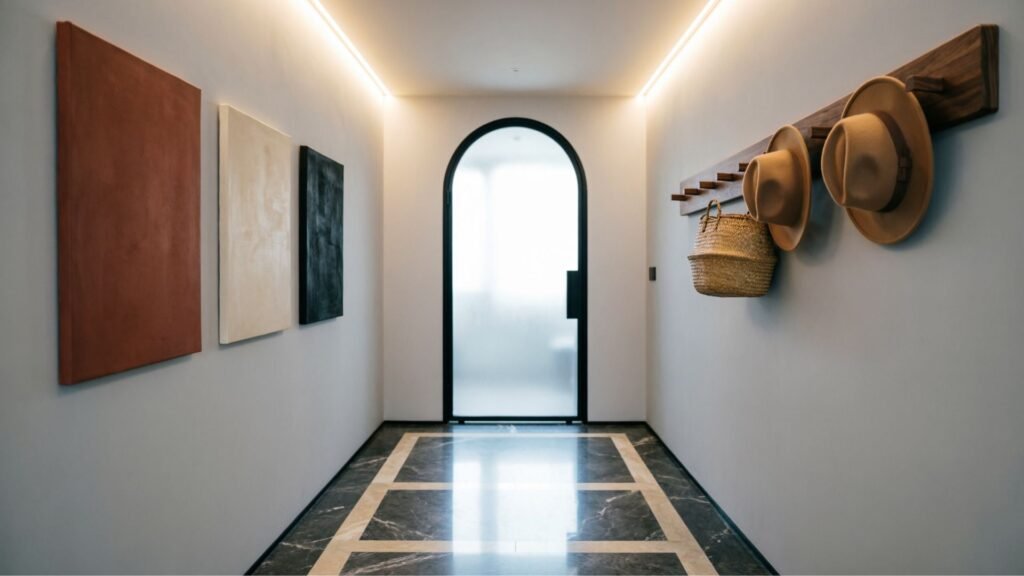
A narrow hallway design is one of the most underestimated spaces in any home. Most homeowners treat it as a passageway a forgotten corridor between rooms. However, with the right narrow hallway design, this space can become a powerful first impression, a functional storage hub, and even a design statement that sets the tone for your entire home.
Narrow hallway design transforms tight, overlooked corridors into functional and stylish spaces. It uses smart layouts, color choices, lighting, and storage to maximize every inch. The goal is simple: make small spaces feel open, welcoming, and organized. Good hallway design improves daily flow, boosts curb appeal, and adds real value to any home. Every narrow hallway design holds hidden potential waiting to be unlocked.
Most homeowners ignore their hallways until clutter takes over. A cramped, dark corridor creates a poor first impression and disrupts daily routines. Narrow spaces feel suffocating without proper planning. The right design fixes these problems instantly.
Mirrors open up walls. Light colors push boundaries outward. Smart storage eliminates chaos. A well-designed hallway sets the tone for the entire home, proving that even the smallest spaces deserve thoughtful attention and creative solutions.
Several key elements define successful narrow hallway design ideas. Vertical shelving maximizes wall space without blocking pathways. Light, neutral tones reflect more light and widen visual perception. Slim, floating furniture keeps floors clear and movement easy. Strategic mirror placement doubles visual depth immediately.
Runner rugs add direction, warmth, and personality. Layered lighting creates atmosphere at every level. Each element works together to create a corridor that feels larger, brighter, and more intentional than its actual dimensions suggest.
Use Vertical Space with Floor-to-Ceiling Shelving:
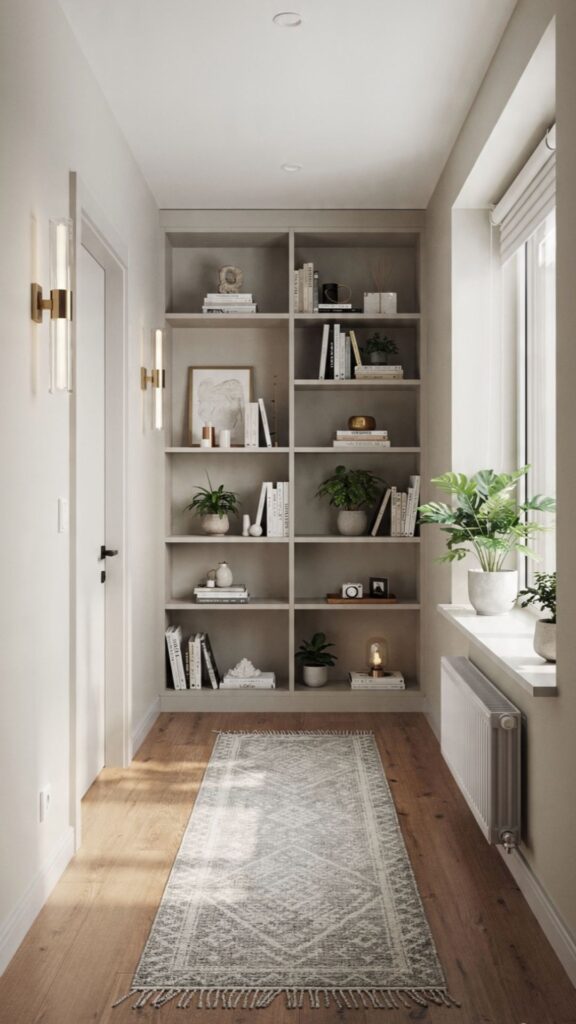
In a narrow hallway design, horizontal space is your biggest constraint so go vertical. Floor-to-ceiling shelving units pull the eye upward, creating a visual illusion of height that makes tight corridors feel more open and airy. Built-in shelves in particular look seamless and custom, avoiding the bulky appearance of freestanding furniture.
This is especially useful if your hallway doubles as a storage zone for shoes, books, bags, or seasonal items. The key is to keep the shelving organized and visually consistent. Use matching baskets, boxes, or bins to store items neatly.
Open shelves with too many mismatched items can quickly feel cluttered and chaotic in a small space. Consider a combination approach closed cabinets at the bottom for shoes and hidden storage, and open shelving above for decorative items or lighter objects.
A real-world example: many Scandinavian-inspired interiors use tall, white-painted shelving in narrow entryways to maximize storage without overwhelming the space visually. The white finish bounces light and keeps things feeling fresh.
You can replicate this look with IKEA’s BILLY or HEMNES system, or opt for custom-built joinery for a higher-end result. Adding a small ladder stool for top-shelf access also brings both function and a design-forward touch.
From a future-focused perspective, modular shelving systems are increasingly popular they adapt as your needs change without requiring full replacements. Brands now offer magnetic, adjustable shelving that can be reconfigured seasonally, which is ideal for hallways that serve multiple household functions throughout the year.
Choose Light, Neutral Paint Colors to Visually Widen the Space:
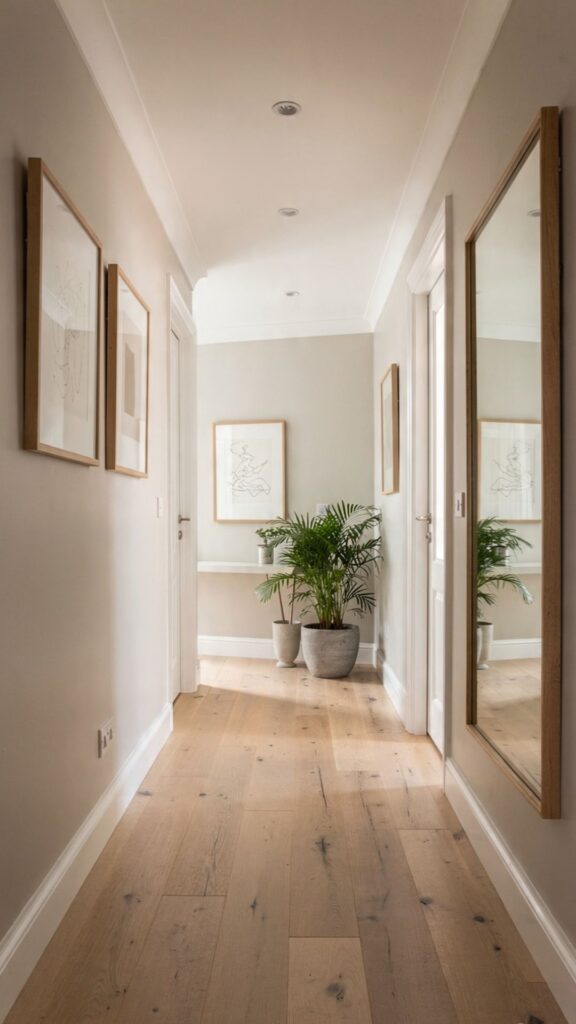
Paint color is the single most cost-effective tool in narrow hallway design. Light shades soft whites, pale grays, warm creams, and blush tones reflect natural and artificial light, making walls appear farther apart than they are. Darker colors absorb light and can make already-tight spaces feel claustrophobic. However, this does not mean dark hallways are impossible; it simply means the lighting strategy must compensate.
One technique that professionals use is painting the ceiling slightly lighter than the walls. This tricks the eye into perceiving more height and openness.
Conversely, if you paint the far end wall of a long hallway in a slightly deeper accent tone, you create depth that draws the eye through the corridor, making it feel intentional rather than cramped. This is called the ‘terminal wall’ technique and is widely used by interior designers working in compact homes.
Finish matters as much as color. Eggshell or satin finishes are practical for hallways because they are wipeable and durable, while also offering a gentle sheen that reflects light better than flat matte paints. High-gloss paint on ceilings is an underrated tip it bounces light dramatically and adds a hint of luxury without additional cost.
LSI keywords to note here: hallway wall color ideas, best paint for small corridors, interior paint tips for entryways. These are all semantically related queries that this section addresses organically, which helps with broader search visibility and topical authority.
Install Mirrors Strategically to Double the Visual Depth:
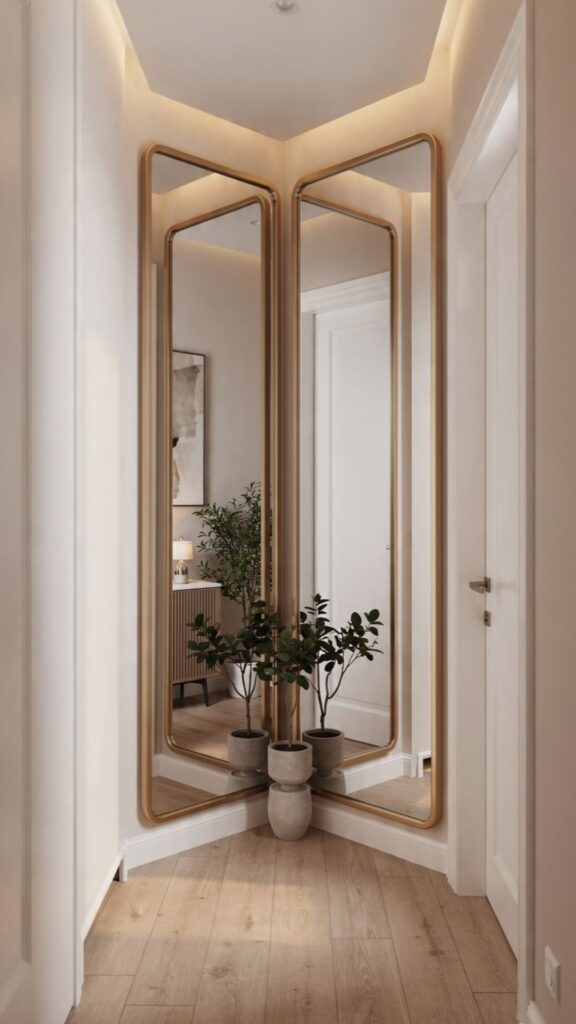
Mirrors are arguably the most powerful optical tool in a designer’s toolkit for narrow hallway design spaces. A well-placed mirror in a hallway creates the illusion of doubled width and depth, making the corridor feel like it extends far beyond its physical boundaries. This trick has been used in architecture and interior design for centuries from Baroque palaces to modern apartments because it genuinely works.
The ideal placement is on one of the longer walls of the hallway, ideally opposite a light source such as a window or wall sconce. This setup reflects light back into the space and creates a sense of infinite extension. A large, single mirror has more impact than several small ones, which can feel fragmented and busy. Leaning a full-length mirror against the wall is a renter-friendly option that also adds a casual, relaxed aesthetic.
Mirror shapes matter too. Arched mirrors are trending in 2026-2027 hallway design because they soften the geometric rigidity of a long corridor. Tall, narrow mirrors echo the vertical proportions of the hallway while still adding visual width. Avoid mirrors that are too wide relative to the hallway’s actual width they can paradoxically highlight the tightness rather than mask it.
For a future-focused upgrade, consider smart mirrors with built-in LED lighting, Bluetooth speakers, or even integrated temperature displays. These multifunctional mirrors are increasingly affordable and add a tech-savvy layer to hallway design that is both impressive and practical for daily routines like checking your appearance before leaving the house.
Check More : Front Porch Decor Ideas That Perfectly Continue Your Narrow Hallway Style Outside.
Opt for Slim, Floating Furniture to Keep the Floor Visible:
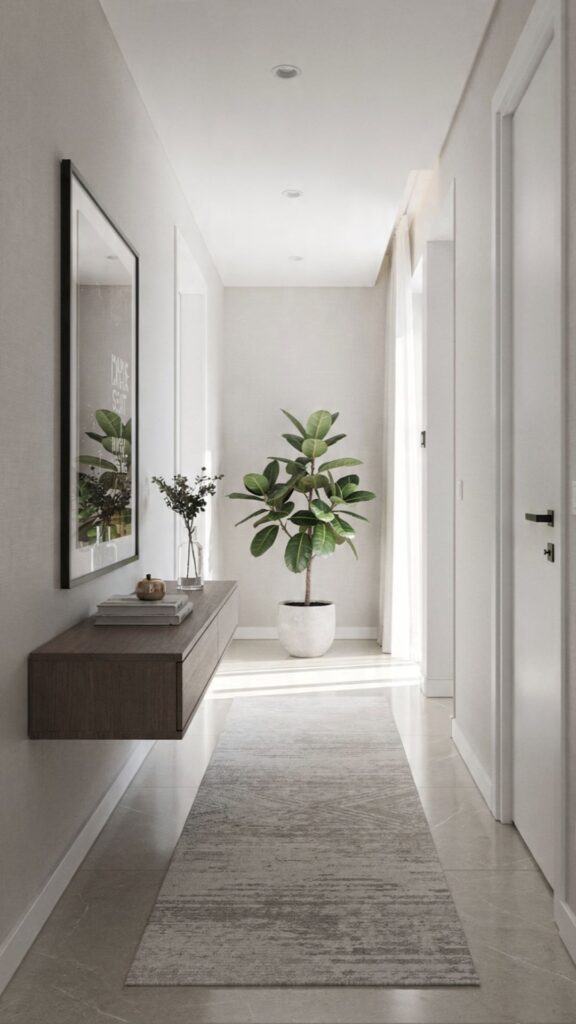
One of the biggest mistakes in narrow hallway design is using bulky, heavy furniture that sits on the floor and visually blocks the pathway. The fix is straightforward: choose slim, wall-mounted, or floating furniture that lifts off the floor. Floating consoles, wall-mounted coat hooks, and suspended shelving units all preserve the visual continuity of the floor, making the space feel larger and less congested.
A floating console table ideally no more than 25-30cm deep is perfect for a hallway. It provides a surface for keys, mail, or a small lamp without eating into walking space. Pair it with a large mirror above and concealed wall hooks, and you have a fully functional, stylish entryway that works even in corridors barely wider than a meter.
The psychology behind this approach is simple: when the floor is visible in an uninterrupted line from one end of the hallway to the other, the brain perceives the space as longer and more open. Furniture that interrupts this visual flow especially at floor level breaks the spatial reading and makes the corridor feel shorter and tighter. This is why even a decorative mat or rug runner should be chosen carefully in terms of width and length.
Look for furniture with tapered legs or hairpin legs in metal finishes these are transparent-feeling and do not visually crowd the floor the way solid wooden bases do. Mid-century modern furniture is particularly well-suited to narrow hallway design for exactly this reason: its emphasis on slender forms and raised profiles is a natural match for small, tight spaces.
Use a Runner Rug to Add Length and Direction:
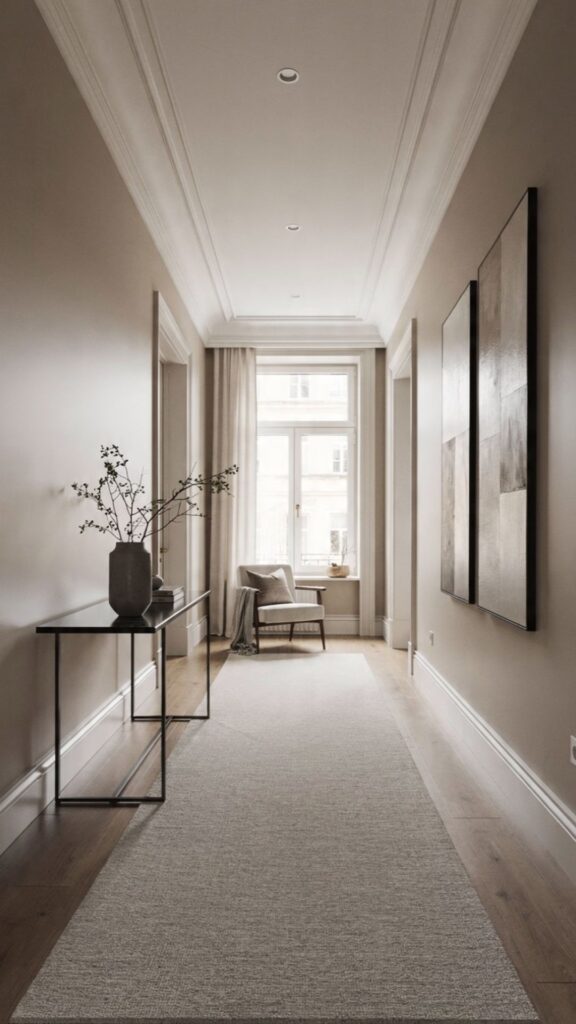
A well-chosen runner rug does something remarkable in a narrow hallway design: it creates a visual lane that guides the eye (and the foot) through the space. This directional quality is highly effective in long corridors, where a runner can actually make the hallway feel more purposeful and dynamic rather than just a blank passageway. The key is choosing the right pattern, size, and color for your specific space.
For narrow hallway design, choose runners that are proportionally scaled typically 60 to 80cm wide for a hallway that is 90 to 120cm wide. Leaving an equal margin of flooring visible on both sides of the runner creates a framing effect that actually makes the hallway look wider. A runner that is too wide close to wall-to-wall coverage eliminates this effect and can make the space feel crowded.
Pattern direction matters. Longitudinal patterns (stripes or geometric designs that run the length of the rug) draw the eye forward and elongate the perceived length of the hallway.
Transverse patterns (horizontal stripes or grids) can actually make a narrow corridor feel shorter, so they are best avoided unless you have an unusually long hallway and want to create a sense of pause or zoning.
Material choice is practical here too. Hallways endure heavy foot traffic, so durable materials like wool, polypropylene, or flat-weave cotton are advisable.
Low-pile or flat-weave rugs are also safer they do not create trip hazards with raised edges, and they are far easier to vacuum and maintain than plush, high-pile alternatives. Non-slip rug pads are essential, especially on hard flooring like tile, wood, or laminate.
Maximize Natural Light with Glazed Doors or Borrowed Light Panels:
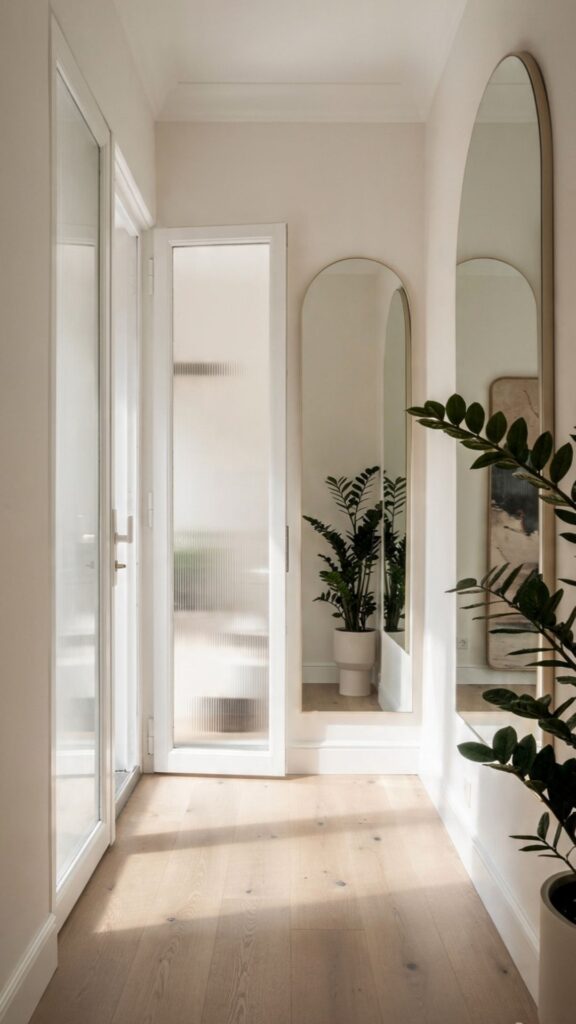
Natural light is transformative in a narrow hallway design. The problem is that most interior corridors are windowless, relying entirely on artificial lighting. However, there are architectural solutions that can introduce light from adjacent rooms without sacrificing privacy or structural integrity.
Glazed interior doors with clear, frosted, or reeded glass panels allow light to pass from naturally lit rooms into the hallway, completely changing the ambience. Borrowed light panels are a more structural solution: small windows or glass panels inserted into the wall between the hallway and an adjacent room.
These can be positioned high on the wall (fanlight style) to bring in light while maintaining privacy. When combined with reflective surfaces mirrors, glossy paint, or polished flooring even a small amount of borrowed light can dramatically brighten a dark corridor.
If structural changes are not possible, the next best option is layered artificial lighting that mimics natural light. LED strips positioned behind skirting boards, recessed ceiling spotlights, and wall sconces at eye level can combine to create a warm, even glow that avoids the harsh shadows typical of a single overhead bulb.
Smart LED systems (like Philips Hue) allow you to adjust color temperature throughout the day warmer tones in the evening, cooler and brighter in the morning which helps the hallway feel alive and responsive rather than static.
One often-overlooked tip: skylights or sun tubes can be installed above hallways in single-storey sections of a home or directly beneath a roof. Sun tubes (also called solar tubes or light tunnels) are remarkably effective at channeling daylight into otherwise windowless corridors, using reflective internal surfaces to transport light over several meters. This is an investment worth considering during renovation, as it permanently solves the darkness problem without ongoing energy costs.
Apply Vertical Stripes or Paneling to Heighten the Space:
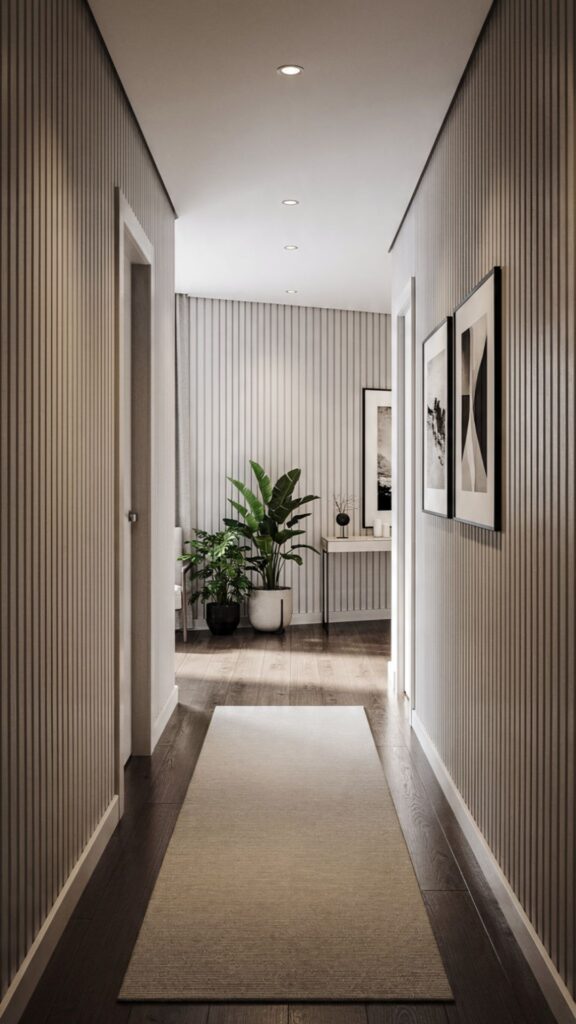
Visual tricks using pattern and paneling are among the most cost-effective upgrades for narrow hallway design. Vertical stripes whether painted directly onto the wall, applied as wallpaper, or created with architectural wall paneling consistently make ceilings feel higher and spaces feel taller. This perception shift is rooted in how the human eye processes vertical lines, interpreting them as height markers that extend the visual field upward.
Classic vertical stripe wallpaper remains popular precisely because it works. Choose two tones from the same color family a base tone and a slightly lighter or more saturated stripe for a sophisticated, subtle effect. Bold, high-contrast stripes can look dramatic and intentional in the right context but risk feeling oppressive in a very narrow corridor. As a rule, the narrower the hallway, the subtler the stripe should be.
Wall paneling particularly vertical shiplap, tongue-and-groove, or fluted paneling is a more architectural approach that adds texture, depth, and a premium feel. Fluted wall panels (channels of parallel vertical grooves) have become one of the biggest interior design trends of 2025-2027, and they are brilliantly suited to hallways.
They add visual interest without pattern, which means they do not compete with artwork or furniture, and they photograph beautifully for anyone considering resale value or rental appeal.
A practical note: if you are applying paneling to a narrow hallway design, keep it to one main feature wall or to wainscoting height (lower third of the wall) rather than full-height coverage on all walls. Too much texture on every surface can make a small corridor feel visually compressed. Balance paneled walls with smooth, painted surfaces or mirrors to maintain breathing room in the design.
Introduce Smart, Hidden Storage Solutions:
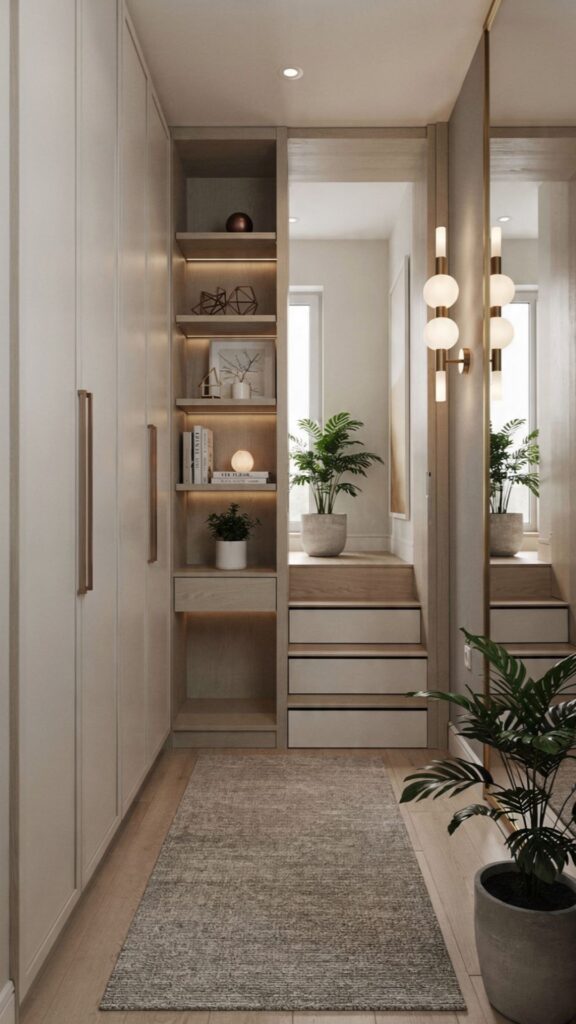
Storage in a narrow hallway design is often an afterthought, resulting in cluttered entryways piled with shoes, bags, and coats that block both movement and sightlines. The solution is intelligent, hidden storage design solutions that contain the mess without adding visual bulk. This is where thoughtful hallway design genuinely improves daily life, turning morning routines from chaotic to calm.
Bench seats with internal storage are one of the most practical investments for a hallway. A slim, upholstered bench with a lift-up lid provides seating (useful for putting on shoes) and concealed storage for seasonal items, spare bags, or sports equipment.
When built into an alcove or fitted against the wall, it takes up minimal space while delivering maximum functionality. Add hooks above and you have a complete entryway solution.
Under-stair storage, where applicable, is another hallway-adjacent space that is frequently underutilized. Custom-built pull-out drawers, open cubbies, or even a small wardrobe fitted beneath a staircase can absorb an enormous amount of household storage, taking the pressure off the hallway itself. This kind of bespoke joinery typically adds tangible value to a property, making it a smart renovation choice.
For renters or those on a budget, consider pegboards, magnetic wall panels, or modular hook systems that mount without permanent fixtures. These allow flexible, customizable storage arrangements that can be adjusted as your needs change. Brands like String Furniture, Muuto, and IKEA offer wall-mounted systems that look considered and intentional rather than makeshift important in a space as high-traffic and high-visibility as a hallway.
Choose the Right Flooring to Create Flow and Continuity:
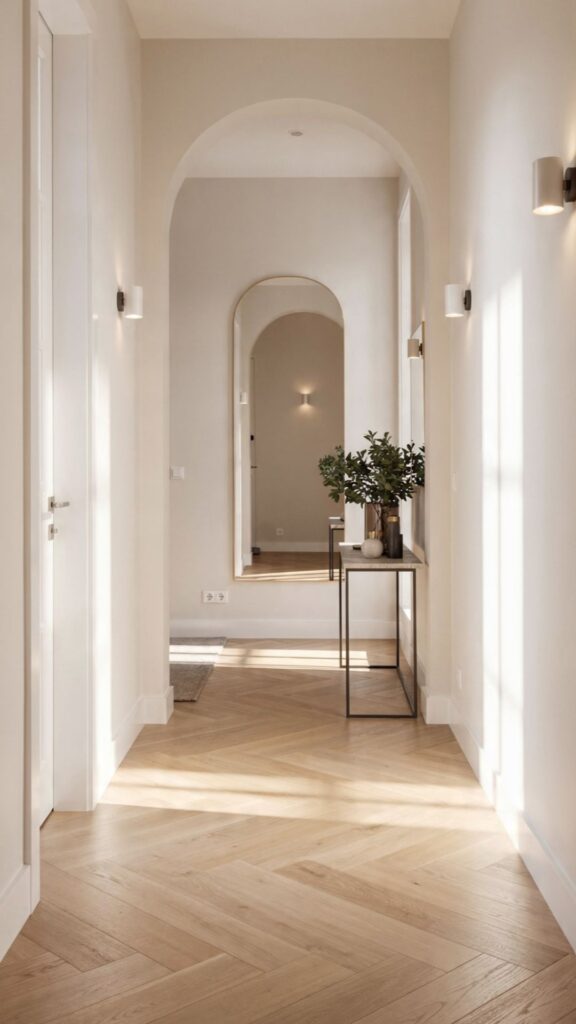
Flooring choice has a disproportionate impact on how a narrow hallway design feels. The wrong flooring can fragment the space, highlight its tightness, or create a visual dead end. The right flooring, however, creates flow a sense of continuity that carries naturally from the entrance into the rest of the home.
This is why flooring decisions in hallways are best made in context with the adjoining rooms rather than in isolation. Large-format tiles or long planks installed lengthwise (running the full length of the corridor) are the gold standard for narrow hallway design.
This orientation leverages the same directional psychology as the runner rug: it draws the eye forward and makes the space feel longer and more open. Smaller tiles or planks laid widthways have the opposite effect, visually shortening the corridor.
Color and reflectivity also matter significantly. Light-toned flooring pale oak, light stone, cream tile reflects light upward and makes the walls feel farther apart. Polished concrete, large-format marble, or high-gloss porcelain tiles are particularly effective in dark hallways because their reflective surfaces multiply ambient light without requiring additional fixtures.
For a warmer aesthetic, wide-plank natural wood in a honey or warm grey tone strikes an excellent balance between warmth and openness.
One future-forward consideration: heated flooring (underfloor heating) in hallways is becoming increasingly common in premium renovations. Beyond comfort, it eliminates the need for radiators in the corridor which often take up precious wall space in narrow hallway design keeping the walls clear for shelving, art, or mirrors. Electric underfloor heating mats are relatively easy to retrofit under tile and represent a meaningful quality-of-life upgrade.
Take a Peek : Hallway Lighting Ideas That Brighten Up Your Narrow Hallway Beautifully.
Layer Lighting for Atmosphere and Depth:
Lighting is the most underutilized tool in hallway design, yet it has the potential to transform the space more dramatically than almost any other single element. Most narrow hallway design rely on a single overhead light often a bare bulb or a basic flush fitting which creates flat, shadowless illumination that does nothing to enhance the space. Layered lighting, by contrast, creates depth, atmosphere, and a sense of considered design.
There are three layers to consider: ambient lighting (the overall base level of light), accent lighting (focused light that highlights specific features or areas), and task lighting (practical light for specific activities, like seeing yourself in a mirror).
In a hallway, ambient lighting is typically handled by recessed downlights or a central pendant. Accent lighting might include LED strips behind shelving, picture lights above artwork, or a statement wall lamp. Task lighting ensures the mirror area is well-lit.
Wall sconces at eye level are particularly effective in narrow hallway design because they create warm pools of light that feel intimate and welcoming without overwhelming a small space. Unlike ceiling fixtures, which can feel harsh from above, wall-mounted lights cast light sideways and downward in a way that flatters the space.
Choosing sconces with a warm color temperature (2700-3000K) creates a cozy, hotel-lobby feel that makes arriving home genuinely pleasant. Motion-activated lighting is a practical addition for frequently used corridors especially helpful for families with children or elderly residents who may need to navigate the hallway at night.
Modern motion-sensor LED strips can be installed under floating shelves or cabinets at skirting board level, providing a gentle, guiding glow without the need to locate a light switch. These systems are energy-efficient, affordable, and remarkably effective at making a hallway feel both safe and sophisticated.
Create a Gallery Wall to Add Personality Without Bulk:
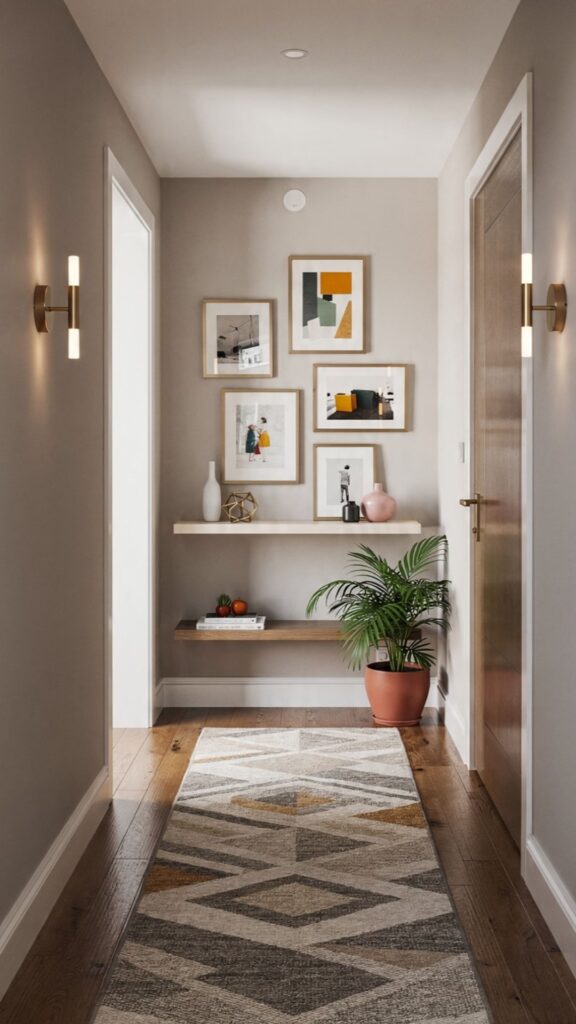
A gallery wall is one of the most personal ways to design a narrow hallway design, transforming a blank corridor into a curated visual journey. Unlike heavy furniture or large decorative objects, a gallery wall adds enormous personality and visual interest without consuming any floor space it lives entirely on the walls. When executed well, it becomes a talking point and a genuine design statement.
In a narrow hallway design, the gallery wall layout matters even more than in a spacious room. A single-column arrangement of frames (vertically stacked) works brilliantly for very narrow hallway design walls, creating a tall, magazine-worthy installation.
A more traditional salon-style arrangement (multiple frames of varying sizes clustered together) works better on longer walls. The key in either case is to plan the layout on the floor first, or use paper templates taped to the wall, before committing any nails.
Frame consistency helps enormously in tight spaces. Matching frames same finish, same depth create a unified, collected look that feels intentional rather than eclectic. However, mixing frame styles can also work if the artwork itself provides the unifying element (a consistent color palette, for example, or black-and-white photography throughout). The most important thing is that the gallery feels curated rather than accidental.
Art content matters too. Abstract prints and landscapes with depth work particularly well in narrow hallway design because they add a sense of visual space a landscape image literally extends the perceived horizon beyond the wall. Conversely, dense, detailed artworks can feel overwhelming in a small corridor. Text-based prints or motivational typography are popular choices for entryways as they set an intentional mood at the start and end of each day at home.
Use Glass or Open-Tread Staircases to Borrow Visual Space:
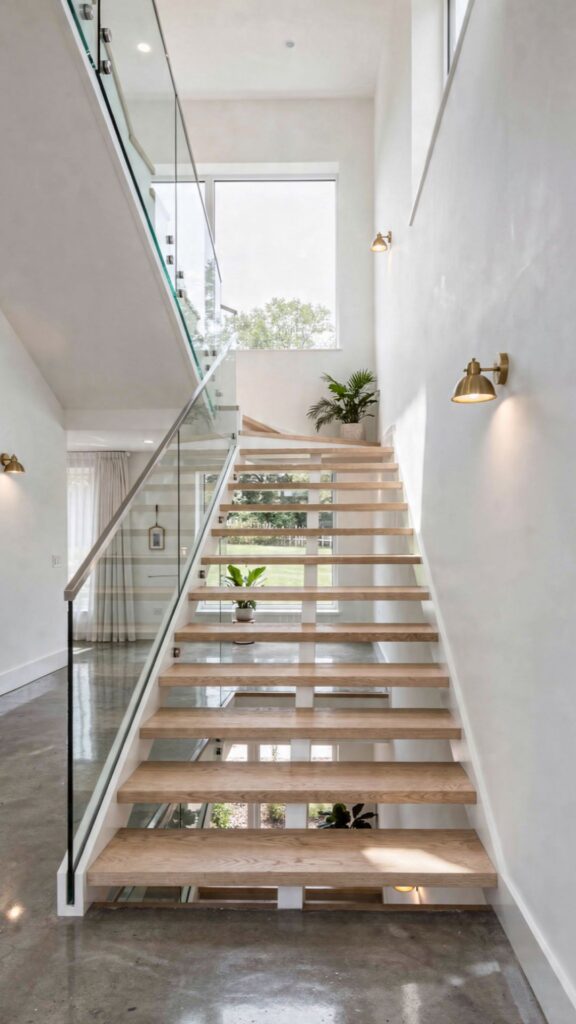
If your narrow hallway design connects to or contains a staircase, the design of that staircase has a massive impact on how open and spacious the corridor feels. Traditional solid-balustrade staircases with chunky wooden banisters and risers create visual barriers that block sightlines and make hallways feel even more confined.
Open-tread staircases with glass or metal balustrades, by contrast, allow light and sightlines to pass through freely, dramatically opening up the space.
Glass balustrades are the most architecturally sophisticated solution. Fully frameless glass panels allow an unobstructed view through the staircase, making the hallway feel as wide as possible. They also create an elegant, contemporary aesthetic that works across a range of interior styles from minimalist to industrial to classic. Glass does require regular cleaning to look its best, which is a practical consideration worth factoring in.
Open-tread staircases (without risers between each step) are another effective strategy. They allow light to filter through from above and create a sense of floating, weightless construction that contrasts beautifully with the solidity of the floor.
This design choice is particularly effective when combined with a double-height ceiling or a skylight above the connection between floors feels visual and immediate rather than separated by a solid wall of stairs.
For existing staircases that cannot be structurally altered, there are still meaningful improvements to be made. Painting the balusters white and the handrail in a contrasting dark tone adds definition without weight.
Replacing solid timber balusters with slimmer metal spindles (a relatively affordable swap) reduces visual bulk considerably. Even adding a mirror to the underside of a staircase landing can reflect light upward into the corridor in a surprising and effective way.
Add Indoor Plants for Life and Freshness:
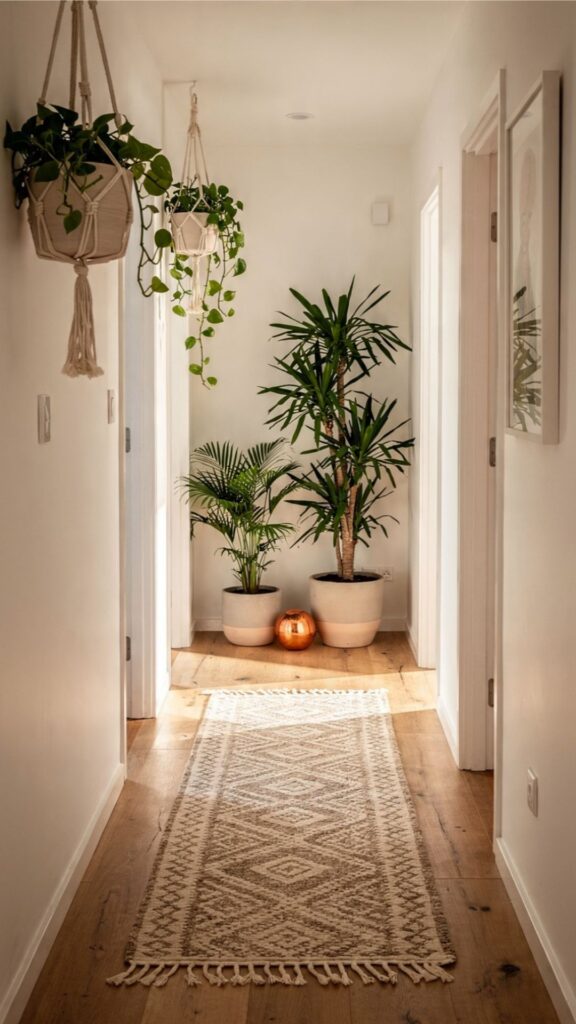
Greenery in a narrow hallway design serves multiple purposes: it adds life and color, improves air quality, creates a biophilic connection to nature, and when chosen and placed thoughtfully can enhance the spatial design rather than clutter it. The secret is selecting plant varieties and display methods that complement the hallway’s dimensions rather than compete with them.
Tall, slender plants are ideal for narrow hallway design corridors. Snake plants (Sansevieria), bamboo palms, and pencil cacti all have vertical growth habits that echo and reinforce the height of the space rather than spreading outward into walking area. A single tall plant in a slim, cylindrical planter in a corner instantly makes the corner feel intentional and alive. Pair it with a small spotlight directed at the plant to create dramatic shadow play on the wall behind.
Trailing plants on shelving such as pothos, string of pearls, or philodendrons add a cascading, organic element that softens the geometric rigidity of shelves and walls. Hanging planters from the ceiling are another space-saving option, though they require careful height calibration in narrow corridors to avoid becoming an obstacle. A planter at head height on a 2.4m ceiling is fine; at 2.1m, it starts to feel intrusive.
For dark hallways with limited natural light, choose shade-tolerant varieties: cast iron plants (Aspidistra), ZZ plants, Chinese evergreens, and peace lilies all thrive in low-light conditions. Alternatively, high-quality artificial plants have improved dramatically in recent years premium silk or preserved plants can look convincingly real in a hallway where detailed inspection is unlikely. They require zero maintenance and are a practical solution for renters or frequent travelers.
Use Wallpaper on a Single Feature Wall for Impact:
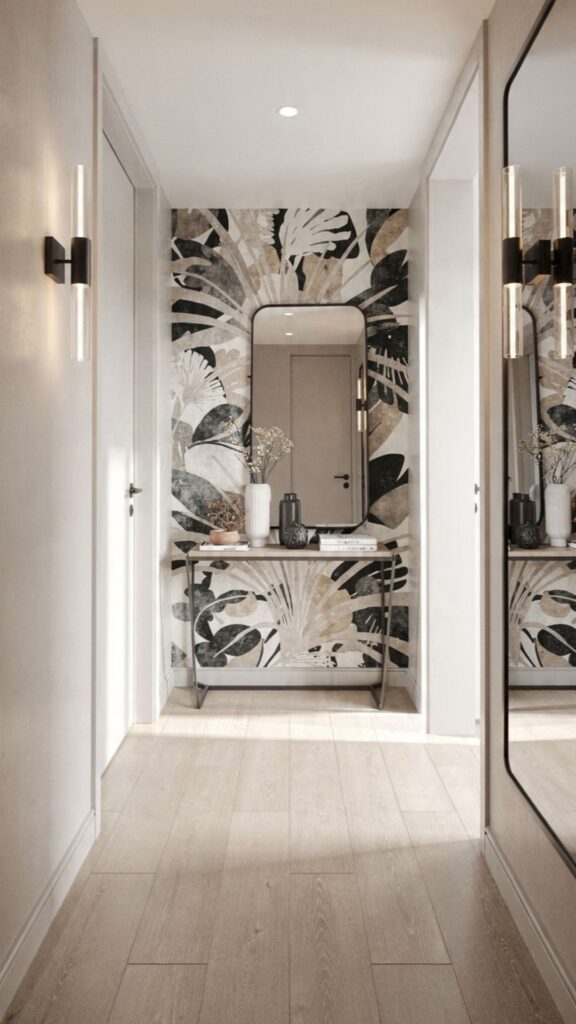
Wallpaper in a narrow hallway design might seem counterintuitive conventional wisdom often warns against strong patterns in small spaces. However, when applied selectively to a single feature wall (typically the end wall of the corridor), bold, dramatic wallpaper can completely transform the experience of walking through the space. The key is strategic restraint: one wall, one statement, everything else kept calm.
The end wall of a long hallway is the ‘terminal wall’ the visual full stop at the end of the corridor. Treating it as a feature wall draws the eye toward it, creating visual depth and making the hallway feel like it has a destination. A rich, nature-inspired mural wallpaper a botanical print, a forest scene, an abstract landscape transforms the end wall into something closer to a window than a barrier.
Pattern scale matters enormously in small spaces. Large-scale patterns can actually work well on an end feature wall precisely because they create a sense of expanse a big leaf or oversized graphic fills the wall without repeating too many times, avoiding the busyness of a small repeat pattern. Small, dense repeating patterns can feel overwhelming in a corridor where you are physically close to the walls at all times.
Peel-and-stick wallpaper has made feature walls far more accessible and renter-friendly. High-quality removable wallpapers from brands like Tempaper, Chasing Paper, and LIVETTE’s offer genuinely impressive designs with clean removal ideal for hallways where you might want to update the look seasonally or with changing trends. This democratizes the feature wall concept for renters and those who like to refresh their interiors frequently.
Incorporate Built-In Seating or a Mudroom Zone:
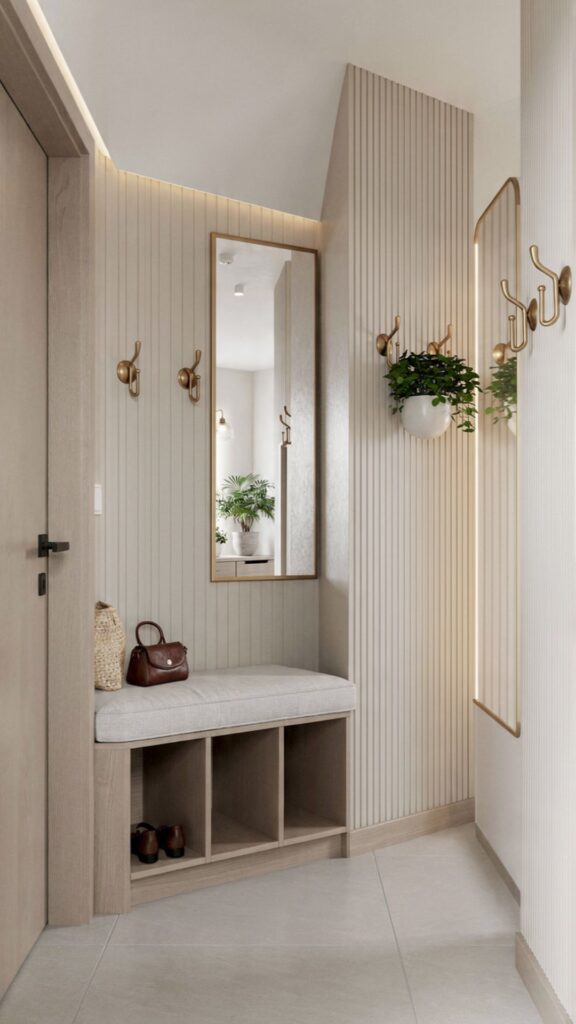
The hallway is the first and last space you experience in your home every day, which means it needs to function as more than just a passageway it needs to handle the practical demands of daily life: dropping bags, removing shoes, hanging coats, sorting mail. A dedicated mudroom zone, even within a narrow hallway design, centralizes all of this activity and prevents the rest of the home from absorbing the chaos of arrivals and departures.
A built-in mudroom zone typically includes: a seat or bench (for shoe removal), coat hooks at adult and child heights, shoe storage below, and a surface for bags and miscellaneous items. In a narrow hallway design, this entire zone can be compressed into a linear wall unit measuring as little as 1.5 to 2 meters wide and 40cm deep.
Custom joinery is the most efficient solution, but flat-pack systems from IKEA (using the HEMNES or PAX systems with aftermarket modifications) can achieve impressive results at lower cost.
For families with children, the mudroom zone is especially important. Color-coded hooks for each family member, labeled cubbies for each child’s school bag, and a clearly designated drop zone for sports equipment all reduce the entropy that tends to accumulate in busy household corridors. Some designers recommend allocating one square meter of hallway mudroom space per family member a useful benchmark when planning layouts.
Even in the smallest apartments, a mini-mudroom concept is achievable. A single floating shelf with three or four hooks below and a small shoe rack at floor level can contain the essentials without requiring significant space.
The psychological benefit of having a designated ‘drop zone’ near the front door is significant it reduces decision fatigue and helps maintain order throughout the rest of the home, which is a quality-of-life improvement that is hard to overstate.
Discover More : Hallway Decor Ideas That Make Your Narrow Hallway Look Wider and More Stylish.
Play with Ceiling Design to Add Unexpected Drama:
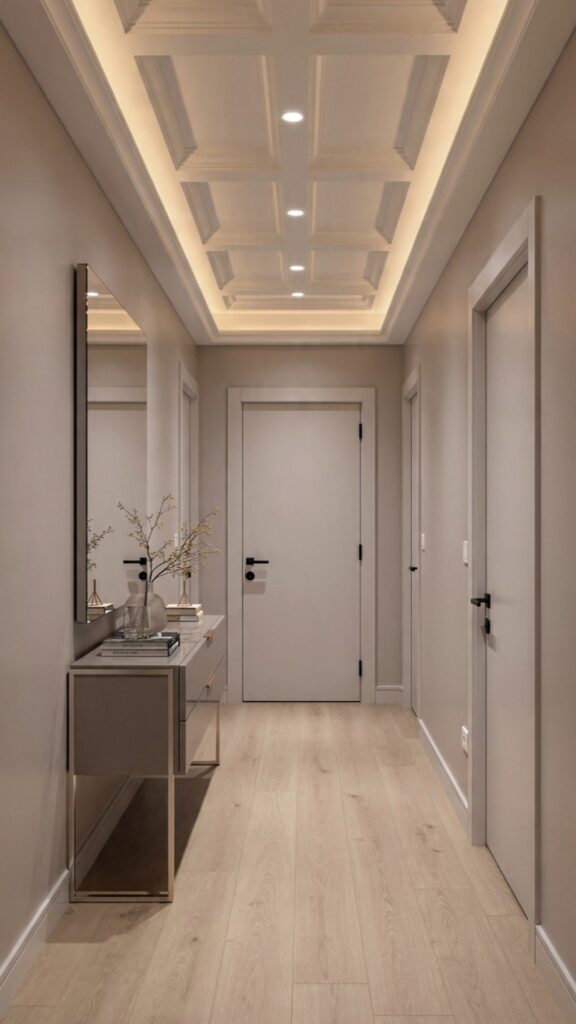
The ceiling of a narrow hallway design is the most underused canvas in residential interior design. Most homeowners paint it white and forget about it entirely. However, a thoughtfully designed ceiling in a narrow corridor can add drama, surprise, and genuine design sophistication and it does not interfere with floor space or wall functionality, making it a uniquely low-compromise design move.
Dark ceiling paint in a narrow hallway design is a bold choice that, contrary to instinct, can work beautifully. Painting the ceiling in a deep navy, forest green, or charcoal creates a sense of intimacy and enclosure that feels intentional rather than oppressive like a jewel box or a private gallery. This approach works best when the walls remain light, creating contrast that emphasizes the architectural volume of the space.
Ceiling moldings, cornicing, and coffered ceiling details add architectural richness to even the most basic hallway. In a period property, restoring or adding egg-and-dart cornicing reinstates historic character. In a contemporary home, simple geometric ceiling battens painted in a contrasting tone create a dramatic grid that draws the eye upward. Both approaches make a ceiling feel designed rather than simply present.
LED ceiling coves where strip lights are hidden behind a recessed perimeter of the ceiling are a popular and practical option for narrow hallway design. They create an indirect wash of light across the ceiling surface that is both functional and atmospheric, eliminating the need for a central fixture and making low ceilings feel higher by directing visual attention toward the illuminated ceiling plane.
This technique is widely used in luxury hotels and high-end residential design, but it is accessible to most renovation budgets when using LED strip lighting and basic joinery.
Conclusion
Narrow hallway design is ultimately about working with spatial constraints intelligently rather than fighting against them. With the right combination of color, lighting, mirrors, smart storage, and vertical thinking, even the tightest corridor can become a beautiful, functional space that enhances daily life and makes a strong first impression.
The 16 ideas in this guide range from budget-friendly quick wins like paint color and runner rugs to longer-term investments like built-in joinery and architectural lighting, giving you a complete toolkit regardless of your budget or timeline.
The most important takeaway is this: every hallway has potential. Start with one or two changes perhaps a mirror and a lighter paint color and see how dramatically the space shifts before committing to larger interventions. Small, considered improvements compound quickly in tight spaces, and what begins as a problem corridor can become one of the most admired features of your home. Start today, and let your hallway reflect the thoughtfulness and quality of everything that lies beyond it.

Team TrandyVilla is the passionate home decor team behind Trandy Villa, where style meets comfort in everyday living. The team loves transforming simple spaces into beautiful, functional homes through smart ideas, budget-friendly hacks, and modern design trends. Their content focuses on helping readers create homes that feel both stylish and personal without spending too much.