
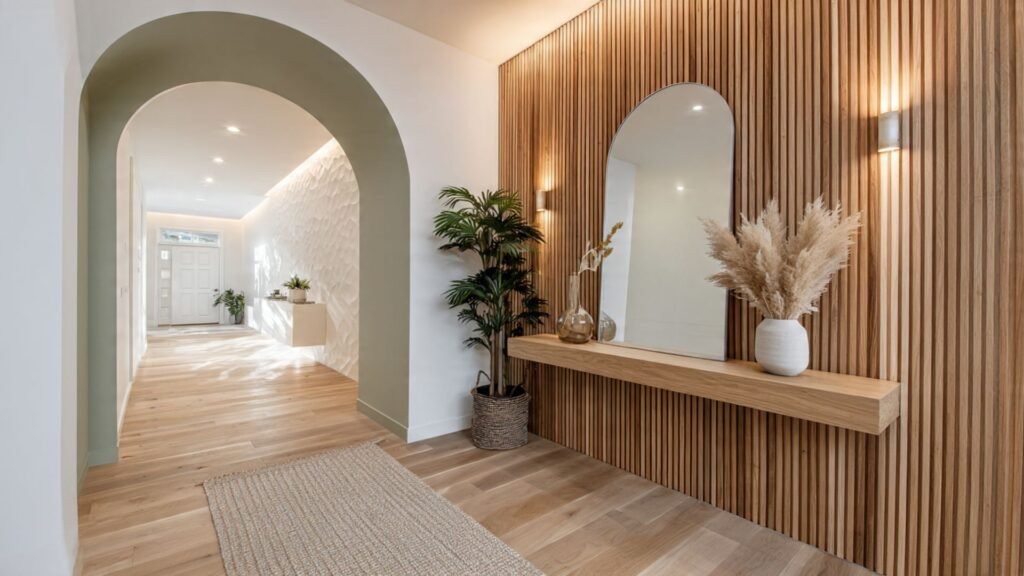
Your hallway is the first space guests see and the last space you pass through every day. It sets the tone for your entire home yet most homeowners treat it as an afterthought. Thoughtful hallway decor changes that entirely. It turns a transitional corridor into a space with personality, purpose, and polish.
Hallway decor is the art of styling your home’s entryway with purpose and personality. It covers wall treatments, lighting, furniture, flooring, and storage. Good decor makes a hallway feel welcoming, organized, and visually connected to the rest of the home. Every design choice serves a clear function while adding beauty to the space.
The right hallway decor transforms a narrow, overlooked corridor into the most memorable part of your home, a space that greets every guest with warmth, intention, and a clear sense of your personal style.
Home decor brands can use a meme creator online to create fun social media posts featuring decorating ideas and relatable home design moments.
Hallway decor ideas range from simple mirror placements to bold wallpaper choices. A well-chosen console table adds both style and everyday function. Smart lighting creates depth and warmth in tight spaces. Coordinated colors and materials tie the hallway to the rest of the home. Practical storage solutions keep the space tidy and clutter-free. Small, deliberate choices produce a hallway that feels polished and well-designed.
Statement Mirrors:
The Hallway’s Most Powerful Design Tool
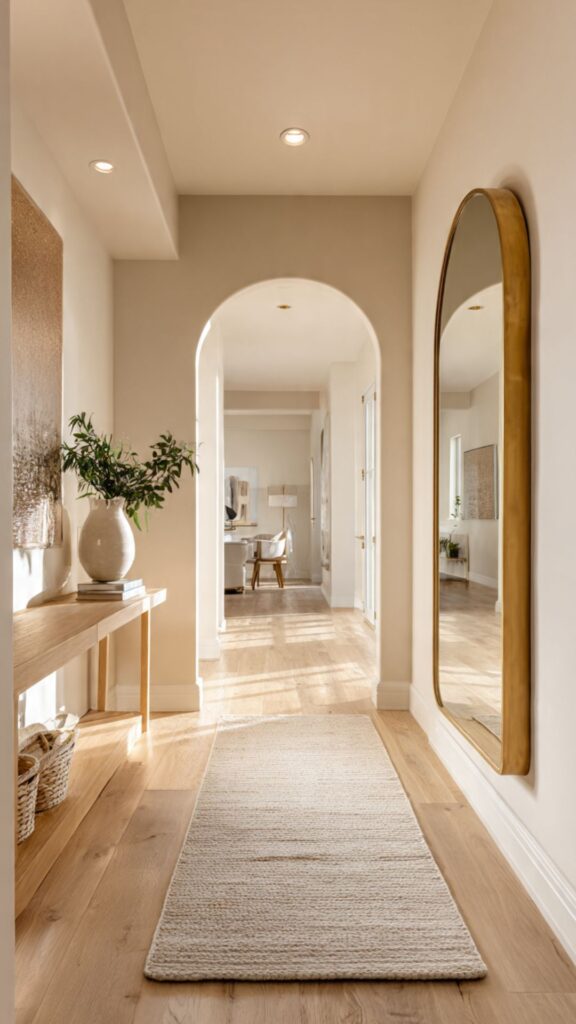
A well-chosen mirror is the single most impactful piece you can add to any hallway. It visually doubles the perceived width of a narrow corridor, reflects natural light deeper into the space, and adds a decorative focal point that makes the hallway feel curated rather than forgotten.
Interior designers consistently reach for mirrors first when working with tight, low-light entryways and for good reason. The shape and framing of your mirror communicates your home’s design language instantly.
An oversized arched mirror in a black metal frame signals contemporary sophistication. A collection of smaller ornate gold-framed mirrors arranged in a gallery cluster reads as eclectic and artistic. A simple, frameless floor-length mirror leans minimalist and modern.
The key is to choose a mirror that reflects literally and figuratively the aesthetic of the rooms beyond it, creating a sense of visual continuity throughout your home. Placement matters as much as selection. Position your mirror directly opposite a window or light source wherever possible to maximize light reflection. If your hallway has no natural light source, position the mirror to face a well-lit pendant or wall sconce – the reflection amplifies the artificial light and creates the illusion of depth.
Avoid placing a mirror at the very end of a long corridor; it creates a visually disorienting “tunnel” effect that makes the space feel smaller, not larger. One insight most styling guides miss: consider the mirror’s reflection as carefully as the mirror itself.
What does it reflect? A cluttered coat rack or a blank wall undermines the effect entirely. Style the wall or surface opposite the mirror with something worth reflecting a console table with a plant, a piece of art, or a carefully arranged vignette. The mirror and its reflection work together as a single composition.
Don’t Miss: Sunroom Ideas for a Peaceful and Light Filled Living Space.
Console Tables:
Style and Function in One Slim Piece
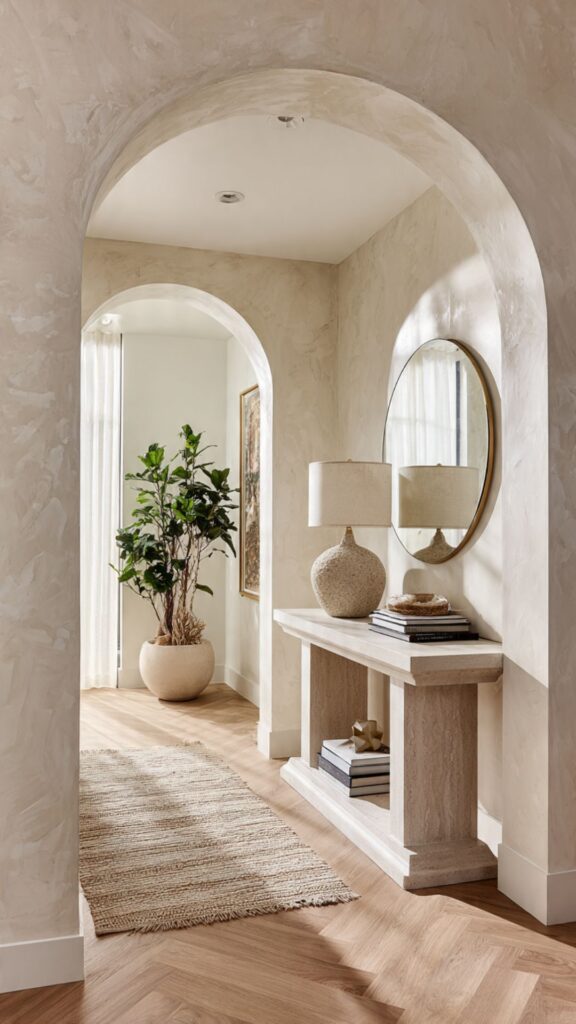
The console table is the workhorse of hallway decor. It provides a surface for everyday essentials keys, mail, bags, while simultaneously anchoring the hallway’s visual design. A well-styled console table transforms a bare wall into a composed, intentional vignette that makes the whole hallway feel designed rather than defaulted.
Proportion is the first consideration. In a narrow hallway, depth matters enormously a console table deeper than 30cm will interrupt traffic flow and make the corridor feel cramped. Many furniture retailers now offer ultra-slim console tables at 20–25cm depth specifically for tight hallways.
These maintain the visual weight and styling surface of a standard console without sacrificing walkable space. Always measure your hallway width before purchasing and leave a minimum of 90cm of clear walking width. Styling the console table is where creativity comes in. The classic formula lamp, object, greenery works because it creates height variation and visual interest across three distinct zones.
However, for 2026, the most compelling console table vignettes lean into natural materials and organic forms: a sculptural ceramic vase, a piece of raw-edge wood, a trailing pothos plant cascading from a terracotta pot. These elements feel curated rather than decorated, which is the distinction between a hallway that looks styled and one that looks genuinely designed.
For families with children or high-traffic households, practicality must inform styling choices. A console with a drawer handles the chaos of everyday life: wallets, chargers, sunglasses, and keys disappear neatly inside rather than accumulating on the surface. Underneath, a rattan basket corrals shoes or bags without visual disorder.
The most successful hallway decor balances beauty with the reality of daily use, and the console table is where that balance is most visibly achieved.
Hallway Lighting:
From Functional to Atmospheric
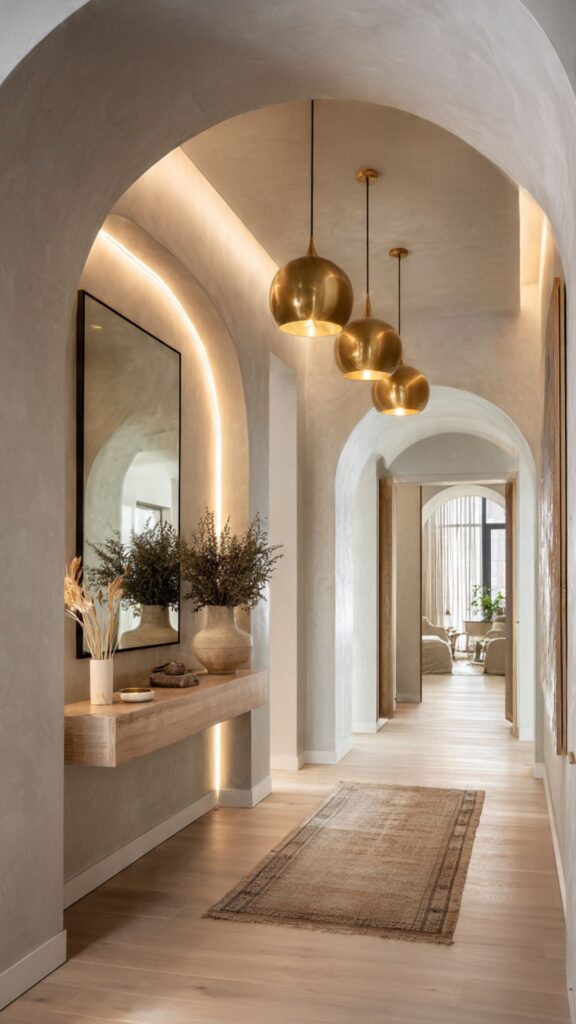
Lighting is the most underinvested element of hallway decor, yet it has the highest impact on how the space feels. Most hallways default to a single overhead light, usually a flat ceiling fixture that produces a flat, uninspiring illumination that makes the corridor feel institutional rather than residential. Upgrading your lighting approach is one of the fastest and most transformative changes you can make.
Layered lighting is the principle that transforms hallways. This means combining three types of light: ambient (general overhead illumination), accent (directional light that highlights art or architectural features), and task (practical light near doors or storage areas).
In a hallway, even two of these three layers create significantly more visual depth than a single overhead source. Wall sconces flanking a mirror, for example, immediately add both ambient and accent quality that a ceiling fixture alone cannot provide.
Pendant lighting deserves special attention in hallways with higher ceilings. A single statement pendant, whether industrial, organic, or sculptural, becomes the hallway’s focal point and anchors the entire decorating scheme around it. In double-height entryways, an oversized pendant creates a dramatic sense of occasion that signals immediately to guests that design has been considered throughout the home.
For lower ceilings, flush-mount fixtures with interesting forms of faceted glass, woven rattan, brushed brass deliver character without sacrificing headroom. Smart lighting technology is increasingly relevant in hallway design. Motion-activated lighting adds safety and convenience particularly useful at night for households with elderly family members or young children.
Dimmer switches allow the hallway’s mood to shift between bright and welcoming during the day and warm and subdued in the evenings. Color temperature matters too: 2700K–3000K (warm white) is the ideal range for residential hallways it flatters skin tones and creates an inviting glow rather than the harsh blue-white cast of higher color temperatures.
Gallery Walls:
Telling Your Story from the First Step Inside
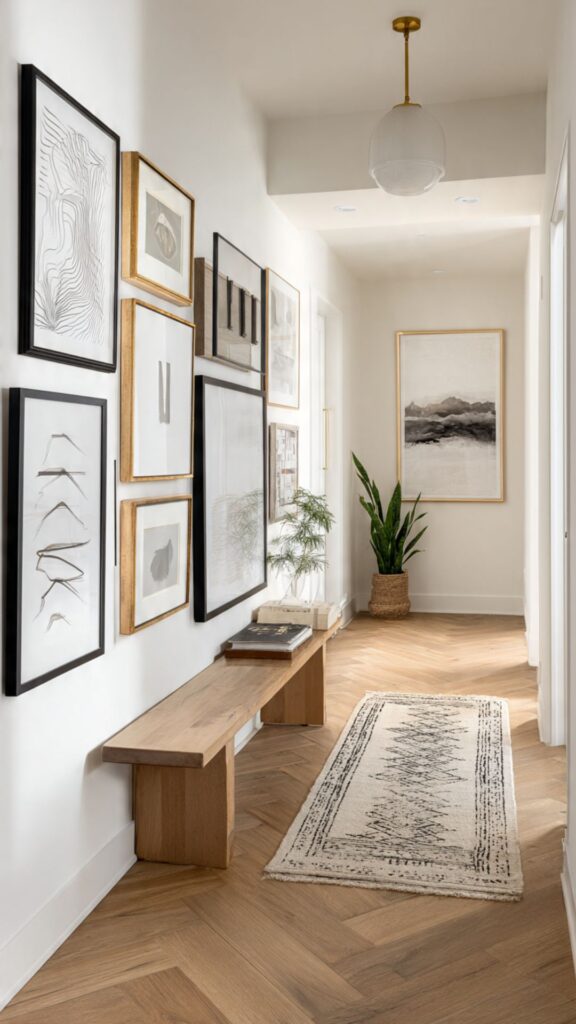
A hallway gallery wall is one of the most personal and impactful forms of hallway decor available. It transforms a blank corridor wall into a curated narrative family memories, collected art, travel photography, or a cohesive collection of prints that communicates your aesthetic sensibility the moment anyone walks through your front door. Done well, a gallery wall makes a hallway feel like the most interesting room in the house.
The most common mistake with hallway gallery walls is randomness. A successful gallery wall has a unifying principle whether that’s consistent framing (all black frames, all natural wood), consistent subject matter (all botanical prints, all black-and-white photography), consistent color palette, or a deliberate mix within a structured grid layout. Without at least one unifying element, a collection of images reads as disorganized rather than curated. Choose your unifying principle before you purchase a single frame.
Layout planning should happen on the floor before anything goes on the wall. Arrange your frames on the floor in front of the wall, experimenting with spacing and composition until the arrangement feels balanced. Photograph the layout from standing height, which approximates how it will look on the wall.
This saves significant time and wall damage compared to the “hang and adjust” approach most people use. For gallery walls in narrow hallways, a single vertical stack of three to five frames often reads more elegantly than a wide horizontal arrangement.
Evolving your gallery wall over time is part of its appeal. Unlike wallpaper or a paint color, a gallery wall can grow and change as your life does. Leave one or two intentional blank spaces in the initial arrangement — these “breathing spaces” make the gallery feel relaxed rather than crowded, and provide room to add new pieces as you collect them. This approach, borrowed from editorial magazine styling, gives your hallway gallery a dynamic, living quality that static decorating can never achieve.
Must Read: Farmhouse Kitchen Ideas for a Warm and Cozy Home!
Hallway Wallpaper:
Maximum Impact in Minimal Square Footage
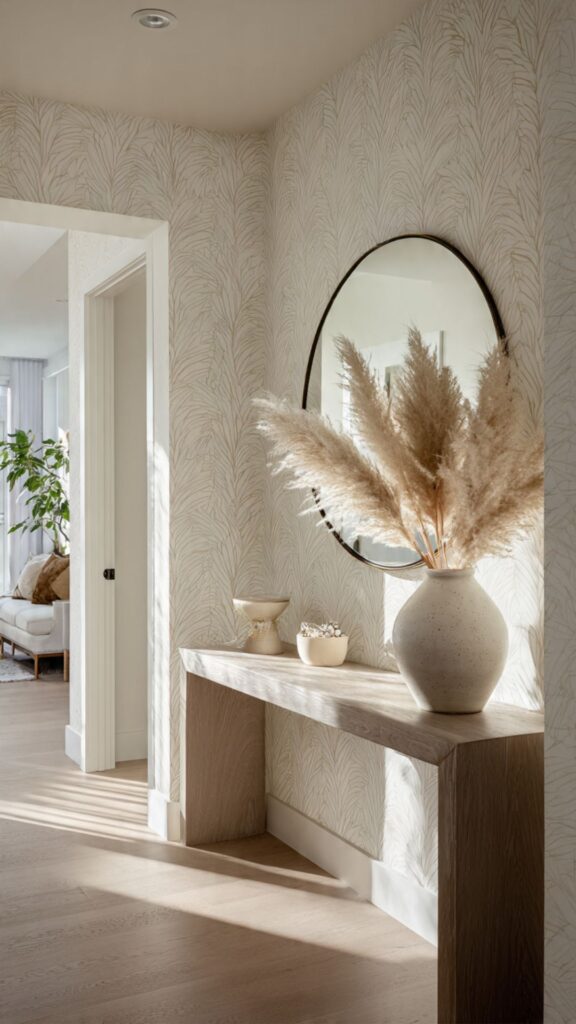
Wallpaper has experienced a full-scale revival, and the hallway is the ideal room to experiment with it. Because hallways are small, a bold or expensive wallpaper pattern becomes affordable – you need far fewer rolls than you would for a living room or bedroom. This makes the hallway the perfect canvas for dramatic patterns, rich colors, or textured finishes that you might hesitate to commit to in a larger space.
Pattern scale is the critical decision. In a narrow hallway, large-scale patterns oversized botanicals, bold geometrics, wide vertical stripes counter-intuitively work better than small, busy patterns. Small patterns in tight corridors create visual noise that makes the space feel cluttered and smaller.
Large patterns, by contrast, read as confident and deliberate, and draw the eye along the length of the corridor rather than closing it in. Vertical patterns specifically elongate the perceived ceiling height, which is particularly valuable in older homes with lower ceilings. Textured wallpapers add a dimension that standard printed paper cannot.
Grasscloth, linen-weave, and embossed papers introduce tactile richness that looks especially sophisticated in entryways and hallways, where guests often linger close to the walls while removing shoes or hanging coats. These textures also photograph beautifully, which matters in an age when home interiors are frequently shared on social media. Beyond aesthetics, textured wallpaper hides minor wall imperfections far more effectively than smooth paper or paint.
The dado rail a horizontal molding that divides the wall into upper and lower sections creates an opportunity for sophisticated two-tone hallway design. Wallpaper above the dado rail combined with painted paneling or contrasting wallpaper below creates visual structure and prevents the hallway from feeling one-dimensional.
This approach also has a practical benefit: the lower section, most susceptible to scuffs and marks in high-traffic hallways, can be painted with a washable, durable finish while the upper section carries the decorative weight of the wallpaper.
Hallway Storage Solutions:
Organizing Without Sacrificing Style
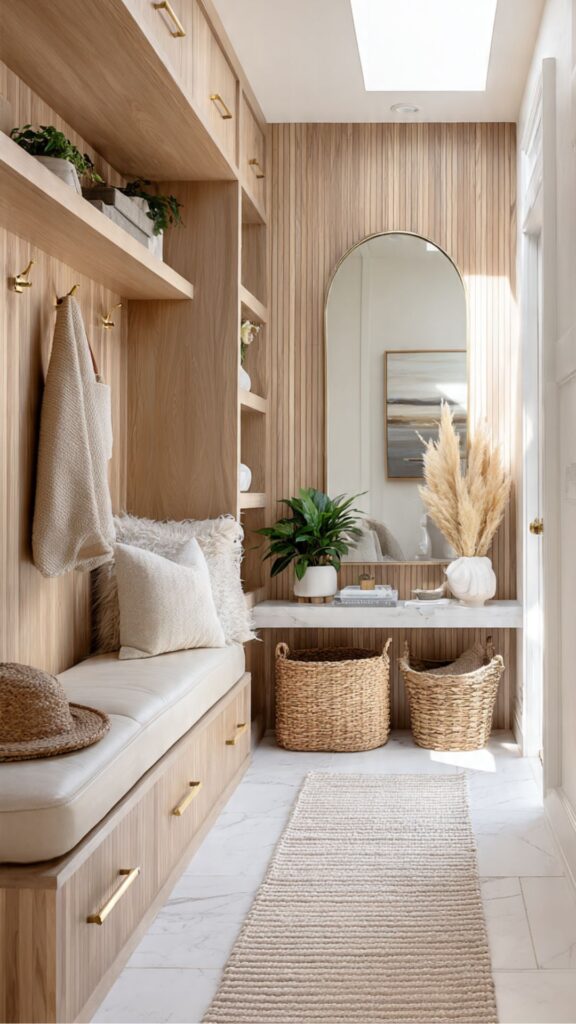
The most beautifully decorated hallway fails immediately if it can’t handle the practical demands placed on it daily. Shoes accumulate at the door. Coats pile on every surface. Bags hang from doorknobs. The solution isn’t more discipline it’s better storage design that makes organization the path of least resistance for every member of the household.
Built-in storage is the gold standard for hallway organization. A run of fitted cabinetry from floor to ceiling with a combination of hanging space, shoe cubbies, open shelving, and closed cabinet doors handles virtually every storage need while presenting a clean, seamless face to the hallway.
The investment is higher than freestanding furniture, but the return in daily function and visual order is transformative. For rentals or lower budgets, high-quality freestanding modular systems from furniture retailers replicate much of this effect with significantly less commitment.
The mudroom concept, long popular in American homes, is increasingly being applied to European and UK hallways, and the timing is right. A dedicated section of the hallway with hooks at multiple heights (adult level, child level), a bench with under-seat shoe storage, and a tray for wet umbrellas and boots handles the chaos of family arrivals and departures with practical elegance. The bench serves a dual purpose: seating for putting on shoes and storage beneath for items that would otherwise pile on the floor.
Open hooks versus closed cabinet doors is a design and lifestyle choice worth deliberating. Open hooks are more convenient items are visible and accessible but they display the inevitable disorder of daily life. Closed doors maintain visual calm regardless of what’s behind them but require more deliberate behavior to use consistently.
The best hallway storage designs use both: open hooks for items in daily rotation, closed storage for seasonal items, sports equipment, or anything that benefits from being out of sight. This hybrid approach satisfies both the functional and aesthetic requirements of a well-designed hallway.
Hallway Flooring:
The Foundation That Sets the Tone
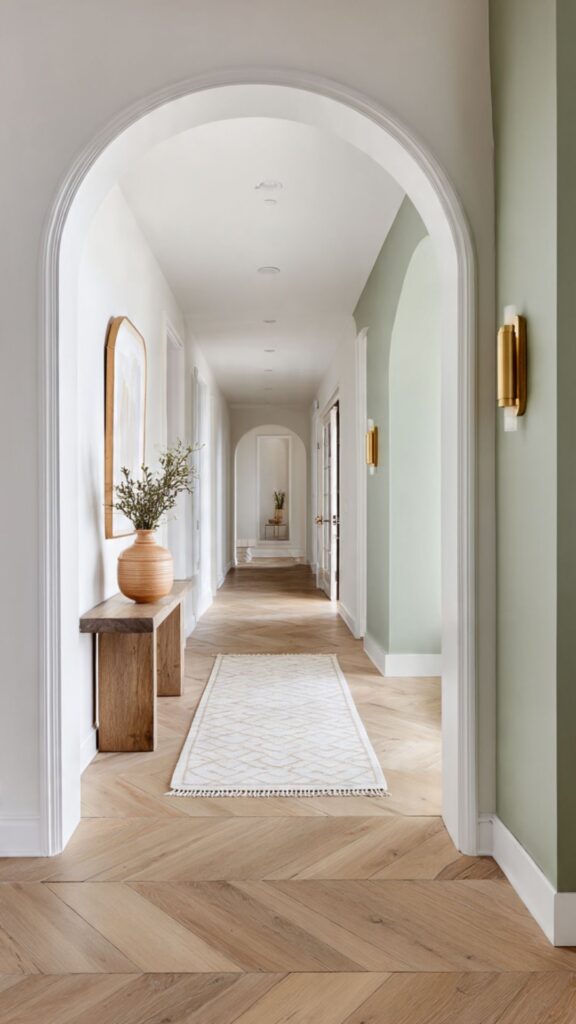
Flooring is the largest visual surface in any hallway and the one that takes the most punishment, tracked-in dirt, wet shoes, heavy foot traffic, and dragged bags. The flooring choice in a hallway therefore needs to balance aesthetic impact with genuine durability, and these requirements are not mutually exclusive. The right material does both beautifully. Encaustic and patterned cement tiles have become one of the defining hallway flooring trends of recent years, and their popularity is well-earned.
A geometric or floral pattern in a hallway creates an immediate visual statement that makes the space feel considered and distinctive. These tiles are also extremely durable, age gracefully, and gain character over time rather than showing wear. The main caveat: they require sealing upon installation and periodic re-sealing to prevent staining a maintenance step that is often underemphasized in design guides.
Engineered hardwood is another strong choice for hallways, offering the warmth and visual continuity of wood with greater dimensional stability than solid hardwood in environments with fluctuating temperature and humidity. Running the boards lengthwise down the corridor parallel to the direction of travel elongates the space visually. A darker stain on lighter walls creates dramatic contrast and ground the corridor; lighter boards on darker walls lift the space and make it feel airier. The direction and tone of the wood communicate the hallway’s character more than almost any other flooring decision.
Transition strips between hallway flooring and adjacent room flooring are a detail that separates professional-quality installations from amateur ones. An elegant, minimal transition in brushed brass or matte black maintains visual flow between spaces rather than interrupting it with an obvious and clunky seam. In open-plan homes where the hallway flows directly into a living area, continuing the same flooring material throughout eliminates the transition entirely and creates a sense of generous, unified space. This is a design decision worth making intentionally at the planning stage rather than resolving as an afterthought.
Also Read: Rooftop Garden Ideas to Transform Your Empty Rooftop.
Indoor Plants for Hallways:
Life, Color, and Clean Air
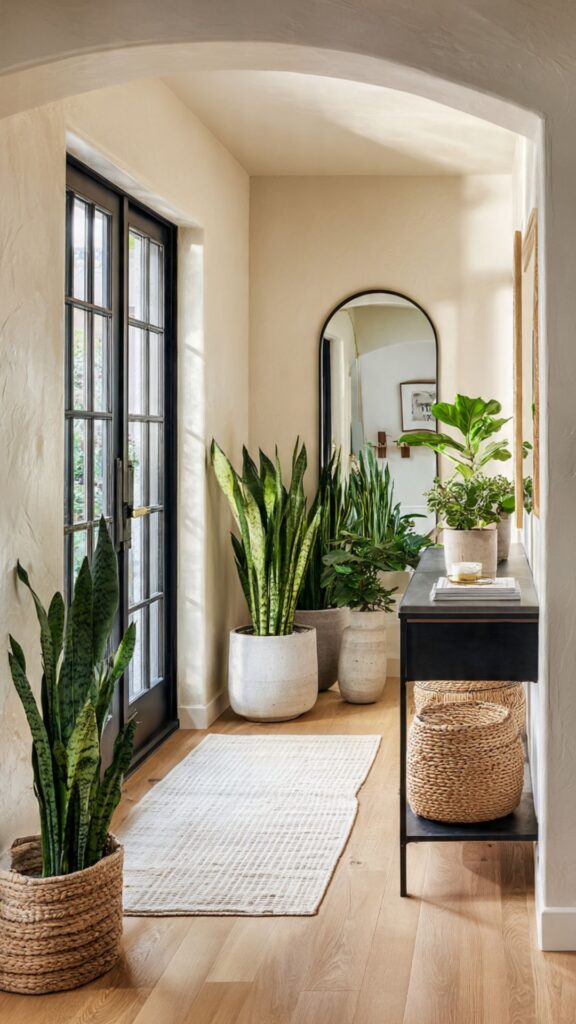
Plants are one of the most accessible and impactful additions to any hallway, yet they’re often skipped because hallways are assumed to be too dark or too narrow for greenery. In reality, many excellent indoor plants thrive in low-light conditions, and even a single well-chosen plant brings the hallway to life in a way that no inanimate decorative object can fully replicate.
Species selection is the key to success in hallway planting. For low-light hallways, cast iron plants (Aspidistra), ZZ plants, snake plants, and pothos are virtually indestructible and genuinely thrive with minimal natural light. For hallways with a window or skylight, fiddle-leaf figs, peace lilies, or bird of paradise create dramatic architectural impact with their bold foliage.
The mistake most people make is choosing plants they love aesthetically rather than plants suited to the actual light conditions resulting in decline and the assumption that the hallway simply “can’t support plants.” Vertical planting strategies are particularly valuable in narrow hallways where floor space is limited. A wall-mounted planter, a tall plant stand, or a slim floor-standing plant tower adds greenery without claiming floor area.
Trailing plants pothos, string of pearls, or heartleaf philodendron hung from a ceiling hook cascade beautifully down a wall and create a lush, layered effect that feels almost sculptural. These vertical approaches are borrowed from urban gardening and work brilliantly in the confined dimensions of most residential hallways.
Beyond aesthetics, the case for hallway plants has a scientific foundation. NASA’s Clean Air Study while often over-cited does confirm that certain houseplants measurably reduce levels of specific airborne pollutants, including benzene, formaldehyde, and carbon monoxide. Since hallways are the primary air exchange zone between the outdoors and your home’s interior, placing air-purifying plants here makes intuitive and practical sense. Spider plants, peace lilies, and rubber plants are among the most effective species for this purpose and also happen to be among the most visually attractive options for hallway display.
Color Psychology in Hallway Decor:
Choosing Shades That Work
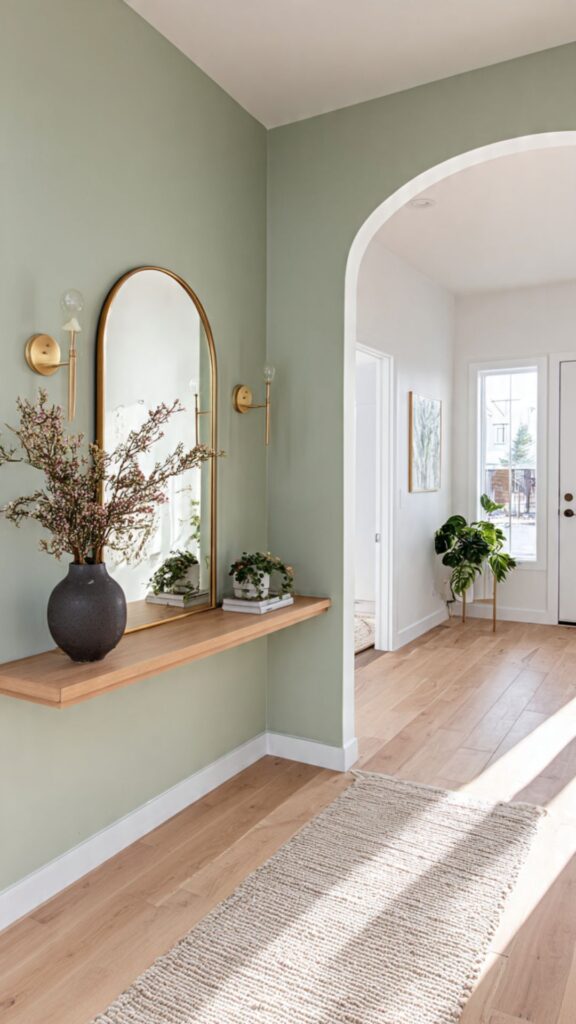
Color is the fastest and most affordable way to transform a hallway, yet it’s also where most homeowners make their biggest mistakes either choosing something too safe (ubiquitous greige) or something too bold without understanding how color behaves in confined, low-light spaces. Understanding a few core principles of color psychology and spatial perception makes the difference between a hallway that feels accidentally right and one that feels deliberately exceptional.
Dark colors in hallways are consistently underestimated. There’s a widespread assumption that small hallways need light colors to feel larger but this is only partially true. Deep navy, forest green, charcoal, and even near-black can make a narrow hallway feel intimate, dramatic, and surprisingly spacious by creating a sense of depth and pushing the walls visually outward.
The key is ensuring that lighting is sufficient: dark walls with inadequate light feel oppressive, while dark walls with well-designed layered lighting feel rich and enveloping. The paint color and the lighting plan must be designed together. Warm neutrals terracotta, warm taupe, sandy ochre are experiencing a strong resurgence in 2026 hallway decor, and they work precisely because they’re flattering in the transitional lighting conditions of most entryways.
Unlike cool grays, which can feel clinical under warm artificial light, warm neutrals read consistently beautiful across different light sources and times of day. They also create an immediately welcoming quality psychologically signaling warmth and comfort before a guest has taken a single step further into the home.
Paint finish is a detail most homeowners overlook but designers never ignore. In hallways, where walls take significant daily scuffing and handling, eggshell or satin finishes are strongly preferable to matte. They reflect slightly more light beneficial in dim corridors and can be wiped clean without damaging the paint layer.
Matte finish, while beautiful in photographs and low-traffic rooms, shows every fingerprint, scuff, and mark in a hallway. This practical choice also has an aesthetic upside: the subtle sheen of satin paint catches light in a way that gives walls a quiet luminosity, particularly beautiful with deeper color choices.
Hallway Decor for Small Spaces:
Smart Design in Tight Corridors
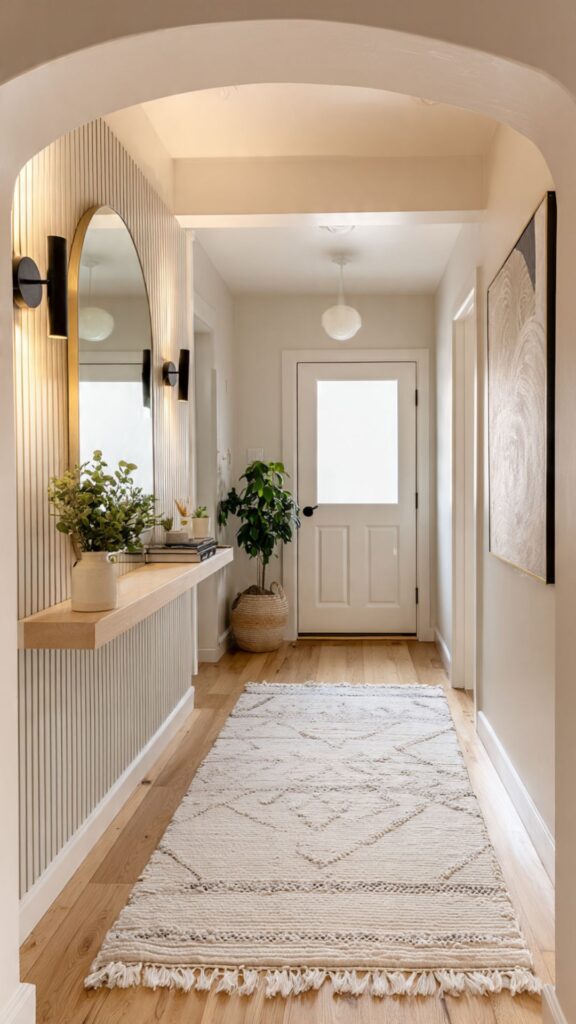
Small hallways present the most constraints and, paradoxically, the most opportunity for creative problem-solving. When every centimeter matters, design decisions become more deliberate and more impactful. The principles that make small hallways work are the same principles that underpin good design generally proportion, purpose, and restraint applied with greater precision.
The vertical dimension is chronically underused in small hallways. Most people furnish to eye height and leave the upper third of the wall completely bare a wasted opportunity in a space where floor real estate is limited. Extending shelving, art, or paneling all the way to the ceiling draws the eye upward and makes the ceiling feel higher.
A tall, narrow bookcase or shelving unit that reaches the ceiling transforms dead vertical space into functional storage and visual interest without consuming additional floor area. Multi-functional furniture is non-negotiable in compact hallways. A slim bench with built-in shoe storage handles two needs in the footprint of one. A wall-mounted fold-down shelf serves as a console table when needed and disappears flush with the wall when not in use ideal for genuinely tight corridors where even a standard console table would obstruct flow.
These multi-purpose solutions require slightly more planning and investment than standard furniture but pay dividends daily in a space where every decision must justify itself twice. Cohesion is the secret weapon of well-designed small hallways. When a small space uses too many competing colors, materials, and styles, it feels chaotic and smaller than it is.
A clear, restrained palette two to three colors maximum and consistent material finishes throughout (matching hardware on hooks and frames, consistent frame colors in gallery walls, flooring that runs unbroken from front door to the corridor’s end) create a sense of deliberate design that makes even the most modest hallway feel considered, calm, and larger than its actual dimensions suggest.
Conclusion
Great hallway decor is about making every square foot work harder aesthetically and practically. From statement mirrors and layered lighting to bold wallpaper and smart storage, each of the hallway decor ideas in this guide offers a genuine, tested approach to transforming your entryway.
The hallway deserves the same design attention as any other room in your home because first impressions, both yours and your guests’, begin the moment that front door opens. Start with one idea, implement it well, and let it inspire the next.

Team TrandyVilla is the passionate home decor team behind Trandy Villa, where style meets comfort in everyday living. The team loves transforming simple spaces into beautiful, functional homes through smart ideas, budget-friendly hacks, and modern design trends. Their content focuses on helping readers create homes that feel both stylish and personal without spending too much.