
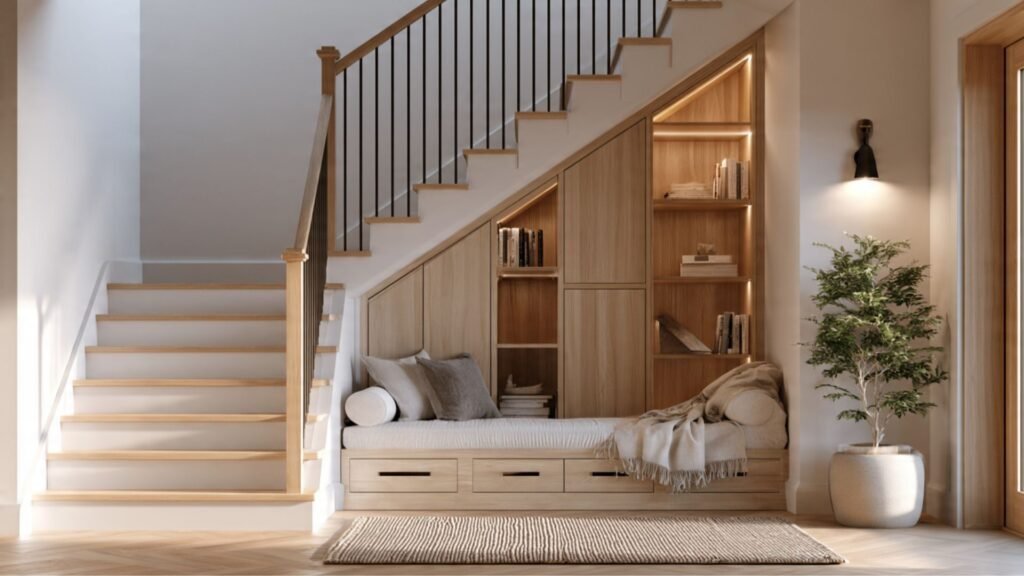
The space beneath your staircase is one of the most overlooked areas in any home. Most homeowners either fill it with random clutter or leave it completely empty neither of which serves them well. However, with the right under stairs storage strategy, this awkward triangular zone can become one of the most functional spots in your entire house.
Under stairs storage ideas help homeowners use empty space beneath staircases in smart ways. These designs add storage, improve organization, and reduce clutter. Built-in drawers, shelves, cabinets, and seating create better function while keeping the home clean, practical, stylish, and comfortable for everyday living needs.
Under Stairs Storage transforms unused areas into practical and attractive spaces for modern homes today. Smart shelves, hidden drawers, reading corners, and compact cabinets improve organization while saving space beautifully. This design idea adds comfort, storage, style, and better functionality without making interiors feel crowded or cluttered.
Under stairs storage ideas fit small apartments, family homes, and modern interiors perfectly today. These solutions support better organization and maximize every square foot efficiently. Wooden drawers, open shelving, compact offices, and storage benches create clean spaces while adding warmth, convenience, structure, and decorative value indoors.
Built-In Drawers:
For a Seamless, Clutter-Free Look
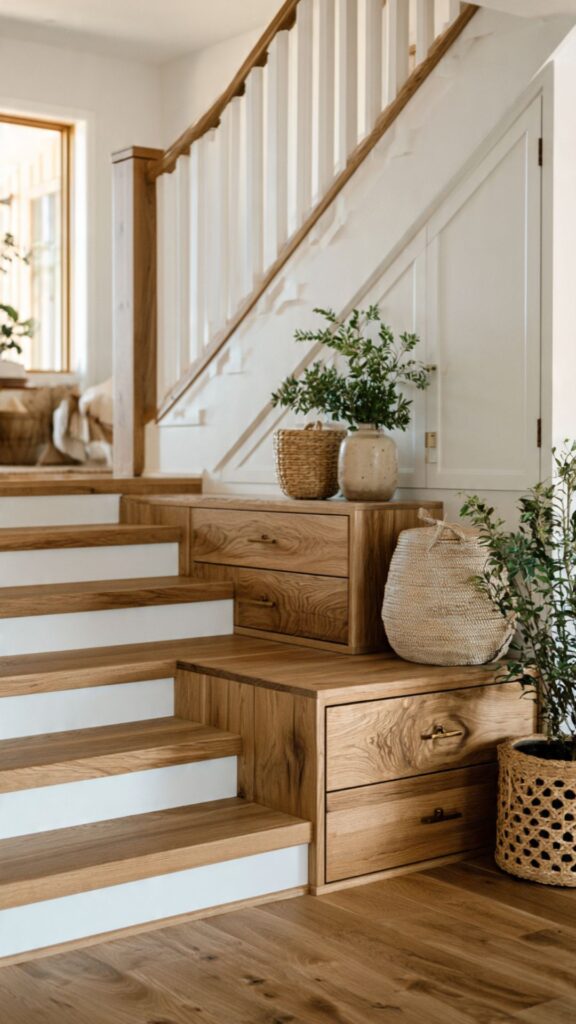
Built-in drawers under stairs storage are one of the most popular and functional solutions homeowners choose when renovating. Unlike open shelving, drawers conceal clutter and give your hallway or living room a sleek, architectural feel. They blend directly into the staircase structure, making them appear intentional and bespoke rather than an afterthought.
The real advantage of pull-out drawers is their adaptability. You can dedicate smaller, shallower drawers near the base of the staircase for shoes, and deeper ones toward the taller end for blankets, seasonal clothing, or children’s toys. This tiered depth approach makes the most of the triangular geometry that typically makes this space tricky to use.
From a material standpoint, choosing the same wood finish as your flooring or staircase creates visual continuity. Soft-close drawer mechanisms are worth the slight additional cost they prevent slamming, extend the life of the joinery, and add that premium, polished feel. Many homeowners report that adding built-in drawers under stairs storage significantly increased their home’s perceived value during resale appraisals.
For families, consider assigning a dedicated drawer to each household member. This approach creates personal accountability everyone knows where their belongings go and it dramatically reduces the chaos of communal dumping grounds near entryways.
A Cozy Reading Nook That Doubles as Storage:
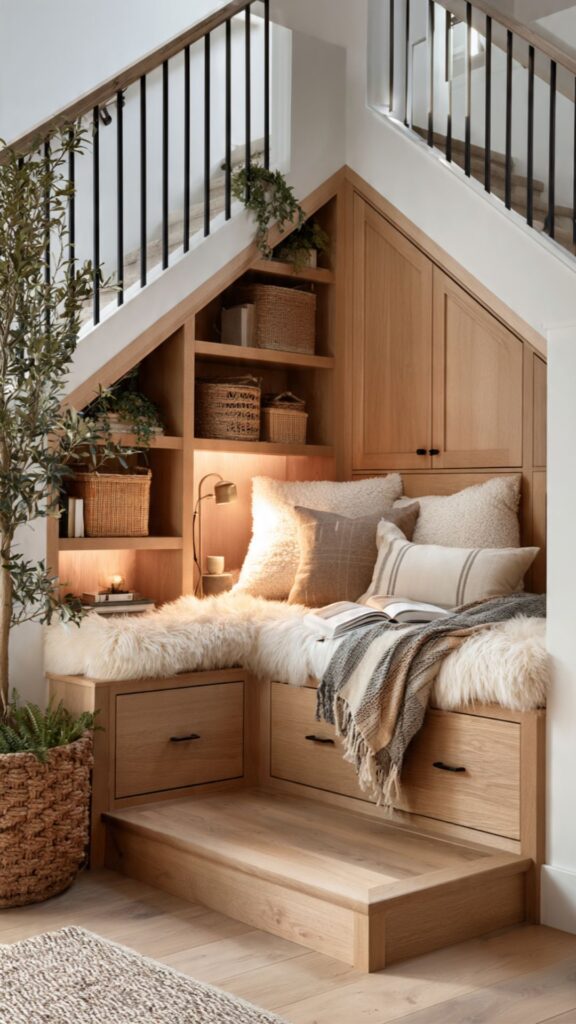
Turning the under-stair area into a reading nook is one of the most charming and emotionally rewarding transformations possible. By adding a built-in bench with a cushioned seat, you create a retreat-like corner that feels intentional and personal. Beneath the bench, deep drawers or hinged-lid compartments can store books, throws, games, or even children’s school supplies.
The triangular shape of the staircase space is actually ideal for a nook because the sloping ceiling creates a natural enclosure a sense of shelter that makes the spot feel cozy rather than cramped. Adding integrated LED strip lighting along the underside of each stair or along the walls transforms the mood entirely, making it inviting even in the evenings.
From a design perspective, lining the back wall with built-in bookshelves within the nook maximizes the storage while also reinforcing the “reading corner” theme. You can use the taller sections of the space (toward the back of the staircase) for full-height shelving, and the lower, angled sections for seating or toy storage.
For families with young children, this kind of under-stair nook becomes a beloved hiding spot. For adults, it becomes a mindful pause a small, intentional space away from the main living area. Either way, it is both emotionally resonant and practically smart.
Bookmark This Now: Staircase Wall Design Ideas That Perfectly Complement Your Smart Under Stairs Storage
A Functional Home Office Under the Stairs:
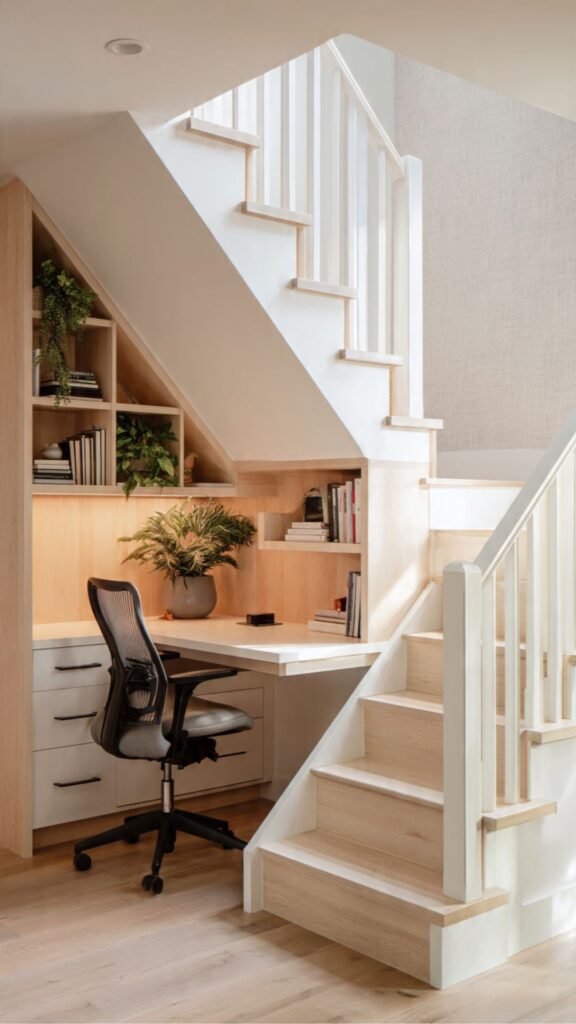
Remote work has changed how we think about home spaces, and the under-stair area is surprisingly well-suited for a compact home office. A built-in desk, proper task lighting, cable management channels, and a few floating shelves above can create a focused workspace without consuming a full room. This solution is especially valuable in smaller homes where a dedicated office is not possible.
The key to making this work is managing the sloping ceiling thoughtfully. Position the monitor or primary working surface in the tallest section of the staircase typically toward the back so you have comfortable headroom while seated. The lower, more angled sections can house a printer, filing drawers, or a small cabinet for office supplies.
One often-overlooked element is acoustic treatment. When tucked under stairs storage, sound can bounce in unexpected ways, especially if the staircase has an open riser design. Adding a plush rug, upholstered panels, or even heavy curtains that can be drawn closed not only improves sound quality but also gives the “office” a sense of privacy when you need to focus or attend video calls.
From a future-proofing standpoint, run electrical conduit and data cables through the wall during the build phase even if you do not need them immediately. Homes with well-integrated tech infrastructure in built-in furniture are increasingly commanding higher interest from buyers who work remotely.
Open Shelving for Books, Décor, and Display:
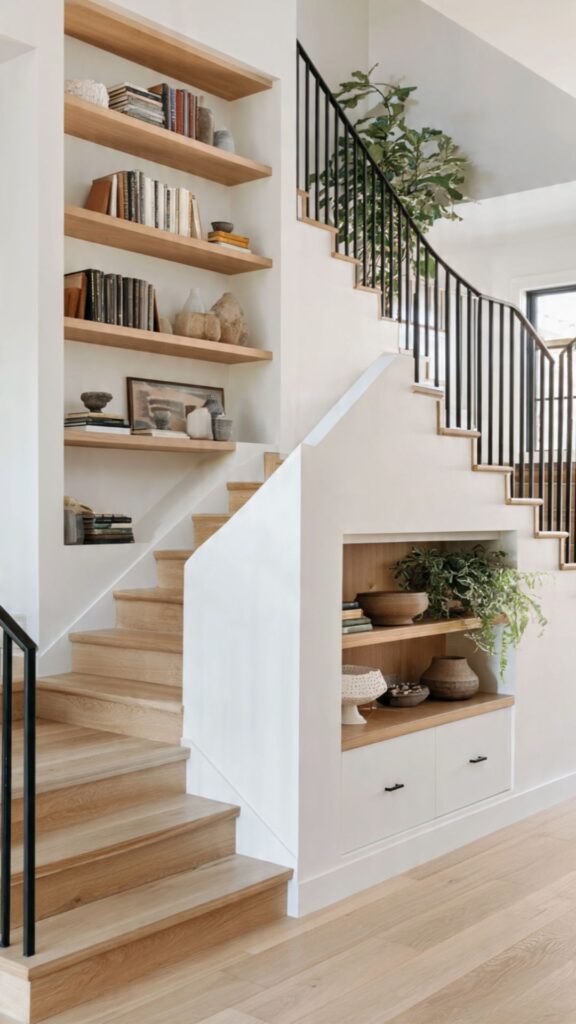
Open shelving under the stairs gives your home a relaxed, editorial quality the kind you often see in design magazines. Rather than hiding everything behind doors, this approach treats the space as a display canvas. Custom-cut shelves that follow the slope of the staircase create a cascading, dynamic visual effect that draws the eye.
This approach works especially well in living rooms and open-plan layouts where the staircase is visible from the main seating area. Curating the shelves thoughtfully mixing books with plants, candles, framed photos, and decorative objects prevents the space from looking like a random storage dump and instead makes it feel like a deliberate design feature.
From a practical standpoint, open shelving works best when you are disciplined about what goes on display. The rule many interior stylists follow is the “one-third rule”: no more than one-third of shelf space should be “active” storage (things you regularly reach for), with the remaining two-thirds acting as display or breathing room. This balance keeps the space from feeling cluttered.
For homeowners who love books, this is perhaps the most personally satisfying under stairs storage idea. There is something deeply appealing about a home that treats books as décor it signals a life well-lived, and the under stairs storage area, when lined with shelves, becomes its own quiet library alcove.
A Dedicated Wine Cellar or Drinks Cabinet:
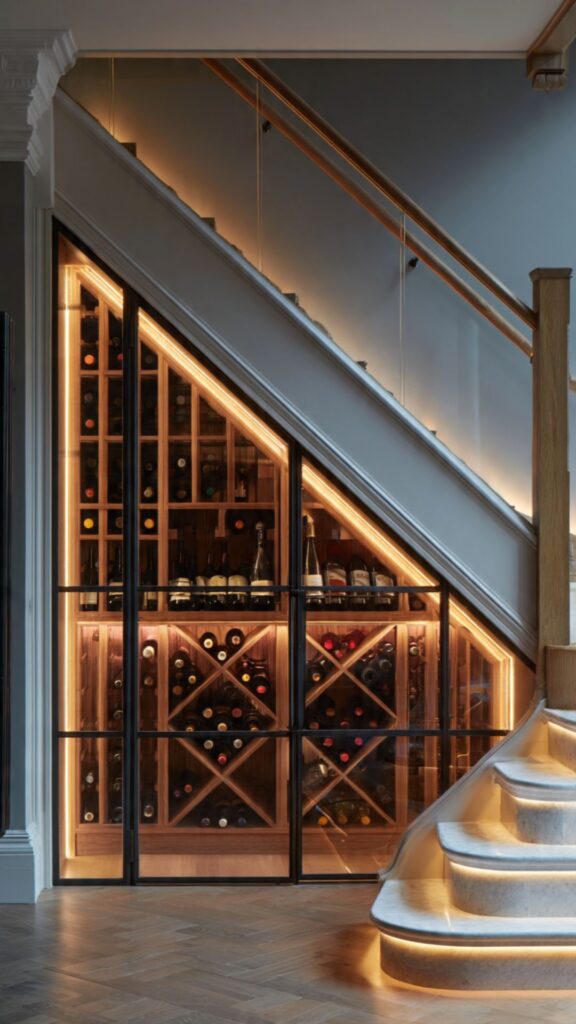
For wine enthusiasts, the area under stairs storage offers a naturally advantageous environment it tends to be cooler, darker, and more stable in temperature than the rest of the house. This makes it an ideal candidate for a custom wine rack or drinks cabinet that goes far beyond what a standard kitchen cabinet can offer.
A built-in wine cellar under the stairs can be as simple as diagonal lattice wine racks fitted into the available depth, or as sophisticated as a fully climate-controlled enclosure with glass doors, integrated LED lighting, and a small serving ledge. The triangular geometry actually works in your favor here, as wine racks can be stepped to follow the slope of the ceiling, accommodating hundreds of bottles in a space that would otherwise go unused.
What makes this idea particularly smart from a home value perspective is that it is a genuinely desirable lifestyle feature. Estate agents consistently report that a well-executed under stairs storage wine cellar or drinks cabinet is a memorable feature that sets a property apart during viewings. It converts a structural oddity into a genuine selling point.
For those who do not drink wine, the same space can become a stylish bar cabinet with integrated storage for spirits, mixers, glassware, and cocktail tools effectively creating an entertainment zone that keeps everything out of the kitchen but close to hand when hosting.
Shoe Storage and a Smart Entryway Station:
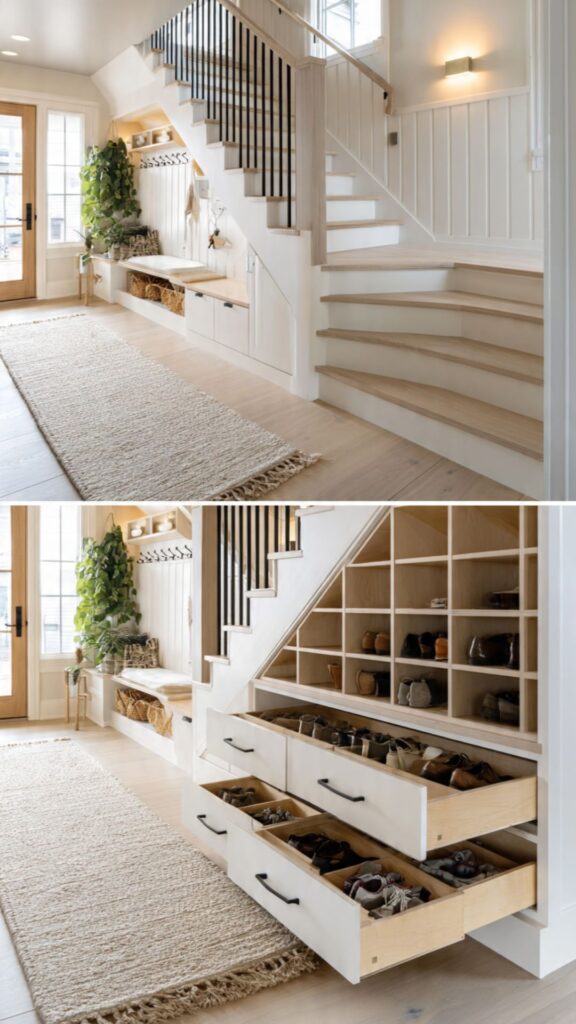
The hallway is where daily life enters and exits the home shoes go on and off, bags get dropped, keys get lost. Designing the under-stair area as a dedicated entryway station solves multiple problems at once. Pull-out shoe racks, hooks for coats and bags, a small bench for sitting, and a drawer for keys and mail creates an organized system that pays dividends every single day.
Shoe storage in particular is an underrated challenge in many homes. A family of four can easily accumulate 20 or more pairs of regularly-worn shoes, and without a designated place for them, they end up scattered across the floor. Built-in angled shoe shelves or pull-out shoe drawers under stairs storage can hold 15–30+ pairs in a compact, accessible format that keeps the entryway visually clean.
From a material and hygiene standpoint, choose surfaces that are easy to wipe down in this zone. Painted MDF is cost-effective, but it struggles with moisture and scuffs. A more durable option is moisture-resistant laminate or painted hardwood with a semi-gloss finish both can withstand the wear and tear of daily entryway use.
The entryway station concept also works as a smart “launch pad” a place where everything needed for leaving the house (shoes, bags, keys, jackets, umbrellas) lives together. This behavioral design principle, borrowed from productivity thinking, reduces the friction of leaving the house on time and eliminates the panicked last-minute searches that disrupt morning routines.
This is Exactly What You Need: Small Apartment Decorating Ideas That Inspire Creative Under Stairs Storage Solutions
Children’s Playroom or Den:
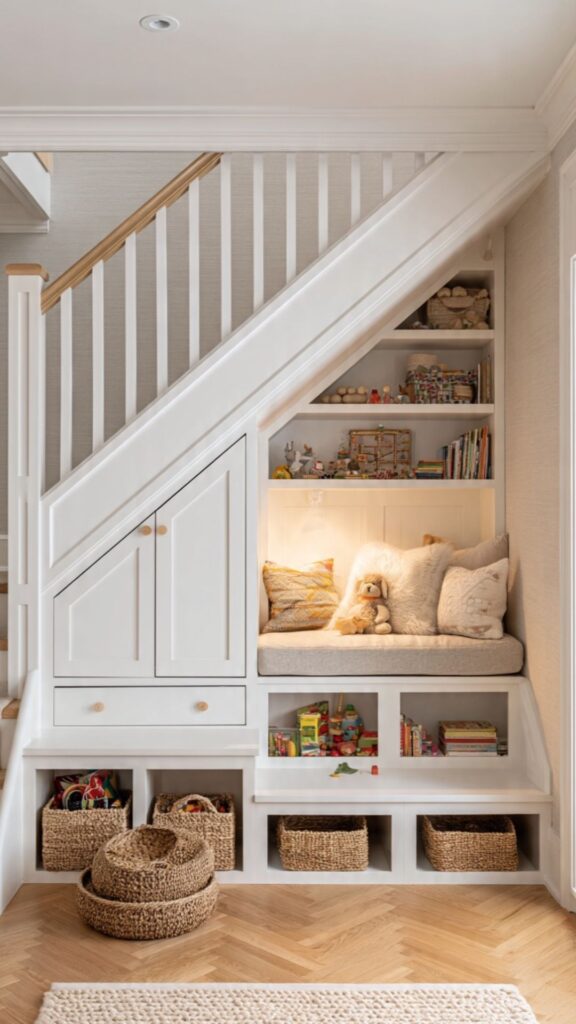
The under-stair area has a magical quality for children its low ceiling, cave-like enclosure, and semi-hidden position make it feel like a secret world. Designing it as a small playroom or den for younger children is one of the most imaginative and beloved under stairs storage ideas available. By adding playful décor, built-in toy storage, and a soft play mat, you create a dedicated play zone that keeps toys corralled and out of the main living space.
Built-in toy storage in this context works best as a combination of open bins (for easy access during play) and closed drawers or cabinets (for tidying up at the end of the day). Color-coding bins by toy type one for building blocks, one for arts and crafts, one for soft toys creates an intuitive system that even young children can follow independently, fostering a sense of ownership and responsibility.
Safety is paramount in this application. Ensure any shelving or furniture is anchored securely to the wall, choose rounded edge profiles over sharp corners, and use non-toxic finishes throughout. If the space will be enclosed with a door, ensure adequate ventilation and a mechanism that cannot accidentally lock from the inside.
As children grow, this space naturally evolves. What starts as a toddler’s play den at age 3 can become a Lego room at age 8, a gaming corner at age 12, and eventually transition back to general storage or a reading nook as children leave home. Designing the built-ins to be modular and adaptable from the outset using adjustable shelving standards, for example ensures the space remains useful across changing life stages.
Utility and Cleaning Supply Cupboard:
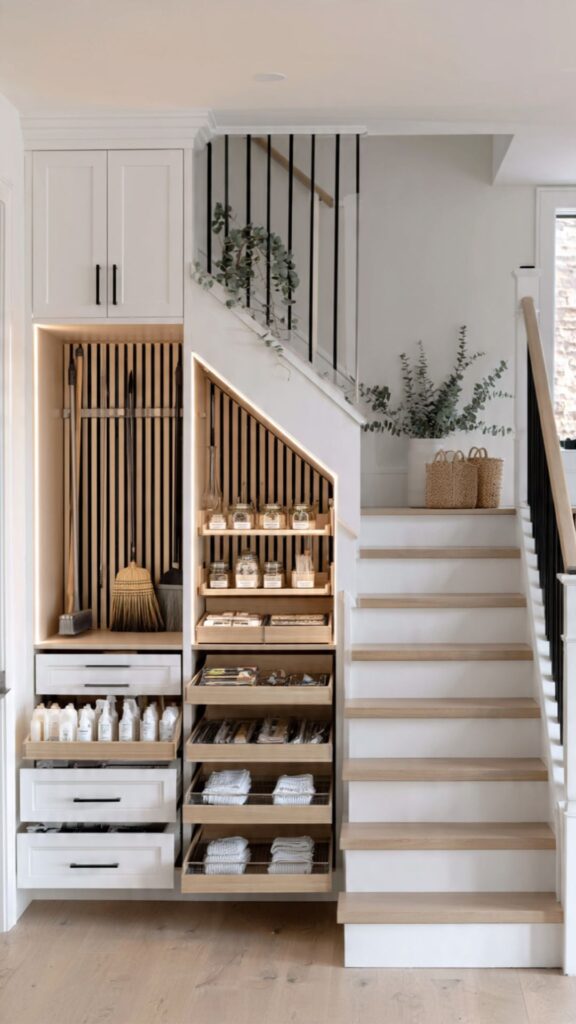
A well-designed utility cupboard under stairs storage might not be the most glamorous idea, but it is perhaps the most practical one for everyday family life. Vacuum cleaners, mops, ironing boards, cleaning products, and laundry supplies are items that every household needs but that rarely have a good home.
The under stairs storage space, with its variable height, is actually perfectly proportioned for tall items like ironing boards and vacuum cleaners that struggle to fit in standard kitchen cabinets. The key to making a utility cupboard work well is thoughtful internal organization rather than simply closing a door on the chaos.
Install a hanging rail for the ironing board, a purpose-built bracket for the vacuum, shallow shelves for cleaning sprays (stored safely out of children’s reach with a child lock on the door), and a hook rail for brooms and mops. This level of intentional internal design transforms a dumping cupboard into a genuinely functional utility zone.
Ventilation is an important consideration for utility cupboards, especially if cleaning chemicals are stored inside. A small passive vent or an active extractor fan ensures air circulation and prevents the buildup of fumes or dampness particularly relevant in older homes or in humid climates.
From a household management perspective, having a centralized home for cleaning supplies means you always know exactly where everything is, restocking is easier to monitor, and the rest of your home kitchen, bathrooms, bedrooms is freed from the visual and spatial clutter of scattered cleaning paraphernalia.
A Pet Corner with Integrated Storage:
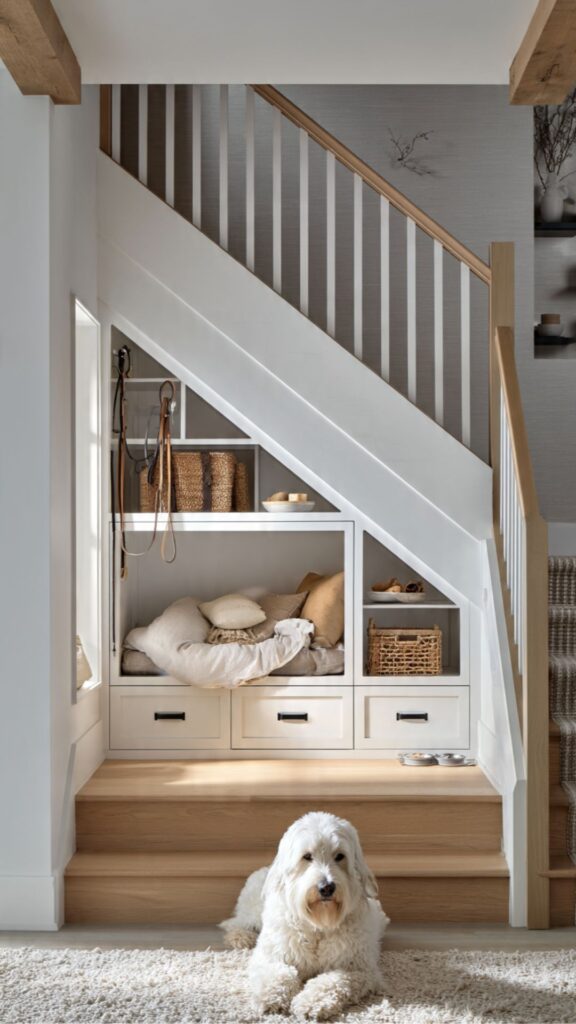
Pet owners often struggle with where to store the accumulation of food, leads, grooming tools, toys, and accessories that come with animal ownership. Designing the under stairs storage space as a dedicated pet zone solves this neatly while also giving your pet their own defined space something many animal behaviorists suggest is beneficial for dogs and cats alike.
A built-in dog bed or cat perch fitted into the lower section of the staircase (where ceiling height is lowest) creates a snug, den-like retreat that pets gravitate toward naturally. Above and around this sleeping area, integrated storage for food bins (with airtight lids), drawers for accessories, and a small hanging area for leads and harnesses keeps the rest of the home free from pet paraphernalia.
Choosing the right materials in a pet zone is critical. Opt for surfaces that are easy to clean sealed hardwood, painted MDF with a gloss finish, or even tiled flooring in the pet area and avoid soft furnishings that absorb pet odors and are difficult to wash. A removable, washable cushion for the pet bed is far more practical than a fixed upholstered unit.
This kind of dedicated pet station also normalizes pet ownership within the home’s design narrative it shows that pets are a considered part of household life rather than an afterthought. For dog owners, having a defined “settling spot” near the entrance also helps with training, as the dog learns quickly that arriving home means going to their spot.
A Pantry or Food Storage Zone:
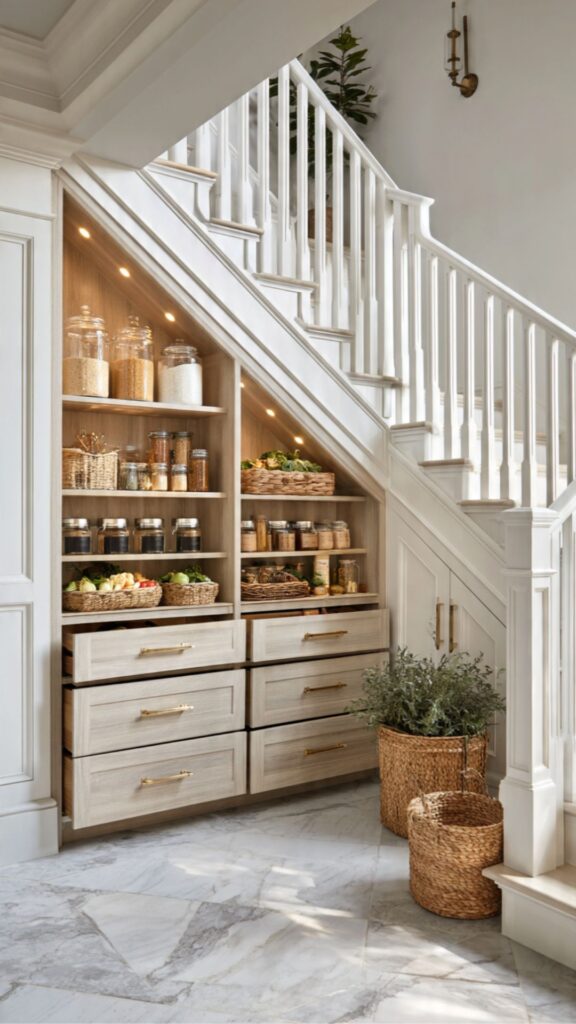
In homes where kitchen storage is limited which describes most urban apartments and smaller terraced houses converting the under-stair area into a walk-in pantry is a genuinely transformative upgrade. The cooler, darker conditions under stairs storage are actually favorable for food storage, making this one of the more historically resonant ideas on this list (before modern refrigeration, under-stair larders were common in Victorian homes for exactly this reason).
Modern pantry design under stairs storage typically involves deep adjustable shelving for dry goods, a pull-out section for root vegetables, a small section with airtight containers for grains and pulses, and door-mounted racks for tinned goods and condiments. Good lighting is essential LED strip lights or a motion-sensor overhead light ensure you can always see what you have without rummaging, which also helps reduce food waste.
The organizational principle that works best in a pantry setting is “first in, first out” newer purchases go behind older ones, ensuring nothing gets forgotten at the back of a shelf until it expires. Labeling containers and using a consistent aesthetic (matching storage containers, uniform labels) transforms the pantry from a purely functional space into one that is genuinely pleasant to interact with.
From a sustainability angle, a well-organized pantry actively reduces food waste by making existing stock visible and accessible. Studies from food waste organizations consistently show that poor visibility of stored food is one of the leading causes of household food waste a problem that a thoughtfully designed pantry directly addresses.
One More Thing: Bathroom Storage Ideas That Share the Same Smart and Clever Storage Approach as Under Stairs storage.
A Smart, Tech-Integrated Storage System:
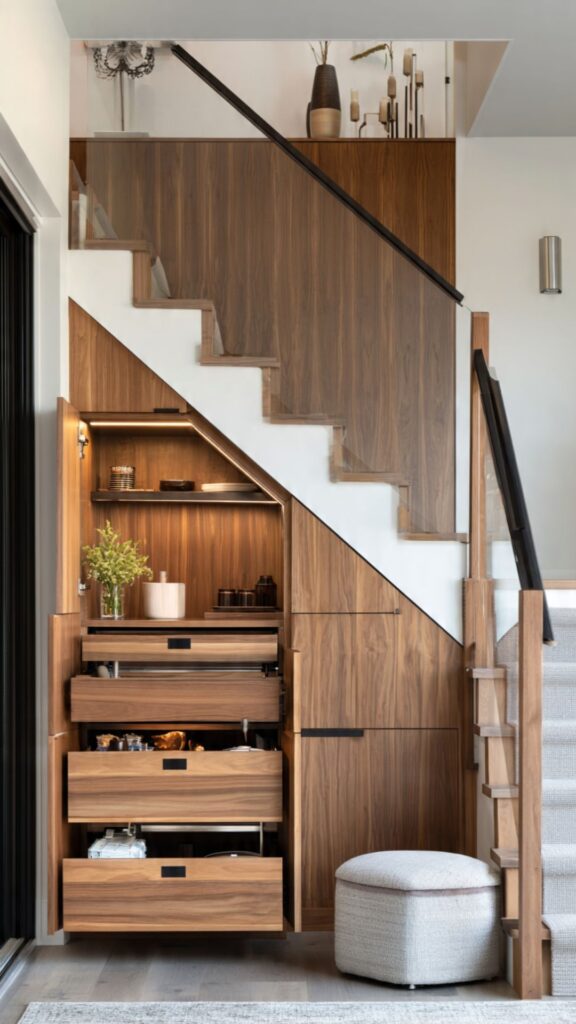
Looking ahead, the under stairs storage space is becoming increasingly relevant as smart home technology becomes more mainstream. Homeowners are beginning to use this zone not just for passive storage but as an active infrastructure hub housing routers, NAS drives, smart home hubs, and even small home server setups in a tidy, concealed enclosure.
Beyond tech infrastructure, smart storage elements like motorized pull-out drawers, app-controlled LED lighting, and integrated charging stations are becoming more accessible and affordable. Imagine opening a specific drawer via voice command, or having your under stairs storage shoe cabinet automatically illuminate when you arrive home via a motion sensor. These are not futuristic fantasies they are products available today at accessible price points.
The practical benefit of centralizing tech equipment in the under stairs storage space is cable management. By running all cables through the structural void of the staircase, you can eliminate the trail of visible wires that plague most living rooms and hallways. A well-designed tech enclosure also provides better thermal management for devices with proper ventilation cutouts than a standard media unit.
For those planning a renovation, it is worth future-proofing the under stairs storage space during the build phase even if you do not intend to use smart features immediately. Running conduit, installing sufficient electrical sockets, and ensuring adequate ventilation during initial construction costs very little compared to retrofitting later and it keeps your options open as technology continues to evolve.
Conclusion
Under stairs storage is not just about tidying up an awkward corner it is about reimagining wasted potential and designing a home that works harder for you every day. Whether you choose built-in drawers, a cozy reading nook, a functional home office, or a smart tech hub, each of these ideas proves that no square foot of your home needs to go unused.
The right solution depends on your lifestyle, household size, and budget but the first step is simply recognizing that this space deserves intentional design. Start with one idea, plan it carefully, and let your under stairs storage area become one of the most surprisingly useful spots in your home.

Team TrandyVilla is the passionate home decor team behind Trandy Villa, where style meets comfort in everyday living. The team loves transforming simple spaces into beautiful, functional homes through smart ideas, budget-friendly hacks, and modern design trends. Their content focuses on helping readers create homes that feel both stylish and personal without spending too much.