
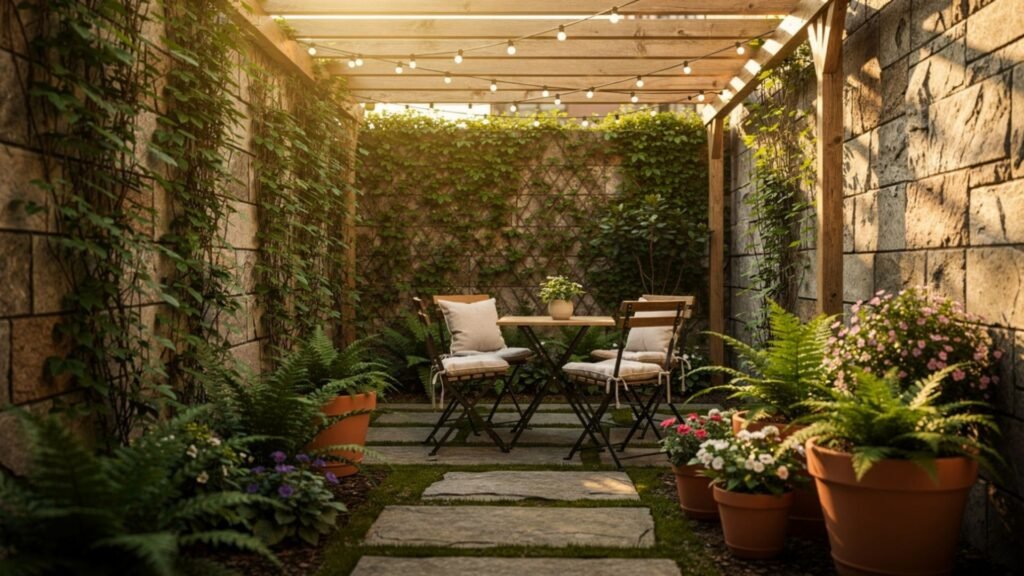
Small courtyard gardens are compact outdoor spaces designed for comfort, beauty, and daily relaxation. These garden ideas use plants, seating, lighting, and paving to improve small areas. They create privacy, add greenery, and make outdoor living more peaceful, stylish, and practical for modern homes today.
Small courtyard gardens turn compact outdoor areas into peaceful retreats with smart layouts, layered plants, warm lighting, and space-saving features. These gardens create comfort, beauty, and privacy while adding natural texture and timeless charm that makes every small outdoor space feel welcoming and relaxing daily.
Small courtyard gardens ideas include vertical planting, container gardens, water features, and simple seating areas. Natural stone, gravel, and warm lighting improve the atmosphere. Mediterranean plants, herbs, and evergreen shrubs add color and texture. Thoughtful layouts help small outdoor spaces feel larger, calmer, and more inviting.
Vertical Gardening:
How to Triple Your Growing Space Without Using More Floor Area
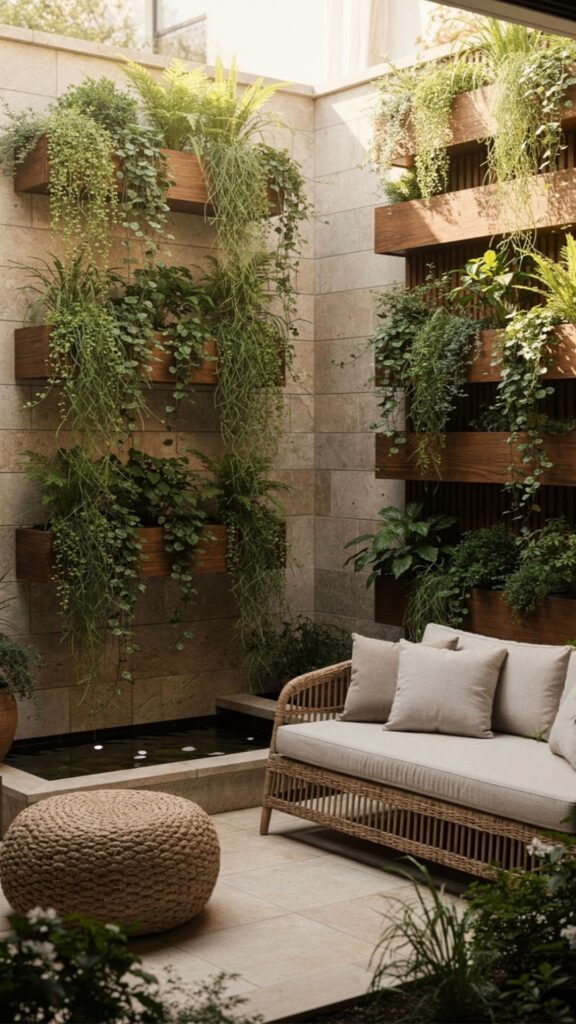
Vertical gardening is the single most transformative technique available to small courtyard gardens designer, and it is consistently underutilized. The principle is simple but powerful: when floor space is limited, grow upward. A courtyard with bare walls is a courtyard with enormous untapped potential.
By treating every vertical surface walls, fences, trellises, pergola uprights as planting space, you can dramatically increase the amount of greenery in a small courtyard gardens without sacrificing an inch of usable floor area. The most established approach to vertical planting in a small courtyard is a trained climber on a wall.
Climbing plants like Rosa ‘Zephirine Drouhin’ (a thornless climbing rose), Clematis armandii (evergreen, fragrant in spring), Trachelospermum jasminoides (star jasmine, wonderfully scented), and Hydrangea anomala subsp. petiolaris (self-clinging, spectacular in flower) can cover an entire courtyard wall within three to five years, transforming a hard architectural surface into a living, textured, seasonal backdrop.
The key is to fix a discreet wire or trellis system to the wall before planting retrofitting support systems through established plants is frustrating and damaging. Living walls vertical planting panels that hold modular planting pockets represent a more contemporary and engineered approach to the same challenge.
Modern living wall systems from manufacturers like Woolly Pocket, Florafelt, and ANS Global are genuinely impressive: they include integrated irrigation, growing media specifically formulated for vertical planting, and plant selections optimized for low-maintenance performance.
A living wall in a small courtyard gardens is a statement piece that doubles as a visual focal point and a significant noise and temperature buffer. However, the ongoing maintenance commitment is higher than most marketing materials suggest regular feeding, occasional replanting, and consistent irrigation management are non-negotiable.
Pro Tip: Fix horizontal wires at 30cm intervals across a blank wall before you furnish the courtyard it’s far easier before furniture and pots are in place. Use stainless vine eyes to maintain a 4–5cm gap between wire and wall for air circulation.
A third vertical approach that is often overlooked: free-standing obelisks and plant towers positioned within large containers. An obelisk planted with a climbing annual like sweet peas, or a perennial clematis trained around a tower frame, adds dramatic vertical height to a container garden without any wall fixings.
This approach is particularly useful for renters who cannot alter walls or fences, and it allows complete flexibility the obelisk and its climber can be repositioned seasonally or replaced entirely as tastes change. For small courtyard gardens in rented properties, container-based vertical gardening is the definitive solution.
Paving and Ground Cover:
The Foundation That Makes or Breaks a Courtyard
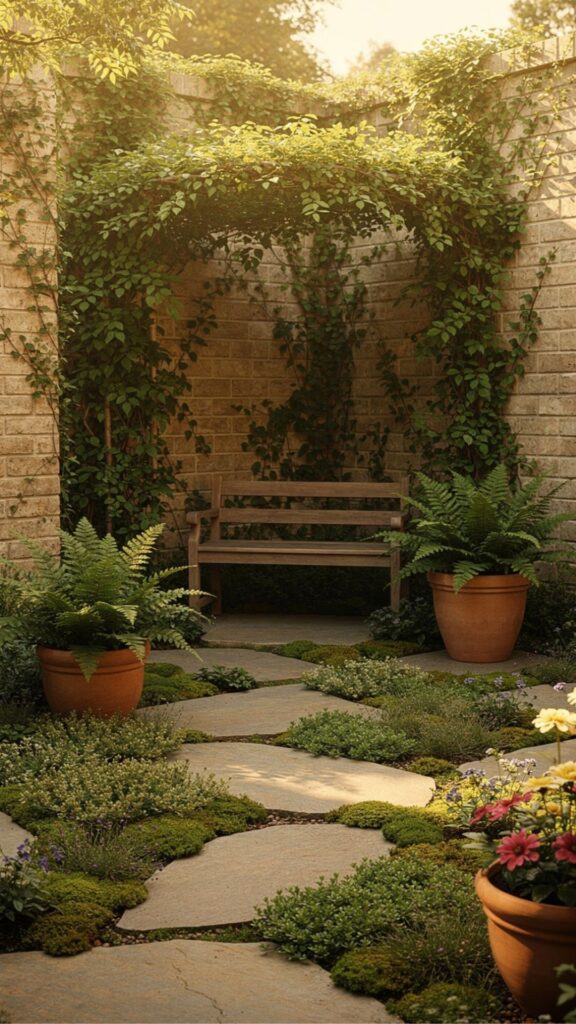
The choice of ground surface in a small courtyard gardens has a more dramatic effect on the finished aesthetic than any other single decision including plant selection. Because a small courtyard gardens is almost entirely visible from any point within it, the flooring dominates the visual composition in a way it never would in a large garden where lawn or planting absorbs most of the ground plane.
Getting the paving right means the courtyard looks considered and polished from day one, even before plants have grown in. Getting it wrong means the space always looks slightly off, regardless of how beautiful the planting becomes. Natural stone limestone, sandstone, slate, and granite remains the benchmark material for courtyard paving, and for good reason. Its textural variation, warmth, and the way it ages over time (developing a patina rather than looking worn) make it incomparably more beautiful than concrete or composite alternatives.
However, the gap in quality between different natural stone suppliers is significant. Riven sandstone in a warm buff or honey tone is universally flattering and works with almost any planting style. Blue-grey slate is sophisticated but can feel cold in north-facing courtyards. Tumbled limestone in a creamy white tone creates a Mediterranean warmth that pairs beautifully with terracotta pots and lavender.
Gravel is the underestimated alternative to stone paving in small courtyards, and it deserves serious consideration. A well-laid gravel courtyard with a proper membrane beneath to suppress weeds, edged cleanly, and kept raked is less expensive than stone, permeable (a genuine environmental advantage), and visually calm in a way that tile or concrete can rarely achieve.
The sound of footsteps on gravel is a sensory detail that adds genuine atmosphere. Gravel also allows planting through it, enabling a naturalistic style where plants like lavender, catmint, and ornamental grasses appear to self-seed through the ground surface, which softens the courtyard’s hard edges organically.
Designer Tip: Lay paving in a running bond (offset) rather than a grid pattern it makes a small courtyard feel wider and more dynamic. Avoid very small tiles or busy patterns, which fragment the visual field and make the space feel smaller.
The joint between paving units is a detail that most courtyard guides ignore entirely, yet it significantly affects the final aesthetic. Standard cement pointing is functional but looks harsh and industrial. A brushed sand joint allows moss and small plants to establish between stones over time, creating a softened, aged look far faster than waiting for plants to grow.
Planted joints using compact Thymus serpyllum (creeping thyme) or Sagina subulata (Irish moss) are the premium option: both are low-growing, traffic-tolerant, fragrant underfoot, and add a living texture to the courtyard floor that no paving material can replicate on its own.
Explore This: Whimsical Garden Ideas That Add a Magical and Dreamy Touch to Your Small Courtyard Gardens.
Container Planting:
The Art of Creating a Garden Without a Single Bed
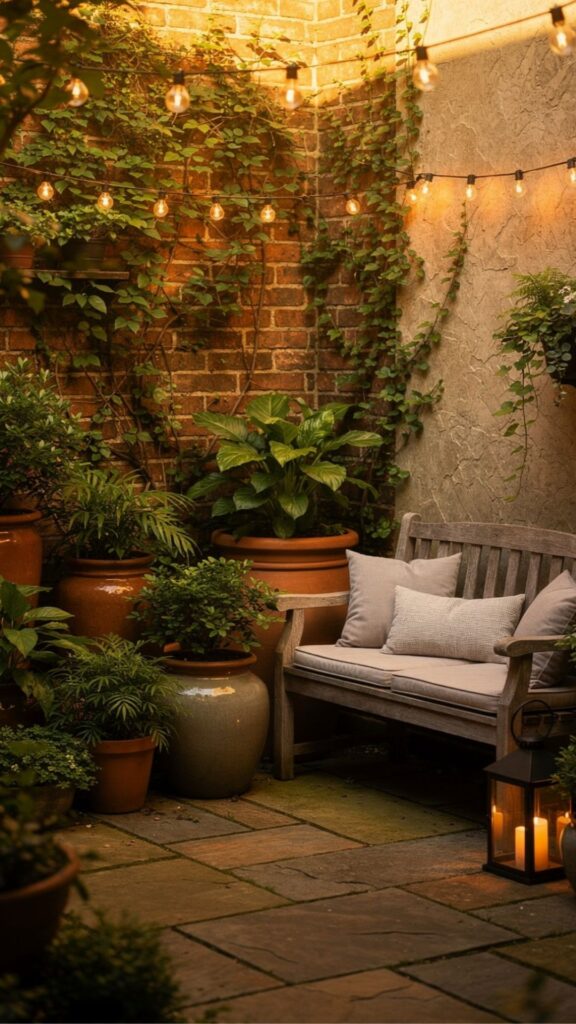
Container planting in a small courtyard gardens is not a compromise it is a design philosophy. Some of the most celebrated small courtyard gardens in the world are planted entirely in containers, with no in-ground beds at all. The advantages are substantial: you have complete control over soil quality (allowing you to tailor the growing medium to each plant’s specific needs).
You can move plants to optimize light conditions seasonally, and you can completely reimagine the arrangement without any ground work. Container gardens are also significantly more accessible for gardeners with limited mobility, raised containers at bench height make gardening genuinely comfortable and enjoyable.
The materials and scale of containers are where most courtyard gardeners go wrong. The most common mistake is choosing containers that are too small not just for aesthetic reasons, but because small containers dry out rapidly in warm weather, limiting plant health and requiring daily watering.
In a small courtyard gardens, one large statement container (60–80cm diameter) surrounded by two or three medium containers (40–50cm) is almost always more effective than a dozen small pots scattered around the space. Large containers also weather better: terracotta freezes and cracks in cold winters, but a large frost-proof glazed ceramic or fibreglass container will outlast a small terracotta pot by decades.
The combination planting approach sometimes called “thriller, filler, spiller” is the most reliable system for creating visually striking container compositions. The thriller is a tall, bold plant that provides height and drama (a clipped topiary ball, a tall ornamental grass, or a standard rose).
The filler is a mounding plant that gives mass and texture (lavender, heuchera, or compact herbs). The spiller is a trailing plant that flows over the container edge and softens its rim (trailing rosemary, bacopa, or nasturtiums). This three-element system works in virtually any combination and at virtually any scale, which is why professional garden designers return to it repeatedly.
Irrigation is the unglamorous topic that determines whether a container garden succeeds or fails in practice. Manual watering of a well-planted container courtyard in summer requires fifteen to thirty minutes daily, which is realistic in theory but unsustainable for many people in practice.
A simple drip irrigation system on a timer, installed through a straightforward DIY process, eliminates this entirely. Modern systems are modular, inexpensive, and can be adjusted to individual container needs with different flow-rate emitters. Installing irrigation before the containers are fully planted and in position is dramatically easier than retrofitting it afterward plan for it from day one.
Water Features in Small Courtyard Gardens:
Sound, Movement, and Wildlife
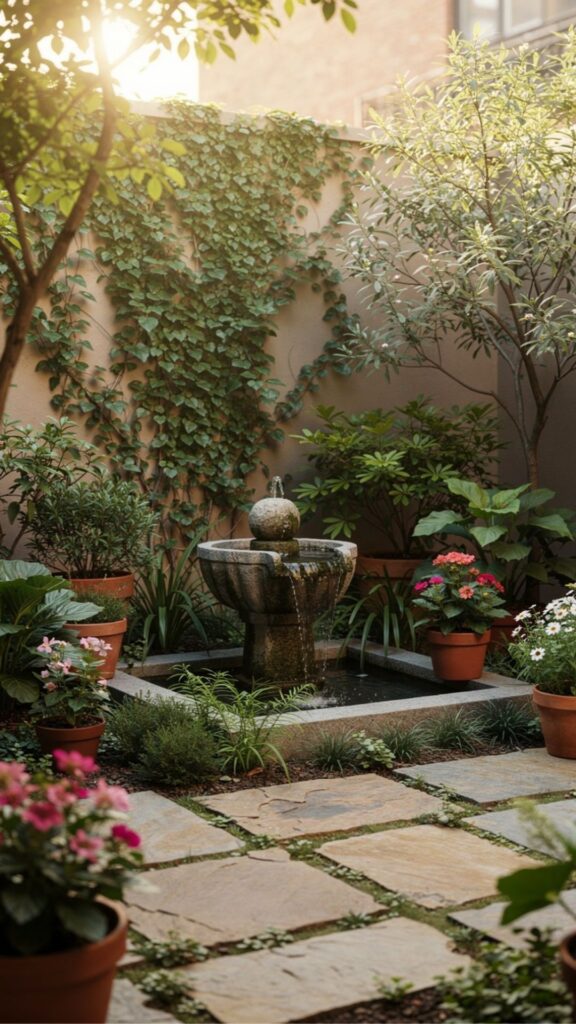
A water feature transforms a small courtyard gardens from a pleasant outdoor space into something genuinely extraordinary. The effect is primarily sensory: the sound of moving water masks ambient urban noise traffic, neighbours, air conditioning units in a surprisingly effective way.
Research consistently shows that the sound of water has measurable stress-reducing effects, which is why water features appear in nearly every high-end spa and meditation garden worldwide. In a compact courtyard where you are sitting within a few metres of the water feature, this effect is amplified considerably. The scale and type of water feature matters enormously in a small space.
A large formal pond or raised rill looks magnificent in a generous courtyard but can dominate and overwhelm a truly compact space. For very small courtyard gardens (under 15 square metres), the most appropriate water features are self-contained units: a millstone fountain where water bubbles up through the centre of a stone, a wall-mounted lion’s head fountain draining into a trough, or a ceramic jar or urn from which water overflows down the exterior surface into a concealed reservoir below.
These features require no open water body, making them child-safe, mosquito-free, and entirely self-contained in operation. Slightly larger courtyards can accommodate a raised formal pool a stone or rendered-brick rectangular raised bed, 15–30cm deep, planted with a single water lily and a marginal plant or two.
The reflective quality of still water in a small courtyard gardens is remarkable: it doubles the perceived size of the space by reflecting the sky and surrounding walls, creates a dynamic quality as light shifts through the day, and attracts birds, pollinators, and beneficial insects that add genuine ecological value. A small solar-powered fountain head in the centre of the pool adds movement and oxygenates the water, keeping it clear without chemical treatment.
“Even the smallest water feature a ceramic bowl with water, a floating candle, and a handful of aquatic pebbles changes the acoustic and emotional quality of a small courtyard gardens completely.”
The maintenance reality of courtyard water features is more manageable than most people expect. A self-contained water feature requires topping up with water weekly in summer (evaporation in a warm enclosed courtyard can be significant) and an annual clean of the pump filter. A raised pool requires algae removal two or three times per year, a partial water change in spring, and pump maintenance.
Neither task takes more than thirty minutes. The disproportionate benefit year-round sound, wildlife habitat, visual beauty, and genuine wellbeing value makes the small maintenance commitment one of the most favourable trade-offs in small garden design.
Privacy Screening:
Creating Seclusion Without Making the Space Feel Smaller
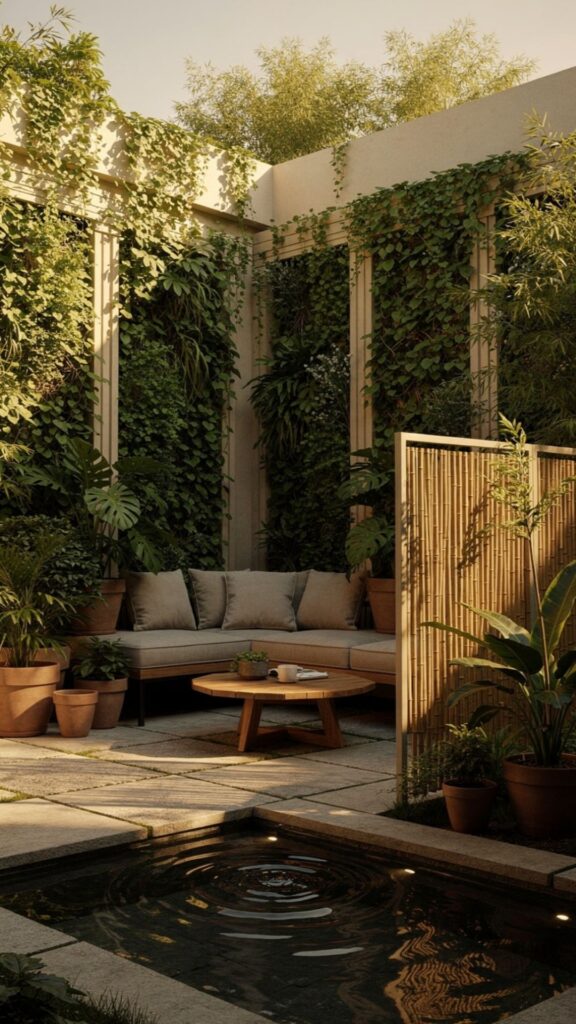
Privacy is the primary practical challenge in most small courtyard gardens, particularly in urban areas where surrounding buildings overlook the space from multiple angles. The instinctive response erecting the tallest possible fence or wall is almost always counterproductive in a small space.
Very high, solid barriers create a shadowed, oppressive enclosure that makes an already-compact courtyard feel like a cell rather than a sanctuary. The design challenge is to achieve genuine visual privacy from overlooking windows and neighbours without darkening or closing in the space further than necessary.
The most sophisticated approach to courtyard privacy uses layered planting at different heights to interrupt sightlines without creating a solid barrier. A tall bamboo (Phyllostachys aurea or Fargesia rufa the latter non-invasive) planted in a long trough along the overlooked boundary creates a moving, airy screen that is visually interesting without being oppressive.
In front of the bamboo, a medium-height evergreen shrub like Sarcococca confusa (sweetbox, wonderfully fragrant in winter) creates a lower layer. This layered approach blocks the view from a specific angle a neighbouring first-floor window, for example without blocking light from other directions.
Tensile shade sails and pergola structures solve the problem of overhead overlooking balconies and upper-floor windows that look directly down into the courtyard. A well-designed pergola with an open-weave fabric roof or slatted timber canopy creates dappled shade overhead while leaving the sides of the courtyard open to light and air.
The permeable nature of the cover means rain passes through while direct overhead views are blocked. Training a climber over the pergola roof wisteria, a grapevine, or star jasmine adds a beautiful, seasonal overhead canopy that evolves through the year.
Expert Tip: Before installing any screening, sit in the courtyard at the actual times you use it and identify exactly which windows or angles present the problem. Targeted, specific screening always works better than perimeter fortification.
Trellis panels deserve specific mention as a privacy solution because they are so frequently misused. A solid expanse of trellis from ground to maximum fence height is no more than a fence with decorative holes it blocks light without meaningfully improving the design.
Trellis used architecturally as a partial extension to an existing fence topped with a planted climber, or as a free-standing frame around a seating area creates the impression of enclosure and privacy without the visual weight. The distinction between a trellis that screens and a trellis that decorates is largely about how it is positioned and planted.
Courtyard Lighting Design:
How to Make a Small Garden Look Magical After Dark
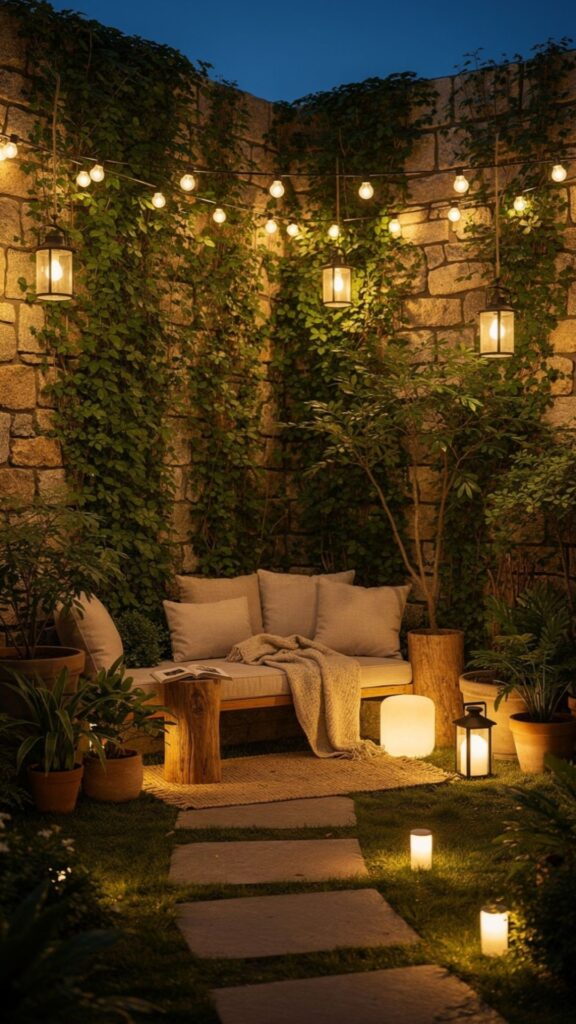
Outdoor lighting is the most consistently underinvested element of small courtyard gardens design, and the gap between a lit and unlit courtyard at night is dramatic. A beautifully planted and furnished courtyard with no lighting becomes invisible after dusk, essentially unusable for half the year in temperate climates.
The same courtyard with a considered lighting scheme warm, layered, carefully directed becomes a place you want to sit in every evening, even in cooler months when a blanket and a heater make outdoor life possible long into autumn.
The three levels of courtyard lighting ambient, accent, and task each serve distinct purposes and should work together. Ambient lighting provides overall illumination without a single harsh light source: this is best achieved through a series of low-wattage, warm-toned (2700K) wall lights positioned at fence or wall height, or through festoon lights strung across the courtyard at canopy height.
Accent lighting highlights specific plants, architectural features, or the water feature: directional LED spotlights buried at the base of a specimen tree or mounted at low level to graze a textured wall create dramatic light and shadow that turns the garden into a living artwork at night. Task lighting provides functional illumination around the dining table or seating area without spilling light everywhere.
Solar lighting has improved dramatically in quality over the last five years, but it remains unreliable in north-facing or heavily shaded courtyards where insufficient solar gain limits battery performance. For a courtyard garden that will be used regularly in the evening, a properly installed low-voltage outdoor lighting system run from a transformer inside the house is far more reliable and produces significantly better results.
The transformer cost and cable installation can typically be offset by the use of low-energy LED fittings, which have running costs so low that the ongoing electricity expense is negligible.
Lighting Tip: Always choose outdoor light fittings rated IP65 or higher for wall and ground use in a garden context. IP44 is insufficient for direct rain exposure. And always specify 2700K warm white cool white (4000K+) makes garden planting look grey and clinical at night.
Candles and lanterns the simplest and most affordable form of courtyard lighting deserve continued celebration in an era of increasingly complex lighting systems. A collection of storm lanterns filled with pillar candles, arranged at different heights on steps, walls, and tables, creates a quality of light that no electrical system can fully replicate.
The movement of candlelight, its warmth, and the ritual of lighting candles before an evening in the courtyard are experiential qualities that matter. A hybrid approach permanent installed lighting for regular use, supplemented by candles for special occasions and summer evenings is the most rewarding outcome.
Japanese-Inspired Courtyard Gardens:
Calm, Minimal, and Endlessly Beautiful
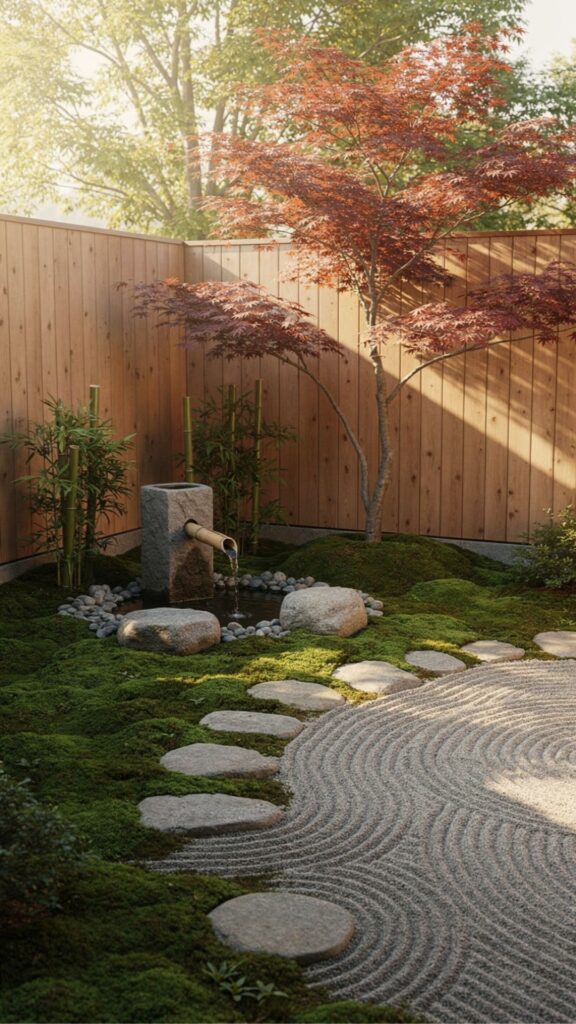
Japanese garden design philosophy is arguably the most directly applicable to small courtyard gardens space of any garden tradition in the world. The entire aesthetic is built around smallness done magnificently Zen temple gardens in Kyoto are often smaller than a suburban back garden, yet they achieve a sense of expansiveness and calm through rigorous editing, deliberate asymmetry, and the use of materials that age and change with extraordinary grace.
Applying these principles to a Western small courtyard gardens produces results that feel genuinely different from any other garden style. The core Japanese garden elements roji (stone path), shizen (naturalism), ma (negative space), and wabi-sabi (the beauty of imperfection) translate directly into actionable courtyard design decisions.
Stone paths through gravel or moss, with stepping stones that require you to slow down and look where you step, create a mindful quality of movement through the garden. A single specimen tree or shrub a Japanese maple (Acer palmatum), a multi-stem silver birch, or a cloud-pruned box is given space to be truly seen rather than crowded by other planting. Gravel raked in a wave pattern around a carefully placed stone suggests water and movement in a completely dry composition.
Plant selection for a Japanese-inspired courtyard is built around four qualities: year-round structure, seasonal change, texture, and restraint. The plant palette is deliberately narrow typically no more than five or six species repeated throughout the space to create coherence.
Mosses, ferns, bamboo grasses, Japanese maples, and evergreen azaleas form the core. Colour is minimal: white, pale pink, and the full spectrum of greens from acid lime to deep forest. The visual satisfaction comes not from abundance but from the quality and arrangement of each individual plant a philosophy completely antithetical to the Western instinct to fill every available space.
The water basin (tsukubai) is the quintessential Japanese courtyard water feature a low stone basin fed by a bamboo spout, surrounded by mossy stones and ferns. It references the ritual handwashing basins of Japanese tea ceremony gardens and brings a deeply contemplative quality to a small urban courtyard that is completely distinct from any Western water feature.
Finding a genuine stone tsukubai in Western garden centres is difficult, but a low, wide stone bowl perhaps a second-hand millstone or a shallow-carved local stone fulfils the same design function with appropriate authenticity for a Western context.
Mediterranean Courtyard Gardens:
Heat, Fragrance, and Timeless Style
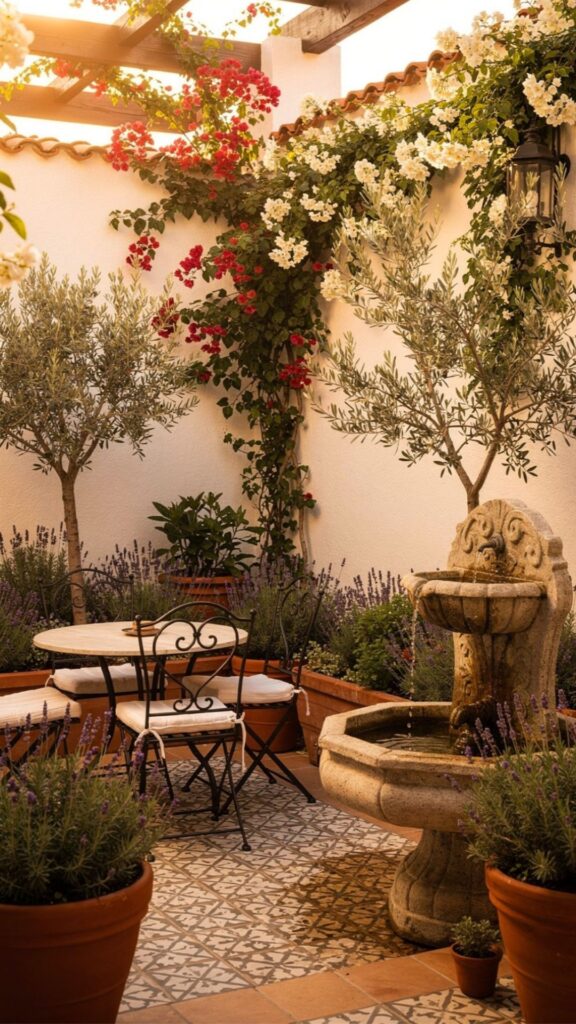
The Mediterranean courtyard is one of the oldest and most refined garden archetypes in human culture from the riad gardens of Marrakech to the sun-drenched patios of Andalusia and the walled gardens of southern Italy, the enclosed Mediterranean garden has been perfected over thousands of years.
Its enduring appeal is not merely aesthetic: it is functional. Mediterranean courtyard design solves exactly the same problems that small urban garden owners face today intense summer heat, limited space, the need for shade and water, and the desire for a space that feels luxurious without requiring constant maintenance.
The defining plants of a Mediterranean courtyard are those adapted to hot, dry conditions: lavender, rosemary, cistus, agapanthus, salvia, and the olive tree. These plants thrive in the hot microclimate of a walled urban courtyard, often performing better there than in open gardens with more variable conditions.
The olive tree deserves particular attention as the defining specimen plant of the Mediterranean courtyard style. A mature olive in a large terracotta container anchors the entire space with a sculptural, silver-leafed presence that looks good in every season, requires minimal water or feeding once established, and develops extraordinary character as it ages.
Terracotta is the material that defines the Mediterranean courtyard aesthetic more than any other in pots, tiles, wall cladding, and even furniture finishes. The warm, burnt-orange tones of terracotta are visually warm in a way that no other material achieves, and they intensify in attractiveness as they weather and develop a patina over time.
A collection of terracotta pots in varying sizes genuine Mediterranean terracotta from Italy or Spain, rather than the thinner machine-made alternatives creates an immediate sense of place and authenticity. Grouped on stone steps or arranged around a central fountain, they transform a plain courtyard into something that feels ancient, considered, and genuinely beautiful.
“The Mediterranean courtyard endures because it solves a universal human problem: how to live beautifully in a confined, hot, urban space. The answer, developed over millennia, is shade, water, fragrance, and stone.”
Colour in a Mediterranean courtyard follows specific rules that are worth understanding before you start. Walls are typically rendered and painted in warm whites, terracotta ochres, or the brilliant cerulean blue of Moroccan and Greek island architecture. Tiles either as flooring or as decorative elements on walls, tabletops, and risers introduce pattern in blues, whites, and yellows.
Planting colour is secondary to fragrance: the emphasis is on scented plants whose presence you notice before you see them. A Mediterranean courtyard in June, when lavender and jasmine and rosemary are all in full growth and the sun-warmed terracotta releases the fragrance of the soil, is one of the most sensory-rich garden experiences available to a small space gardener.
Also Check: Garden Lighting Ideas That Transform Your Small Courtyard Gardens into a Beautiful Nighttime Space.
Kitchen Herb Gardens in a Courtyard:
Beauty, Function, and Daily Use
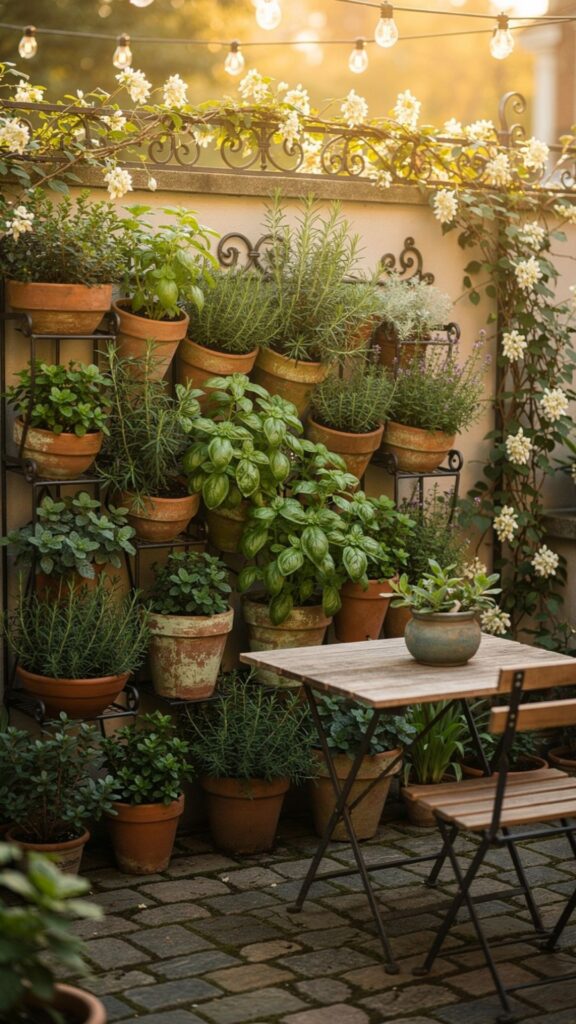
The kitchen herb garden in a small courtyard gardens is one of the most satisfying intersections of beauty and function available to the urban gardener. Herbs are, almost without exception, beautiful plants their foliage textures, flower forms, and growth habits give them genuine ornamental value that makes them entirely appropriate in a design-led courtyard garden rather than hidden away in a utilitarian corner.
The added dimension of daily use stepping out to pick rosemary for roasted vegetables, mint for drinks, or basil for pasta creates a relationship with the garden that is qualitatively different from purely ornamental planting. Mediterranean herbs rosemary, thyme, sage, lavender, and oregano are perfectly suited to courtyard growing conditions.
They thrive in the warm, sheltered microclimate of a walled courtyard, require relatively poor, free-draining soil (excess fertility produces lush but flavour-weak growth), and are drought-tolerant once established. Positioning them on the hottest, most sun-exposed side of the courtyard maximises the essential oil production that makes them most fragrant and flavourful.
Brushing past them as you move through the courtyard releases their fragrance a sensory detail that elevates the experience of using the space enormously. The design of a courtyard herb garden deserves the same consideration as any ornamental planting scheme.
A classic approach is a formal parterre layout: a small square divided into four by low clipped box hedging (or, as box blight is now a significant problem, clipped Ilex crenata or Euonymus japonicus ‘Green Rocket’ as disease-resistant alternatives), with a different herb in each quarter and a central focal point a small standard bay tree, an ornamental urn, or a simple stone birdbath. This formal structure gives year-round visual coherence even in winter when the herbs die back, because the structural clipping remains.
Grow Tip: Mint is the one herb that must always be grown in a container it is an aggressive spreader that will colonise an entire bed within a season. A terracotta pot sunk into the ground or placed near the kitchen door is the ideal solution.
Less commonly discussed in herb garden guides: the significant difference in culinary performance between container-grown and in-ground herbs. Herbs grown in the ground develop larger root systems, more robust growth, and more concentrated flavour than the same plants in containers.
If your courtyard has any in-ground beds even a narrow border along a sunny wall prioritise planting rosemary, thyme, and sage directly into the soil. Reserve containers for basil (which needs the contained warmth of a pot in temperate climates), mint (which must be contained), and annual herbs that you replace each year.
Seating and Furniture in Small Courtyards:
How to Choose, Scale, and Arrange
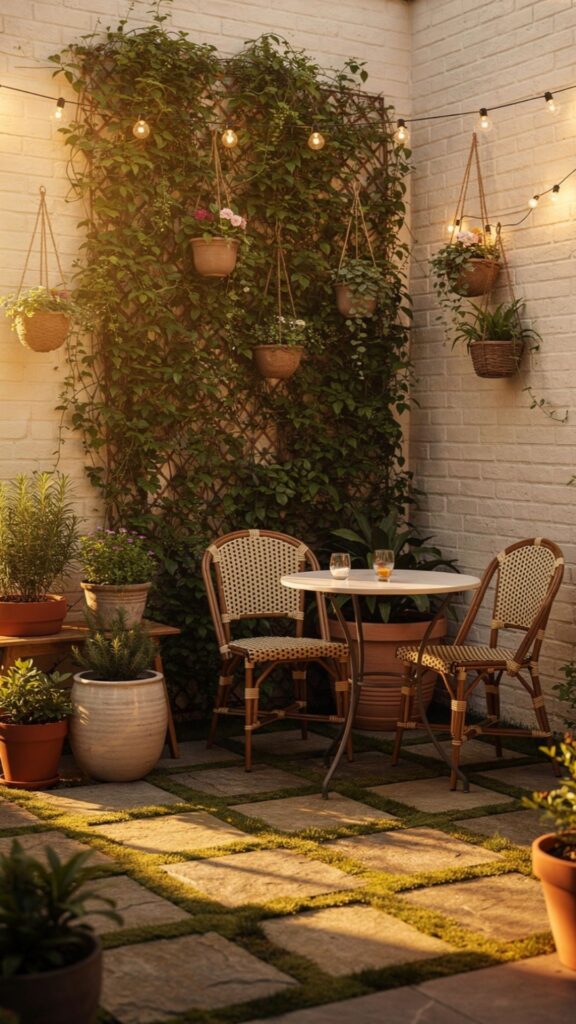
The furniture in a small courtyard garden is not merely functional it is a structural design element that defines how the space is used, perceived, and enjoyed. In a large garden, furniture can be repositioned freely without significantly affecting the design.
In a small courtyard gardens, a dining table and chairs might occupy thirty to fifty percent of the total floor area making their scale, material, and placement critically important decisions that affect every other aspect of the design. Getting this right early avoids the frustration of a beautifully planted courtyard that is somehow never as comfortable or usable as it should be.
Scale is the most common furniture mistake in small courtyard gardens. The instinct to choose small, compact furniture to “save space” frequently backfires. A table that is too small for comfortable dining forces people to sit awkwardly, with insufficient elbow room or leg space, which makes the dining experience unpleasant regardless of how attractive the garden looks.
A round table typically allows more flexible seating arrangements than a rectangular one in tight spaces it can accommodate an extra chair in a pinch and has no awkward corners to navigate around. A table of 80–90cm diameter seats four adults comfortably and occupies a reasonable footprint in a courtyard.
Material selection for courtyard furniture is a durability decision as much as an aesthetic one. Powder-coated steel or aluminium furniture is virtually maintenance-free and available in a range of colours and styles from genuinely simple to quite architectural. Solid teak or iroko furniture develops a beautiful silver-grey patina with weathering but requires annual oiling if you prefer to maintain the honey colour.
Rattan and wicker must be synthetic (resin wicker) to survive outdoor exposure in temperate climates genuine rattan deteriorates within one or two seasons of rain. The most overrated courtyard furniture material is painted softwood: it looks beautiful when new and requires repainting every two to three years to maintain that appearance.
Space Tip: A fold-flat dining table wall-mounted on a courtyard wall is the ultimate space-saving furniture solution it provides a full dining surface when needed and vanishes completely when not in use, freeing the entire floor area.
Cushions and textiles are the fastest way to transform the atmosphere of a courtyard seating area, and their importance is frequently underestimated. Outdoor cushions in thoughtfully chosen colours terracotta, sage, dusty blue, or natural linen can anchor an entire colour palette and make a modest furniture set look genuinely expensive and considered.
The practical requirement is that all outdoor textiles are made from genuinely outdoor-rated fabric (solution-dyed acrylic like Sunbrella, or equivalent) that does not fade, mould, or disintegrate with weather exposure. Storing cushions inside during extended wet weather dramatically extends their life, but genuinely outdoor-rated fabrics should comfortably survive the full summer season outdoors without deterioration.
Shade Solutions for Hot Courtyards:
Staying Cool Without Losing Light
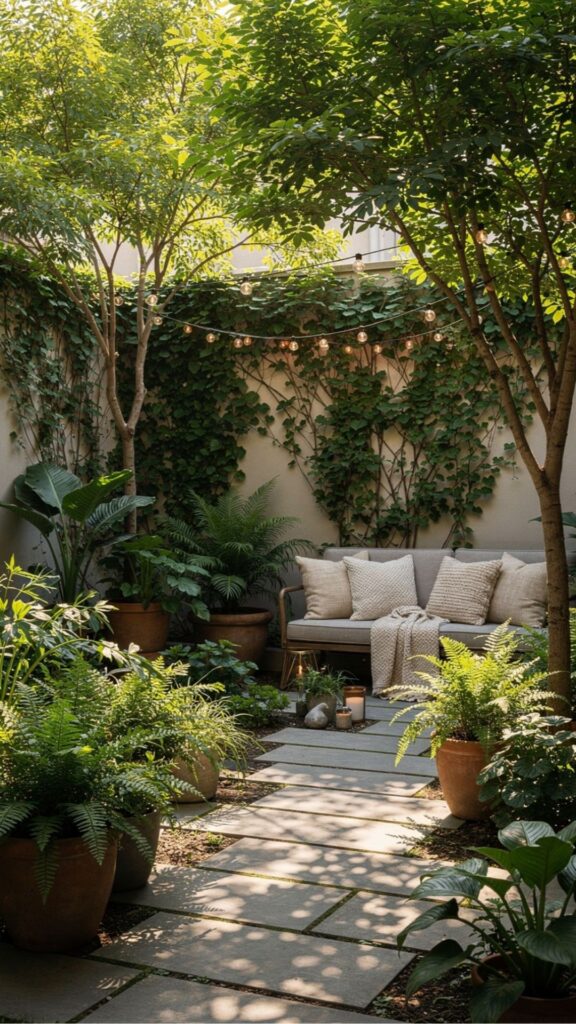
An enclosed walled courtyard facing south or west can become uncomfortably hot in summer the very microclimate that allows tender plants to thrive can make the space genuinely unpleasant to sit in during the hottest part of the day.
Managing shade in a small courtyard gardens is therefore both a comfort issue and a design challenge: you need to reduce solar gain at peak heat while preserving the light quality and spaciousness that make the courtyard worth using in the first place. The worst outcome is a courtyard that is shaded but dark comfortable in temperature but gloomy and damp-feeling.
A deciduous tree or large shrub is the most elegant shade solution because it is seasonally intelligent. In summer, when shade is needed, it is fully leafed out and provides genuine canopy cover. In winter, when every available ray of pale sunshine is precious, it is bare, allowing maximum light penetration.
In a container, a multi-stem Amelanchier lamarckii (snowy mespilus) is exceptional: spring blossom, summer shade, autumn colour, and winter structural interest in a single specimen. A standard Cercis canadensis ‘Forest Pansy’ (redbud) in a large container performs similarly, with spectacular purple foliage through summer and the added benefit of being truly spectacular in flower.
Shade sails are the most versatile and cost-effective engineered shade solution for a small courtyard gardens. Modern shade sails in high-density polyethylene (HDPE) fabric block sixty to ninety percent of UV radiation while allowing air circulation, which prevents the stifling, still-air heat that can build under a solid canopy.
The key to a successful shade sail installation is the angle of the sail: a flat horizontal sail is visually dull and allows rain to pool; a sail tensioned at a steeper angle sheds rain effectively and creates a more dynamic architectural form. Multiple overlapping triangular sails create a particularly sophisticated canopy that blocks sun from different angles through the day.
A retractable awning mounted to the house wall is the premium shade solution it allows complete flexibility between full sun and full shade at the touch of a button, and modern motorised awnings with wind sensors retract automatically in strong gusts, removing the practical concern of damage during storms.
The cost is significant (typically £1,500–£4,000 installed), but for a courtyard that is used as a primary outdoor living space throughout the summer, the investment is genuinely justifiable. It fundamentally changes the relationship between the interior of the house and the courtyard, making the transition from inside to outside genuinely seamless throughout the season.
Low-Maintenance Courtyard Garden Design:
Beauty Without the Work
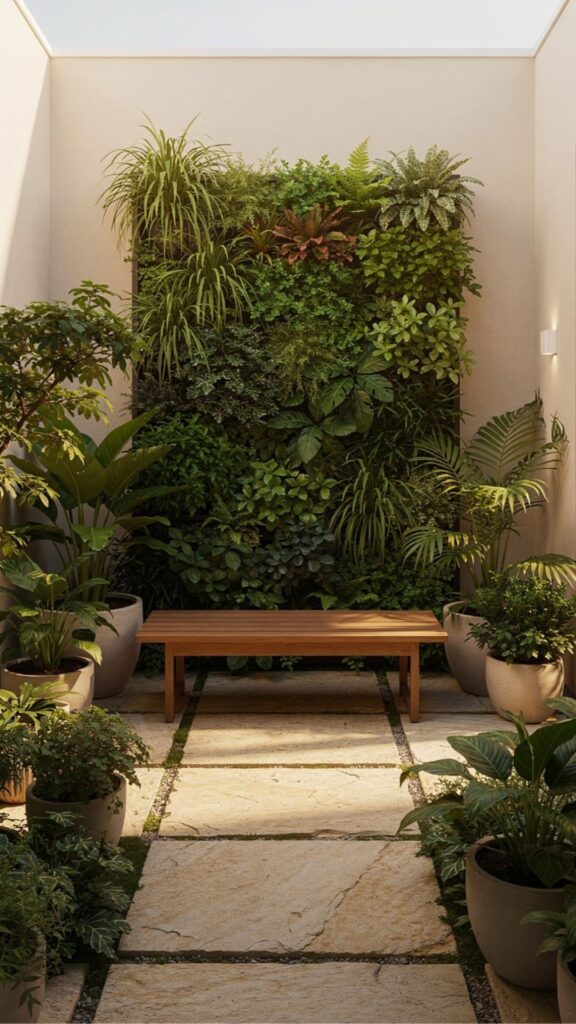
The idea that beautiful gardens require substantial ongoing effort is one of the most persistent and damaging myths in horticulture. A well-designed small courtyard gardens where plant selection, soil preparation, irrigation, and structure have all been thought through carefully at the outset should require no more than two to four hours of maintenance per month to stay looking excellent year-round.
Achieving this is entirely possible, but it requires making different design decisions from those that produce high-maintenance gardens, and understanding which elements of traditional garden design are responsible for the majority of maintenance burden. Lawn is the single highest-maintenance element in any garden, and the decision to exclude it from a small courtyard gardens is almost always the right one.
A small patch of lawn in a courtyard requires weekly mowing during the growing season, edging, scarifying, aeration, feeding, and watering during drought a significant collective time investment for a tiny area of grass that will, in an enclosed courtyard, struggle with shade, competition from surrounding paving, and foot traffic.
Replacing lawn with stone paving, gravel, or a planted ground cover is the single decision most likely to reduce courtyard maintenance dramatically while improving the design quality of the space. Plant selection is the second critical maintenance decision. Plants that require annual pruning, staking, deadheading, or lifting and dividing are higher maintenance than those that largely care for themselves.
The most reliably low-maintenance small courtyard gardens plant include clipped evergreens (box, ilex, pittosporum), ornamental grasses (Hakonechloa macra, Stipa tenuissima), shade-tolerant ground covers (Pachysandra, Vinca, Epimedium), drought-tolerant Mediterranean shrubs, and structural specimen trees. This planting palette requires minimal intervention: an annual clip for the evergreens, a cut-back for the grasses, and occasional feeding. That is genuinely all.
Maintenance Tip: Apply a 7–10cm deep mulch of composted bark to all planted beds in spring. It suppresses annual weeds almost entirely, retains soil moisture, and feeds the soil as it breaks down. It is the highest-return, lowest-effort garden task available.
Hardscaping decisions also affect maintenance in ways that are rarely discussed upfront. Light-coloured paving shows algae and moss growth more visibly than darker stone, requiring more frequent cleaning. Complex ground patterns with many small joints accumulate weed seedlings more quickly than large-format paving with fewer joints.
Timber decking in a shaded courtyard develops algae rapidly and requires annual treatment or mechanical cleaning. These are not reasons to avoid any of these material they are factors to weigh against their aesthetic benefits and to plan appropriate maintenance regimes for from the outset rather than discovering by surprise.
Small Courtyard Gardens on a Budget:
Maximum Impact for Minimum Spend
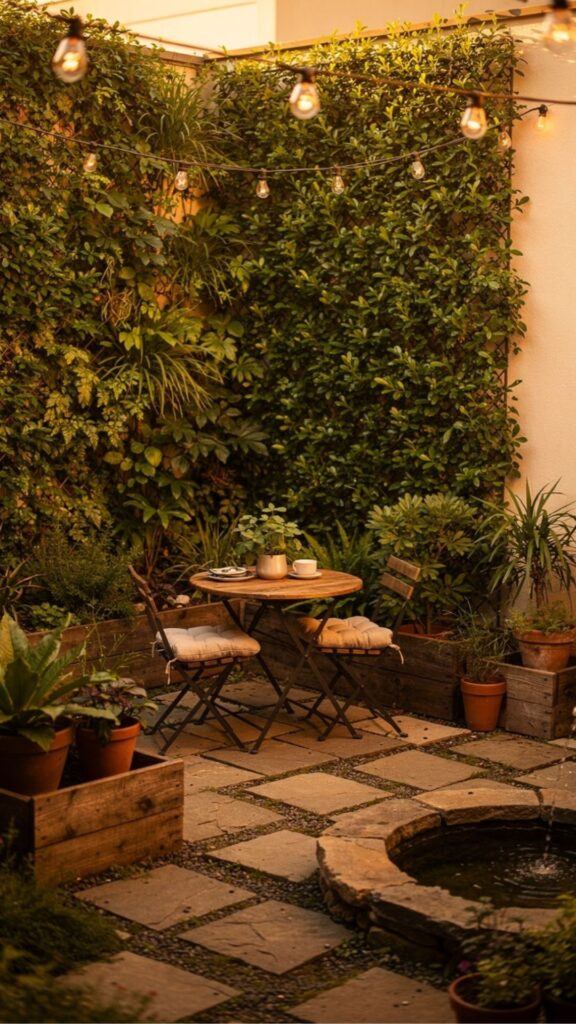
Designing a beautiful small courtyard gardens on a limited budget is genuinely achievable perhaps more so than in any other type of garden because the small scale means that even inexpensive materials and plants have an outsized impact.
A single well-chosen specimen plant in a small courtyard becomes a focal point; in a large garden, it would be invisible. This compression of scale means that budget spent strategically in a small courtyard delivers visual results that would cost many times more in a larger garden. The key is understanding where to spend and where to save.
The highest-impact budget spend in a courtyard garden is paint. A tin of exterior masonry paint applied to a previously bare or tired wall transforms the courtyard’s entire character immediately before a single plant or piece of furniture is introduced.
A deep, warm colour sage green, terracotta, deep navy, or warm white makes the wall feel intentional and designed rather than incidental. The cost is typically under £50 for a small courtyard gardens wall, the labour is straightforward DIY, and the visual transformation is immediate and dramatic.
This single intervention, more than any other, is responsible for the “before and after” moments that make budget courtyard makeovers so compelling. Growing plants from seed and cuttings is the most sustainable and cost-effective way to plant a courtyard garden over time. Hardy annuals like sweet peas, nasturtiums, and cosmos can be grown from seed for pennies per plant, yet they deliver months of colour and, in the case of sweet peas, extraordinary fragrance.
Perennials like echinacea, salvia, and hardy geranium can be divided from established garden centres’ stock plants or sourced from plant swaps and community gardens. A small courtyard gardens requires relatively few individual plants to look full and considered perhaps fifteen to twenty specimens in total which makes sourcing them patiently over a season or two entirely practical.
“The most beautiful courtyard gardens I have designed were not the most expensive. They were the ones where every decision from the paint colour to the pebble in the corner was made with genuine intention.”
Reclaimed and salvage materials are the budget courtyard designer’s greatest asset. Reclaimed brick, stone, and terracotta available from architectural salvage yards, demolition sites, and online marketplaces often looks more beautiful than new materials, ages gracefully, and costs a fraction of new equivalents.
A set of reclaimed terracotta tiles as a courtyard floor, an old stone sink as a planter, and a salvaged iron gate as a decorative panel can collectively define a courtyard’s entire aesthetic for less than £200. The patina and history of these materials adds a depth and authenticity that cannot be purchased new at any price.
Must Check: Back Patio Ideas That Perfectly Inspire Your Small Courtyard Gardens Design.
Four-Season Interest in a Small Courtyard:
A Garden That Looks Beautiful All Year
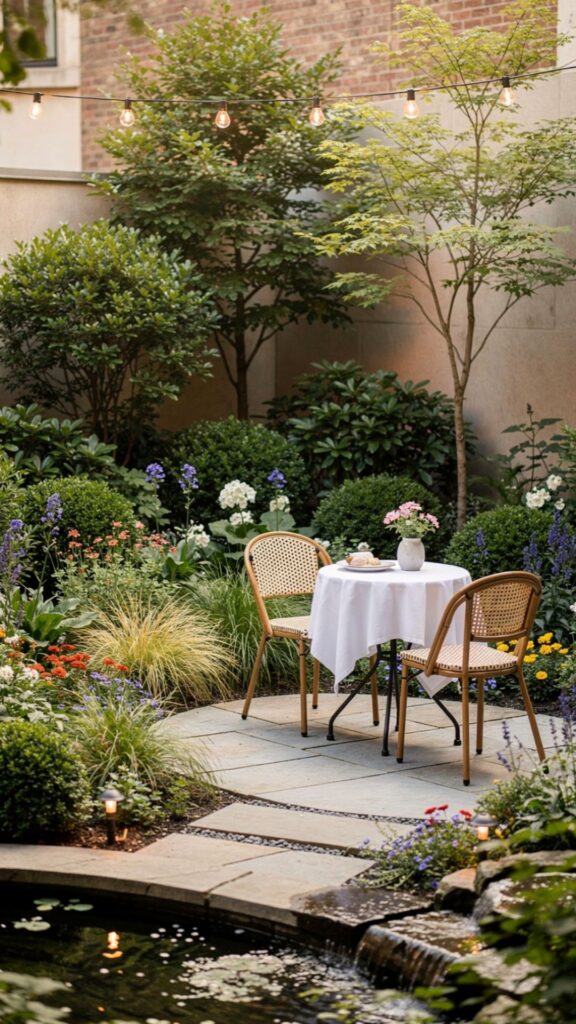
The ambition to create a courtyard garden with genuine interest in every month of the year is achievable in a small space and arguably more important in a courtyard than in a large garden, because the courtyard is visible from inside the house through windows all year round.
A garden that looks magnificent in June and July but bare and grey from November to March is failing for half the year in the space you are most likely to look at from the warmth of your kitchen or living room. Designing for four-season interest from the outset rather than retrofitting seasonal interest into a scheme designed primarily for summer produces a fundamentally better garden.
The framework of a four-season courtyard is built on structural evergreens that hold their form and colour through winter. Clipped box, ilex, pittosporum, sarcococca, and fatsia japonica all provide green structure and visual interest when deciduous plants are dormant.
Around this evergreen framework, the seasonal performers cycle through: spring bulbs (narcissus, tulips, muscari) emerging through permanent planting in February and March; early summer roses and clematis in May and June; lavender, agapanthus, and echinops in July and August; asters, sedums, and the seed heads of grasses persisting beautifully through September and October.
Winter is the season most frequently forgotten in courtyard planting plans, yet it contains some of the most rewarding garden plants available. Sarcococca confusa (Christmas box) produces tiny white flowers in January and February that release a powerful vanilla fragrance on mild winter days extraordinary in the sheltered warmth of a walled courtyard.
Hellebores flower from December through March in shades of plum, white, and blush pink. Cyclamen coum creates a carpet of silver-patterned leaves and small pink flowers through the darkest months. And the structural quality of deciduous trees and shrubs in winter bare stems, interesting bark, and the geometric quality of well-trained climbers is genuinely beautiful in a way that is often not appreciated until you have experienced a winter garden designed to showcase it.
Year-Round Tip: Plant a witch hazel (Hamamelis mollis) in a large container. It flowers on bare stems in January and February with spidery, intensely fragrant yellow or orange flowers the most remarkable winter performance of any small tree, and utterly transformative in a courtyard in the depths of winter.
The four-season courtyard garden also rewards investment in hard landscape materials that look as good in winter as in summer. Natural stone develops a more beautiful character in rain and damp than it does in bright sunlight the contrast of wet stone against the silvery bark of a birch or the russet stems of a dogwood is genuinely striking.
A well-designed water feature continues to perform in winter: even when ice forms on the surface of a raised pool, the composition of stone, ice, and surrounding structural planting creates a landscape quality that is completely distinct from summer and utterly worth experiencing. The best small courtyard gardens do not hibernate in winter. They simply perform differently and beautifully.
Final Thoughts:
Your Small Courtyard Garden Is Ready to Become Something Special
Small courtyard gardens are not a limitation they are a design opportunity that, when approached with intention and knowledge, produces some of the most beautiful, personal, and genuinely usable outdoor spaces imaginable. Every idea in this guide from vertical planting and water features to Japanese-inspired simplicity and four-season interest can be applied at virtually any scale and budget, because the courtyard’s small size amplifies the impact of every thoughtful decision.
The key takeaway is this: start with the elements that will last the paving, the wall colour, the structural planting and layer in seasonal interest, personal touches, and furniture as your budget and vision develop. A small courtyard gardens is never truly finished, and that is precisely what makes it so rewarding to design, plant, and live in.
Pick one idea from this guide, take it outside this weekend, and begin. The most beautiful small courtyard gardens always start with a single deliberate decision.

Team TrandyVilla is the passionate home decor team behind Trandy Villa, where style meets comfort in everyday living. The team loves transforming simple spaces into beautiful, functional homes through smart ideas, budget-friendly hacks, and modern design trends. Their content focuses on helping readers create homes that feel both stylish and personal without spending too much.