
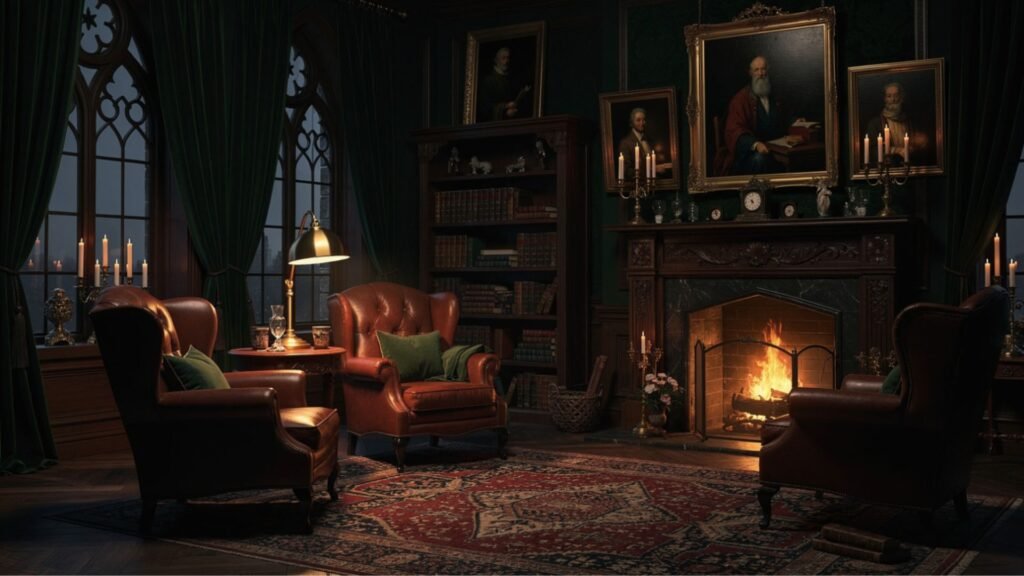
Dark academia isn’t just an aesthetic it’s a mood, a philosophy, and increasingly, a design movement reshaping how people think about living spaces. Rooted in the romanticism of old European libraries, gothic architecture, and classical literature, a dark academia living room invites you to slow down, think deeply, and surround yourself with beauty that carries weight.
A dark academia living room is a moody and intellectual interior style inspired by vintage libraries, gothic architecture, and classic literature. Dark academia living room ideas focus on deep colors, antique furniture, warm lighting, layered textures, books, and artistic décor that create a calm, elegant, and timeless atmosphere inside the home.
Dark academia living room designs create a warm and thoughtful space filled with vintage charm and rich character. This style combines dark colors, soft lighting, aged wood, and scholarly décor beautifully. It brings comfort, personality, depth, and a relaxing old-world feeling into modern living spaces naturally.
Dark academia living room ideas use velvet fabrics, dark wood furniture, antique accents, and layered lighting to build a cozy environment. Botanical décor, framed art, candles, and classic books complete the aesthetic. These design elements help transform ordinary living rooms into refined, peaceful, and visually captivating spaces.
Master the Dark Academia Color Palette:
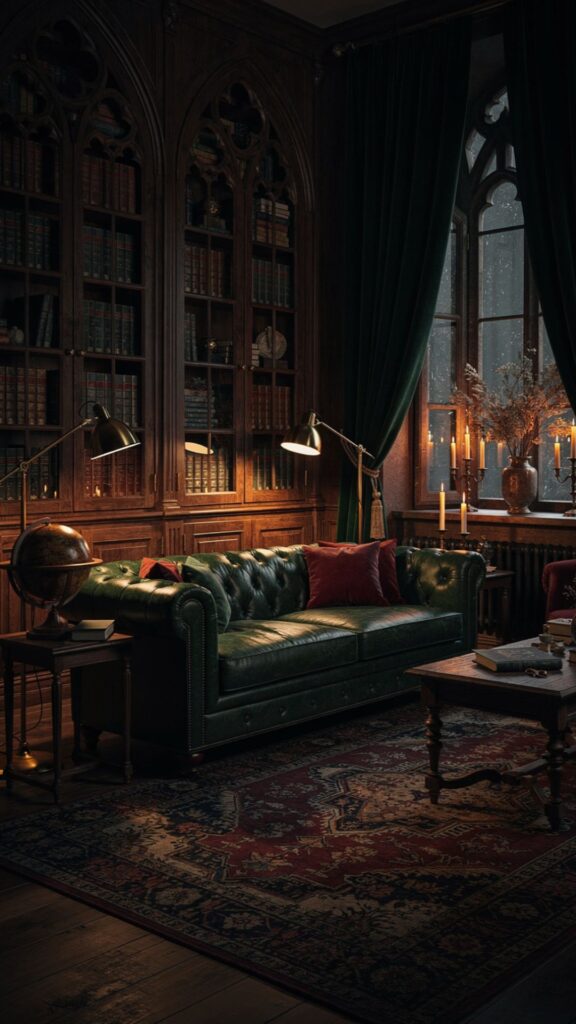
The foundation of any dark academia living room is its color story. Unlike minimalist or Scandinavian interiors that favor bright whites and light grays, dark academia leans into deep, saturated tones that evoke old stone walls, worn leather, and candlelit libraries.
The core palette typically includes charcoal, forest green, oxblood red, dark walnut brown, aged ivory, and warm mustard gold colors that feel like they belong to centuries past while remaining livable in a modern home.
When applying this palette, avoid the mistake of going uniformly dark on all surfaces. Instead, use your deepest tones on a single focal wall or the ceiling yes, the ceiling while keeping other surfaces in warmer mid-tones like mushroom, taupe, or aged parchment.
This prevents the room from feeling oppressive and maintains a sense of atmospheric depth. Farrow & Ball’s “Brinjal,” “Mole’s Breath,” or Benjamin Moore’s “Newburyport Blue” are excellent starting points that real designers use for this aesthetic.
One often-overlooked trick is color-drenching painting the walls, trim, and even ceiling in the same deep shade. This technique, gaining popularity among interior designers for dark aesthetics, creates a cocoon-like effect that makes the room feel intentionally theatrical rather than accidentally dark. Pair deep wall colors with warm incandescent lighting and the space transforms from gloomy to gloriously atmospheric.
The most successful dark academia living room pair cool-toned walls (forest green, midnight blue) with warm-toned accessories (brass, amber glass, aged leather). This temperature contrast is what separates a moody room from a cold one.
Build a Statement Wall with Aged Textures:
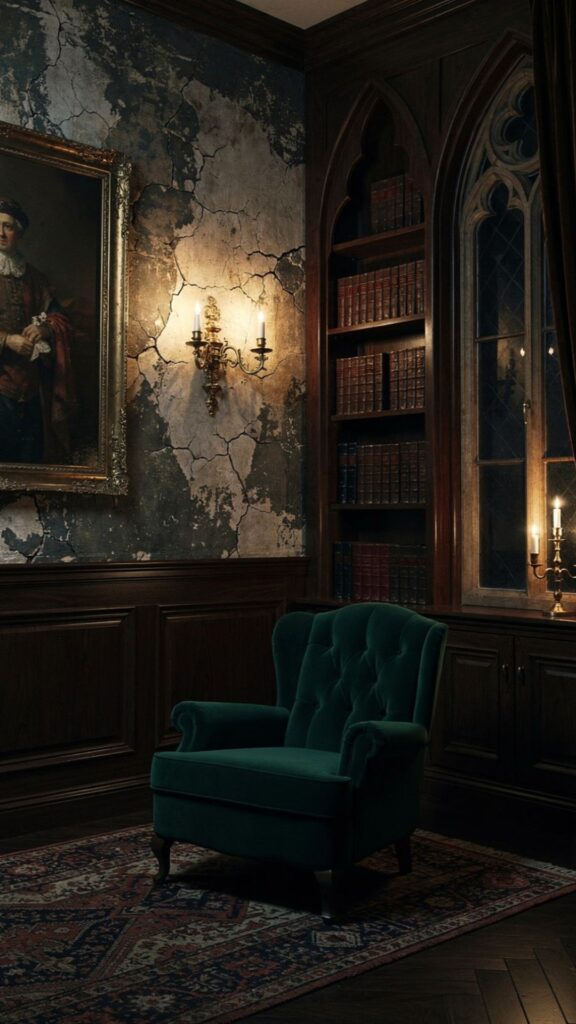
Walls in a dark academia living room are never mere backgrounds they are storytelling surfaces. Exposed brick adds industrial romance; dark-stained wood paneling evokes Victorian gentlemen’s clubs; textured plaster in charcoal or umber recalls the walls of old Oxford halls.
If your budget allows only one transformation, investing in textured wall treatment yields the highest aesthetic return of any dark academia living room upgrade, immediately shifting the room’s personality from ordinary to extraordinary. Wainscoting the classic wooden paneling applied to the lower half of a wall is particularly effective and surprisingly affordable as a DIY project. Installed at around chair-rail height with a contrasting paint above, it grounds the room in old-world tradition.
For renters or those on tighter budgets, removable wallpaper featuring vintage maps, classical illustrations, or dark botanical prints achieves a similar effect without permanent commitment. Brands like Tempaper and Chasing Paper have impressive dark academia-appropriate collections.
Imagine walking into a living room where the far wall is paneled in dark-stained oak up to waist height, painted in deep forest green above, and crowned with a plaster cornice. A framed anatomical print hangs centered above the fireplace. You immediately feel like you’ve stepped into a 19th-century scholar’s study yet everything is functional and contemporary beneath the surface.
Plaster and lime wash paint techniques are also experiencing a major revival within this aesthetic. Limewash, applied in layers with a brush, creates a naturally aged, matte finish that catches light beautifully and looks as though the wall has absorbed decades of candlelight. It’s one of the few finish techniques that actually looks better in a dim room and for dark academia living room, that’s a crucial advantage over standard flat paint.
Must Read This: https://trandyvilla.com/small-living-room-ideas/.
Curate Antique and Dark Wood Furniture:
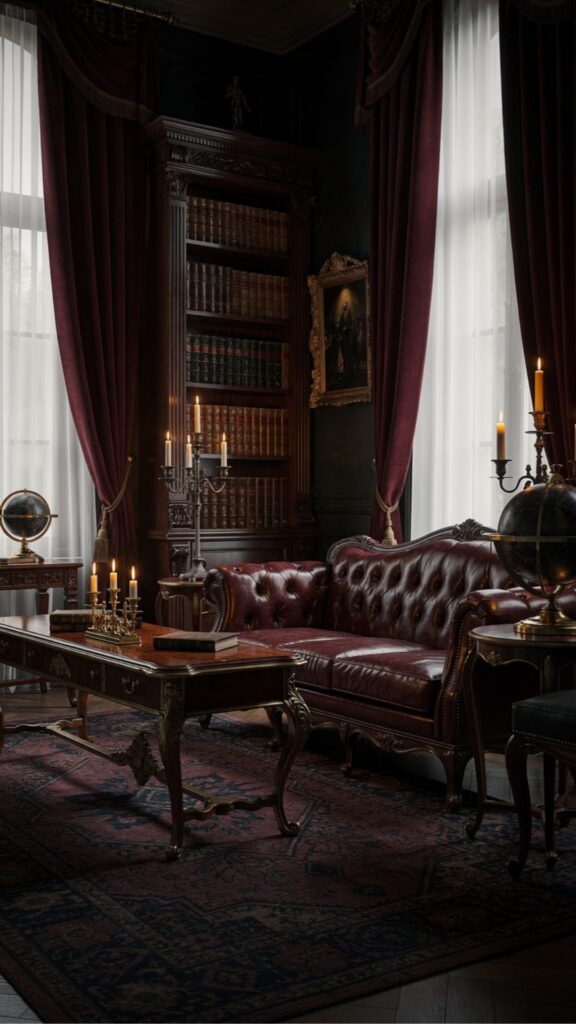
Furniture in a dark academia living room should feel as though it was inherited rather than purchased. This doesn’t mean you need genuine antiques it means you need pieces that carry a sense of history in their form, material, and finish. Dark stained hardwoods like mahogany, walnut, and ebonized oak are the materials of choice.
Look for pieces with carved details, turned legs, brass hardware, and proportions that feel substantial and grounded. Avoid anything with straight, minimal lines dark academia furniture should feel slightly ornate without becoming baroque.
Thrift stores, estate sales, Facebook Marketplace, and antique markets are your best sources for genuinely aged pieces at accessible prices. A Victorian-era wingback chair reupholstered in dark green velvet or oxblood leather becomes an instant centerpiece.
A heavy oak coffee table with some honest wear tells a more compelling story than any flat-pack alternative. That said, modern brands like World Market, Anthropologie, and even IKEA’s darker collections (like the Lövbacken or Hemnes range in dark stain) can be elevated with period-appropriate hardware swaps and throw styling.
- Wingback armchairs — the most iconic dark academia living room seating piece; choose deep jewel-toned velvet or aged leather upholstery
- Chesterfield sofas — tufted leather in oxblood, forest green, or cognac adds immediate period character
- Secretary desks or escritoires — even if purely decorative, they signal the scholarly identity of the space
- Ladder bookshelves — dark wood, leaning or wall-mounted, loaded with layered books and objects
- Drum side tables — round, brass-accented, ideal for stacking books and placing a reading lamp
Pay close attention to furniture arrangement when building this aesthetic. Rather than pushing everything against the walls (the most common living room mistake), pull pieces inward to create intimate conversation zones. A pair of wingbacks angled toward a coffee table, with a floor lamp positioned behind one, creates a scholar’s reading nook that immediately becomes the soul of the room.
Layer Lighting for a Moody, Warm Glow:
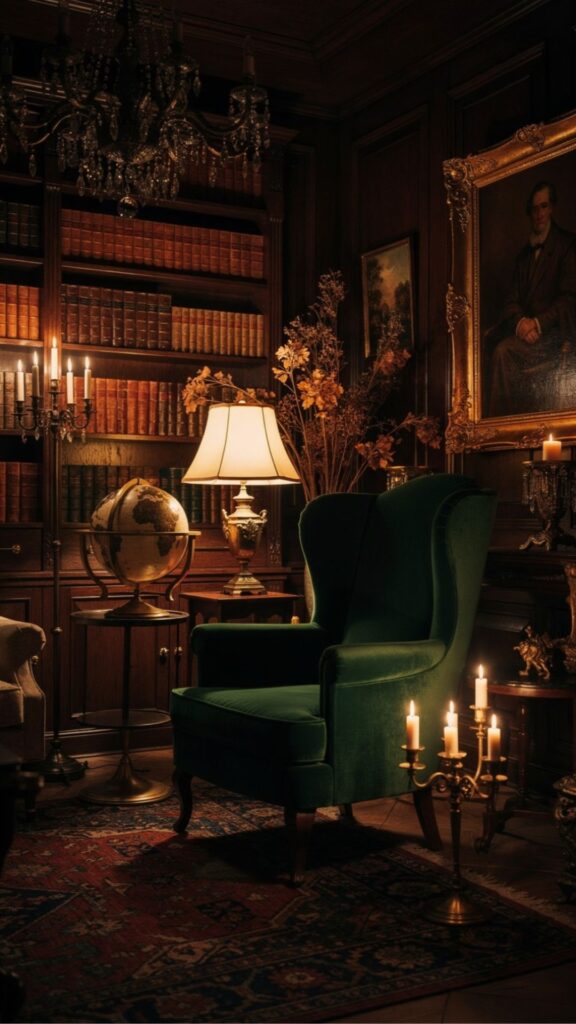
Lighting is arguably the single most transformative element in a dark academia interior and it’s also where most people make their biggest mistakes. The worst thing you can do in a dark academia living room is install a single bright overhead fixture.
Overhead lighting flattens a room, strips it of shadow and mystery, and destroys the atmospheric depth you’ve worked hard to create. Instead, dark academia lighting design relies on multiple low-level light sources working together: floor lamps, table lamps, wall sconces, and candlelight all emitting warm, amber-toned light in the 2200–2700K range.
Think of lighting in layers: ambient, task, and accent. Ambient light comes from dim overhead fixtures (use a dimmer switch, always) or wall sconces with warm Edison bulbs. Task lighting is provided by a proper reading lamp positioned by the wingback chair or desk area a brass adjustable arc lamp or banker’s lamp works beautifully here.
Replacing standard bulb covers with amber-tinted or smoked glass shades reduces color temperature further and adds a warm bronze cast to the room the visual equivalent of candlelight without the fire risk. This one swap can make a modern lamp feel Victorian.
Accent lighting highlights art, bookshelves, or architectural features: small picture lights above framed prints, battery-powered LED strip lights along the backs of shelves, or small spotlights drawing attention to a gallery wall. Don’t underestimate actual candles, either. Pillar candles grouped on a mantelpiece, taper candles in brass holders on a side table, or wax melts in dark vessels add flickering warmth that no electric bulb can replicate.
For safety, high-quality flameless LED candles from brands like Luminara are essentially indistinguishable from real candles at arm’s length and are a reasonable alternative. The key is abundance one candle is decorative, seven candles are atmospheric.
Create a Scholar’s Book Corner:
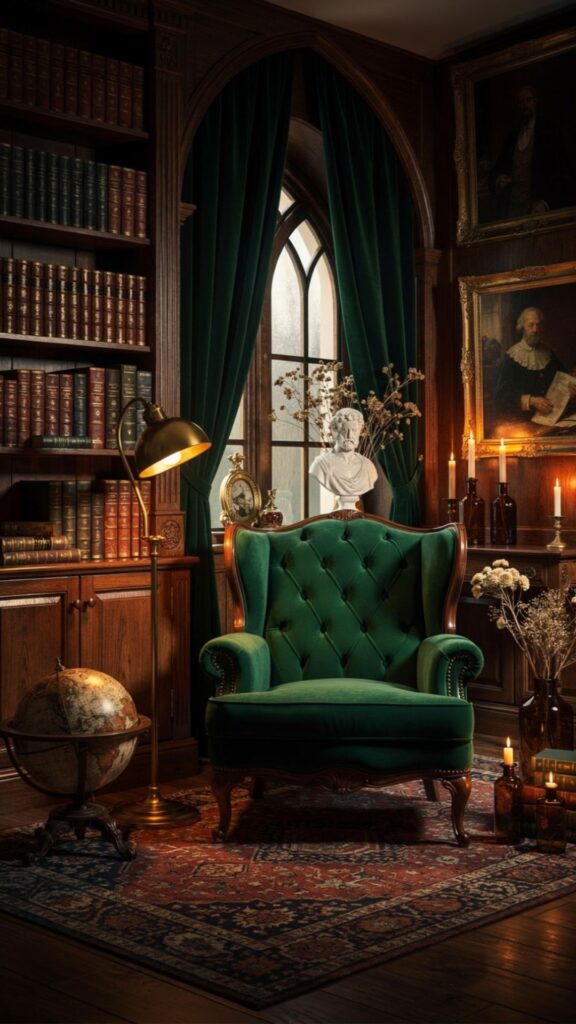
Books are the heartbeat of dark academia not as decoration, but as evidence of an intellectual life lived. A dark academia living room without books is like a library without shelves: it misses the point entirely. The goal is to create a book corner that reads as a genuine scholar’s territory: layered, personal, and slightly over-stuffed with knowledge.
This doesn’t require an enormous collection strategic curation matters more than volume. Fill your shelves with a mix of genuine reads and visually interesting spines, vintage hardcovers, atlases, leather-bound volumes, and field guides.
Shelf styling in dark academia differs from minimalist approaches. Rather than evenly spacing books with careful breathing room, dark academia shelves are dense and layered. Double-stacking books with smaller volumes in front creates depth. Interspersing objects between grouped books a brass magnifying glass, a small skull, a glass inkwell, a dried plant specimen gives the shelves narrative texture.
Picture a floor-to-ceiling bookshelf in dark walnut, backlit with warm LED strips behind the top row of books. The middle shelves hold dense collections of classics, science texts, and mythology, interspersed with a mounted butterfly collection, a vintage globe, and a stack of art books laid horizontally.
At the base, a leather trunk serves as both storage and a surface for an open atlas. The whole arrangement reads as lived-in and deeply personal.
Turning some books spine-inward creates a deliberately mysterious, antiquarian look that’s both visually interesting and perfectly in-character. For those who don’t own extensive book collections, thrift stores often carry leather-bound hardcovers, encyclopaedia sets, and vintage reference books for minimal cost.
Alternatively, many dark academia living room enthusiasts purchase books specifically for their aesthetic spine quality and gradually replace them with copies they actually intend to read a practice that has the pleasant side effect of building a genuine library over time.
Also Check: https://trandyvilla.com/black-living-room-decor/
Use Art and Prints to Tell a Story:
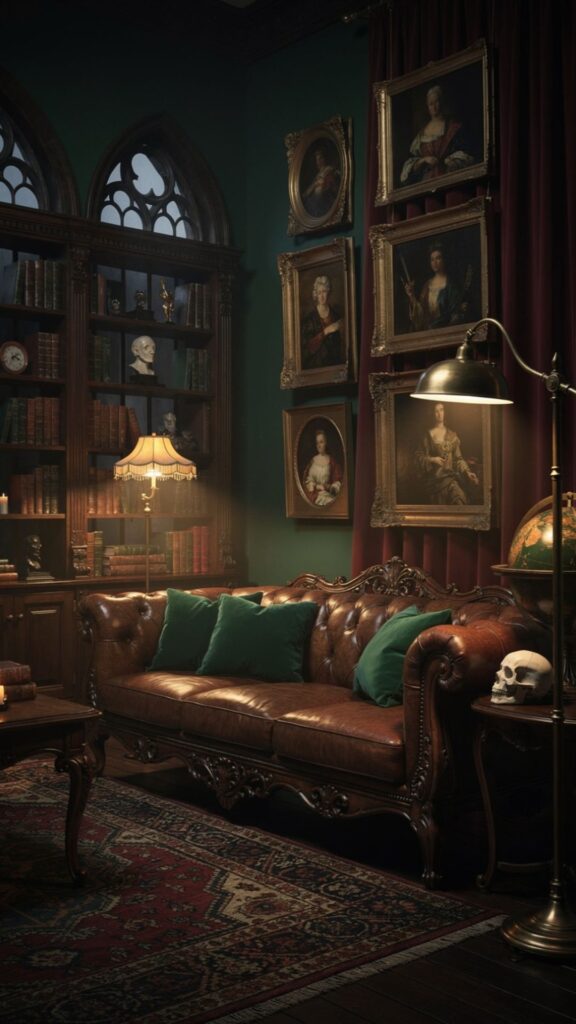
Wall art in a dark academia living room should feel like it was collected during travels through antiquity rather than chosen from a home goods store. The most effective pieces include oil painting reproductions of classical landscapes and portraits, anatomical illustrations (da Vinci’s Vitruvian Man, antique botanical prints), vintage maps, celestial charts, architectural engravings, and still-life paintings with heavy chiaroscuro lighting.
Black-and-white photography from the early 20th century also works beautifully, especially formal portraiture and architectural studies. Gallery walls are a powerful tool here, but the dark academia living room version differs from the trendy modern gallery wall in important ways. Frames should be dark mahogany, black, or gilded gold and they don’t need to match each other.
An intentional mix of frame styles and sizes, hung slightly closer together than conventional design advice suggests, creates the impression of a collection built over time rather than assembled in an afternoon. Overlap frames occasionally, or lean some against others on a shelf, for authentic layered complexity.
- Artvee.com and Rawpixel.com — free high-resolution public domain artwork including Renaissance masters, Victorian botanical prints, and antique maps, ready to download and print
- Etsy — search “dark academia print,” “vintage anatomy print,” or “antique celestial map” for affordable instant-download options
- Local estate sales — genuine oil paintings, often in stunning original frames, at a fraction of gallery prices
- Museum shop prints — authenticated reproductions of works from major collections add credibility to your curated aesthetic
Consider the relationship between your art and your lighting when hanging pieces. A single picture light mounted above an important painting creates an almost religious focal point as though the piece is illuminated for study rather than decoration. This small touch elevates any reproduction into something that reads as a treasured original and adds the kind of dramatic accent lighting the dark academia living room aesthetic thrives on.
Incorporate Rich, Tactile Textiles:
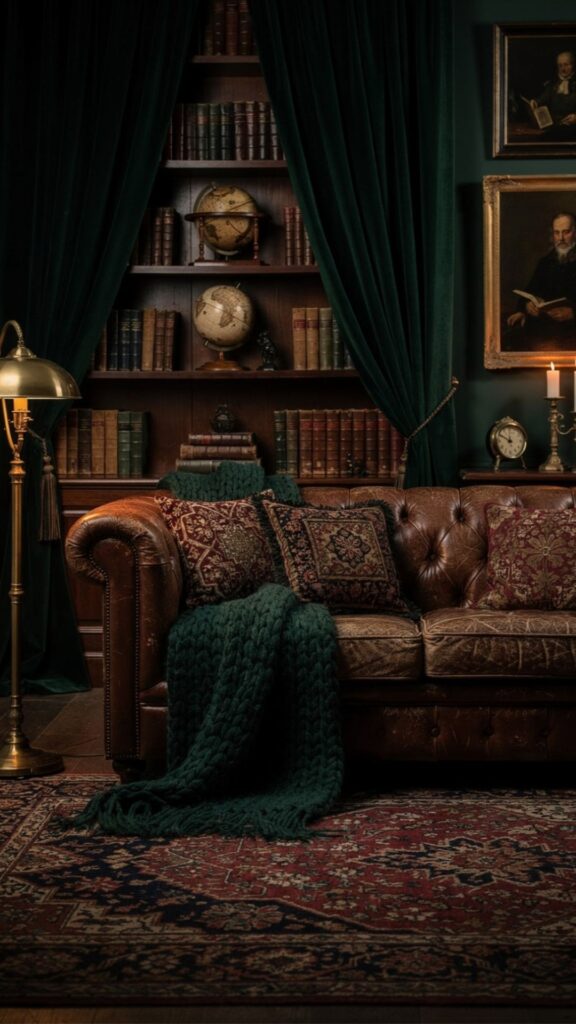
Textiles are how a dark academia living room achieves its characteristic sense of warmth despite its deep color palette. Without layered fabric, a moody-colored room risks feeling cold and uninhabited. The materials that define this aesthetic are velvet, brocade, wool, linen, tartan, and worn leather each carrying a different sensory quality that contributes to the overall feeling of a richly lived-in space.
These aren’t materials chosen for practicality alone; they’re chosen because they absorb light, invite touch, and carry visual weight that lighter fabrics simply cannot. A deep-pile velvet sofa in forest green or navy becomes the room’s anchor. Layered throw blankets a cable-knit wool, a fringed tartan, a lighter linen draped naturally over furniture (never folded too neatly) add accessibility and comfort.
Cushions in contrasting dark jewel tones with brocade or tapestry patterns build visual richness on seating surfaces. Crucially, a large, dark-patterned rug think Persian, Turkish, or Victorian-style florals in deep reds, greens, and golds does more to unify the room than almost any other single textile investment.
The most underrated textile in dark academia interiors is the curtain. Heavy, full-length velvet or chenille curtains in deep green, navy, or burgundy that pool slightly on the floor add extraordinary drama and make ceiling heights feel grander than they are. Always hang curtain rods as high as possible at ceiling height if possible for maximum impact.
Layering different textile weights and textures is the key to avoiding a flat, over-styled look. A velvet sofa gains interest when combined with a nubby wool throw and a smooth leather pillow. A tartan armchair becomes more compelling beside a brocade cushion.
The visual rhythm created by these material contrasts is what gives a dark academia living room its sense of depth and discovered complexity as though different elements were gathered from different eras and places.
Bring in Natural Elements and Botanical Decor:
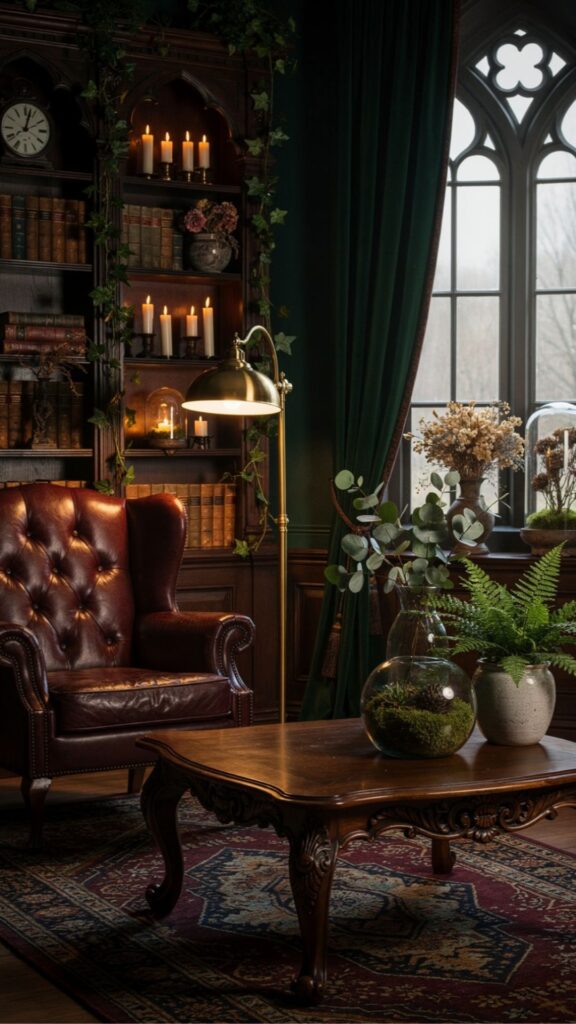
One of the most distinctive and often overlooked aspects of dark academia living room aesthetic is its relationship with the natural world. Not the bright, tropical, Instagram-friendly plant collections of modern boho style, but something darker and more Victorian: botanical specimens, pressed flowers, dried herbs, twisted branches, and plants with dramatic, architectural forms.
The dark academia living room relationship with nature is scholarly nature as a subject of study, preserved and observed, rather than simply displayed for color and cheer. Dried botanicals are especially effective: eucalyptus, pampas grass in muted tones, dried roses, lunaria (the translucent silver-dollar plant), and preserved magnolia leaves all maintain the aesthetic’s muted, aged color palette.
Mounted botanical specimens under glass domes, pressed flowers in herbarium-style frames, and terrariums housing moss and ferns add organic life without introducing the bright greens that would conflict with the room’s deep tones. Living plants that work beautifully in dark academia living room spaces include fiddle-leaf figs, snake plants, dark-leafed begonias, and trailing pothos in dark ceramic pots.
On the mantelpiece: two brass candlesticks flanking a glass cloche housing a preserved moth collection. Between them, a small earthenware pot of trailing ivy. On the wall above, a framed page from a Victorian botanical atlas. The arrangement takes up four square feet but communicates an entire worldview curious, meticulous, romantically scientific.
Twisted branches from willow, birch, or manzanita placed in a tall, dark ceramic vase create sculptural drama without competing with the room’s other visual elements. For those interested in a slightly gothic edge, dried seed pods, crow feathers (ethically collected), and vertebrae or shell collections housed in glass apothecary jars add a wonderfully eccentric, naturalist quality that’s entirely in keeping with the aesthetic’s roots in Victorian natural philosophy.
Add Curio Collections and Found Objects:
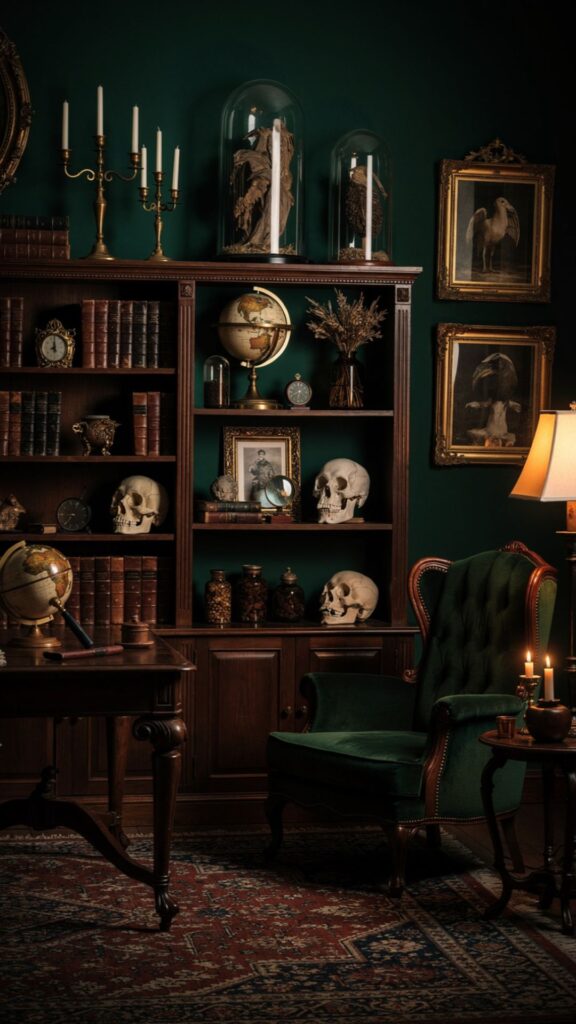
The dark academia living room is, at its philosophical core, a cabinet of curiosities a Wunderkammer brought into domestic life. This means the room should feel populated with objects that inspire curiosity and suggest stories: antique scientific instruments, vintage cameras, old hourglasses, celestial globes, pocket watches, taxidermy, fossils, inkwells, wax seal kits, magnifying glasses, and aged tomes stacked on side tables.
Each object functions not merely as decoration but as a conversation piece, a prompt for inquiry, a suggestion of the mind that inhabits the space. The key to curating a successful collection is to group objects by theme or material rather than distributing them randomly across all surfaces. A cluster of brass objects compass, telescope, letter opener, magnifying glass on a side table reads as a deliberate collector’s arrangement.
A grouping of amber glass apothecary bottles, a mortar and pestle, and a bundle of dried herbs on a wooden tray tells a different but equally compelling story. When every surface holds a random single object, the effect dissipates; when objects are intentionally grouped, they generate visual and conceptual meaning.
- eBay and Etsy vintage sections — best sources for antique scientific instruments, apothecary bottles, pocket watches, and Victorian-era objects at accessible prices
- Flea markets and brocantes — unpredictable but often the most rewarding source for genuinely unusual objects
- Natural history museum gift shops — high-quality fossil replicas, anatomical models, and specimen prints
- Family heirlooms — inherited objects carry the most authentic provenance and are already rich with personal history
- Antique map dealers — even small, inexpensive maps carry tremendous historical weight when properly framed
Display is as important as selection. Collections housed under glass domes or in vitrine cabinets take on an almost museum-quality importance. A glass-topped coffee table with a display layer beneath can house a rotating collection without requiring additional shelf space. Staggering objects at different heights using book stacks, wooden risers, or decorative boxes adds the three-dimensional complexity that separates a curated room from a cluttered one.
Explore: https://trandyvilla.com/japandi-living-room/
Engage the Senses: Scent, Sound, and Atmosphere:
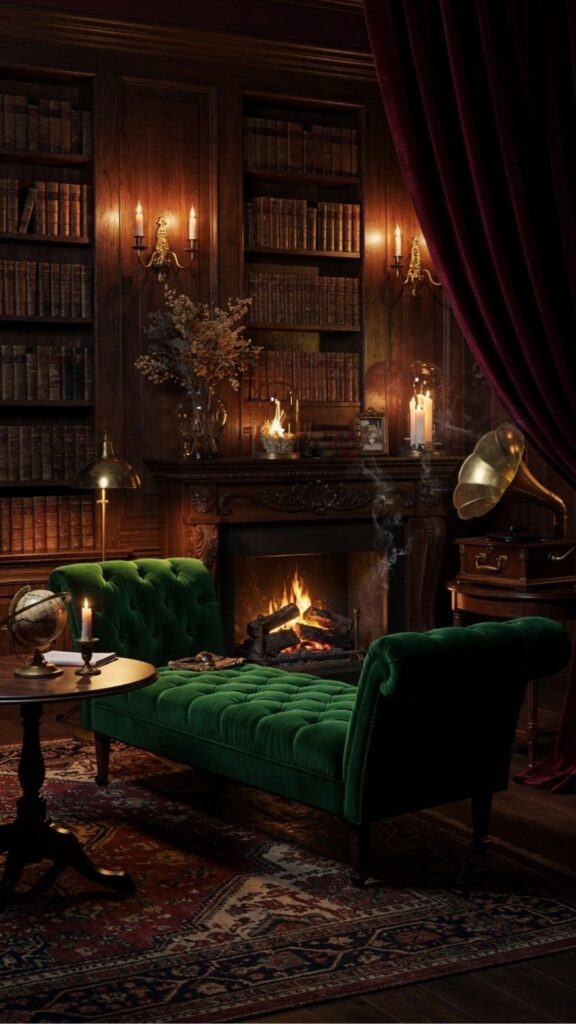
The most sophisticated dark academia living rooms are not just seen they are felt and smelled. Truly immersive spaces engage all the senses, and dark academia has a remarkably specific sensory signature: the smell of old books and wood smoke, the sound of vinyl records or rain on windows, the tactile comfort of worn wool and cracked leather.
These sensory layers are not superficial extras they are what transform a well-styled room into an experience that people remember long after they’ve left. Scent is enormously powerful and criminally underused in interior design. For dark academia living room spaces, seek candles and diffusers with notes of amber, sandalwood, vetiver, tobacco, leather, beeswax, old books (petrichor or paper-adjacent scents), cedarwood, and dried flowers.
Brands like Byredo, Diptyque (“Feu de Bois”), Boy Smells, and P.F. Candle Co. offer options in this register. Lit beeswax candles produce a honey-warm scent naturally aligned with the aesthetic. Incense in resins like frankincense, copal, or dragon’s blood adds a darker, more ceremonial note for evenings.
Sound design is the secret weapon of dark academia living room atmosphere. A quality turntable playing classical recordings Satie, Debussy, Chopin transforms the room’s emotional register within seconds.
For those without a record player, curated playlists labeled “dark academia music” on Spotify and YouTube offer surprisingly effective alternatives including orchestral film scores, Gregorian chant, and romantic-era chamber music.
Temperature and tactile comfort complete the sensory picture. A dark academia living room should feel warm — literally warm, with adequate heating, but also warm through texture: thick rugs underfoot, soft throws within arm’s reach, cushioned seating that invites prolonged occupation.
These are rooms designed to be inhabited for hours at a stretch, by someone who settles in with a book and doesn’t surface until midnight. That intention the room as sanctuary for slow, deliberate living is ultimately what makes the dark academia living room aesthetic so enduringly compelling and so deeply different from spaces designed merely to impress at a glance.
Final Thoughts
A dark academia living room is far more than a visual aesthetic it’s a declaration that the space you inhabit reflects the richness of the life you intend to live there. From moody color palettes and antique furniture to layered lighting and multi-sensory atmosphere, every element works together to create a retreat that feels both timeless and deeply personal.
The most successful dark academia spaces aren’t assembled in a weekend; they’re built gradually, object by object, with genuine curiosity and intentional care. Start with one idea from this guide perhaps a color transformation or a book corner and let the space evolve naturally. The best dark academia living rooms are never finished; they simply grow richer over time.

Team TrandyVilla is the passionate home decor team behind Trandy Villa, where style meets comfort in everyday living. The team loves transforming simple spaces into beautiful, functional homes through smart ideas, budget-friendly hacks, and modern design trends. Their content focuses on helping readers create homes that feel both stylish and personal without spending too much.