
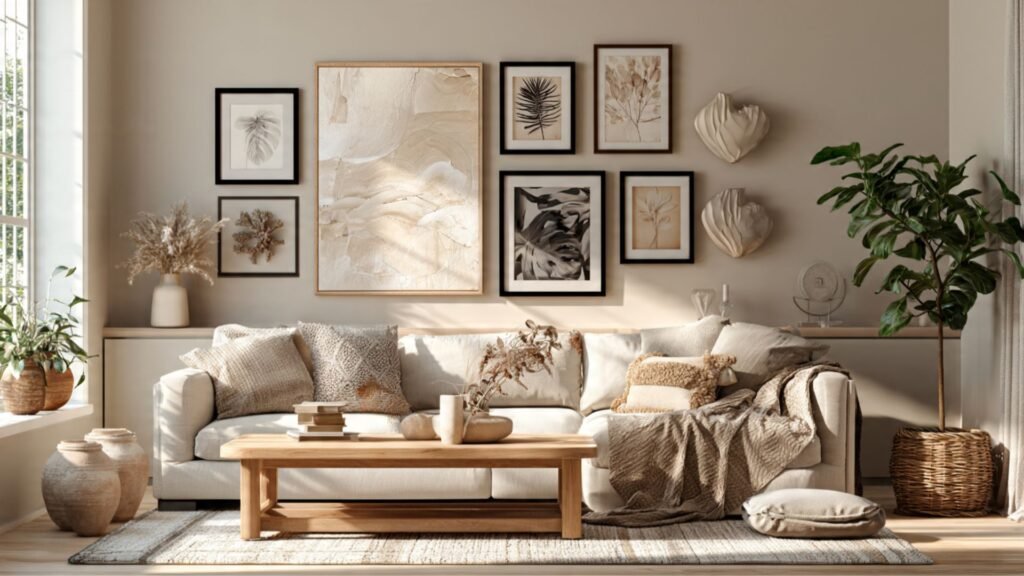
Wall Art Living Room Ideas focus on decorating walls with artwork that adds style, balance, and personality. These ideas help create a welcoming atmosphere, improve visual appeal, and complete the overall room design. They also highlight personal taste and make the space feel more comfortable and organized.
Wall Art Living Room design can instantly enhance the look and feel of a home. The right artwork adds character, creates a focal point, and brings color and texture to the space. It is a simple way to make a living room feel polished, attractive, and thoughtfully decorated.
Wall Art Living Room Ideas include gallery walls, oversized paintings, framed prints, abstract artwork, and decorative shelves. These options suit different interior styles and budgets. Thoughtful art placement and balanced proportions help create a cohesive, elegant, and visually appealing living room.
Anchor Your Sofa Wall with a Single Commanding Piece:
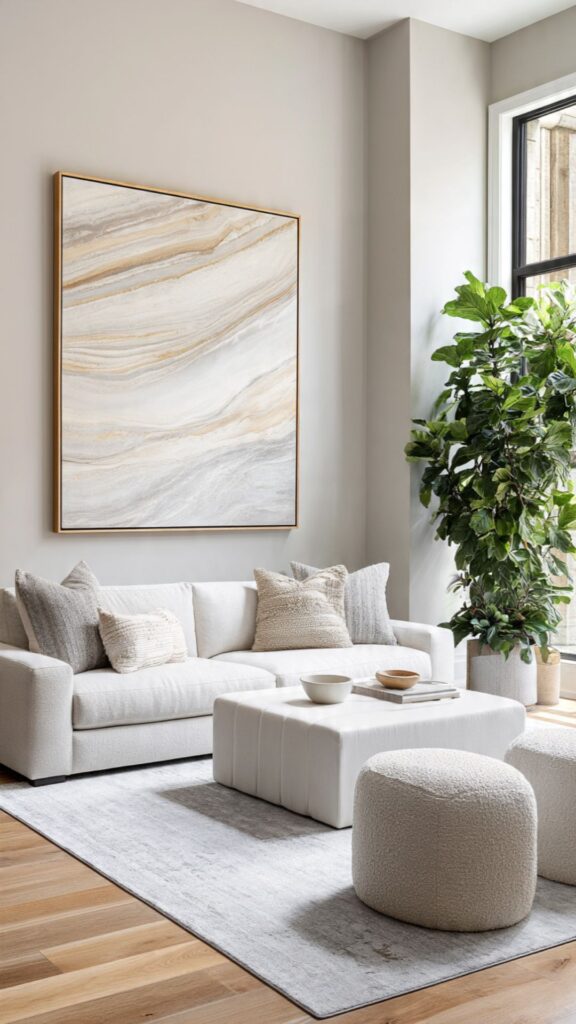
The wall directly behind your sofa is the most important real estate in your living room. It’s the first thing guests see when they enter, and it sets the tone for the entire space. Instead of scattering multiple small pieces across this wall, consider anchoring it with a single commanding artwork one piece bold enough to hold the eye and strong enough to define the room’s character.
The size relationship between your sofa and the art above it is critical. Your artwork should span roughly 75% of the sofa’s width no more, no less. Too wide and it overpowers the furniture; too narrow and it floats awkwardly in empty space. For a standard 84-inch sofa, that means looking for artwork in the 60–65 inch range. This proportion creates the visual balance that makes a room feel professionally designed rather than haphazardly put together.
Subject matter matters enormously on this wall. A serene landscape creates a restful, expansive backdrop ideal for relaxed, conversational living rooms. A bold abstract in deep jewel tones creates energy and drama, making the room feel vibrant and dynamic. A large-scale portrait or figurative work adds an artistic, intellectual quality that signals a curated aesthetic. Before buying, ask yourself: what do I want people to feel when they sit in this room? Let that answer guide your choice.
One underrated tip: consider the back of your sofa color when choosing the anchor piece. If your sofa is a warm caramel leather, cool-toned art creates a sophisticated contrast. If your sofa is a charcoal velvet, warm amber or golden artwork creates visual harmony without blending in. This color dialogue between furniture and art is something experienced designers always consider but rarely explain in accessible terms.
Build an Eclectic Art Ledge Display:
For Easy Flexibility
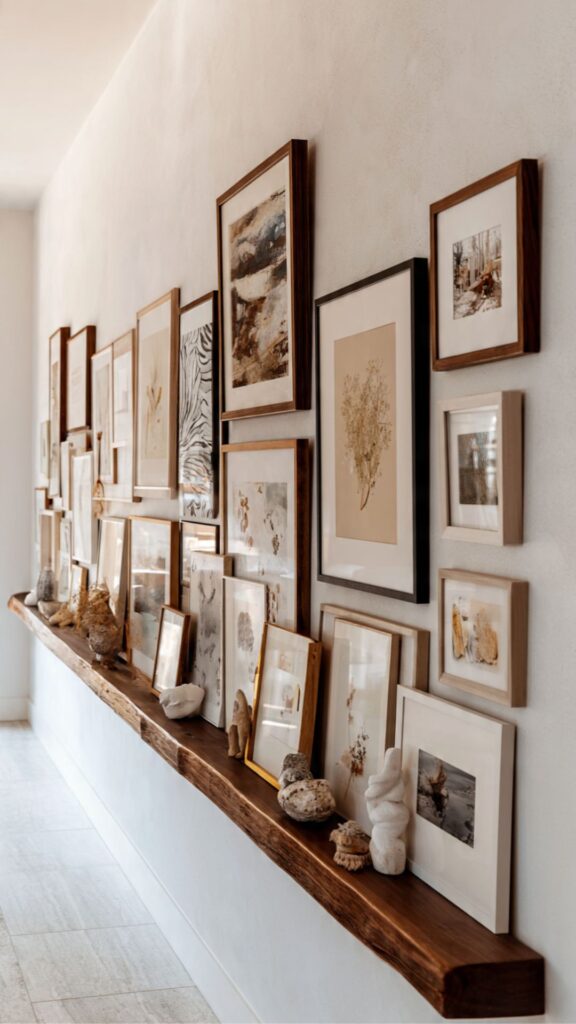
Art ledges narrow shelves mounted at picture-rail height are one of the most practical and stylish solutions for living room wall art. Unlike traditional hanging, ledges let you lean, layer, and swap artwork freely without putting new holes in your walls. This makes them ideal for renters, for people whose taste evolves quickly, and for anyone who wants to refresh their living room décor seasonally without redecorating.
The layering technique is what makes art ledges truly special. Place a large framed print at the back, lean a medium canvas in front of it at a slight angle, then tuck a small framed photograph or object at the front. This depth creates a three-dimensional, gallery-like quality that flat wall hanging simply cannot replicate. Add a small plant, a ceramic object, or a stack of art books to the ledge for an organic, lived-in feel that elevates the display from décor to personal curation.
What competitors rarely discuss is how art ledges change the relationship between you and your art. When changing a piece requires un-hammering nails and patching walls, most people leave art unchanged for years even when their tastes evolve or the art no longer excites them. Ledges remove that friction entirely. You can update the display in minutes, which means your living room walls stay current, personal, and visually stimulating year-round.
For maximum visual impact, use IKEA’s MOSSLANDA or similar picture ledges in a warm wood finish for traditional spaces, or matte black metal ledges for contemporary and industrial living rooms. Mount two or three ledges at different heights on the same wall or a single long ledge spanning the full width of a feature wall for a built-in, architectural quality that makes the display feel intentional rather than improvised.
Read This: Picture Wall Ideas That Perfectly Inspire Your Beautiful and Stunning Living Room Wall Art
Use Color Blocking Techniques:
To Frame Your Artwork
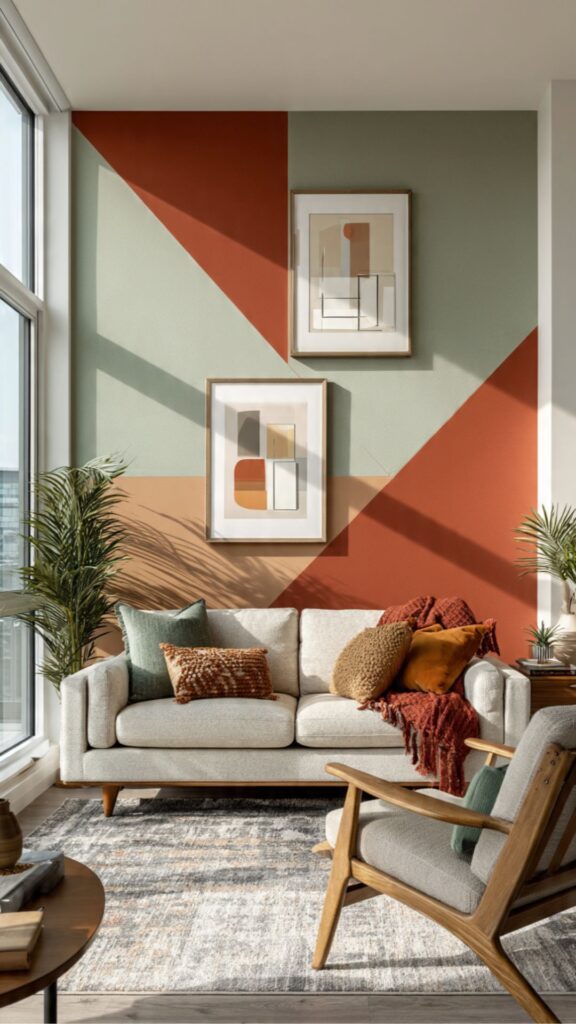
Color blocking painting a section of the wall in a contrasting or complementary color specifically to frame your artwork is one of the most underused and visually striking wall art strategies available. Instead of hanging art on a plain white or neutral wall, you paint a geometric shape (rectangle, arch, or full panel) behind the artwork, creating a built-in frame effect that feels architectural and intentional.
This technique works especially well in rental apartments where large-scale repainting isn’t possible. A single painted rectangle in a deep, saturated color forest green, terracotta, navy, dusty rose behind a cluster of framed prints transforms an ordinary wall into a designed vignette. The cost is minimal: one small can of paint and an afternoon. The visual impact, however, is enormous it looks like something from an editorial interior photograph.
The color you choose for the block matters strategically. A warm terracotta block behind warm-toned artwork creates a harmonious, enveloping feel. A deep charcoal block behind bright, colorful art creates dramatic contrast that makes the colors in the artwork pop with gallery-like intensity. Cool sage green behind botanical prints creates a nature-immersive backdrop that reinforces the artwork’s subject. In each case, the color block isn’t competing with the art it’s amplifying it.
Beyond rectangles, consider arched color blocks a trend that exploded in 2023 and continues strong into 2026. A painted arch in a rich, warm tone with a single artwork hung within it creates a focal point that feels almost portal-like, drawing the eye and adding architectural drama to flat walls. This is particularly effective in living rooms with high ceilings, where the arch helps fill vertical space that art alone often can’t reach.
Hang Artwork in Unexpected Corners and Nooks:
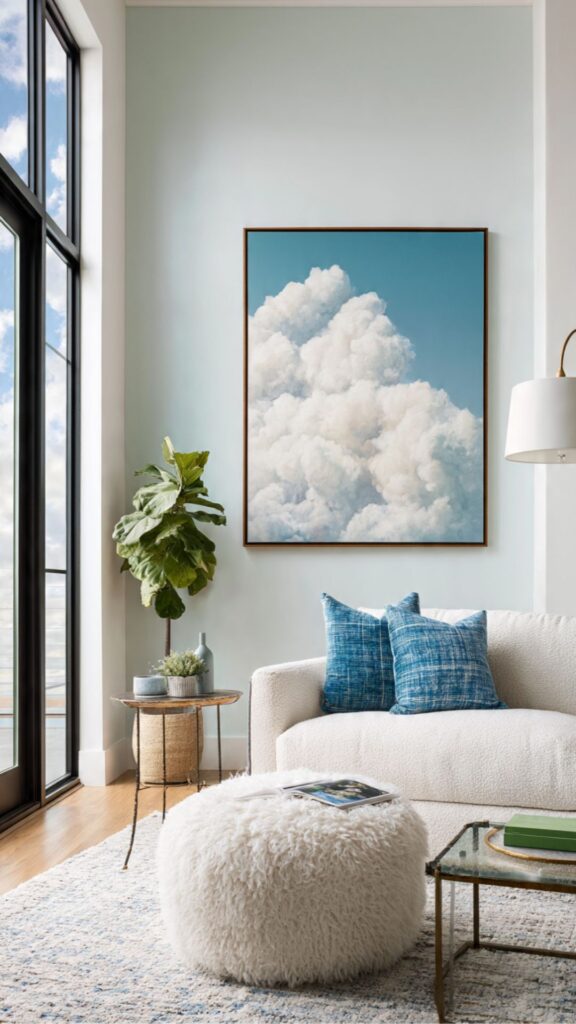
Most people hang wall art living room only on the main, central walls of their living room and completely ignore corners, alcoves, and nooks. This is a significant missed opportunity. Corners are naturally intimate spaces that draw the eye precisely because they’re unexpected. A carefully placed piece of art in a living room corner creates surprise, depth, and the impression of a thoughtfully designed space rather than a standard decorated one.
Corner art placement works best with floor-standing or leaning artwork. A large canvas leaned into a corner at a slight angle, flanked by a tall plant on one side and a floor lamp on the other, creates a styled vignette that feels organic and effortless. This approach is common in Scandinavian and Japanese-inspired interiors, where negative space is valued and every corner is treated as a design opportunity rather than dead space.
Alcoves the recessed spaces often found on either side of a fireplace or chimney breast are another underutilized canvas. Hanging one focused piece of artwork in each alcove, at the same height and in complementary but not identical frames, creates a sense of symmetry and order that anchors the room. This is a classic interior design technique that dates back to Georgian architecture and remains as effective today as it was centuries ago.
For a more contemporary approach, consider corner-spanning art two related pieces hung on adjacent walls that meet at the corner, so the artwork effectively wraps around the wall junction. This technique, increasingly popular in maximalist and eclectic interiors, creates an immersive, room-embracing quality that makes the art feel like part of the architecture rather than something added to it.
Incorporate Vintage and Antique Prints:
For Layered Character
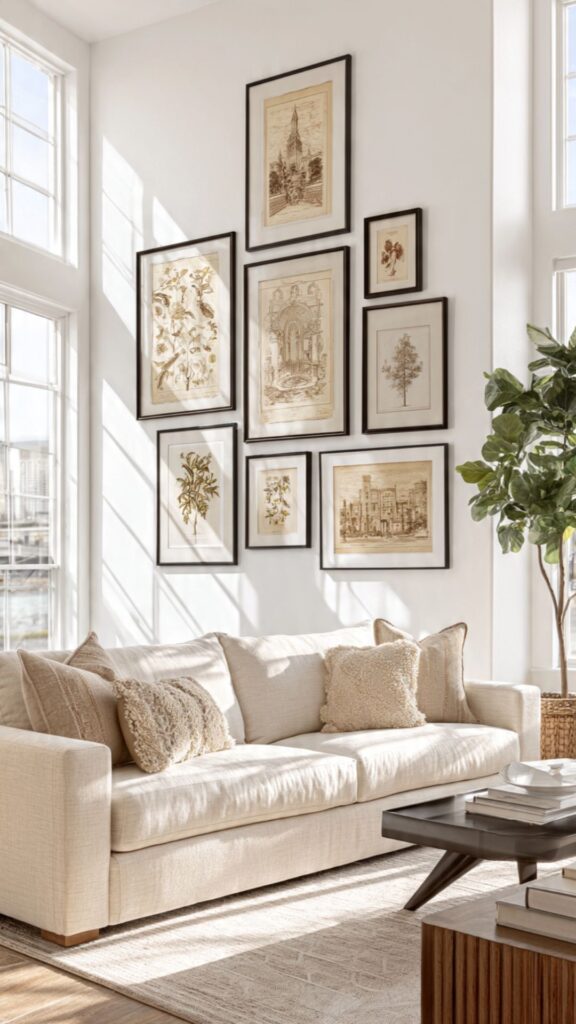
In a world of algorithm-curated digital prints and mass-produced wall art, vintage and antique pieces offer something genuinely irreplaceable: history, patina, and authentic character. A single vintage botanical print, antique map, or aged lithograph brings a depth of feeling to a living room wall that no contemporary reproduction can match. These pieces carry the weight of time and that weight translates directly into visual richness.
Finding vintage prints is easier and more affordable than most people realize. Estate sales, charity shops, local antique markets, and online platforms like eBay, Etsy, and Vinterior regularly surface beautiful, affordable pieces. Vintage botanical illustrations from the 18th and 19th centuries originally produced as scientific documents are particularly sought after for their extraordinary detail, aged paper tones, and timeless subject matter. A set of three or four framed in matching antique gold frames creates an instant heirloom-quality display.
What makes vintage art so powerful from a design perspective is its imperfection. Slight foxing on aged paper, faded colors, the texture of old printing techniques these qualities add visual warmth and tactile interest that perfectly printed contemporary art lacks. In an interior dominated by clean lines and modern furniture, a vintage print introduces exactly the kind of human irregularity that prevents a room from feeling sterile or showroom-like.
One approach that designers love: mixing vintage prints with contemporary art in the same arrangement. A Victorian botanical illustration alongside a modern abstract print sounds contradictory but works beautifully when unified by a consistent frame finish or color palette. This time-layering technique blending different eras in a single curated display creates the kind of collected-over-time aesthetic that instantly communicates a rich personal history and a confident design sensibility.
Design a Themed Art Wall Around Your Personal Passion:
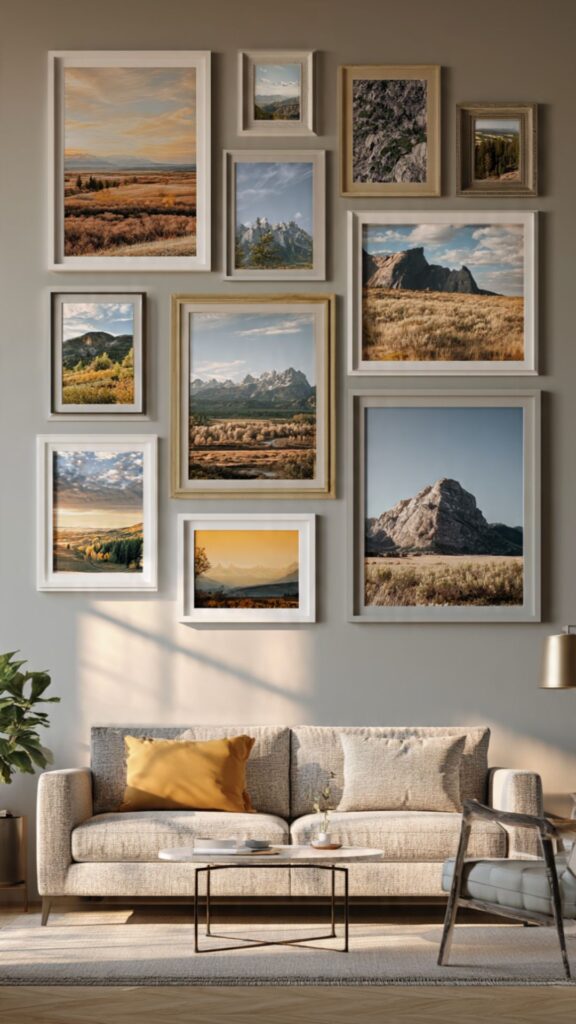
The most memorable living room walls aren’t the most expensive or the most perfectly coordinated they’re the most personal. A themed art wall built around a genuine personal passion travel, music, architecture, botany, sport, film, literature creates an immediate sense of authentic character that no amount of interior styling can manufacture. It tells visitors exactly who lives in this home, and that specificity is deeply attractive.
The execution is simpler than it sounds. If you love travel, build a wall around maps, destination photographs, vintage travel posters, and pressed botanicals from places you’ve visited. If music is your passion, frame album covers, concert tickets, handwritten lyrics, or musical notation prints. If architecture moves you, architectural elevation drawings, brutalist photography, and geometric abstract prints create a cohesive, intellectually rich display. The theme provides the curatorial logic; everything else is just curation.
One insight that’s rarely discussed: themed walls work best when they mix media and formats rather than staying uniform. All travel posters in matching frames creates a predictable, poster-shop feel. But a vintage map in an ornate gold frame, a personal travel photograph in a simple black frame, a painted postcard pinned without a frame, and a small object (a compass, a key) mounted alongside the art creates a genuinely personal installation rather than a decorative display.
The themed approach also gives you a clear, principled answer to the most common wall art dilemma: “should I buy this piece?” If it fits your theme and speaks to your passion, yes. If it’s beautiful but irrelevant, no. This decision framework removes the paralysis that many people feel when building a wall art collection and gradually produces a living room wall that feels cohesively, unmistakably yours.
Bookmark This Now: Japandi Living Room Ideas That Show How the Perfect Wall Art Can Elevate Your Whole Living Room Style
Explore Maximalist Layering Wall Art Living Room:
For a Rich, Collected Feel
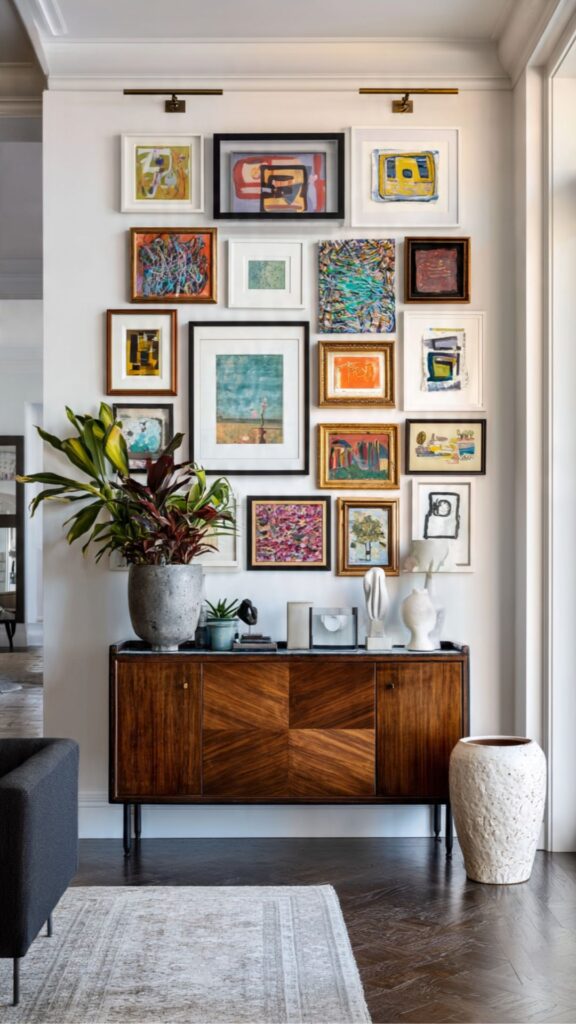
Maximalism is no longer the decorating philosophy that minimalism displaced it’s back, fully confident, and increasingly celebrated in mainstream interior design. In the context of living room wall art, maximalist layering means building arrangements of intentional density and richness: many pieces, many styles, many scales all united by a carefully considered underlying logic of color, mood, or theme.
The critical distinction between maximalism and clutter is intentionality. A cluttered wall is random. A maximalist wall is deliberate. Every piece has been chosen, every arrangement considered, every color relationship weighed. The result feels abundant and energetic rather than chaotic and overwhelming. Achieving this requires a discipline that, paradoxically, maximalist spaces demand more of than minimalist ones because there are more decisions to get right.
For a living room, maximalist layering works best on a single feature wall rather than all four. Choose your largest, most dominant wall usually the one opposite the main entry point or the wall behind the primary seating and commit to building a rich, dense arrangement there. Keep adjacent walls simple, even bare, to give the maximalist feature wall room to breathe and dominate. This contrast is what gives the arrangement its visual power.
Color is the glue that holds maximalist arrangements together. Even if you’re mixing wildly different art styles impressionist prints alongside contemporary photography alongside folk art ceramics a consistent color palette running through the arrangement creates coherence. Pull three or four colors from your living room’s existing palette and ensure that every piece on the wall references at least one of them. This is the designer’s secret to maximalist walls that feel curated rather than collected by accident.
Light Your Wall Art Strategically:
For a Gallery-Quality Effect
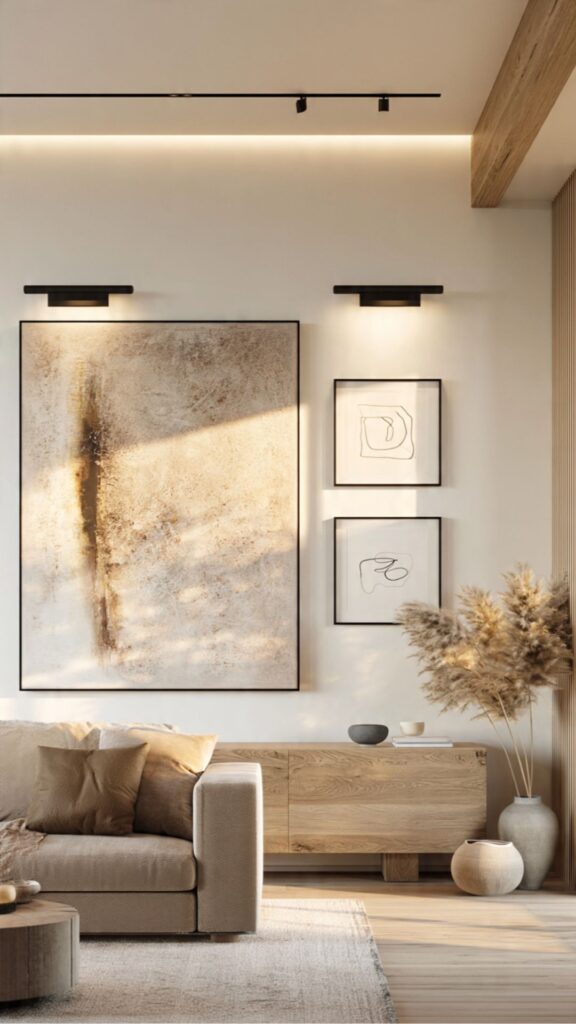
Most living rooms light their art accidentally whatever ambient light happens to fall on the wall is what the art gets. Professional galleries, by contrast, treat lighting as an integral part of the art experience. Bringing even a fraction of that intentionality to your wall art living room lighting will transform how the pieces look and how the room feels after dark.
Picture lights small, directional lamps that mount directly onto the frame or wall above a piece are the most traditional solution and remain highly effective. Modern LED picture lights are slim, energy-efficient, and available in warm color temperatures (2700–3000K) that enhance rather than flatten the colors in artwork. A warm-toned picture light above a landscape painting, for example, makes the colors glow with an almost luminous quality that overhead lighting simply cannot produce.
Track lighting and adjustable spotlights are the preferred solution when you have multiple pieces to illuminate or when your art arrangement changes regularly. A simple two or three-spotlight track mounted on the ceiling, aimed at the art wall, creates a flexible lighting system that can be redirected whenever you rearrange. For gallery walls with many pieces, soft ambient uplighting (a floor lamp positioned behind furniture near the wall) creates a warm glow that illuminates the entire arrangement without the harshness of direct spots.
One strategic insight most guides completely overlook: the color temperature of your art lighting should match the dominant tones in the artwork. Warm white light (2700K) enhances warm-toned art oils, watercolors, earthy photography. Cool white light (4000K) brings out the crispness and clarity in graphic prints, black-and-white photography, and cool-toned abstracts. Getting this match right makes the difference between art that looks displayed and art that looks alive.
Choose Art That Grows With Your Interior Over Time:
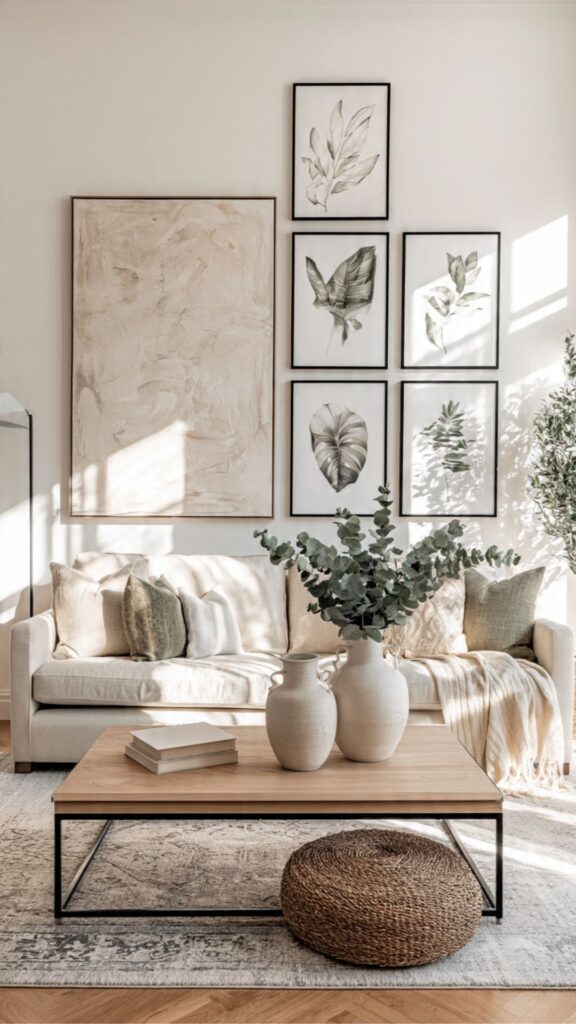
One of the most common and costly wall art mistakes is buying pieces that work perfectly now but become obsolete the moment you repaint, reupholster, or remodel. Truly smart art buying means choosing pieces with a longevity built into them artworks that have enough visual independence to work across different color schemes, furniture styles, and interior moods as your home evolves.
Certain art characteristics predict longevity reliably. Strong composition the underlying visual structure of how elements are arranged within the frame outlasts trends in color or style. A painting with excellent compositional balance will continue to command attention even as everything around it changes. Similarly, art with a limited, neutral, or versatile color palette blacks, whites, warm grays, earthy browns, muted greens adapts more easily to changing interiors than pieces built around very specific, trend-driven colors.
Abstract art, as mentioned elsewhere, ages well precisely because it carries no dated references. But representational art can also be timeless when it depicts subjects of universal, enduring appeal: the human form, the natural landscape, still life arrangements, architectural forms. These subjects have been considered worthy of artistic representation for centuries and they’ll remain so for centuries more. Buying art within these broad categories is a reliable hedge against future obsolescence.
There’s also a psychological dimension to long-lasting art choices. Research in environmental psychology suggests that people form genuine emotional bonds with artworks they live with over time especially pieces that reward repeated looking, revealing new details, moods, or interpretations with each viewing. Buying art that offers this depth of engagement means your living room walls will continue to interest and delight you long after the initial decorating excitement has faded.
Use Black and White Art:
For Sophisticated Timelessness
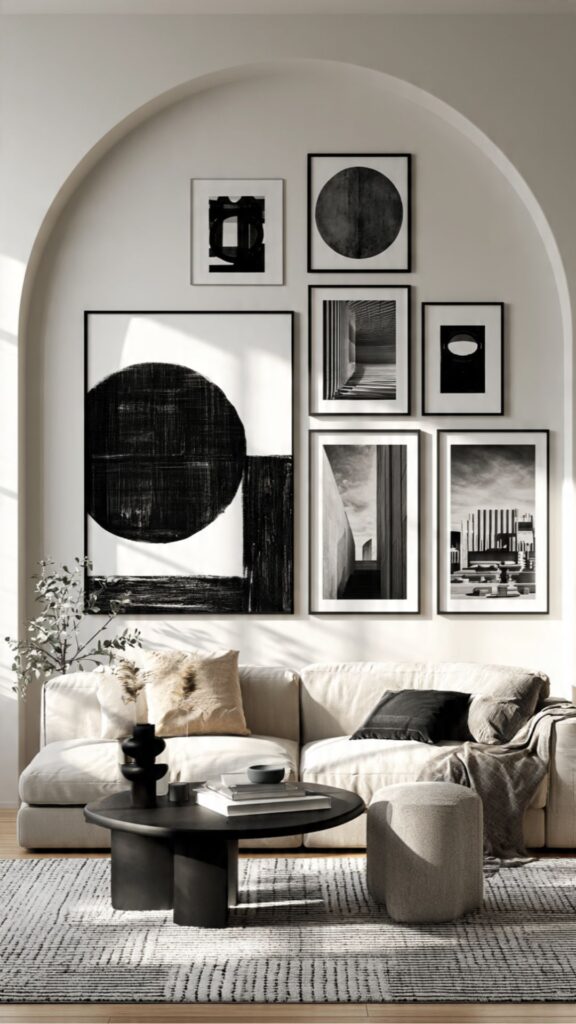
Black and white wall art occupies a unique position in interior design: it works in virtually every living room style, at every budget level, and across every color scheme. Whether your living room leans coastal, industrial, traditional, or contemporary, a well-chosen black and white piece integrates seamlessly. This universality is what makes it the most reliably safe yet genuinely sophisticated wall art choice available.
The range of black and white art is far wider than most people consider. Architectural photography, portrait studies, abstract ink drawings, botanical line art, typographic prints, graphic geometric designs, street photography, fashion photography all of these exist in powerful black and white versions. The absence of color directs attention purely to composition, light, shadow, and form, which is why black and white work often feels more artistically serious than its color equivalents.
For maximum visual impact, group black and white pieces together rather than mixing them with color art. A curated black and white gallery wall even with very different subjects and styles has a cohesive, editorial quality that immediately elevates a living room’s visual sophistication. Frame all pieces in matte black for a contemporary look, in natural wood for warmth, or in antique silver for a more classical feel. The consistent framing creates unity across diverse subjects.
One advanced technique: introduce a single, small accent of color into an otherwise all-black-and-white arrangement. One small framed piece with a deep burgundy, forest green, or warm terracotta palette among five or six black and white pieces creates a focal point that draws the eye and prevents the arrangement from feeling flat. This technique the designer’s equivalent of a red lip with a monochrome outfit adds just enough visual interest to make the whole arrangement feel intentional and complete.
Read This First: Dark Academia Living Room Ideas That Prove How Bold and Beautiful Wall Art Can Transform Any Living Room
Treat Your Fireplace Wall as a Dedicated Art Zone:
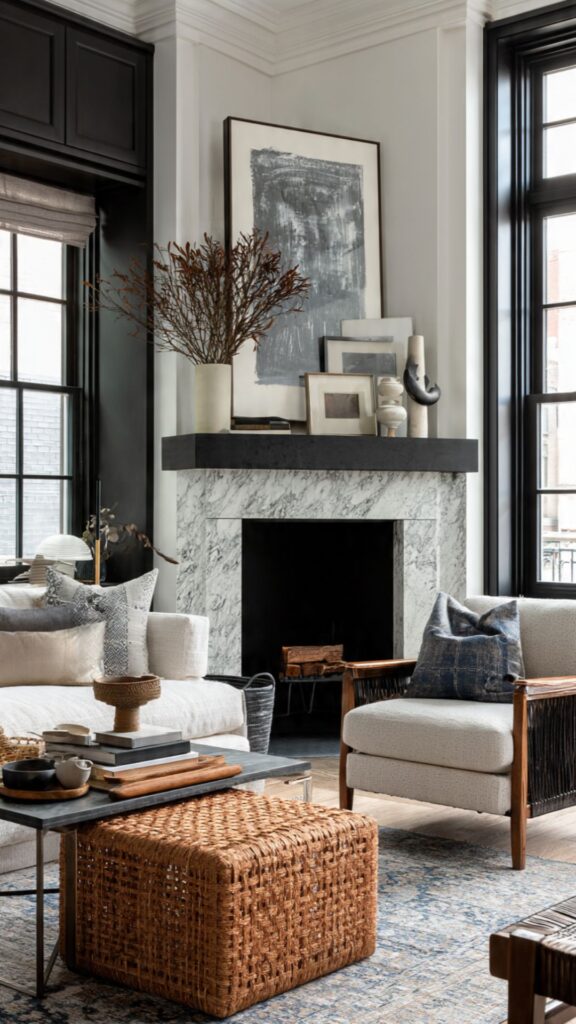
The fireplace wall is the natural focal point of most traditional and transitional living rooms yet it’s frequently under-decorated, with a single mirror or one small painting perched above the mantel doing insufficient work for such a visually important space. Treating the entire fireplace wall as a dedicated art zone rather than just the area above the mantel unlocks a level of visual drama and design coherence that transforms the entire living room.
The mantel itself is a display surface, not just a shelf for candles and family photos. Treat it as a curated vignette: one or two carefully chosen objects at varying heights, a leaned (not hung) artwork at the back, and negative space deliberately left to prevent crowding. The art leaned against the wall on the mantel should be significantly larger than feels comfortable ideally filling the full width of the chimney breast above the mantel. This scale is what creates the dramatic, editorial quality that elevates the fireplace from architectural feature to visual centerpiece.
Above the mantel, the wall space up to the ceiling is often ignored after a single picture is hung. Consider treating this vertical space as a dedicated art column a curated stack of artworks in descending size from ceiling to mantel, or a single oversized piece that fills the chimney breast from mantel to cornice. Both approaches command the room with architectural authority, making the fireplace wall feel like it was designed rather than decorated.
For living rooms without a working fireplace, a decorative surround either an architectural salvage piece or a purpose-built faux fireplace creates the same focal-point opportunity. Pair it with a fully considered art zone on the chimney breast, and you’ve created the most powerful design moment in the room entirely by strategic art placement. This approach consistently produces the greatest visual return on investment of any single decorating decision in the living room.
Conclusion
Great wall art living room design isn’t about spending more it’s about thinking more carefully about proportion, placement, lighting, and personal meaning. From a single commanding anchor piece to a themed personal display or a maximalist layered arrangement, each idea in this guide gives you a concrete, actionable path to a living room that feels genuinely designed.
Pick the idea that resonates most with your current space, apply it with intention, and see how quickly your walls go from background to the most compelling feature in the room.

Team TrandyVilla is the passionate home decor team behind Trandy Villa, where style meets comfort in everyday living. The team loves transforming simple spaces into beautiful, functional homes through smart ideas, budget-friendly hacks, and modern design trends. Their content focuses on helping readers create homes that feel both stylish and personal without spending too much.