
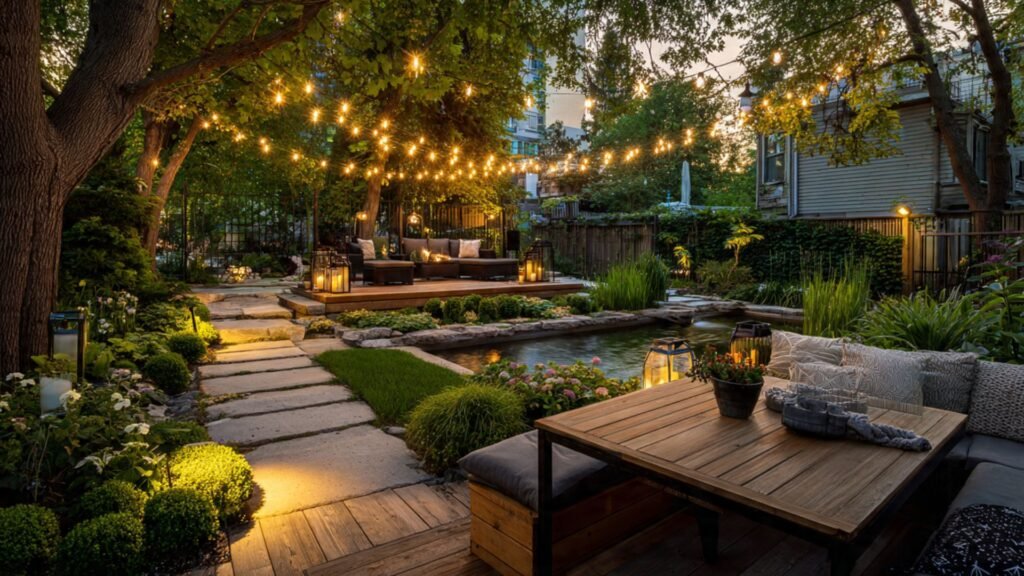
Garden lighting is one of the most powerful and underused tools in outdoor design. A well-lit garden extends your living space beyond sunset, adds security, and elevates curb appeal dramatically. Whether you have a compact urban balcony or a sprawling countryside garden, the right lighting transforms it entirely. This guide covers 15 expert-backed garden lighting ideas each with unique insights, real examples, and actionable advice to help you illuminate your outdoor space with confidence and style.
Garden lighting refers to the use of outdoor lights to illuminate and enhance the beauty of a garden space. It serves multiple purposes improving safety, extending outdoor time, and boosting curb appeal. Garden lighting ideas range from string lights to solar path lights, spotlights, and lanterns.
Transform your outdoor space after dark with the right garden lighting. A well-lit garden creates a warm, inviting atmosphere that impresses guests and adds value to your home. Smart garden lighting choices turn an ordinary yard into a stunning nighttime retreat worth enjoying every evening.
Garden lighting ideas include solar-powered stake lights, LED strip lights along pathways, lanterns near seating areas, and uplights for trees or garden walls. Solar lights save energy and require no wiring. LED options last longer and cost less to run. Layering different light types creates depth and visual interest in any garden space.
Solar Garden Lights:
Eco-Friendly Illumination That Pays for Itself
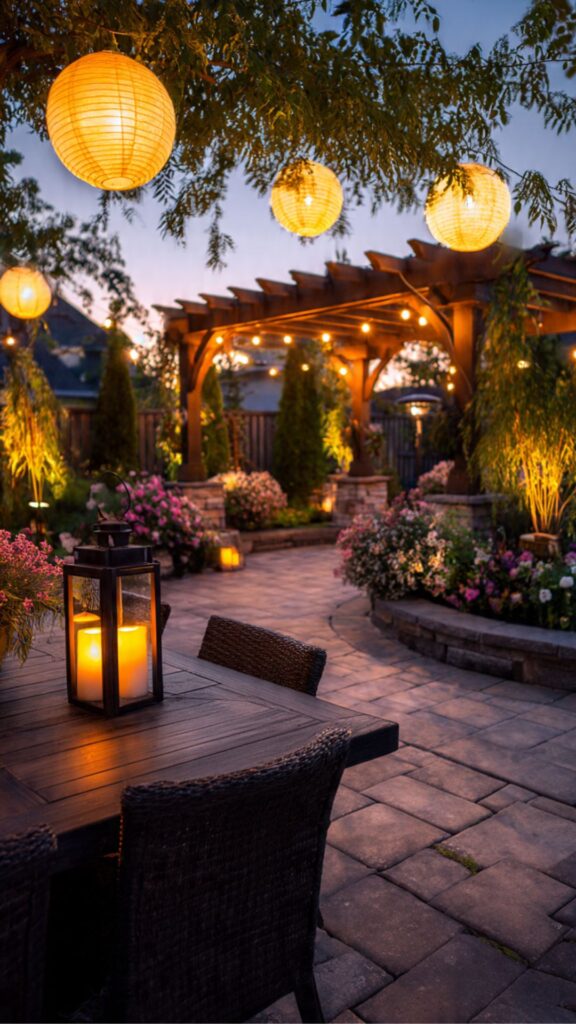
Solar garden lights have evolved far beyond the dim, unreliable options that first appeared on the market. Today’s solar-powered outdoor lights use advanced photovoltaic panels and lithium-ion batteries that store enough energy to power LEDs through eight to twelve hours of consistent nighttime illumination.
This makes them a genuinely viable primary lighting option not just a decorative supplement. For homeowners looking to reduce electricity bills while improving their garden’s ambiance, solar lighting delivers an outstanding return on investment within the first year of use.
The key to maximizing solar garden light performance lies in placement during installation. Panels must receive unobstructed sunlight for a minimum of six hours daily to charge fully. Shaded gardens, therefore, require careful planning placing solar stake lights along sunnier border edges while reserving wired or battery-powered options for darker corners.
This hybrid approach ensures consistent performance across the entire garden regardless of canopy coverage or seasonal sun angle changes. Modern solar garden lights now come in a remarkable range of styles from minimalist geometric stake lights to ornate lanterns, path markers, and wall-mounted fixtures.
Brands are also integrating smart technology, allowing homeowners to control brightness levels and scheduling via smartphone apps. Some premium solar light models even include motion sensors, making them dual-purpose security and ambiance tools. This crossover between aesthetic lighting and functional safety technology is one of the most exciting developments in outdoor lighting design today.
Looking ahead, solar garden lighting will continue improving as battery storage technology advances alongside solar panel efficiency gains. Within the next decade, homeowners can expect solar lights that maintain full brightness throughout an entire winter night even in northern climates a current limitation that deters some buyers. Investing in solar garden lights now, even at current efficiency levels, establishes the habit and infrastructure for a fully sustainable outdoor lighting system in the near future.
Path Lighting:
Guiding Steps with Style and Safety
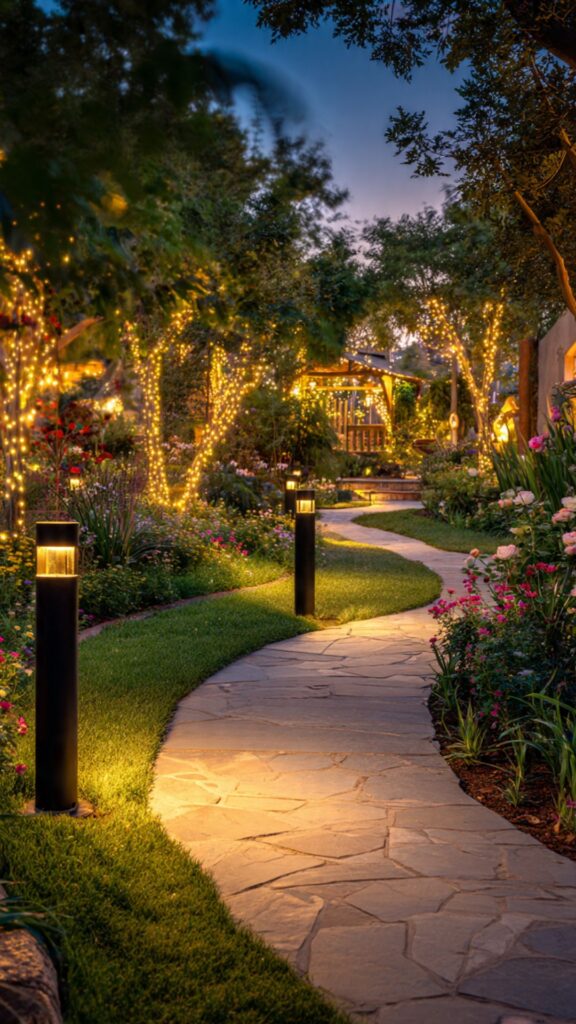
Garden path lighting serves a dual purpose that makes it one of the most practical investments in outdoor design. Functionally, it prevents trips and falls on uneven ground, steps, and gravel paths after dark. Aesthetically, it creates a welcoming visual corridor that draws visitors through the garden with a sense of intention and arrival. Well-designed path lighting is the outdoor equivalent of a well-lit hallway it communicates care, thoughtfulness, and safety simultaneously.
The spacing of path lights is a detail that significantly affects the final look but receives little attention in most garden lighting guides. Lights placed too close together create a runway effect that feels clinical rather than welcoming.
The ideal spacing for most residential path lights is between 60 and 90 centimetres apart, staggered on alternating sides of the path rather than symmetrically placed. This staggered arrangement creates a softer, more natural rhythm of light that guides the eye without overwhelming it.
For a layered, professional look, combine low-profile path stake lights with ground-level recessed lights embedded directly into paving or decking. The recessed options create a flush, architectural quality that feels bespoke and deliberate they are particularly effective along clean-edged contemporary paths and patios.
Bollard-style path lights work well in larger gardens where the scale requires a more substantial fixture to avoid looking underpowered. Each style communicates a different design language, so matching the fixture style to the garden’s overall aesthetic is essential.
One often-missed insight is the importance of light colour temperature in path lighting. Warm white (2700–3000K) creates an inviting, golden glow that suits cottage gardens and traditional landscapes. Cool white (4000–5000K) reads as crisper and more contemporary, suiting modern or minimalist garden designs. Choosing the wrong colour temperature even with the right fixture style can undermine the entire aesthetic. Always test a single light in situ before purchasing the full set.
If You Love Garden Lighting, You Will Fall in Love with These Rooftop Garden Ideas Too.
Fairy Lights in the Garden:
Effortless Magic for Any Outdoor Space

Garden fairy lights also known as string lights or festoon lights are the single most transformative lighting addition available at any budget level. A strand of warm-white fairy lights woven through a pergola, draped across a fence, or wrapped around a mature tree immediately creates a sense of occasion and enchantment. This is the lighting choice that turns an ordinary outdoor dinner into a memorable evening, and it requires very little technical skill to install effectively.
The distinction between fairy lights and festoon lights is worth clarifying for homeowners shopping for outdoor string lighting. Fairy lights use very small, closely spaced LEDs on thin wire, creating a delicate, twinkling effect ideal for foliage, trellises, and intricate structures.
Festoon lights, by contrast, use larger exposed bulbs on heavier cable, creating a more substantial, café-style effect better suited to open pergola canopies, between trees, or across wider spans. Both have their place, and combining the two in a layered lighting scheme creates exceptional depth and visual warmth.
Waterproofing is a non-negotiable consideration for any garden fairy light purchase. Look for an IP44 rating at minimum for lights used in sheltered outdoor areas. For lights exposed to direct rain or used in open garden beds, an IP65 or higher rating is essential.
The difference matters enormously IP44-rated lights used in exposed conditions degrade rapidly, developing flickering issues and safety risks within a single season. Paying slightly more for correctly rated lights is always the smarter long-term investment.
Creative applications of garden fairy lights extend well beyond the obvious pergola drape. Filling a large glass lantern or jar with a coiled strand of micro fairy lights creates a beautiful, inexpensive garden centrepiece.
Threading lights through willow or bamboo screening transforms a functional privacy barrier into a glowing feature wall. Wrapping the trunk and lower branches of a single specimen tree with warm fairy lights creates a striking focal point that anchors the garden’s nighttime visual hierarchy with remarkable elegance.
Spotlights and Uplighting:
Highlighting Garden Features Dramatically
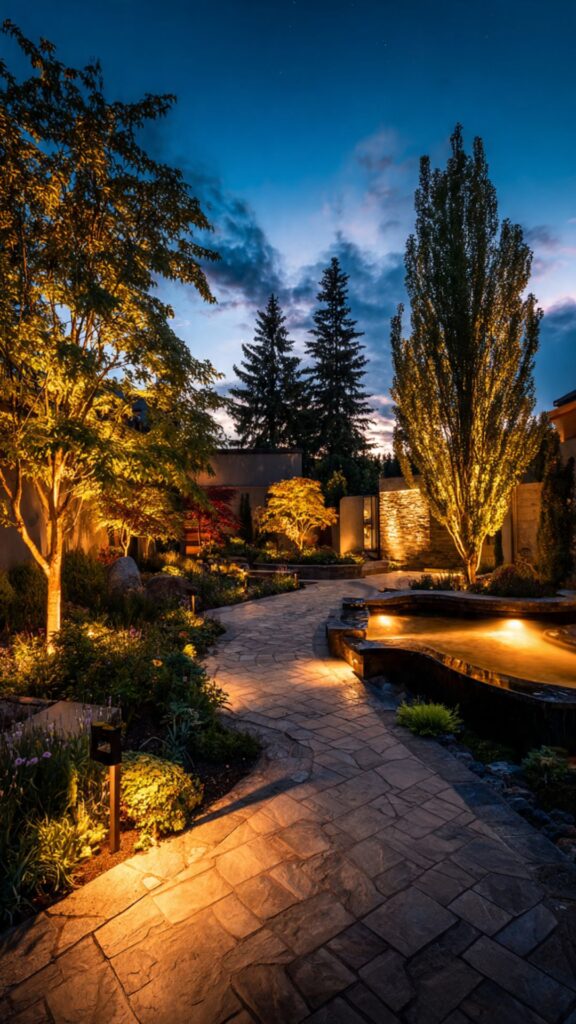
Garden spotlights and uplighting are the professional’s choice for creating drama, depth, and architectural interest in outdoor spaces. By directing a focused beam of light upward at a tree, sculpture, wall, or architectural feature, uplighting creates striking silhouettes and shadow play that give the garden a three-dimensional quality after dark.
This technique is used extensively in luxury landscape design precisely because its visual impact dramatically exceeds its installation cost. The angle and distance of uplight placement determine the quality of the effect. Placing an uplight too close to a tree trunk creates harsh, unnatural shadows that flatten the canopy above.
Positioning the fixture further back typically one-quarter to one-third of the tree’s height away from the base allows the beam to spread more naturally, capturing the full form of the canopy and creating the kind of gentle, even illumination seen in professionally landscaped gardens. This placement principle applies equally to wall washing, sculpture lighting, and architectural feature uplighting.
LED spotlights with adjustable beam angles are strongly preferred over fixed-beam alternatives for garden uplighting. A 15-degree beam creates an intense, narrow spotlight ideal for highlighting a single sculpture or architectural detail.
A 45-degree beam distributes light more broadly, better suited to illuminating a wide hedge, wall, or multi-stemmed tree. Fixtures with interchangeable lenses offer the greatest flexibility, allowing homeowners to adjust the lighting as the garden evolves over seasons and years.
Colour temperature is again a critical variable in spotlight selection. Trees with silver or grey bark birch, eucalyptus, and ghost gum, for example are best illuminated with a cool-white spotlight (4000–5000K) that emphasises their pale, luminous quality.
Warm-toned stone walls, terracotta pots, and timber features benefit from warm-white uplighting (2700–3000K) that enhances their inherent richness. Mismatching colour temperature to material tone is one of the most common garden lighting mistakes and one of the easiest to avoid with a small amount of advance planning.
Garden Wall Lights:
Combining Function and Architectural Detail

Exterior wall lights are one of the most underappreciated elements of garden lighting design. Mounted on the walls of the house, garden buildings, boundary walls, or pergola posts, they provide ambient illumination across seating areas and garden zones while also contributing meaningfully to the architectural character of the space.
The right wall light reads as a permanent, considered feature of the garden not an afterthought bolted on for practicality. Choosing the correct size of wall light for the surface it occupies is a detail that most homeowners underestimate. A small, delicate lantern mounted on a large expanse of rendered wall looks timid and lost.
A substantial wall-mounted fixture one that is proportionally matched to the wall surface area and the scale of the surrounding garden commands the space confidently. Interior designers apply this proportional logic automatically; outdoor spaces deserve the same careful consideration.
Wall lights with a downward-facing shade or directional louvre create a focused pool of light beneath the fixture, minimising light scatter into neighbouring properties and reducing sky glow a growing concern as light pollution becomes a more prominent environmental issue.
This design choice is also the most flattering for paved or decked surfaces directly below, as the concentrated downlight creates rich shadows that accentuate texture and material quality. Some local planning authorities in the UK and Europe now actively encourage or mandate this style of directional fitting in planning guidance documents.
The wiring of garden wall lights requires either a qualified electrician for hard-wired installations or the use of low-voltage LED wall lights that can connect safely to an outdoor transformer. In new garden builds, planning wall light cable runs before hard landscaping is completed saves significant cost and disruption later. For retrofit installations, surface-mounted conduit is a practical solution and when painted to match the wall colour, becomes virtually invisible within a season of weathering.
Decking and Step Lights:
Subtle Safety with Big Visual Impact
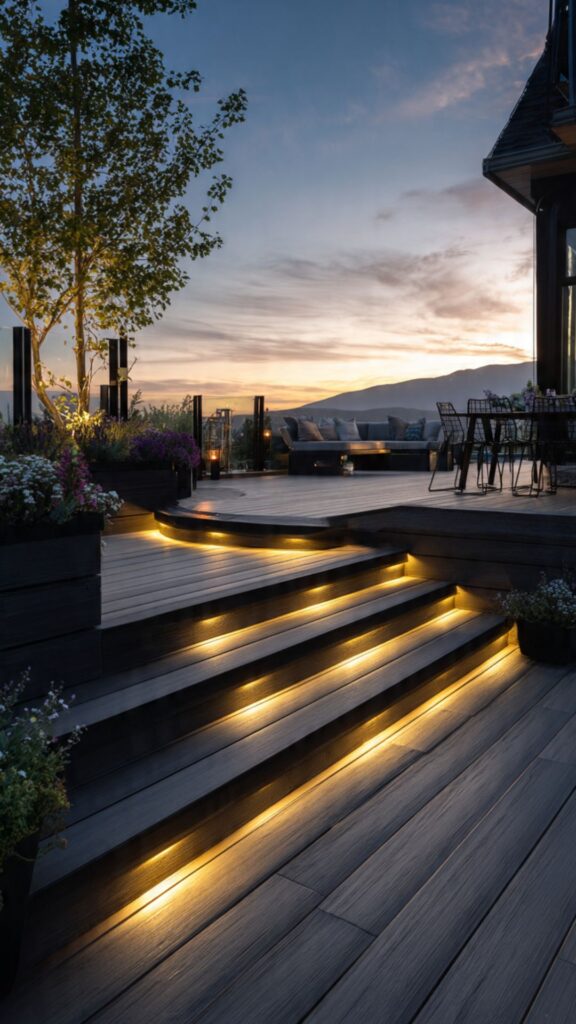
Decking and step lights are among the most functional garden lighting additions available, yet they contribute enormously to a garden’s nighttime aesthetic when installed with care. Recessed into the risers of garden steps or the fascia boards of decking, these low-level lights create a soft wash of illumination that defines surfaces and edges without glare. The result is a garden that feels genuinely safe and navigable after dark, while simultaneously looking polished and professionally designed.
The installation of decking lights requires planning before the decking boards are laid, making it one of the most important lighting decisions to make early in a garden redesign project. Retrofit installation is possible using surface-mounted LED strip or clip-on step lights but the recessed look is significantly more refined.
Low-voltage LED decking lights are the standard choice, as they operate safely in close proximity to wood and can be wired to a central transformer with a timer or dusk-to-dawn sensor for hands-free operation.
Spacing and layout of decking lights directly affect the final quality. Lights placed every 1.2 to 1.5 metres along decking fascia boards create a rhythm that defines the deck edge clearly without appearing cluttered. On steps, one light per riser on alternating sides achieves the same safety objective as one on every riser but creates a more elegant, less industrial look.
This alternating approach is a subtle detail that distinguishes considered garden lighting schemes from the purely functional. The addition of step and decking lights also adds measurable value to a property. Estate agents consistently report that outdoor lighting particularly functional lighting that increases safety positively influences buyer perception during viewings that extend into evening hours.
For homeowners considering selling in the medium term, decking and step lights represent an excellent balance of moderate installation cost and high perceived-value return.
Garden Lanterns and Candlelight:
Warm, Portable Ambiance
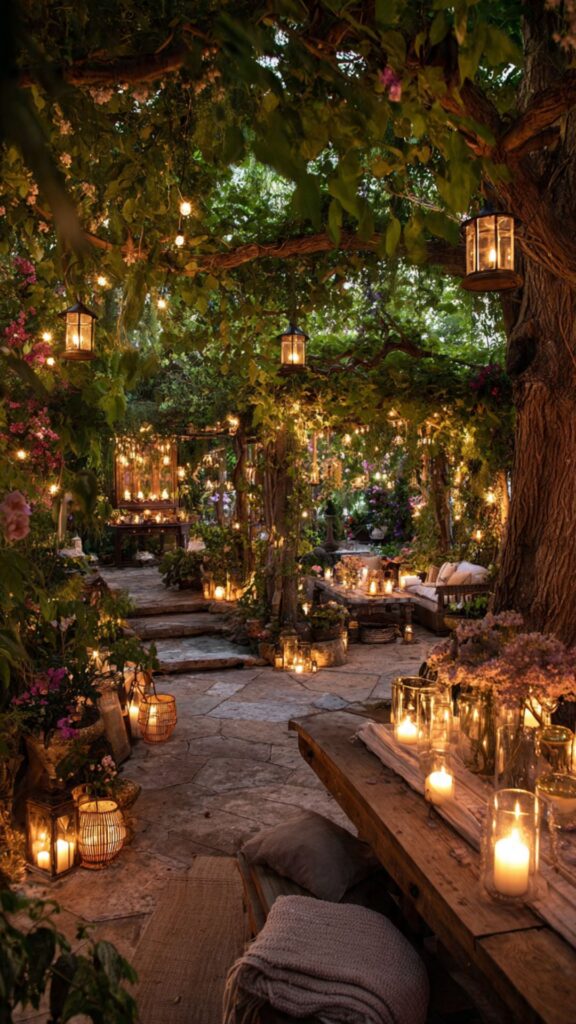
Garden lanterns represent the most accessible and immediately gratifying entry point into outdoor lighting. Available in styles ranging from Moroccan-inspired metalwork to clean Scandinavian glass, they require no installation, no electrician, and no planning just placement and a candle or flameless LED insert.
This simplicity is their greatest strength: lanterns can be repositioned, taken indoors, and updated seasonally without any commitment or cost beyond the initial purchase. The choice between real candles and flameless LED candles in garden lanterns deserves genuine consideration rather than the dismissive treatment it often receives. Real candles create a quality of warm, living light that no LED currently replicates fully the gentle flicker and the subtle warmth they emit contribute meaningfully to the atmosphere of an evening garden gathering.
However, flameless LED candles with flicker simulation technology have advanced to a point where the difference is negligible in larger lanterns viewed from conversational distances. For windy sites, uncovered lanterns, and households with children or pets, flameless options are the safer and more practical choice.
Clustering garden lanterns in groups of varying heights creates a far more compelling visual effect than spacing them individually across a wide area. A cluster of three to five lanterns mixing tall floor-standing models with medium table lanterns and small tea-light holders creates an improvised lighting installation that feels intentional and artistically considered. Place these clusters at the corners of seating areas, at the base of steps, or at path junctions to mark important garden moments with warm, inviting light.
Solar-powered garden lanterns that charge during the day and activate automatically at dusk now achieve a quality of light output that rivals candle-powered alternatives. Premium models use amber-tinted LEDs that deliver exceptional warmth, and some include dusk-to-dawn sensors with multi-hour programmable run times.
For garden owners who entertain frequently but prefer a low-maintenance lighting setup, solar lanterns offer the perfect balance of convenience, aesthetics, and sustainability.
LED Garden Lighting:
Energy Efficiency Meets Longevity
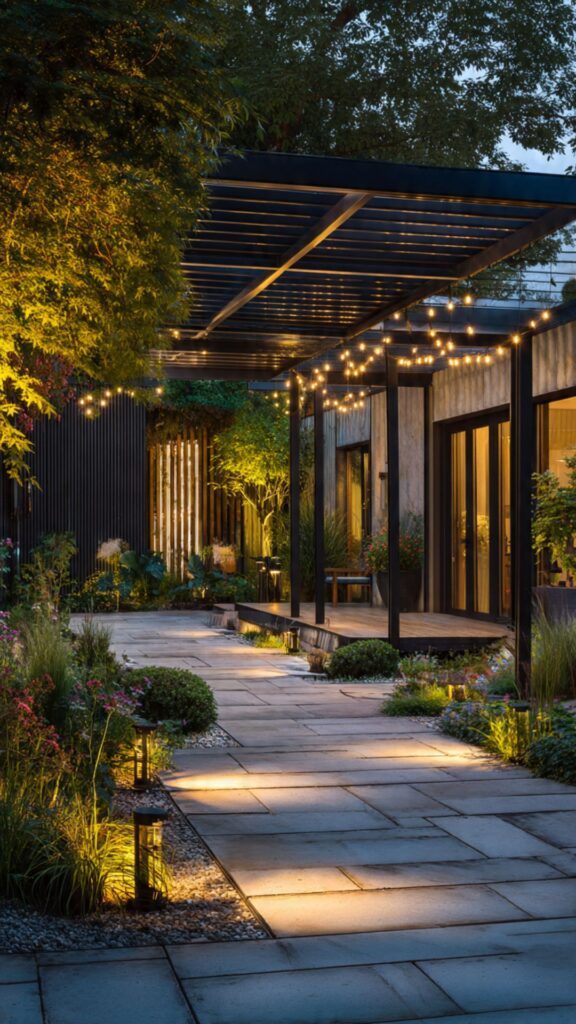
LED technology has fundamentally transformed garden lighting over the past decade, and the advantages extend far beyond the much-cited energy efficiency benefits. Modern LED garden fixtures consume up to 80 percent less electricity than their halogen predecessors while delivering equivalent or superior light output.
This efficiency translates directly into dramatically lower running costs an important consideration for homeowners who keep their garden lights on for several hours each evening throughout the year. The lifespan of quality LED garden lights is another significant advantage that rarely receives the emphasis it deserves. A good LED fixture will deliver 25,000 to 50,000 hours of operation before the light output degrades to 70 percent of its original level the industry standard for functional end-of-life.
For a garden light running five hours per night, this represents 13 to 27 years of service from a single fixture. This longevity fundamentally changes the economics of garden lighting, shifting the calculation from cheapest-upfront to best-lifetime-value.
LED garden lights also offer colour temperature flexibility that older technologies could not. Tunable white LED systems allow homeowners to adjust colour temperature from warm amber through to daylight white using a simple controller or smartphone app.
This flexibility is genuinely useful across different seasons warmer temperatures in winter create a cosy, welcoming garden atmosphere, while cooler temperatures in summer enhance the freshness of foliage and render outdoor entertaining spaces crisply and clearly.
The most forward-thinking garden lighting installations now integrate LED fixtures with smart home systems connecting outdoor lights to platforms like Google Home, Amazon Alexa, or Apple HomeKit. This integration allows voice control, automated scheduling, motion-triggered activation, and even synchronisation with weather data, automatically adjusting brightness on stormy evenings.
For homeowners building or renovating in 2025 and beyond, designing the garden lighting system to be smart-home compatible from the outset is a decision that adds both convenience and future-proofs the installation.
A Well Lit Garden Pairs Perfectly with a Cozy Sunroom — Take a Lovely Look.
Garden Pond and Water Feature Lighting:
Creating Reflective Drama
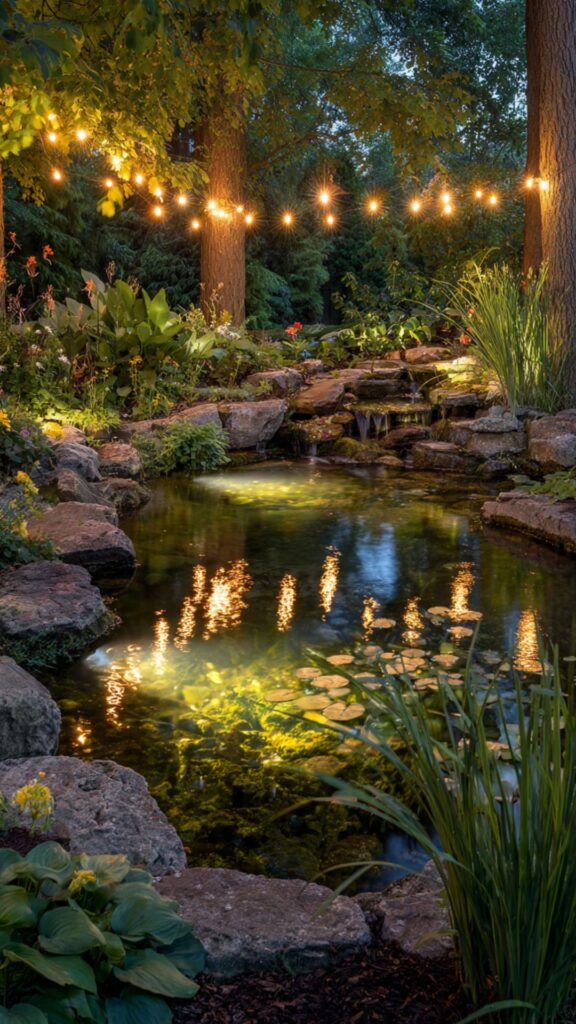
Water feature lighting is one of the most visually spectacular garden lighting techniques available, yet it remains underexplored by the majority of homeowners who have ponds, fountains, or water walls in their gardens. Submersible LED lights placed within a pond or beneath a water feature create extraordinary effects the movement of water scatters and refracts light in constantly shifting patterns that animate the entire surrounding garden with reflected movement. No static lighting technique achieves anything close to this level of dynamic visual interest.
Submersible garden pond lights must be specifically designed and rated for permanent underwater use. IP68-rated submersible LEDs are the correct specification this rating guarantees continuous immersion protection, as opposed to splash resistance ratings that degrade rapidly in constant contact with water. Incorrectly specified lights used in ponds create genuine safety hazards and typically fail within weeks.
Quality submersible garden lights from reputable manufacturers use sealed, potted LED modules with no accessible connections, eliminating the risk of water ingress entirely. The positioning of pond lights significantly affects the visual outcome. Lights directed upward from the pond floor create the most dramatic silhouette effects,
particularly when aimed at emergent plants, fountain jets, or waterfall cascades. Side-directed lights illuminate underwater planting and fish movement, creating an aquarium-like quality after dark. Floating solar lights add a surface-level element that moves naturally with water movement, creating a completely different and more playful lighting effect that works particularly well in wildlife ponds and naturalistic garden settings.
Coloured LED submersible lights are available and can create striking effects, but they require careful use to avoid looking garish. Single-colour applications deep blue for a contemporary pool, warm amber for a traditional koi pond work far better than multicolour settings, which tend to undermine the natural beauty of the water feature. The most sophisticated approach is to use colour-changing submersibles set permanently to a single carefully chosen colour that complements the surrounding garden palette at night.
Smart Garden Lighting Systems:
Technology That Transforms Control
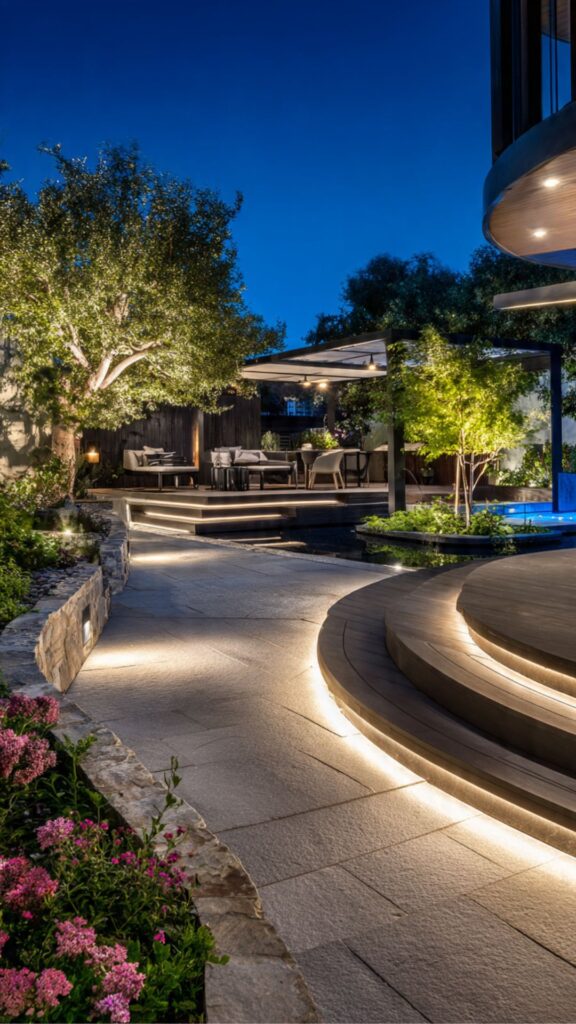
Smart garden lighting has moved from a luxury novelty to a genuinely practical and increasingly affordable option for the modern homeowner. Connected garden lighting systems allow complete control of every light in the garden from a single app, enabling homeowners to create scenes, set schedules, adjust brightness, and respond to motion all without leaving the house. For garden owners who travel frequently or simply value convenience, the practical benefits are substantial and immediate.
The architecture of a smart garden lighting system typically involves a central hub or bridge that connects to the home’s Wi-Fi network, with individual smart switches, plugs, or purpose-built smart fixtures connected to it. Philips Hue Outdoor, Lutron Caseta, and LIFX are among the leading systems offering dedicated outdoor smart lighting ranges.
Each has a different approach to ecosystem integration and control, so selecting the system that is most compatible with your existing smart home devices is the most important purchasing decision to make before buying individual fixtures.
Motion-triggered smart garden lighting deserves special attention as a security tool that most homeowners underutilise. Unlike traditional PIR motion lights that activate to full brightness and alarm visitors and neighbours, smart motion lights can be programmed to activate at low brightness when triggered by wildlife or gentle movement scaling up to full illumination only when a more significant motion pattern is detected.
This nuanced response makes smart motion lighting far more useful and neighbour-friendly than conventional motion-sensing alternatives. One underreported capability of smart garden lighting systems is their integration with astronomical clock functions. These systems automatically adjust on and off times based on the precise sunset and sunrise times for your geographic location, recalibrating daily throughout the year without any manual input.
This means the garden lights are never accidentally left on through the night or failing to activate during an unexpectedly early winter sunset. For gardens where consistent, hands-free operation is a priority, this feature alone justifies the smart lighting investment.
Festoon Lights for Garden Entertaining:
The Ultimate Outdoor Ambiance Tool
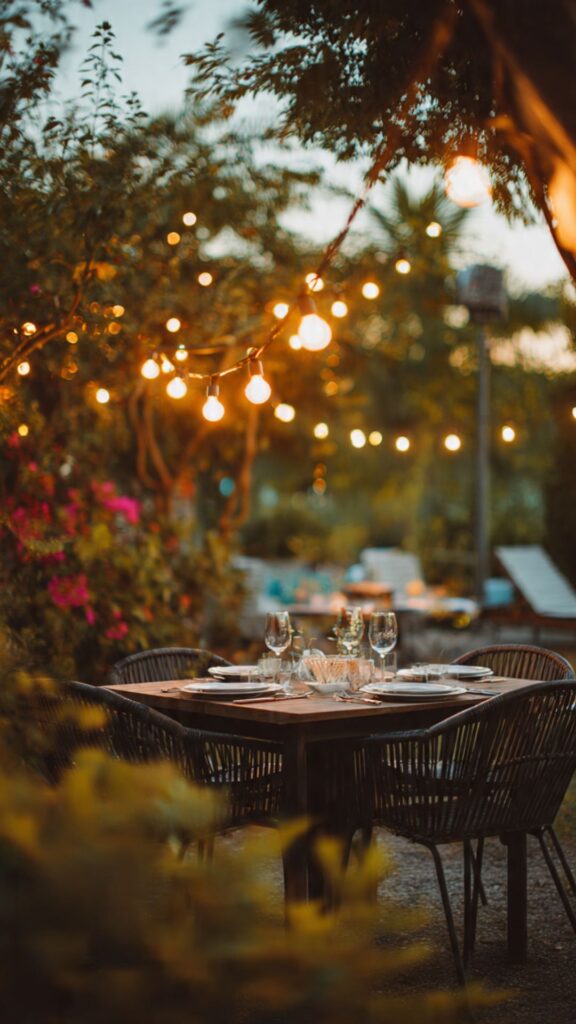
Festoon lights have become the defining outdoor entertaining lighting trend of the past decade, and for good reason. Their warm, oversized bulbs suspended between posts, trees, or pergola beams create an instantly celebratory atmosphere that transforms a garden into an outdoor room regardless of its size or style.
From intimate dinner parties to large summer gatherings, festoon lights provide the perfect backdrop flattering to guests, warm in colour, and immediately communicating that the space has been thoughtfully prepared.
Choosing between vintage Edison-style bulbs and modern LED festoon bulbs is a decision worth considering carefully. Edison-style bulbs with their visible glowing filaments deliver an exceptionally warm, characterful light that photographs beautifully and creates genuine nostalgia.
However, they consume significantly more energy than LED alternatives and have a much shorter lifespan. LED festoon bulbs in an amber-tinted format now closely replicate the filament aesthetic while delivering substantially better efficiency and durability. For a garden used heavily through the entertaining season, LED is the more practical long-term choice.
The structural installation of festoon lights requires more thought than their casual appearance suggests. Spans exceeding three to four metres require intermediate support either a central post, a tensioned wire, or a structural anchor point to prevent the cable from sagging and compromising both the aesthetic and the waterproof integrity of the connections.
Properly tensioned festoon light installations maintain a gentle, intentional curve rather than the drooping sag that characterises poorly planned installations. This structural detail is rarely discussed in retail product descriptions but makes an enormous difference to the finished result.
For year-round outdoor living spaces covered terraces, garden rooms, and large pergolas permanently installed festoon lighting on a weatherproof circuit with a dimmer capability creates a garden entertaining setup of genuine quality.
The ability to dim festoon lights from full entertaining brightness down to a soft, ambient glow as the evening progresses mirrors the lighting transitions of a well-managed restaurant interior and achieves the same effect of extending the evening comfortably and naturally.
Garden Border and Bed Lighting:
Illuminating Planting for Nighttime Beauty
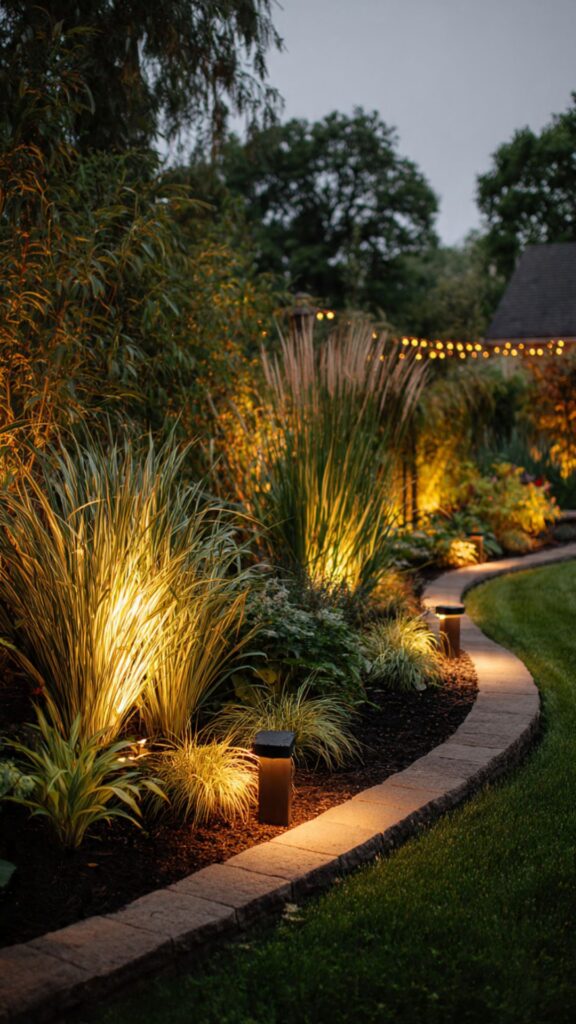
Illuminating garden planting borders, raised beds, and specimen plants is one of the most rewarding and least commonly executed garden lighting techniques. During daylight hours, a garden’s planting is its primary visual asset. At night, without lighting, those same plants become invisible dark masses that contribute nothing to the garden’s atmosphere.
Strategic low-level lighting within and around planting areas transforms this entirely, revealing the texture, form, and colour of foliage and flowers in ways that can be genuinely more beautiful than their daytime appearance.
Low-voltage LED spike lights inserted directly into border planting are the most practical tool for illuminating garden beds. Their spike mounting allows repositioning as planting matures and changes seasonally an important flexibility given that a border in June looks completely different from the same border in October.
Positioning spike lights to illuminate from below and slightly behind the plant rather than pointing directly at the front of the plant creates a more naturalistic, layered quality of light that avoids the harsh, interrogation-lamp effect of front-on illumination.
Grasses and ferns respond particularly well to backlighting within garden borders. The translucency of their fine foliage allows light to pass through rather than simply reflect off the surface, creating a glowing, luminous quality that is genuinely spectacular on calm evenings.
Placing a small LED spike light immediately behind a clump of ornamental grass Stipa tenuissima or Deschampsia flexuosa, for example and directing it upward at a shallow angle creates a beacon of warm light within the border that anchors that section of the planting scheme after dark.
Uplighting large specimen plants within borders a standard rose, a clipped box topiary, or an architectural agave creates focal points within the planting scheme that guide the eye and give the nighttime garden a structured hierarchy.
Without this hierarchy, all elements compete equally for attention and the result is visual noise rather than composition. Treating the night garden as a curated lighting composition with focal points, middle ground, and ambient fill is a professional landscape design principle that elevates any garden lighting scheme significantly.
Colour-Changing Garden Lights:
Creative Flexibility for Every Occasion
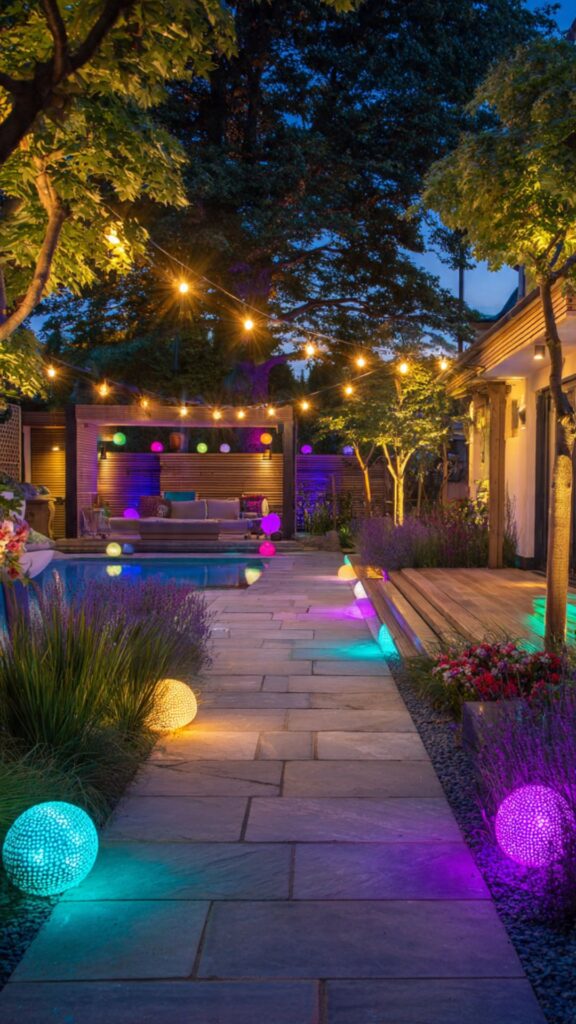
Colour-changing LED garden lights also known as RGB garden lights offer homeowners the ability to transform the mood, palette, and atmosphere of their outdoor space at the touch of a button. This flexibility makes them particularly valuable for gardens used across multiple contexts: family dining on a Tuesday evening, an adult dinner party on a Friday, a children’s garden party on a Sunday afternoon.
Each context benefits from a completely different lighting palette, and RGB garden lights deliver this variety from a single installed fixture. The key to using colour-changing garden lights effectively is restraint. The temptation to cycle through multiple colours or use saturated primaries results in a garden that looks like a fairground rather than a designed outdoor space.
The most sophisticated approach uses the full colour gamut primarily for special occasions, while establishing a high-quality warm white or soft amber as the default everyday setting. This approach preserves the garden’s ambient quality on ordinary evenings while retaining the flexibility for dramatic colour events when desired.
Specific colour palettes work exceptionally well in garden contexts. Deep blue lighting applied to swimming pools, water features, and surrounding planting creates a serene, resort-quality atmosphere that is tremendously effective for evening entertaining. Soft green lighting within tree canopies creates a bioluminescent, forest quality that suits wildlife gardens and natural planting schemes.
Warm amber applied to stone, timber, and terracotta surfaces enhances their natural warmth in a way that feels almost Mediterranean in character. Each palette tells a different story selecting the right one for the garden’s architecture and planting style is the designer’s skill.
Integration of colour-changing garden lights with smart home systems brings this flexibility to its fullest expression. Pre-programmed scenes “summer evening,” “winter warm,” “party mode” can be activated with a single voice command or app tap, eliminating the need to manually adjust individual fixtures.
Some advanced smart lighting platforms also allow synchronisation with music, adjusting light colour and brightness in response to audio input. While this feature is more relevant to indoor spaces, its outdoor application for garden parties and events creates genuinely memorable experiences.
Love a Beautiful Garden? Your Living Room Deserves the Same Attention.
Moonlighting Effect:
The Most Beautiful Garden Lighting Technique You’ve Never Tried
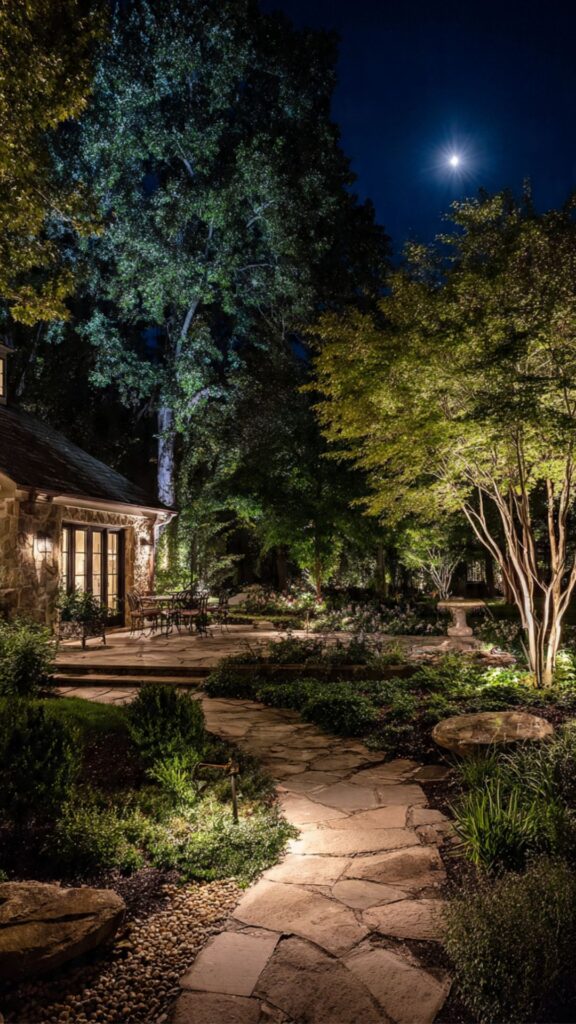
Moonlighting is a professional landscape lighting technique that involves mounting fixtures high in trees and directing soft, diffused light downward through the canopy to simulate the natural quality of moonlight filtering through branches. The result dappled, gentle light that moves with the wind is arguably the most beautiful effect achievable in garden lighting, yet it remains almost entirely unknown outside specialist landscape design circles.
This single technique, executed well, can transform an ordinary garden into something genuinely otherworldly. The technical requirements for moonlighting are relatively straightforward but must be correctly executed. Fixtures need to be mounted as high in the tree as is safely accessible ideally at two-thirds of the tree’s height or above.
LED downlights with a wide, diffused beam angle (60 degrees or wider) distribute light softly through the canopy, creating the dappled shadow pattern on surfaces below. Cool-white or neutral-white colour temperatures (3500–4000K) most closely replicate natural moonlight and should be used in preference to warm-white, which reads as lamp light rather than moonlight.
The shadow patterns cast by moonlighting on paved, gravel, or lawn surfaces below are as important to the visual effect as the light itself. The movement of these shadows in a breeze creates the animated, living quality that makes moonlighting so compelling. Gardens with established trees particularly those with interesting branch structure such as oak, olive, or multi-stemmed birch respond best to this technique.
Newly planted or small-canopy trees do not yet create sufficient leaf density to produce the desired dappled effect, though they can be pre-wired for moonlighting fixtures that will grow into their full effect over coming years.
Moonlighting is also the garden lighting technique most respectful of wildlife, neighbours, and the natural environment. By directing light downward rather than upward into the sky it minimises light pollution almost entirely while delivering its visual effect entirely within the garden boundary.
In an era of growing awareness about the damaging effects of artificial light on nocturnal wildlife and insect populations, moonlighting represents a technique that is as environmentally considered as it is aesthetically superior.
Sustainable Garden Lighting:
Designing for the Environment and the Future
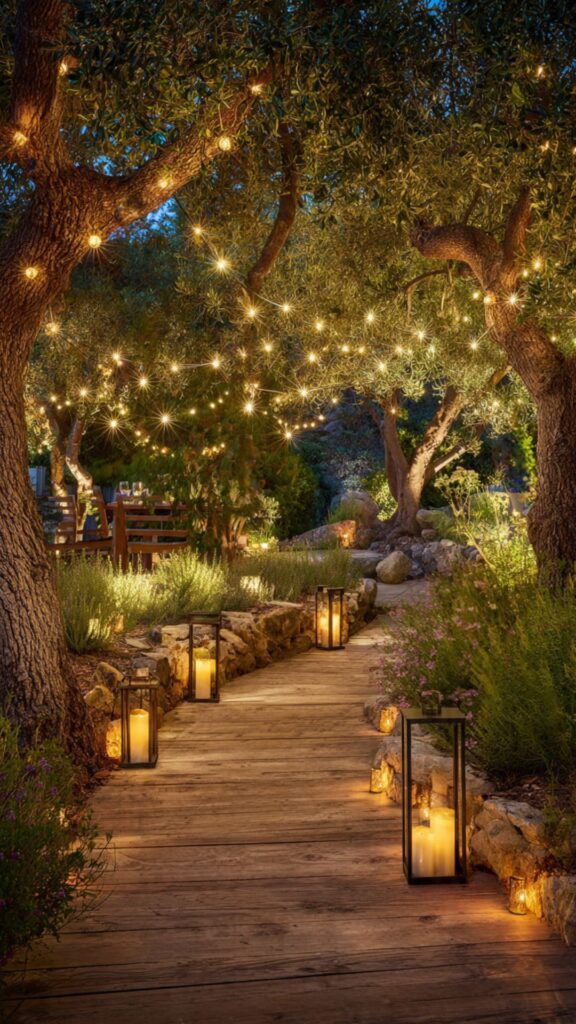
Sustainable garden lighting is no longer a niche interest reserved for committed environmentalists it is increasingly the baseline expectation of informed homeowners and a meaningful consideration in responsible garden design.
The outdoor lighting sector accounts for a significant proportion of household electricity consumption in most developed countries, and the design choices made in garden lighting have direct, measurable effects on energy use, wildlife habitats, and local light pollution levels. Making thoughtful choices at the specification stage costs little more than making uninformed ones.
The foundation of sustainable garden lighting is LED technology combined with controls. LEDs operating on a dusk-to-dawn sensor with an automatic shut-off at midnight consume a fraction of the energy of lights running all night without control.
Adding dimming capability reduces consumption further a light running at 50 percent brightness uses approximately 50 percent less energy, with the additional benefit of creating a warmer, more atmospheric garden environment. Timer controls, occupancy sensors, and smart scheduling are all straightforward tools that make a genuine and measurable difference to energy consumption with no compromise to light quality.
Wildlife-conscious garden lighting is a growing design discipline that addresses the well-documented harmful effects of artificial light on moths, bats, hedgehogs, and other nocturnal species that depend on darkness for navigation, feeding, and reproduction.
The practical design responses to this concern are simple and effective: use warm-white lighting (below 3000K) rather than cool-white or blue-rich LEDs, which are disproportionately disruptive to insect and bat navigation. Direct all light downward. Use motion sensors to limit the duration of illumination. Avoid lighting garden boundary hedges and wild areas where nocturnal wildlife shelters and feeds.
Looking ahead, the future of sustainable garden lighting includes solar systems powerful enough to operate all night through winter, bio-degradable fixture housings made from recycled materials, and fully integrated smart lighting networks that adapt in real time to occupancy, weather, and wildlife activity.
Several leading landscape design practices in the UK and Northern Europe are already specifying amber-only LED systems which have minimal impact on insect navigation as a standard rather than an optional addition. For homeowners who value both beautiful gardens and a responsible relationship with the natural environment, this is the direction in which garden lighting is unmistakably heading.
Conclusion
Garden lighting is one of the most transformative and rewarding investments a homeowner can make in their outdoor space. From solar stake lights along a simple path to the magical drama of professional moonlighting through mature tree canopies, the right lighting choices extend the enjoyment of your garden into every evening of the year.
The key takeaway is this: great garden lighting is not about brightness it is about placing the right quality of light in the right location for the right purpose. Start with one idea from this guide, apply it thoughtfully, and let your garden’s nighttime character begin to reveal itself.

Team TrandyVilla is the passionate home decor team behind Trandy Villa, where style meets comfort in everyday living. The team loves transforming simple spaces into beautiful, functional homes through smart ideas, budget-friendly hacks, and modern design trends. Their content focuses on helping readers create homes that feel both stylish and personal without spending too much.