
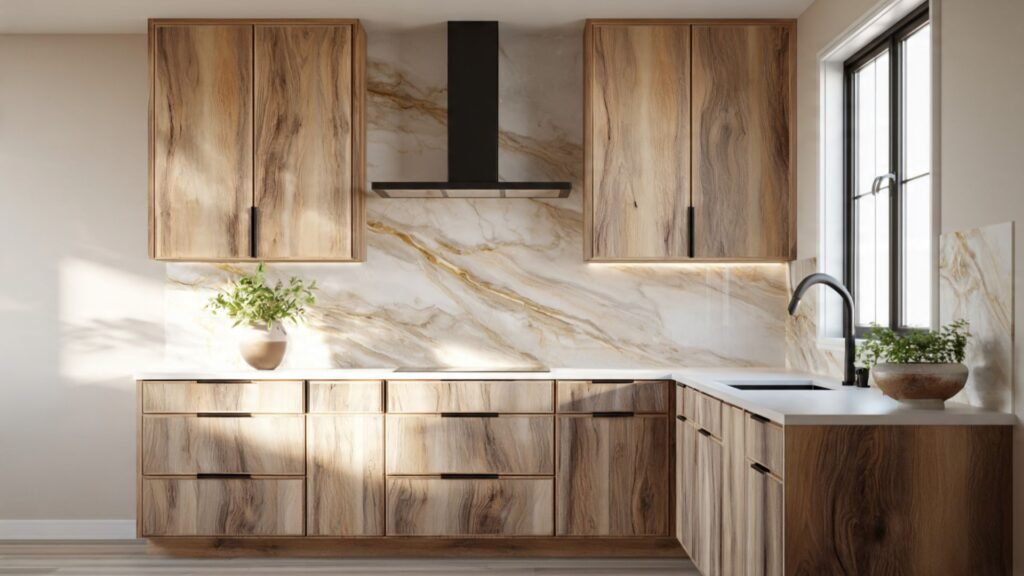
Your kitchen backsplash ideas does far more than protect walls from splashes and grease. It’s the visual backbone of your entire kitchen the element that ties countertops, cabinetry, and lighting into a unified design story. A well-chosen kitchen backsplash can increase your home’s perceived value by thousands of dollars, yet many homeowners treat it as an afterthought.
Kitchen Backsplash is a protective and decorative wall surface placed behind sinks and cooking areas that prevents stains, adds style, and improves kitchen value while offering easy cleaning and durable design solutions for modern and traditional home interiors everyday use.
Modern kitchen design emphasizes stylish backsplashes that enhance aesthetics, protect walls from moisture and grease, and increase property appeal through materials like tile, stone, glass, and wood, offering homeowners flexible choices for different budgets and interior styles today spaces globally.
Kitchen Backsplash Ideas help homeowners choose materials, patterns, and colors that match kitchen layouts. They guide renovation decisions, improve visual balance, and support long term durability while reflecting personal taste and modern interior design trends in practical ways effectively clearly.
Classic Subway Tile Backsplash:
The Evergreen Choice
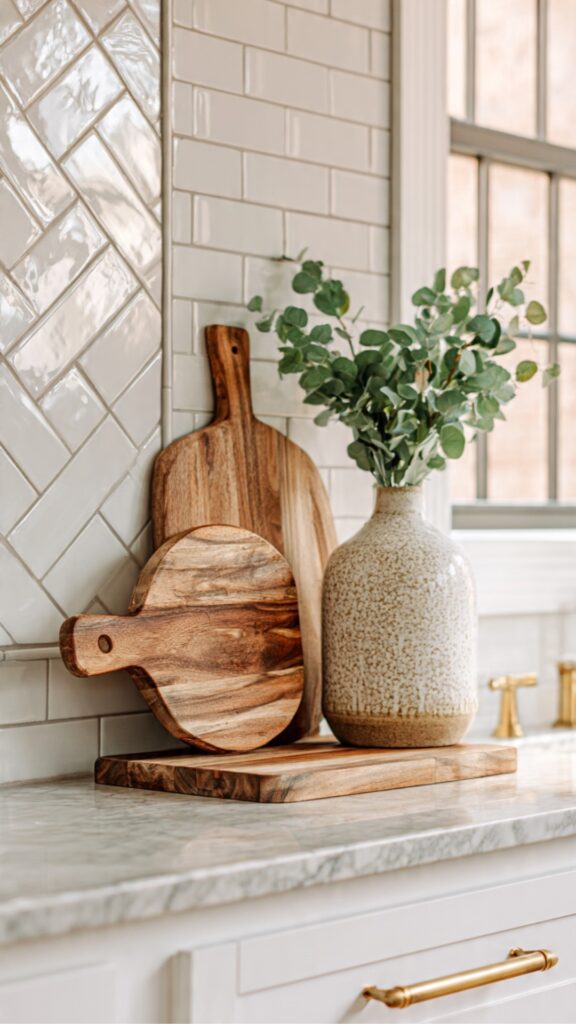
Subway tiles have dominated kitchen design for over a century, and there’s a genuine reason they keep coming back: they work. Originally installed in New York City subway stations in the early 1900s, these rectangular 3×6-inch ceramic tiles became a design shorthand for cleanliness, order, and timelessness. In kitchens, their flat reflective surface bounces light beautifully, making even compact spaces feel larger and more luminous than they actually are.
What most design guides won’t tell you is that the real magic of subway tile lies in the grout, not the tile itself. A bright white subway tile paired with a charcoal or dark gray grout creates a grid-forward, graphic look that reads as distinctly modern and bold.
The same tile with a matching white grout nearly disappears into the wall, creating an almost seamless, quiet backdrop. This means your budget doesn’t have to change your grout color choice does the heavy design lifting.
In 2026, the subway tile revival is leaning heavily into beveled edges and handmade variations with slight color variation per tile (crackle glaze, linen finish). These small imperfections add warmth that polished machine-made tiles can’t replicate.
For longevity, subway tiles are among the best investments in a kitchen backsplash ideas renovation. They’re easy to clean, widely available, and universally compatible with resale markets.
If you’re planning to sell your home within 5–10 years, a well-grouted subway tile backsplash is one of the safest aesthetic choices you can make. Consider running the tile all the way up to the ceiling behind open shelving for a dramatic, high-end finish that rivals much more expensive materials.
Zellige Moroccan Tile:
Artisan Character for Modern Kitchens
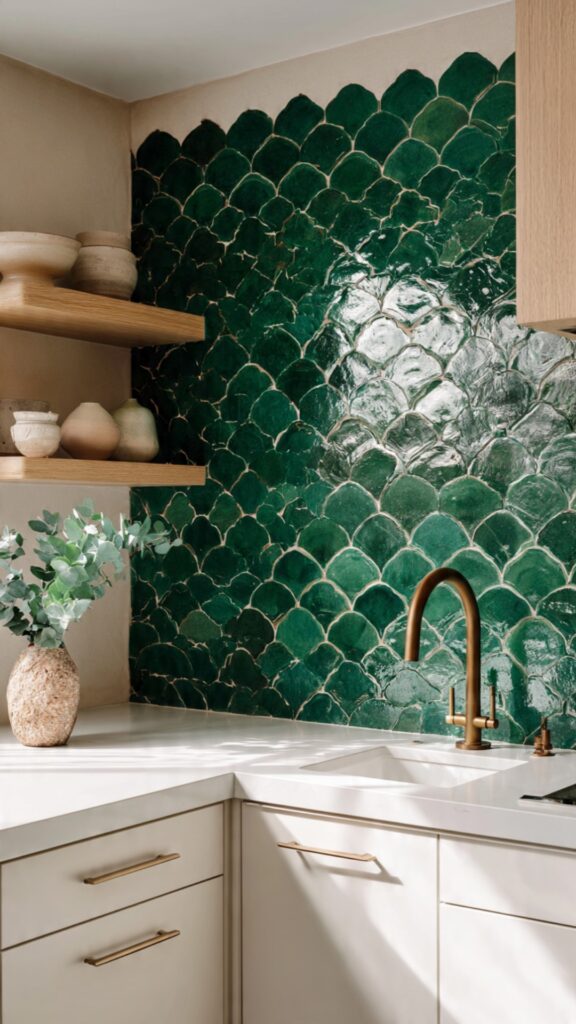
Zellige tile has arguably been the most talked-about backsplash material of the past three years and for good reason. Handcrafted in Morocco from natural clay and colored with mineral pigments, each Zellige tile is slightly different in color, thickness, and sheen. When installed together, these variations create a luminous, jewel-like surface that catches light from every angle.
No two Zellige walls ever look quite the same, which is precisely what makes them so covetable in an era of mass-produced interiors. The practical reality of Zellige, however, deserves careful consideration before you commit. Because each tile is hand-cut and hand-glazed, they’re not perfectly uniform installers need to be experienced with this material to avoid uneven layouts.
The surface is also more porous than standard glazed ceramic, so sealing is essential, particularly around the stove. Expect to pay a significant premium over standard tile: quality imported Zellige typically runs between $20–$50 per square foot before installation.
Order 15–20% more Zellige tile than your square footage requires. Breakage during cutting is higher than with regular tile, and dye lots between batches can vary noticeably.
Color-wise, Zellige shines brightest in sage green, terracotta amber, deep cobalt, and creamy white. A full-height sage Zellige backsplash behind a farmhouse sink, paired with warm wood open shelving, is one of the most-pinned kitchen combinations on design platforms right now.
As more homeowners lean into the “collected, slow-living aesthetic,” Zellige will remain a strong design choice well into the next decade it’s not a trend so much as a rediscovery of craftsmanship.
Do Not Leave Without Reading: Farmhouse Kitchen Ideas That Pair Absolutely Beautifully with Your Stunning Kitchen Backsplash ideas
Marble Slab Backsplash:
Seamless Luxury, Zero Grout Lines
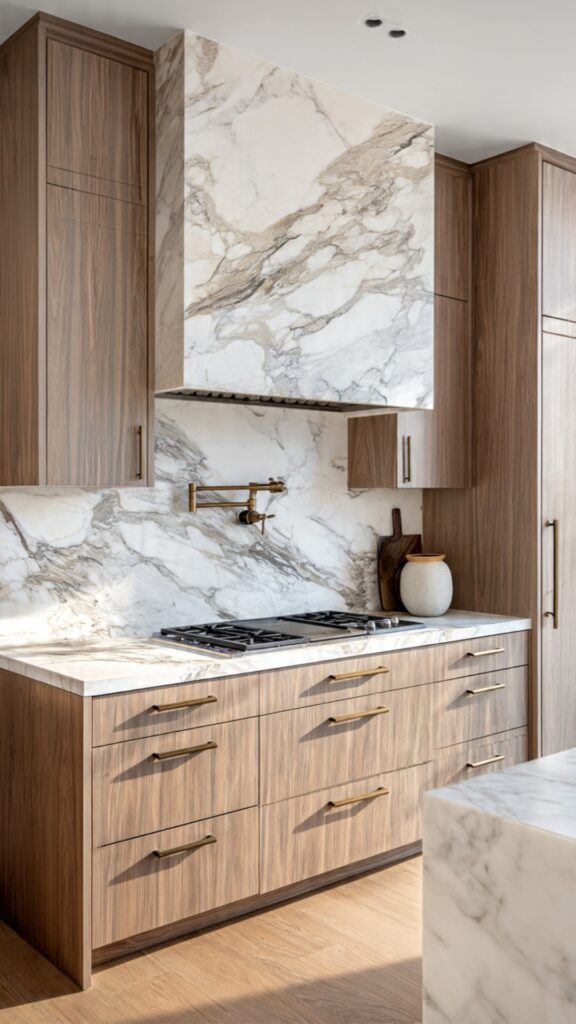
A marble slab backsplash represents the pinnacle of kitchen luxury and it’s a genuinely different design choice from marble tile. Rather than working with individual pieces, a slab installation uses large, continuous sheets of natural stone that run from countertop to upper cabinet without interruption.
The result is an unbroken sweep of veining that creates an almost architectural sense of drama, particularly when the slab is “book-matched” meaning two slabs are opened like a book so their mirror-image veining meets in the center.
The performance concerns around natural marble are real but often overstated. Yes, marble etches and can stain if acidic liquids like lemon juice or wine are left to sit. However, the etching that forms on honed marble (matte finish) over time develops into what designers call a “patina”.
A lived-in character that many homeowners actually come to love. For busy family kitchens, consider a leathered or honed finish rather than polished, as it hides fingerprints and minor marks far more forgivingly.
For 2026 and beyond, the most exciting marble development is engineered sintered stone (like Dekton or Neolith) that mimics marble’s look with near-zero porosity. It’s heat-proof, stain-resistant, and available in large format slabs a genuine evolution over both natural marble and standard porcelain.
Budget-wise, natural marble slabs start around $40–$100 per square foot installed, though premium varieties like Calacatta Gold or Statuario can reach well above that. A smart alternative: use a marble slab only above the range as a statement focal piece, and pair it with simpler tile across the rest of the kitchen. This approach delivers maximum visual impact at a fraction of the full cost a design move that many high-end kitchen backsplash ideas designers use themselves.
Terracotta & Earthy Tile:
Warmth That Never Goes Out of Style
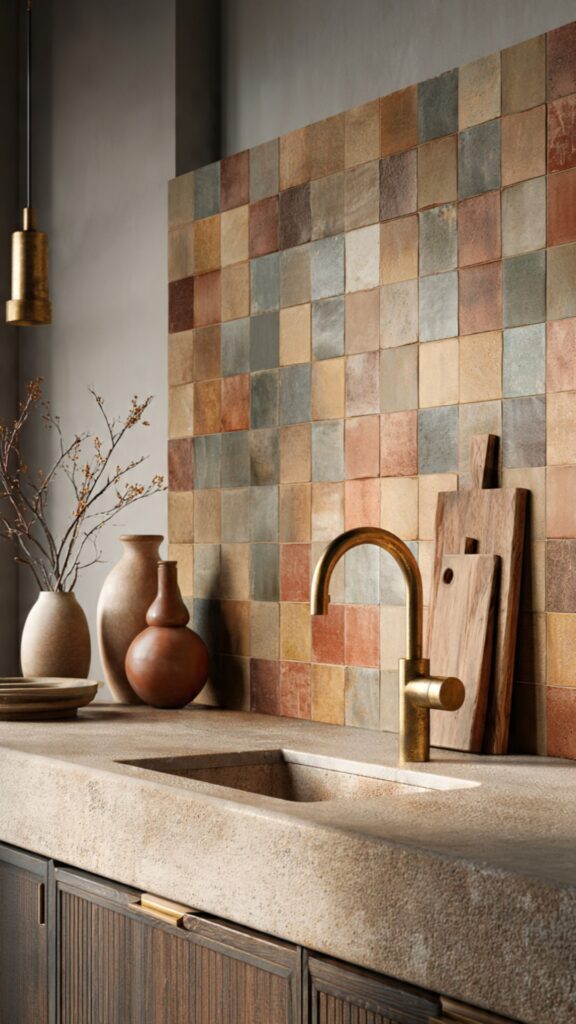
Terracotta is the original backsplash material, predating virtually every other option on this list by thousands of years. Made from fired clay in warm red, orange, and amber tones, terracotta tiles carry a visual warmth that ceramic or porcelain simply cannot replicate artificially.
In recent years, terracotta has made a massive comeback not as a rustic country kitchen backsplash ideas cliché, but as a sophisticated, grounding element in contemporary and Mediterranean-inspired kitchen designs Modern terracotta tile comes in shapes far beyond the traditional square.
Hexagonal terracotta tiles create a honeycomb pattern that reads as both organic and geometric. Scallop-edged “fish scale” terracotta tiles add textural dimension. For backsplashes specifically, smaller format terracotta tiles (2×2 or 3×3 inches) work beautifully, as they create more grout lines that break up the intense warmth of the clay color and prevent the wall from feeling too heavy.
Quick Tip: Seal terracotta tile before grouting, not just after. The porous clay will absorb grout permanently if you skip this step, leaving a hazy residue that’s extremely difficult to remove.
Terracotta works beautifully with white plaster walls, natural linen fabrics, warm wood finishes, and unlacquered brass fixtures, creating a timeless Mediterranean or Southwestern-inspired look. Its earthy tones add warmth and character, making the space feel both relaxed and inviting.
It’s also a sustainable choice for kitchen or bathroom backsplashes. Unglazed terracotta is made from natural clay without synthetic dyes, and many manufacturers now offer reclaimed or recycled tiles from older buildings. For homeowners who value eco-friendly design, terracotta is one of the most responsible and long-lasting material options available.
Herringbone Pattern Tile:
Directional Drama in Classic Form
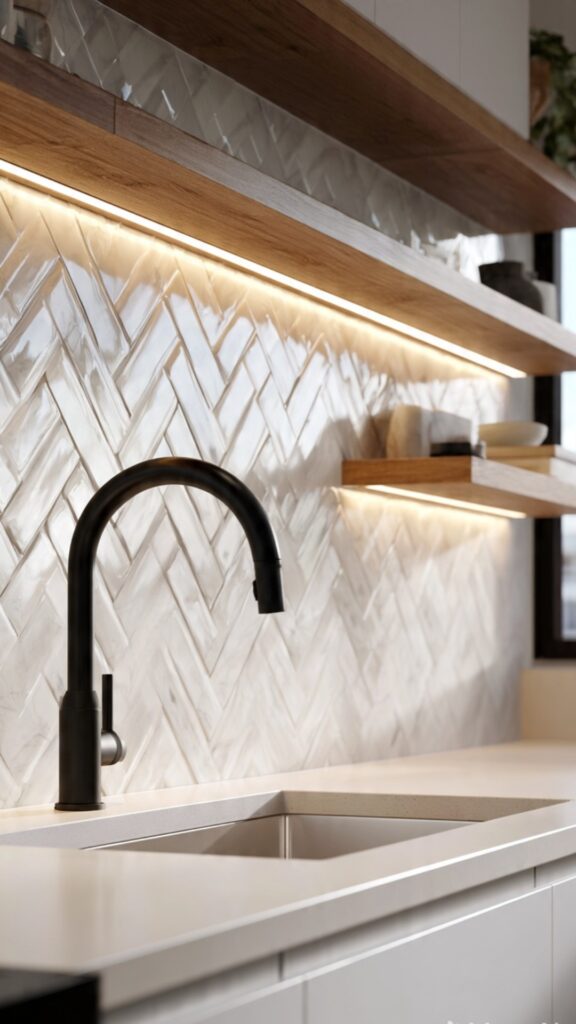
The herringbone pattern transforms even the most ordinary tile into something visually compelling. By setting rectangular tiles at 45-degree angles to form a zigzag “V” formation, the pattern creates a strong sense of movement and energy that standard horizontal or vertical layouts simply cannot achieve. In a kitchen context, herringbone backsplashes draw the eye horizontally making kitchens feel wider or vertically when oriented to emphasize ceiling height.
What separates a stunning herringbone from a merely decent one is the tile size and grout joint width. Thin-format tiles (3×9 or 2×8 inches) in herringbone create an elongated, elegant rhythm. Wider tiles make the pattern chunkier and more casual. For grout, narrow joints (1/16 inch or less) let the pattern speak clearly; wider joints risk making the installation look sloppy. This is a detail most tile installers know intuitively, but it’s worth discussing explicitly before work begins.
An emerging variation is “chevron” tile where tile ends are cut at an angle so the V-points meet precisely, rather than staggering. It’s more expensive to install due to cutting waste, but creates a sharper, more tailored result that reads as more contemporary than traditional herringbone.
Material-wise, herringbone works beautifully in marble, polished porcelain, matte subway tile, and even wood-look tile. The pattern is particularly striking in a two-tone approach alternating white and light gray tiles in herringbone creates a subtle woven texture that adds depth without visual chaos.
For a focal-point backsplash behind the range, a herringbone installation in a contrasting tile to the rest of the kitchen backsplash ideas creates an almost fireplace-like sense of centeredness and ceremony around the cooking zone.
Glass Tile Backsplash:
Light-Reflecting, Modern, and Low-Maintenance
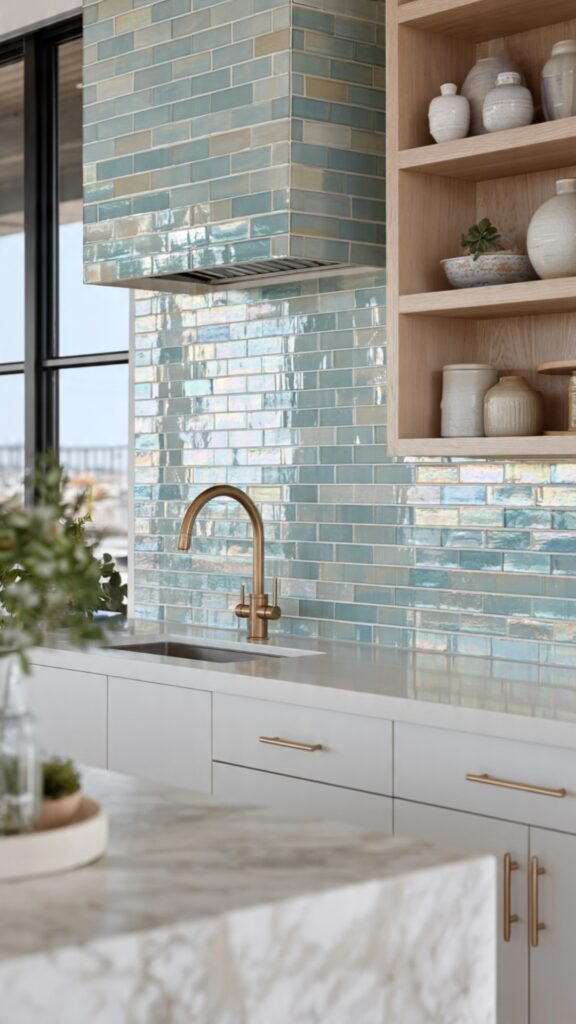
Glass tile backsplashes have a unique optical quality that no other material replicates: they reflect light from both the front surface and from inside the glass body itself, creating a subtle luminosity that shifts depending on your kitchen’s lighting conditions.
This makes glass tile an exceptional choice for kitchens with limited natural light particularly north-facing rooms or basement kitchens where every bit of reflected brightness matters. Aqua, seafoam, and pale blue glass tiles are consistently among the best-selling colors because they amplify whatever natural light exists.
From a maintenance standpoint, glass tile is one of the most practical backsplash choices available. Non-porous and completely impervious to staining, glass wipes clean with minimal effort there’s no sealing required, and grout lines (often sealed with epoxy grout in glass tile installations) resist discoloration over time. The main practical caveat is that standard glass tile shows water spots and fingerprints more readily than matte surfaces, particularly in high-contrast colors like deep charcoal or navy.
Quick Tip: Always use white or light-colored thinset mortar beneath glass tile any dark-colored adhesive bleeds through translucent glass and significantly mutes the tile’s color and luminosity.
The most exciting development in glass tile is “iridescent” or “dichroic” glass, which shifts between multiple colors depending on viewing angle and light source. A surface that appears champagne gold in morning light might read as copper or rose in evening incandescent lighting. For homeowners who want a backsplash that feels genuinely alive and changing throughout the day.
Iridescent glass tile offers a dynamic quality that’s completely unique in the backsplash category and still relatively rare, which means it reads as distinctly individual rather than trend-chasing.
Concrete & Cement Tile:
Industrial Soul with Designer Sensibility
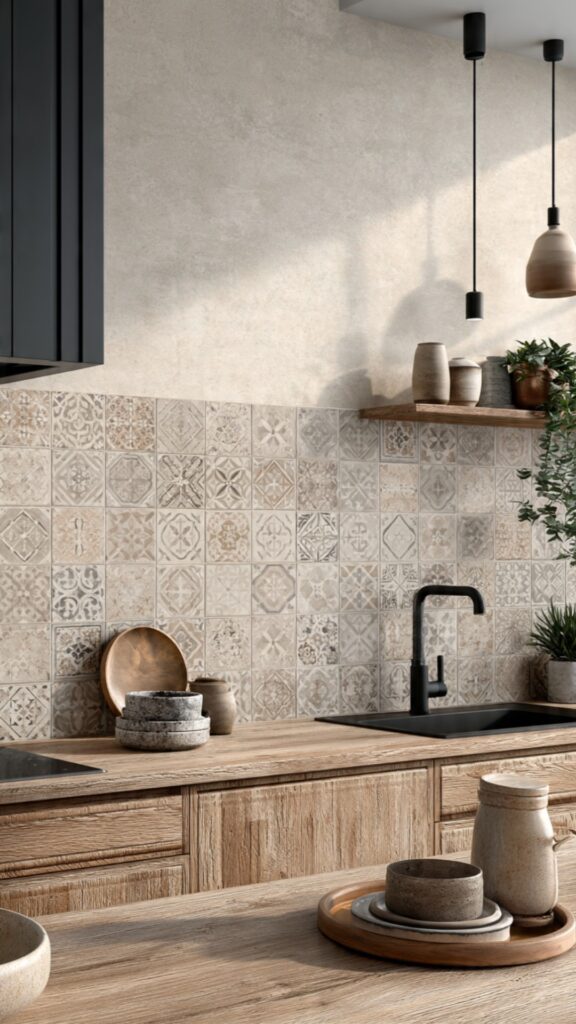
Concrete and cement-look backsplashes speak to a particular design philosophy: the beauty of raw, honest materials that don’t pretend to be anything they’re not. Poured concrete panels, concrete-look porcelain tile, and hand-pressed cement tiles each bring a different texture and weight to a kitchen wall.
In open-plan spaces with exposed beams, steel appliances, and reclaimed wood elements, a concrete backsplash anchors the industrial-organic aesthetic in a way that feels genuinely coherent rather than assembled. Actual poured concrete panels (often called “Ardex” or “microcement” when thin-applied) are gaining significant traction in high-end renovations.
Applied like plaster at 2–4mm thickness over existing tile or drywall, microcement creates a completely seamless surface no grout joints, no individual tiles, just a smooth continuous expanse of gray texture that reads as architectural rather than decorative. Sealed properly, it performs respectably in kitchen backsplash ideas environments, though it requires professional application and periodic resealing.
Concrete-look large-format porcelain (24×48 inches or larger) is the practical alternative to real concrete it delivers the same muted, textured aesthetic with zero porosity, no sealing requirements, and significantly simpler installation, though grout joints remain.
The color palette of concrete-inspired backsplashes has expanded considerably beyond standard gray. Warm taupe concrete, blush-tinted cement, and even terracotta-toned concrete finishes now appear in design-forward kitchens, bridging the gap between the industrial and the Mediterranean.
Cement encaustic tiles which are cement-bodied but feature geometric patterns pressed into the surface offer perhaps the most versatile option, combining the material’s authenticity with visual richness that competitors in the pure-gray concrete space simply can’t match.
Your Next Favorite Read: Blue Kitchen Cabinet Ideas That Create a Gorgeous Look Alongside Your Kitchen Backsplash
Reclaimed Wood Plank Backsplash:
Texture, Story, and Organic Warmth
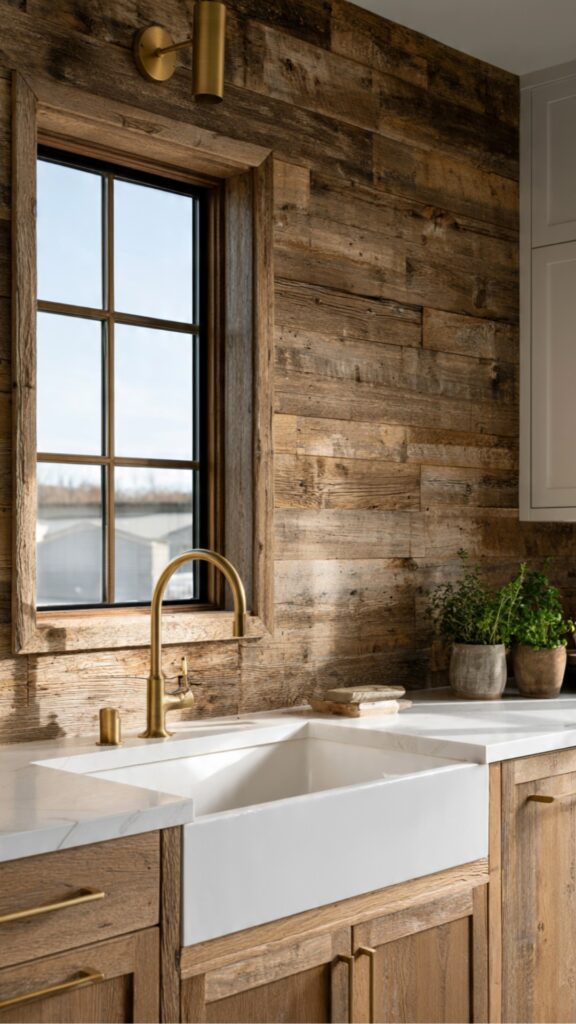
A wood backsplash is the design choice that surprises people most and converts them fastest when they see it done well. The instinctive objection is practical: wood in a kitchen, near heat and moisture? But the reality is that a properly sealed and installed wood backsplash behind a non-cooking wall (around a window, beneath open shelving, or behind a coffee station) performs beautifully for years. Even behind a range, heat-tempered wood or wood-look tile used strategically can create extraordinary visual warmth.
Reclaimed barn wood is the most popular variety for backsplash applications, for good reason. Its weathered gray, silver, and brown tones carry natural variation that new wood can’t replicate every plank tells a visual history. When installed horizontally in a kitchen backsplash ideas with white cabinetry and marble countertops, reclaimed wood creates the kind of organic contrast that feels genuinely collected rather than designed. It’s the backsplash equivalent of a handmade ceramic bowl on a perfectly set table.
Quick Tip: Use a penetrating oil finish rather than a surface lacquer on wood backsplashes it seals the grain without creating a plastic-looking film, and it’s far easier to spot-repair if damage occurs over time.
For kitchens where actual wood feels too risky particularly around high-use cooking areas wood-look porcelain tile in plank format delivers the aesthetic without the maintenance concerns. Modern wood-look porcelain has reached a level of photographic realism that even design professionals sometimes mistake for the real thing on first glance.
The difference, of course, is in the touch: real wood has warmth and texture that no tile fully replicates. But in a photograph-friendly kitchen backsplash ideas designed partly for social sharing, the visual distinction matters less than many purists would admit.
Stacked Vertical Tile:
A Simple Layout Change with Big Visual Impact
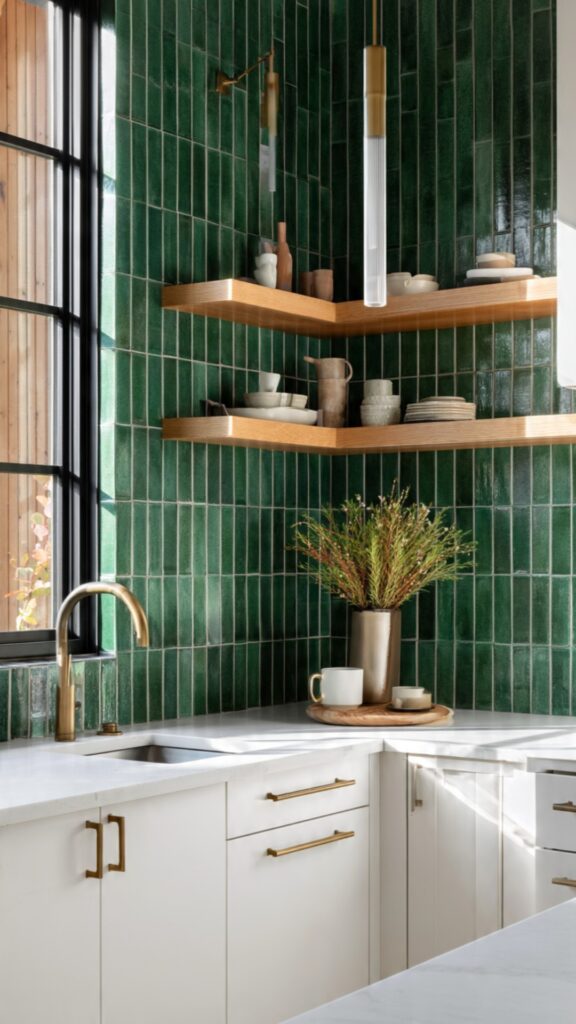
Sometimes the most transformative design decision isn’t the material you choose it’s how you orient and stack it. Stacked tile (where tiles are laid in perfect vertical or horizontal columns with no offset) creates a dramatically different visual rhythm than traditional brick-bond patterns.
Vertical stacking, in particular, draws the eye upward, making kitchen walls feel taller and more proportional in rooms with standard 8-foot ceilings. This is a technique actively used by interior designers to “correct” squat kitchen backsplash ideas proportions without structural work.
The stacked pattern works best with rectangular tiles rather than squares, since the directional emphasis of the layout needs the length of the tile to carry the vertical line. Long, thin tiles in the 2×8 or 2×12 inch range create almost a reeded or fluted effect when stacked vertically particularly in soft stone or matte ceramic. This pairs exceptionally well with handleless, flat-front cabinetry in a contemporary European kitchen aesthetic, where every surface is intentional and clean.
Installers sometimes charge more for stacked layouts than traditional offsets because they require more precise cutting and alignment especially around outlets and windows. Always confirm your installer’s experience with this pattern before signing a contract.
From a trend perspective, vertically stacked tile gained massive momentum from the “Japandi” design movement the fusion of Japanese minimalism and Scandinavian warmth that has dominated interior design publications since the early 2020s.
In this context, long format vertically stacked tile in soft off-white, warm gray, or pale greige (gray-beige) creates exactly the kind of considered, serene backdrop that Japandi kitchens require. It’s a quietly confident choice that ages exceptionally well precisely because it avoids ornamental complexity.
Mosaic Tile Backsplash:
Intricate Detail for Statement Spaces
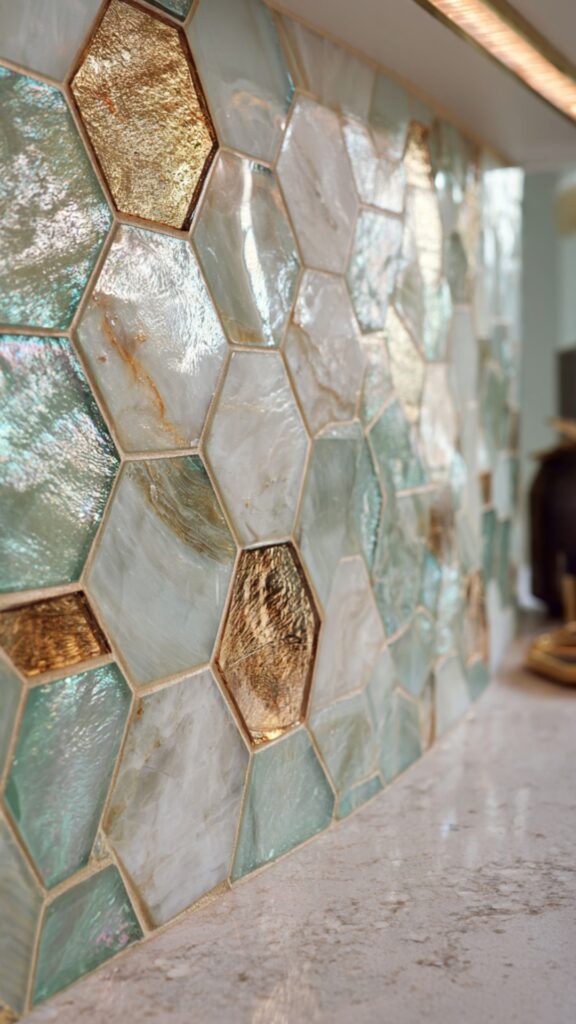
Mosaic tiles, usually made from pieces smaller than 2×2 inches and attached to mesh-backed sheets, add a level of detail and texture that larger tiles cannot achieve. They are available in many styles, from simple single-color glass designs to more decorative patterns featuring stone, mirror, or metallic finishes.
Because mosaics offer endless design possibilities, they can make a kitchen backsplash ideas feel more artistic and unique. Their intricate appearance adds personality and visual depth, making them a great choice for homeowners who want a space that feels stylish and one of a kind.
A key design principle with mosaic backsplashes is the concept of visual distance. Up close, a mosaic resolves into its individual pieces the texture, variation, and craftsmanship become visible and tactile. From across the kitchen, the same mosaic reads as a unified color field or image.
This means choosing a mosaic design requires thinking about how it will look both in detail (while cooking up close) and from across the room (during everyday use). Complex pictorial mosaics tend to work better as framed feature panels above the range rather than across an entire backsplash run.
Tip: Mesh-backed mosaic sheets need to be set into the mortar within 15 minutes of spreading the adhesive skins over quickly, particularly in warm weather, causing sheets to shift and misalign during installation.
For 2026, one of the most exciting mosaic developments is the use of recycled glass cullet crushed glass from wine bottles and industrial waste pressed into mosaic sheets with a highly irregular, jewel-like surface. These eco-forward mosaics combine genuine sustainability credentials with a visual richness that mass-produced tile cannot match.
Several independent tile studios now offer custom recycled glass mosaic commissions, where homeowners can specify colors drawn from a specific bottle type or glass source a genuinely personalized and environmentally conscious backsplash option.
Fluted & 3D Tile, Kitchen Backsplash Ideas:
Sculptural Surfaces That Change With Light
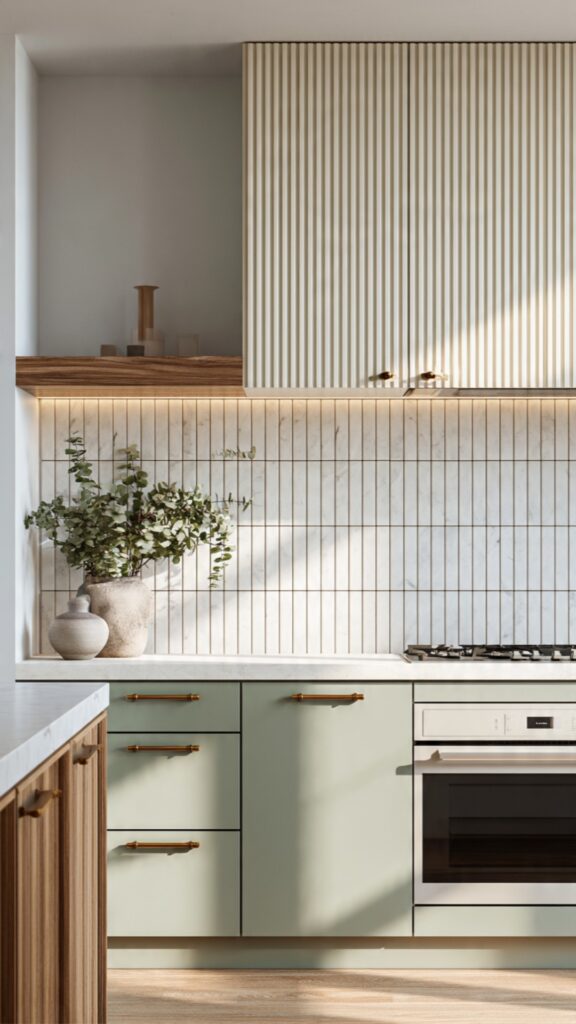
Fluted and three-dimensional textured tiles represent one of the most exciting developments in kitchen backsplash ideas design in recent years. Rather than relying on color or pattern alone for visual interest, these tiles use physical relief grooves, ridges, ripples, or geometric protrusions to create surfaces that shift in appearance as light moves through the kitchen throughout the day.
A fluted white tile installation in morning light creates soft, dramatic shadows that entirely disappear under flat afternoon light giving you a backsplash that’s visually dynamic without being busy or distracting.
The design vocabulary of 3D tiles has expanded significantly beyond simple fluting. Wave-profile tiles, diamond-grid tiles, petal-shaped bas-relief tiles, and curved “scallop” tiles are all available from major tile manufacturers now. What unites them is the principle of light interaction the tile’s color becomes secondary to its physical form.
This means monochromatic palettes (all white, all cream, all sage) tend to work best with textured tiles, allowing the shadows created by the relief to provide all the visual complexity the wall needs.
Fluted tiles require experienced installation grout lines must be perfectly consistent to avoid the “shadow” of grout interrupting the clean geometry of the ridges. Many designers specify unsanded grout in narrow joints specifically for this application.
From a spatial design standpoint, fluted tiles deserve special consideration in kitchen spaces adjacent to living or dining areas. Because their visual interest is subtle and shifts with ambient lighting rather than announcing itself immediately, they create a sense of discovery guests often don’t notice the texture at first, then find themselves drawn closer to examine it.
This quality of considered restraint is increasingly valued in contemporary kitchen design as a counterpoint to the maximalist statement backsplashes that dominated the previous decade of kitchen backsplash ideas renovations.
Matte Black Tile Backsplash:
Dramatic Contrast for Modern Kitchens
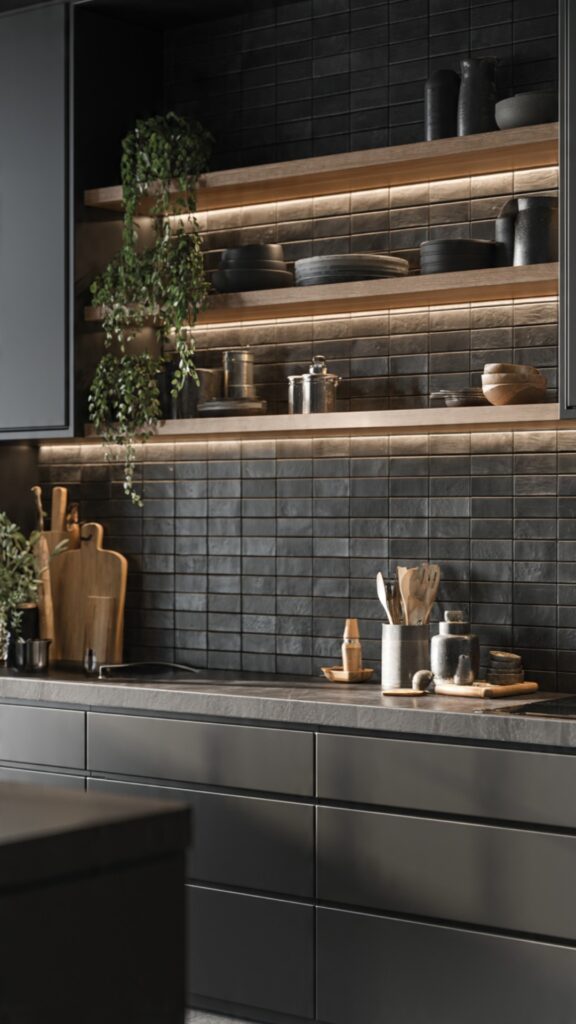
Matte black backsplash tile is the design equivalent of a tailored black suit timeless, immediately sophisticated, and surprisingly versatile despite appearing limiting on first consideration. In kitchens with white or light gray cabinetry, a matte black backsplash creates an electric contrast that photographs beautifully and reads as confidently contemporary in person.
In kitchens with warm wood cabinetry or walnut-toned finishes, the same black tile reads warmer and more intimate the matte finish absorbing rather than competing with surrounding tones.
One of the biggest mistakes people make with black backsplashes is choosing a glossy finish instead of matte. While glossy black tiles look bold and eye-catching, they tend to show fingerprints, water spots, and grease marks very easily, which means they need frequent cleaning to maintain their appearance. Matte black tiles, on the other hand, are much better at hiding everyday marks and smudges.
The only downside is that matte black can sometimes make a kitchen backsplash ideas feel darker or smaller if the rest of the space lacks enough light and contrast. Pairing it with lighter colors, reflective surfaces, or good lighting helps create a more balanced and modern look.
Tip: Balance a matte black backsplash with warm-toned lighting (2700K–3000K color temperature) rather than cool white LEDs. Cool lighting on black surfaces reads as institutional; warm lighting creates depth and drama.
Black tile’s versatility extends to materials beyond ceramic. Black slate, black limestone, black basalt, and black quartzite all appear in kitchen backsplash ideas applications, each with distinct textural qualities. Charcoal slate, for instance, has a naturally split surface with silver and dark blue mineral veining that prevents the monotony of a flat black surface.
As the “dark kitchen” aesthetic continues its rise with designers increasingly specifying inky cabinets, dark islands, and moody hardware black backsplash tile has evolved from an edgy statement choice into a foundational element of a genuinely contemporary kitchen vocabulary.
One More Thing: Dark Rustic Kitchen Ideas That Show How the Perfect Backsplash Can Transform Your Whole Kitchen
Patterned Encaustic Tile:
Global Craft Tradition Meets Contemporary Kitchens
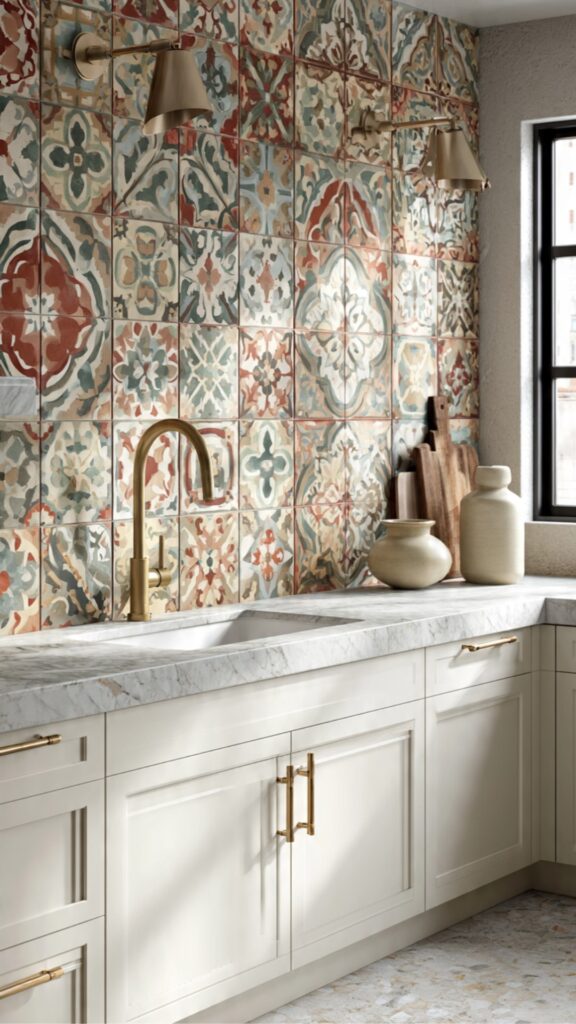
Encaustic cement tiles also called hydraulic tiles in European contexts have been produced by hand in North Africa, Portugal, Spain, and South America for over 150 years. Unlike glazed ceramic, their color and pattern penetrate through the entire body of the tile (to a depth of 3–4mm), which means surface wear doesn’t strip away the design.
In high-traffic kitchen environments, this makes them among the most durable patterned tile options available the pattern literally cannot wear off in the way surface-printed designs eventually do.
The design vocabulary of encaustic tile is extraordinarily rich. Geometric star-and-cross patterns from Moorish architecture, bold bicolor graphic designs from Portuguese tradition, and delicate floral motifs from Victorian-era English tile-making all exist within this category.
For kitchen backsplash ideas, the most successful encaustic applications tend to select one pattern and one or two accent colors that echo elements already present in the kitchen a tile whose blue matches the kitchen’s trim color, or one whose warm amber mirrors existing copper fixtures.
Encaustic tiles should always be sealed before grouting and again after their cement body is highly absorbent and will permanently stain with grout residue if this step is skipped. Use a penetrating, non-film-forming sealer applied in at least two coats.
A particularly effective design move with patterned encaustic tile is restraint in placement. Rather than tiling an entire backsplash run in a bold geometric pattern (which risks visual overwhelm), consider using encaustic tile as a bordered feature panel perhaps a 24×30 inch section above the range framed on all sides by simple contrasting border tiles.
This approach creates a decorative focal point that references global craft traditions while keeping the broader kitchen backsplash ideas palette calm and livable. It’s a design approach commonly used in high-end hotel kitchens, where the goal is personality without chaos.
Butcher Block Extension Backsplash:
Continuity, Function, and Warmth
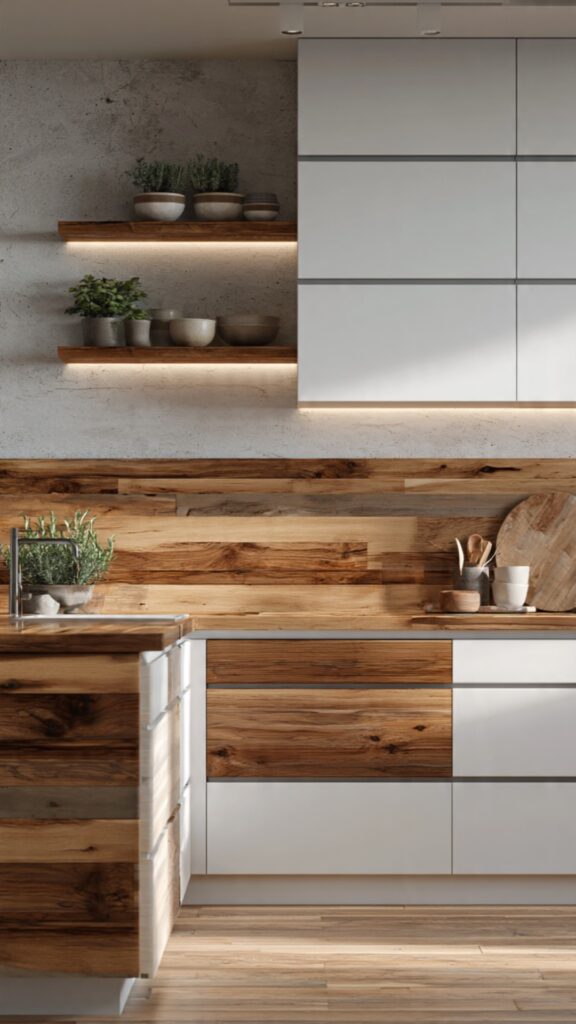
Extending a butcher block countertop vertically up the wall as a backsplash typically 6 to 18 inches above the counter creates one of the most seamless and functional kitchen designs possible. The visual continuity of the wood flowing from horizontal surface to vertical wall eliminates the visual break that a contrasting backsplash material creates, making even small kitchens feel more expansive and carefully considered.
In farmhouse and Shaker-style kitchens particularly, this approach creates an almost furniture-like quality to the counter zone that feels handmade and permanent.
The practical benefits extend beyond aesthetics. The butcher block backsplash section immediately behind a prep area is genuinely useful a place to lean cutting boards, prop recipe tablets, and provide a slightly warmer, quieter surface than tile for the inevitable times something hits the wall during active cooking. Wood also absorbs rather than reflects sound, making a kitchen backsplash ideas with a wood backsplash perceptibly quieter than one with tile or stone during meal preparation.
Tip: Use end-grain butcher block for vertical backsplash applications where possible its cellular structure is more resistant to moisture penetration than face-grain or edge-grain wood, and it provides a naturally different (more grid-like) visual texture than standard plank configurations.
Maintenance is the legitimate concern with butcher block backsplashes. Unlike the countertop version, which can be sanded and re-oiled relatively easily, a vertical installation is harder to refresh without removing it entirely. For this reason, hardened finishes a penetrating hardwax oil or a food-safe polyurethane in 3+ coats perform better than pure mineral oil on vertical applications.
Wiping down the backsplash section immediately after cooking (rather than allowing grease and moisture to sit overnight) is the single most impactful maintenance habit for long-term performance.
Exposed Brick Backsplash:
Raw Character That No Tile Can Imitate
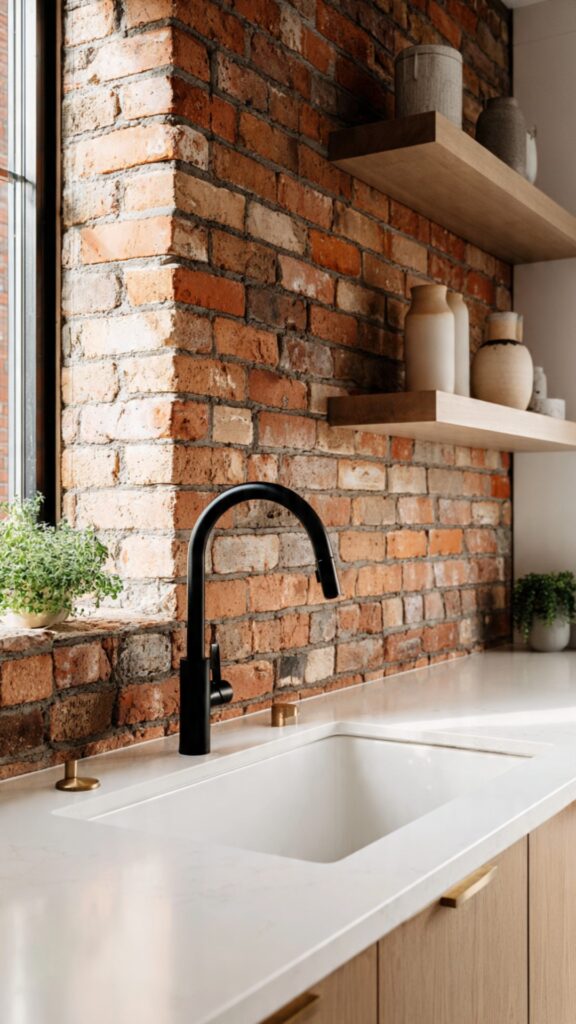
Exposed brick is perhaps the most democratizing of all kitchen backsplash ideas option, because in older homes it’s already there behind plaster, beneath drywall, waiting to be uncovered. And when it is uncovered, it brings an irreplaceable sense of history, permanence, and authenticity that no manufactured tile can replicate.
Each brick carries its maker’s imprint, the marks of its mortar joints, and the slight imperfections of a surface that was never intended to be decorative. This honest quality is precisely what makes it so desirable in an age of seamlessly designed interiors.
For homes without existing brick, thin brick veneers (3/8 to 1/2 inch thick brick slices adhered to the wall) provide a nearly identical aesthetic at far lower cost and disruption than structural brick installation. Quality thin brick veneer is difficult to distinguish from full-depth brick in normal kitchen lighting conditions, and it installs over standard drywall or cement board without requiring structural support.
Several manufacturers now offer thin brick in non-traditional colors whitewashed, charcoal-stained, and lime washed pale gray that bridge the gap between brick’s rustic heritage and contemporary kitchen backsplash ideas design.
Limewashing exposed brick applying a thin coat of diluted lime-based paint is one of the fastest-growing kitchen backsplash ideas transformation right now. It softens brick’s red tones into a pale, chalky warmth that photographs beautifully and pairs with virtually every cabinet color from white to deep navy to sage green.
Sealing is non-negotiable for kitchen brick backsplashes. Raw brick is extremely porous and will absorb cooking grease deeply within weeks without a penetrating sealer applied across the entire surface. A matte-finish brick sealer (not a gloss gloss finishes look plasticky and fake on brick) preserves the raw visual quality while providing a wipeable surface that performs reasonably well near cooking zones.
Reapplication every 3–5 years keeps the protection current. With proper sealing and maintenance, an exposed brick backsplash genuinely ages better than most tile options developing a patina of character that only improves with time in a well-used kitchen.
Conclusion
Your kitchen backsplash ideas is one of the highest-impact, most cost-effective upgrades available in any home renovation. Whether you’re drawn to the timeless simplicity of subway tile, the artisan character of Zellige, or the raw warmth of exposed brick, the right choice reflects how you actually live in your kitchen not just how it photographs.
Start with the surfaces you already love in your kitchen (countertops, cabinets, flooring) and work backward to a backsplash that elevates, not competes. The best kitchen backsplash ideas are the ones that make you feel something every time you walk into the room.

Team TrandyVilla is the passionate home decor team behind Trandy Villa, where style meets comfort in everyday living. The team loves transforming simple spaces into beautiful, functional homes through smart ideas, budget-friendly hacks, and modern design trends. Their content focuses on helping readers create homes that feel both stylish and personal without spending too much.