
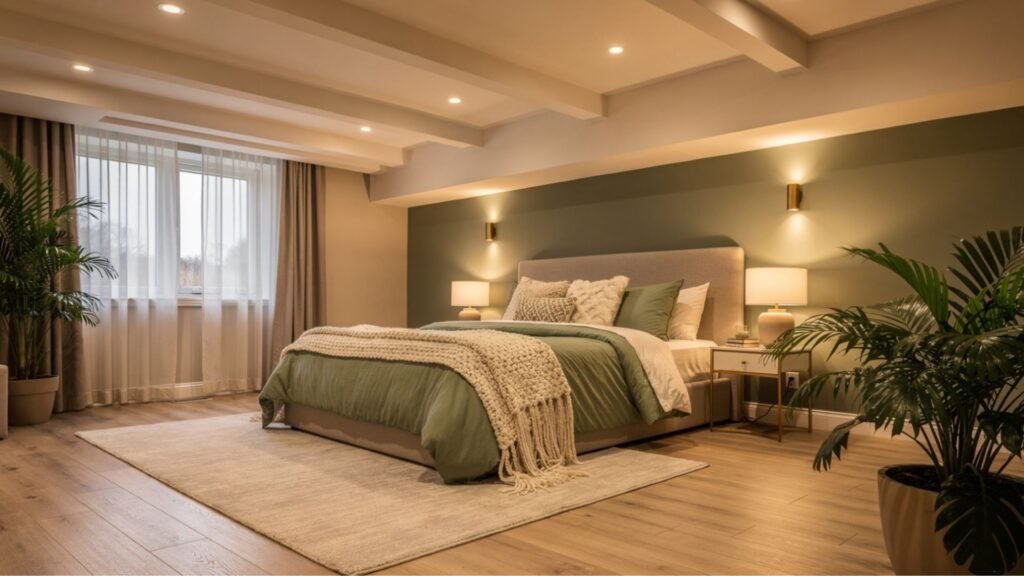
Basement bedrooms get a bad reputation and most of the time, it’s completely undeserved. Yes, basements present unique challenges: lower ceilings, limited natural light, potential moisture issues, and a psychological association with dark, unfinished utility spaces. But with the right design approach, a basement bedroom can be one of the most comfortable, private, and atmospherically rich rooms in an entire home.
A Basement Bedroom is a sleeping space designed in the lower level of a home. Smart Basement Bedroom Ideas improve comfort, lighting, storage, and privacy. Good layouts create a cozy atmosphere and maximize available space. Functional designs also increase home value and improve everyday living conditions beautifully.
A stylish Basement Bedroom creates a warm and private retreat for relaxation and comfort daily. Smart lighting, soft textures, and modern furniture improve the atmosphere and maximize functionality. Thoughtful upgrades make lower-level spaces feel brighter, larger, organized, welcoming, and visually appealing throughout every season beautifully.
Basement Bedroom Ideas include layered lighting, built-in storage, warm flooring, and accent walls. Neutral colors and mirrors improve brightness and create visual depth. Soft furnishings and vertical design elements add comfort and style. Functional layouts transform unfinished lower levels into elegant and comfortable living spaces.
Maximize Natural Light with Strategic Window Upgrades:
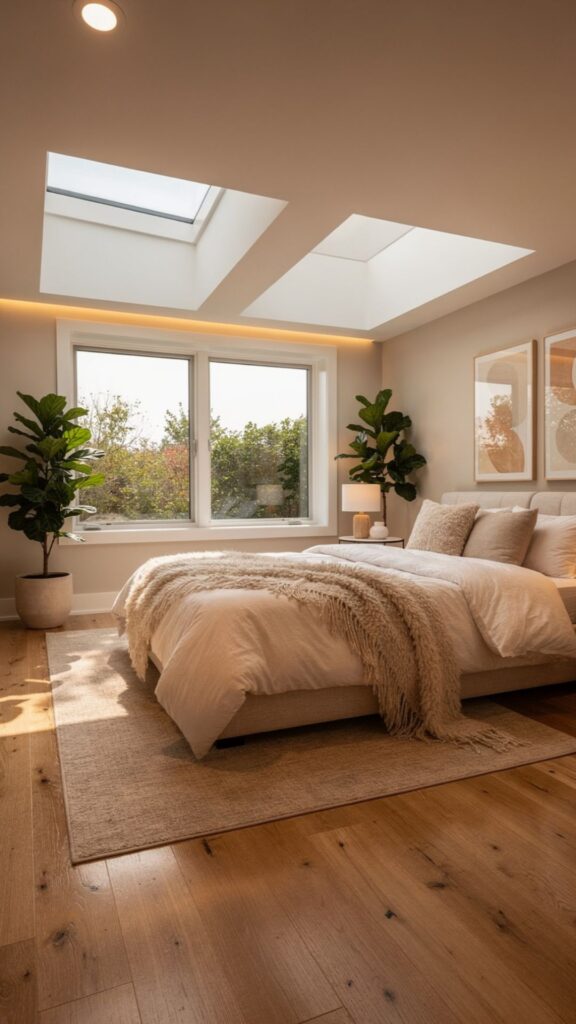
The single biggest challenge in any basement bedroom is natural light and it’s the challenge that has the most impact on whether the room feels like a proper bedroom or a converted storage space. Most basement bedrooms have either no windows, small hopper windows near the ceiling, or egress windows that meet code but don’t do much for the room’s ambiance.
Addressing the window situation before any other design decision is the most important investment you can make in a basement bedroom conversion. Egress window wells are the most impactful upgrade available. By excavating the soil outside a basement wall, installing a reinforced metal or concrete well, and cutting a larger window opening.
You can bring genuine daylight into a basement bedroom while simultaneously meeting building code requirements for emergency exit a legal requirement in most jurisdictions for any basement room classified as a sleeping space. The window well itself can be made more attractive and functional by lining it with stone, adding drainage gravel at the base, and installing a polycarbonate cover that keeps out rain and debris while allowing light through.
Light tube skylights also called solar tubes or tubular daylighting devices are a brilliant solution that most basement bedroom design guides never mention. These devices consist of a rooftop dome that captures daylight, a highly reflective tube that runs through the floor structure, and a diffuser panel in the ceiling of the basement room.
They deliver surprisingly strong, natural-feeling light even in deeply buried basement spaces without the structural complexity of a conventional skylight. For basement bedrooms directly below an unobstructed section of roof, they’re often the most cost-effective way to bring in true natural light.
Mirror placement is the non-structural complement to window upgrades. A large mirror positioned directly across from a window or window well multiplies the available light by reflecting it deeper into the room. Floor-to-ceiling mirrored wardrobe doors on the wall opposite a window well create a particularly effective light-amplifying effect while also serving a practical storage function.
The combination of maximized windows and strategic mirror placement can make a basement bedroom feel significantly brighter than its above-grade counterparts especially in the morning hours when low-angle light enters window wells most effectively.
Choose the Right Color Palette:
To Make the Space Feel Larger
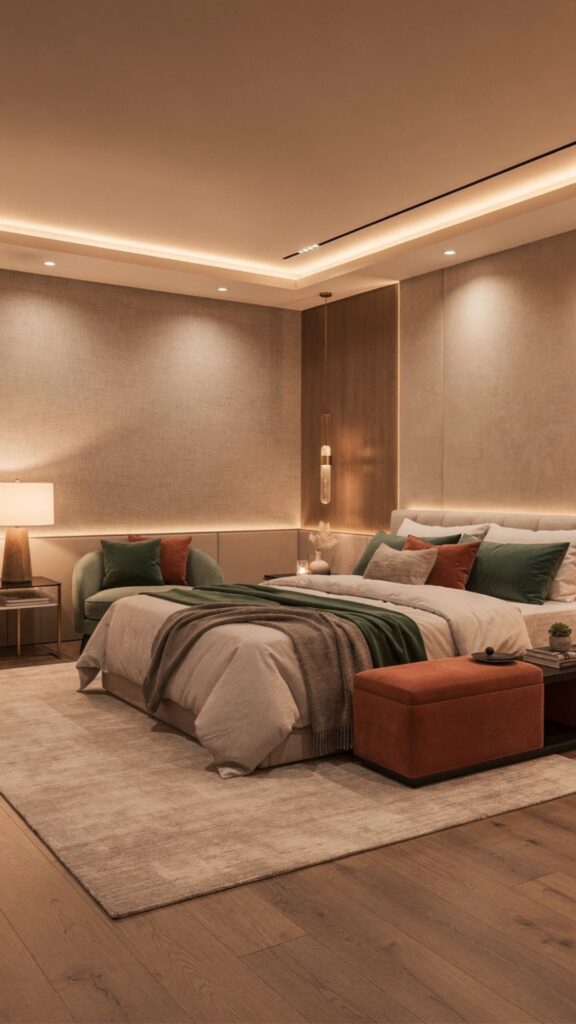
Color is one of the most powerful and most misused tools in basement bedroom design. The instinctive response to a dark, low-ceilinged room is to paint everything white and while that’s not wrong, it’s also the most predictable and often least interesting solution.
Understanding why certain colors work in basement bedrooms, and how to use them intelligently, gives you access to a far wider range of beautiful, effective design options than the standard “go light and neutral” advice suggests.
Light reflects off surfaces in two ways: through value (how light or dark a color is) and through undertone (the underlying warmth or coolness in the color). In basement bedrooms, warm-undertone whites and off-whites creams, linen tones, warm putty actually feel brighter than cool blue-white or stark bright whites, even if they technically have slightly lower reflectance values.
This is because the eye interprets warm-toned light as more natural and comfortable. Colors like Benjamin Moore’s Pale Oak, Farrow & Ball’s Pointing, or Sherwin-Williams’ Accessible Beige consistently outperform pure white in below-grade spaces.
For basement bedrooms that lean into their cozy, cave-like quality rather than fighting it particularly rooms used by teenagers, young adults, or as guest rooms deeper colors can work beautifully. A basement bedroom painted in deep navy, forest green, warm charcoal, or rich terracotta creates an intentionally moody, enveloping atmosphere that feels luxurious rather than dark.
The key is ensuring the bedding, lighting, and soft furnishings are warm and inviting to prevent the deep color from feeling oppressive. This “dark and cozy” design approach is one of the fastest-growing trends in bedroom design generally, and basement bedrooms are its natural home.
Ceiling color is a detail most basement bedroom guides address too simplistically with “paint the ceiling white.” In reality, painting a basement ceiling the same color as the walls or even a tone or two lighter visually raises the ceiling height by removing the sharp contrast line where wall meets ceiling.
This optical trick is well-documented in interior design literature and works particularly well in basement bedrooms with lower ceiling heights. A continuous flow of color from wall to ceiling makes the room feel more expansive and intentional, and it’s a technique used consistently by professional interior designers working on below-grade spaces.
Peek Inside: LED Lights Bedroom Ideas That Brighten Up Your Basement Bedroom Beautifully.
Install Recessed Lighting:
For a Clean, Open Feel
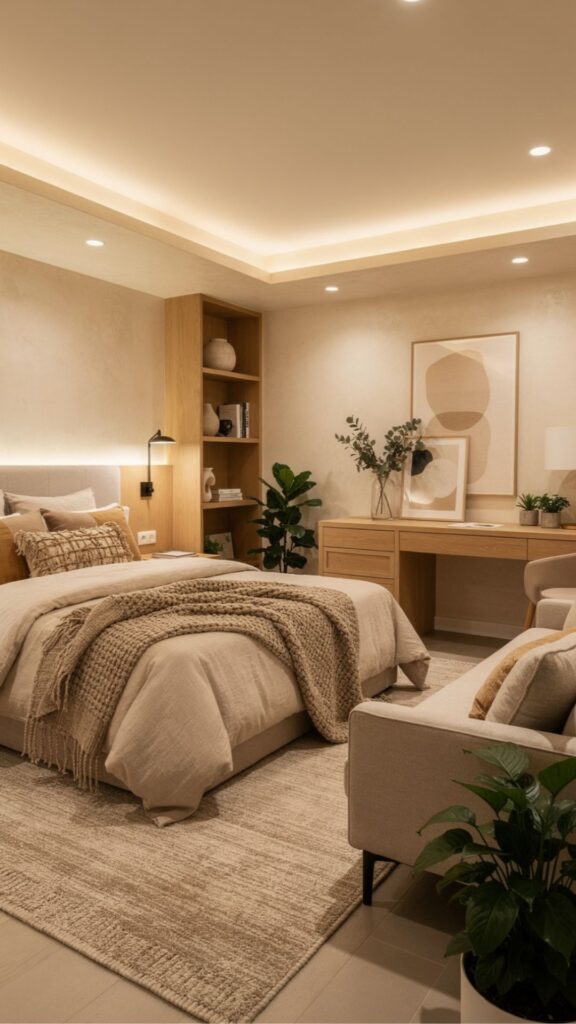
Lighting is arguably more important in a basement bedroom than in any other room in the home because it is, in many cases, the only light source the space will ever have. Getting the lighting right doesn’t just affect how the room looks; it affects how occupants feel, how alert or relaxed they are, and whether the room feels like a comfortable living space or a disappointing conversion.
Yet most basement bedroom renovations treat lighting as an afterthought, chosen after everything else has been decided. Recessed LED downlights (pot lights) are the default choice for basement bedrooms for good reason. They sit flush with the ceiling, which preserves every inch of ceiling height critical in a space where height is already limited.
They distribute light evenly across the room without the shadows created by a single central fixture. Modern LED versions are energy-efficient, long-lasting, and available in a range of color temperatures. For a basement bedroom, specify bulbs in the 2700K–3000K range (warm white) rather than cooler temperatures, which can feel clinical and institutional in a sleeping space.
The most common mistake in basement bedroom lighting is installing only one circuit of recessed lights and connecting them all to a single switch. This gives you an all-or-nothing choice: full brightness or total darkness. Experienced designers always recommend at least two separate lighting circuits in a basement bedroom.
One for general ambient illumination (the recessed downlights), and one for accent or task lighting (bedside sconces, a reading lamp, LED strips along a feature wall). Connecting the ambient lights to a dimmer switch adds a third level of control the ability to set exactly the right atmosphere for sleep, reading, or relaxation.
Layered lighting the professional design principle of combining ambient, task, and accent light sources is even more impactful in a basement bedroom than elsewhere because it compensates for the absence of natural light at different times of day. Bedside wall sconces eliminate the need for table lamps that consume precious nightstand space.
LED strip lighting behind a floating headboard creates a warm, diffused glow that functions as a beautiful alternative to overhead lighting in the evening. Under-bed LED strips on motion sensors serve as practical night lights without disturbing a sleeping partner. Each layer serves a purpose, and together they create a room that feels as dynamic and well-designed as any above-grade bedroom.
Use Egress Windows:
To Meet Safety Codes and Add Value
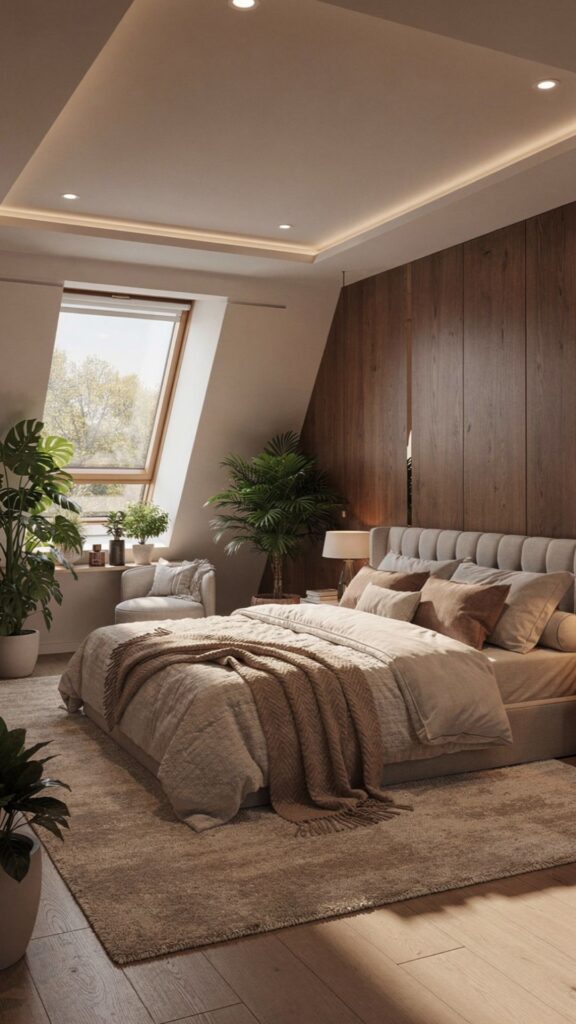
Egress windows are not optional in basement bedrooms they’re a legal requirement in virtually every jurisdiction in the United States, Canada, and increasingly in other countries. A basement room cannot legally be classified as a “bedroom” without a window that meets minimum egress specifications: large enough for an occupant to escape through and for emergency responders to enter.
Building a basement bedroom without an egress window isn’t just a code violation it’s a genuine safety hazard and a significant liability issue that can surface during home sales when inspection reveals the discrepancy. The standard egress window requirements in the International Residential Code (IRC) followed by most U.S. jurisdictions specify a minimum net clear opening of 5.7 square feet, with a minimum height of 24 inches and minimum width of 20 inches, with the sill no higher than 44 inches above the finished floor.
These dimensions ensure that an adult can exit through the window in an emergency. If your existing basement windows don’t meet these specifications, they must be upgraded before the room can be legally listed or marketed as a bedroom a fact that directly affects property value and mortgage appraisal. The installation process for an egress window involves cutting through the foundation wall a job that genuinely requires a structural engineer’s sign-off and a qualified contractor with concrete cutting equipment.
However, the cost is typically $2,500–$5,000 per window including excavation, well installation, and window framing an investment that pays back handsomely in the increased value of adding a legal bedroom to the home. In most real estate markets, a legal additional bedroom adds $10,000–$30,000 in appraised value, making the egress window one of the highest-ROI basement renovation investments available.
One detail even experienced contractors sometimes overlook: the window well drainage system. Without proper drainage at the base of the window well, rainwater collects and eventually finds its way into the basement through the window frame or the foundation wall junction.
Every egress window well should include a gravel drainage layer at the base (minimum 6 inches deep), connected ideally to the home’s footing drain or a dedicated dry well. Adding a properly fitted polycarbonate cover the type that allows the window to still open from inside for emergency egress keeps the well clear of leaves and debris year-round while still meeting code.
Create a Built-In Bedroom Closet:
For Smart Storage
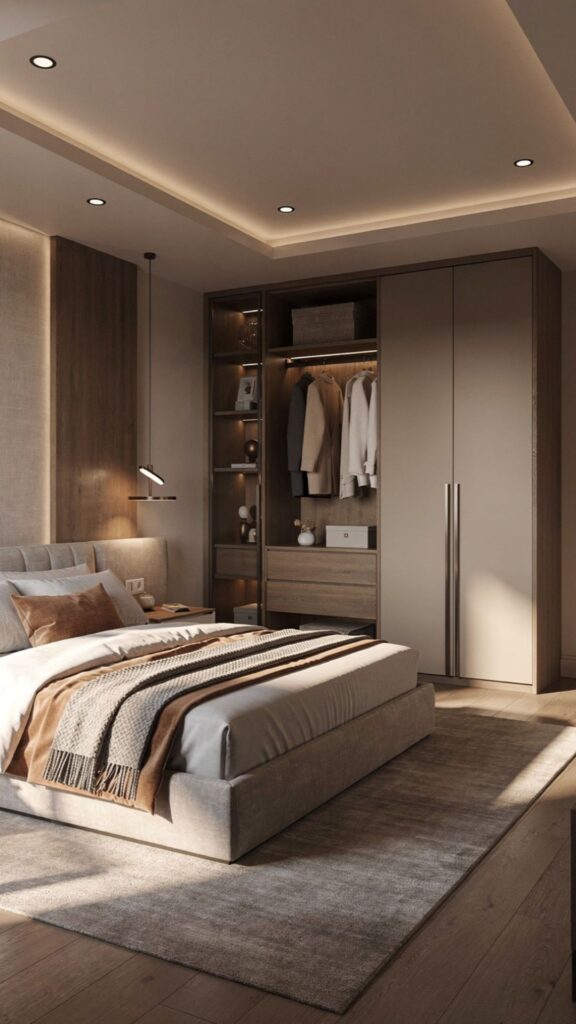
Storage is perpetually under planned in basement bedroom designs. The room gets the bed, the lighting, and the paint color and then someone realizes there’s no closet. In many basement conversions, there simply isn’t a pre-existing closet space, which means storage must be created deliberately as part of the design.
This constraint, approached thoughtfully, can actually produce better storage outcomes than an above-grade bedroom that inherited an inadequate closet from original construction. Built-in wardrobes that use the full wall width and extend from floor to ceiling are the most space-efficient storage solution for basement bedrooms.
They create a significant amount of hanging and shelving capacity within a defined footprint, and crucially their flat fronts don’t project into the room the way freestanding armoires or standalone wardrobes do. In a basement bedroom where ceiling height may already feel limited, a built-in wardrobe with flush or sliding doors preserves the visual spaciousness of the room better than any freestanding alternative.
The door style choice for built-in bedroom storage in a basement is particularly consequential. Hinged doors require clearance space to swing open, consuming floor area that a smaller basement bedroom may not have to spare. Sliding barn-style doors eliminate the swing clearance problem and add visual character, but they always leave half the wardrobe inaccessible at any given moment.
Bi-fold doors are a middle ground they need less swing clearance than hinged doors and allow full access to the interior. For mirror-fronted sliding wardrobes specifically, the light-reflecting benefit adds enough value that many basement bedroom designers choose them regardless of the access trade-off.
Under-stair storage is a basement bedroom opportunity that’s almost universally underutilized. If the staircase leading to the basement runs along a wall adjacent to the bedroom space, the triangular void beneath the stairs can be converted into a surprisingly large and functional storage area.
Custom built-in drawers on sliders, a pull-out shoe rack, a hidden home office nook, or a simple fitted shelf system all are achievable in under-stair spaces that would otherwise be wasted. A joiner or skilled carpenter can typically design and install a custom under-stair storage solution for less than the cost of a freestanding wardrobe, with dramatically better results.
Add an Accent Wall:
To Create Visual Depth and Interest
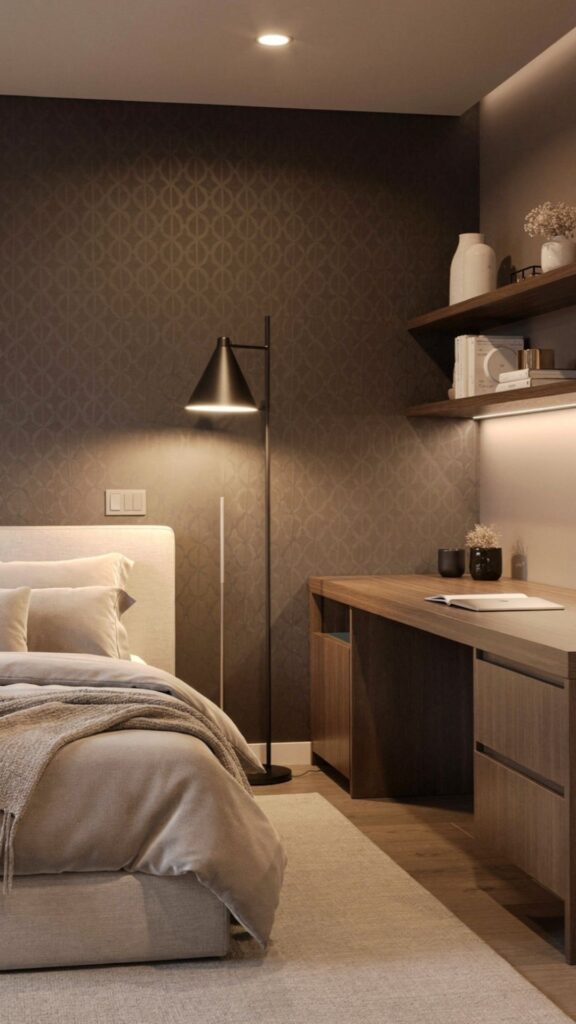
An accent wall is one of the simplest, most cost-effective ways to give a basement bedroom a sense of design intention and spatial depth. In a room that might otherwise feel like a plain rectangular box, a single wall treated differently with color, texture, pattern, or material creates a focal point that anchors the room’s design, draws the eye, and makes the space feel considered rather than merely functional.
For basement bedrooms especially, the accent wall does additional work by creating visual interest that compensates for the absence of outdoor views or natural architectural features. The wall behind the bed the headboard wall is almost always the right choice for an accent treatment in a bedroom. It frames the bed visually, creates a natural focal point for the room, and is the first thing you see when entering the space.
Painting this wall in a deeper or contrasting color while keeping remaining walls lighter is the simplest execution. However, the most impactful accent walls combine color with texture: limewash paint (with its subtle variation and depth), board-and-batten paneling, shiplap, or a wallpaper with dimensional texture all create effects that flat paint alone cannot achieve.
Wallpaper on a basement bedroom accent wall is experiencing a significant design renaissance, and the range of options available today peel-and-stick, paste-the-wall, fabric-backed makes installation more accessible than it’s ever been. Textured wallpapers (grasscloth, linen weave, concrete-effect) add warmth and depth that’s particularly valuable in below-grade spaces.
Bold pattern wallpapers large botanical prints, geometric designs, moody landscape murals make the accent wall a true statement piece that transforms the entire character of the room. A basement bedroom with a wall-to-wall botanical mural behind the bed feels nothing like a basement it feels like a bespoke, designed space.
Shiplap and board-and-batten paneling are two wood-based accent wall treatments that work especially well in basement bedrooms because they add texture without adding visual weight. Shiplap’s horizontal lines draw the eye across the wall, which can make a narrow basement bedroom feel wider. Board-and-batten’s vertical lines do the opposite they pull the eye upward, visually raising the ceiling.
Both can be painted any color and are relatively straightforward DIY projects for intermediate-level woodworkers. For a basement bedroom serving as a guest room or teenager’s room, these paneling techniques create a level of finish that looks far more expensive than the actual material and labor cost involved.
Soundproof the Basement Bedroom:
For Better Sleep
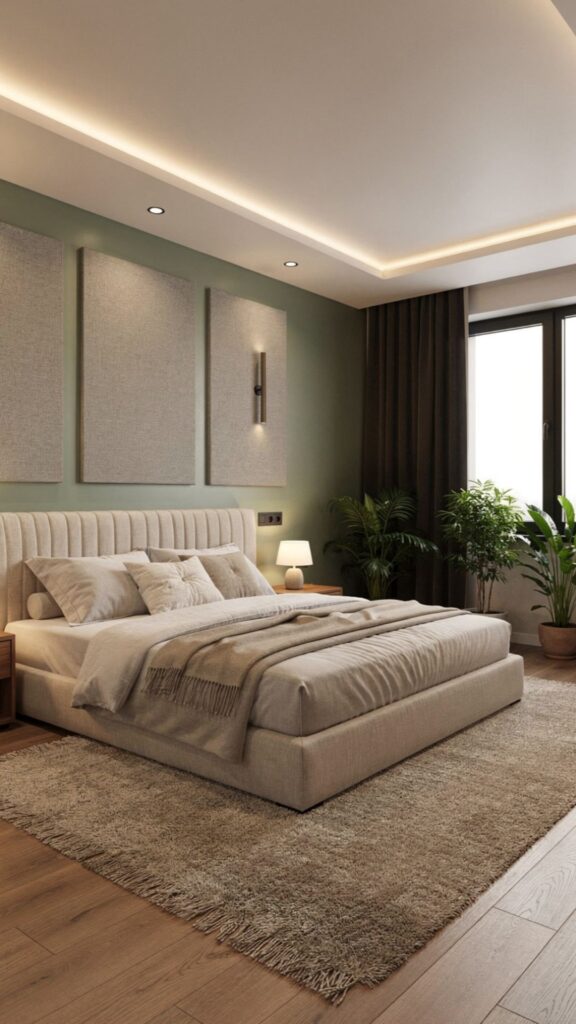
Basement bedrooms have a natural acoustic advantage they’re partially or fully below grade, surrounded by earth and concrete rather than open air, which provides inherent sound insulation from exterior noise. However, they often have the opposite problem: noise transmission from the floors above.
Footsteps, kitchen sounds, television, and conversation from the main living areas travel directly through the floor-ceiling assembly and into the basement bedroom with surprising clarity particularly in homes with open floor plans above. Addressing this is one of the most impactful quality-of-life improvements in any basement bedroom design.
The most effective soundproofing intervention happens during the construction or renovation phase, before the ceiling is closed. Adding acoustic insulation specifically rockwool (stone wool) batt insulation rather than standard fiberglass between the ceiling joists dramatically reduces impact noise (footsteps) and airborne noise (voices, TV) transmission.
Rockwool is denser than fiberglass and has significantly better sound absorption properties; it’s the material professional recording studios use between floors. If your basement bedroom ceiling is already finished, adding a layer of resilient channel beneath the existing drywall before re-sheeting achieves similar results without completely demolishing the ceiling.
For finished basement bedrooms where structural intervention isn’t practical, surface-level soundproofing measures still make a meaningful difference. A thick area rug with a dense rubber pad beneath it on the bedroom floor absorbs impact noise that would otherwise resonate through the slab.
Heavy curtains even on windows, which also helps control the limited natural light add mass that dampens airborne sound. Soft furnishings generally (upholstered headboards, fabric wall panels, plush throws and cushions) all contribute to absorbing sound within the room. The cumulative effect of multiple soft materials is significant even if each individual addition seems minor.
Door sealing is a detail that most basement bedroom guides completely miss. The gap beneath a hollow-core interior door is the single biggest acoustic weakness in most room separation systems sound travels through this gap more efficiently than through the wall itself. Installing a door sweep (a rubber or brush seal that attaches to the bottom of the door and closes the gap when the door is shut) reduces this transmission significantly.
Upgrading from a hollow-core door to a solid-core door which contains solid wood or composite fill rather than a cardboard honeycomb interior reduces sound transmission further still. These two changes together improve the acoustic separation between the basement bedroom and the rest of the home more than almost any other non-structural intervention.
Design a Teen Bedroom in the Basement:
For Privacy and Independence
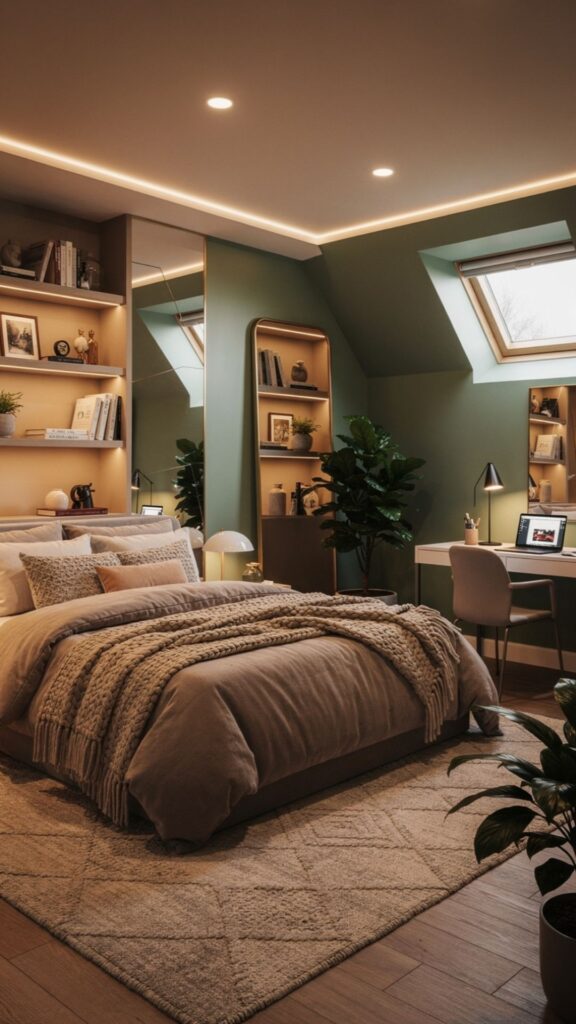
The basement bedroom is often the natural choice for a teenager in the household and when designed thoughtfully, it becomes one of the most valuable gifts a parent can give an adolescent: genuine privacy, a sense of ownership over a personal space, and a degree of separation from the main family living areas that supports healthy development of independence.
The design challenge is creating a basement teen bedroom that functions as a complete personal environment rather than just a relocated version of the upstairs bedroom. The foundational principle of a great teen basement bedroom is multifunctionality. Teenagers don’t just sleep in their rooms they study, socialize with friends, pursue hobbies, exercise, and increasingly work remotely on creative and academic projects.
A basement space that accommodates only sleeping wastes the potential of what is typically a larger-than-average room. A dedicated study zone with a proper desk, ergonomic chair, and good task lighting; a lounge area with a sofa or floor cushions for friends; and a sleeping zone these three zones create a complete personal environment that a teenager can actually live in rather than merely sleep in.
Technology integration is an area where teen basement bedrooms can genuinely excel. A basement location means electrical work is accessible from below, making it straightforward to add multiple dedicated circuits for gaming setups, music production equipment, or home studio configurations.
Built-in cable management raceways in walls, floor boxes for central power access, structured wiring panels keeps the space organized and future-proofed for whatever technology the occupant’s interests demand. Parents who think ahead about technology infrastructure during the initial basement bedroom build consistently report that this was the single most appreciated design decision from their teenager’s perspective.
One insight professional interior designers who work on teen spaces consistently emphasize: give teenagers genuine creative input in the design process, but within a structural framework set by the parent. Letting a teenager choose wall color, lighting style, accent pieces, and layout is empowering and produces a space they feel genuine connection to.
Deciding together on the structural elements flooring, storage, study zone dimensions ensures the room will function well for years rather than becoming impractical as the teenager’s needs evolve. This collaborative approach produces better outcomes than either pure parental control or unlimited teenage creative direction alone.
Don’t Scroll Past: Master Bedroom Decor Ideas That Elevate Your Basement Bedroom to a Whole New Level.
Transform Your Basement into a Cozy Guest Bedroom:
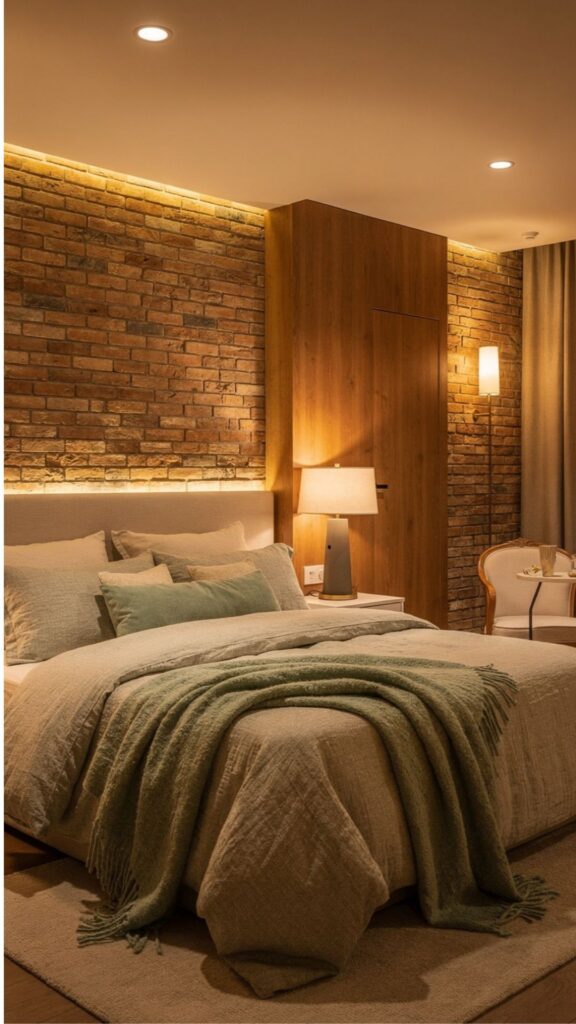
A guest bedroom in the basement solves one of the most persistent challenges in residential design: providing comfortable accommodation for visitors without permanently dedicating a main-floor room to occasional use. When a basement guest bedroom is well designed, guests often prefer it it’s quieter than rooms above the main living areas, cooler in summer, and has an appealing cocoon-like quality that promotes deep sleep.
The key is transforming the space from a place guests tolerate to one they genuinely look forward to returning to. The hotel-room mentality is the most useful design framework for a basement guest bedroom. Hotels solve the exact problem you’re trying to solve: creating a comfortable, self-contained sleeping environment for someone unfamiliar with the space who will be there for a limited time.
Study what makes a hotel room feel luxurious: high-quality mattress and bedding, multiple pillow options, blackout curtains, good reading lights on both sides of the bed, a mirror at full height, accessible power outlets near the bed for charging, and a luggage rack that gets bags off the floor. These details cost relatively little but make an enormous difference to the guest experience.
Storage and bathroom proximity are practical considerations that significantly affect guest comfort. A basement guest bedroom without an adjacent bathroom requires guests to walk upstairs in the night a frustrating experience that immediately undermines the sense of hospitality.
If budget and plumbing access allow, adding a basement bathroom or even a half-bath adjacent to the guest bedroom transforms the space into a complete guest suite a feature that adds significant value both to the living experience and to the home’s market value.
Even a simple three-piece bathroom (shower, toilet, sink) requires only a modest footprint and creates a genuinely hotel-like self-contained guest environment. Personal touches make a guest bedroom feel welcoming rather than merely adequate. A bedside table with a small lamp, a glass of water, and perhaps a book or magazine. A hook on the back of the door for a robe.
A small basket with toiletry essentials (travel-size shampoo, soap, a few individually wrapped toiletries). Fresh flowers or a simple plant. A handwritten welcome note or printed Wi-Fi password. None of these cost more than a few dollars, but they communicate that the guest’s comfort was genuinely considered. That communication that someone thought about what you’d need is the essence of hospitality, and it elevates a converted basement space into a room people ask to return to.
Use Low-Profile Furniture:
To Work With Lower Ceilings
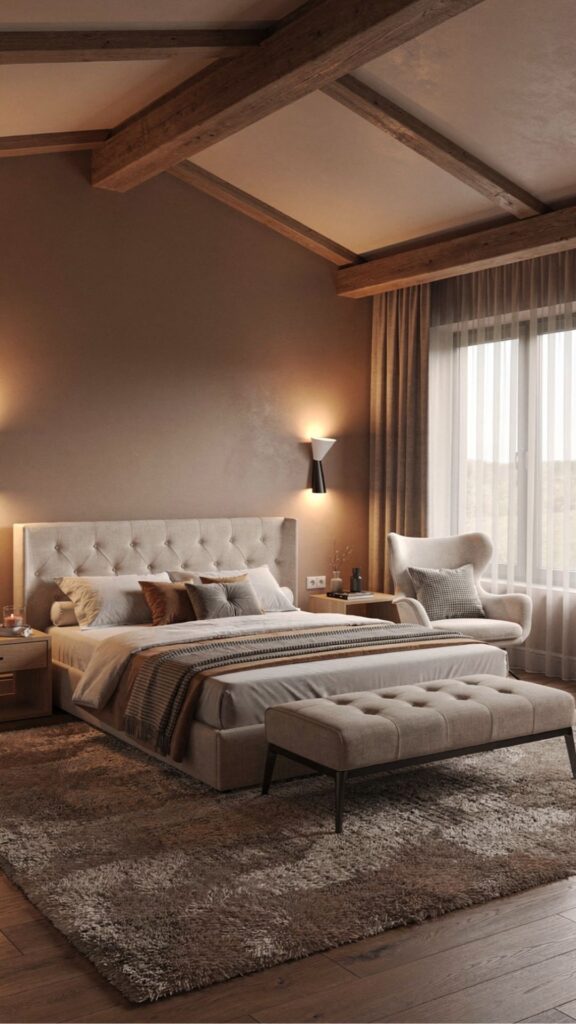
Ceiling height is the most common physical constraint in basement bedrooms, and furniture scale is one of the most powerful tools for either working with it or fighting against it. Tall furniture in a low-ceilinged room creates a sense of compression the eye reads the small distance between the top of the wardrobe and the ceiling as evidence that the room is too small.
Low-profile furniture does the opposite: it emphasizes the horizontal dimensions of the room, keeps sightlines open, and creates breathing room above the furniture that makes the ceiling feel higher than it actually is. The bed is the most critical furniture choice in this regard. Platform beds those with a low, built-in base rather than a traditional bedframe with legs sit significantly closer to the floor than standard beds.
Combined with a low, padded headboard rather than a tall one, a platform bed in a basement bedroom keeps the visual mass of the largest piece of furniture concentrated in the lower portion of the room. This is the same principle that Japanese and Scandinavian bedroom design traditions have exploited for decades to create bedrooms that feel serene and spacious regardless of their actual dimensions.
Secondary furniture nightstands, dressers, and seating should follow the same low-profile principle. Floating nightstands (wall-mounted rather than freestanding) eliminate legs entirely, which makes them feel lighter and keeps floor space visually clear.
A long, low dresser (what furniture designers call a “credenza-height” dresser, typically around 30 inches tall) provides significant storage capacity without rising to a height that competes with the ceiling. A bench at the foot of the bed or a low-slung lounge chair provides seating without the visual bulk of a full armchair.
One furniture principle that most basement bedroom guides miss entirely: the importance of furniture with legs selectively applied. While overall furniture height should be kept low, choosing a bed frame with short legs rather than a solid platform actually creates a visual gap between the furniture and the floor, making the floor area appear larger.
It’s a counterintuitive balance: keep the top of furniture low, but allow some visual access to the floor beneath major pieces. This principle, drawn from retail visual merchandising and applied to residential design, creates a sense of spaciousness that solid-base furniture cannot achieve.
Add Warmth with the Right Flooring Choices:
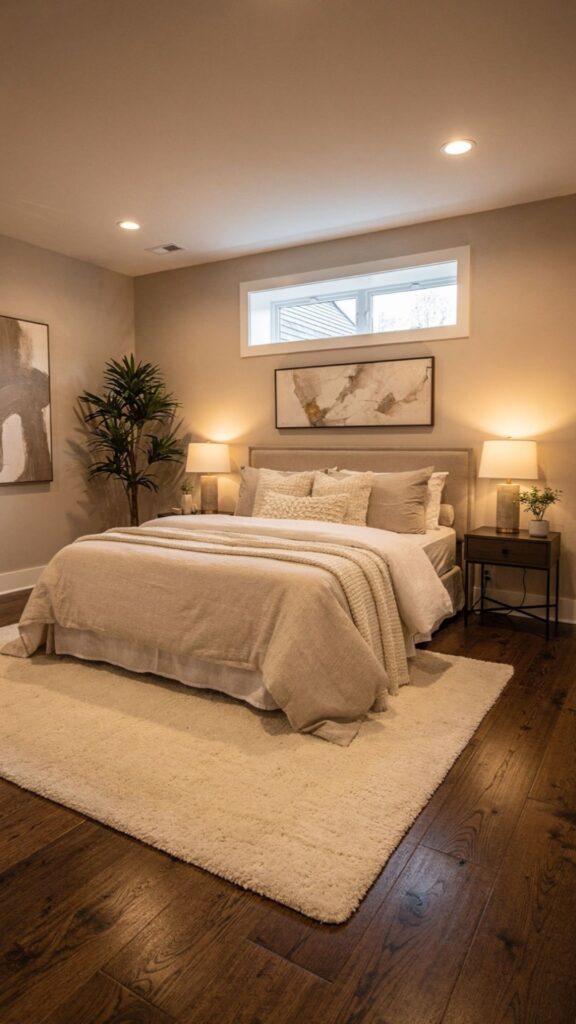
Basement floors present a distinct challenge that above-grade bedrooms never face: they sit directly on a concrete slab that’s in contact with the earth, which makes them cooler and more susceptible to moisture than any other floor in the home.
Choosing the wrong flooring material in a basement bedroom doesn’t just produce an uncomfortable room it can result in moisture damage, mold growth, and flooring failure within a few years of installation. The right flooring choice addresses both comfort and moisture simultaneously.
Luxury vinyl plank (LVP) flooring is the clear leader for basement bedroom applications in 2026, and the technology behind it has improved dramatically. Modern LVP is 100% waterproof throughout its thickness (not just on the surface), dimensionally stable across temperature fluctuations, comfortable underfoot, and available in high-quality wood-look finishes that are genuinely difficult to distinguish from real hardwood.
It installs as a floating floor directly over concrete no adhesive required which means moisture that does make it through the slab can’t be trapped beneath a glued-down surface. For basement bedrooms, this combination of properties is unmatched by any other flooring category.
Engineered hardwood is a valid alternative for basement bedrooms with confirmed low moisture levels and stable conditions. Unlike solid hardwood, which expands and contracts significantly with moisture changes and should never be installed below grade, engineered hardwood’s cross-ply construction makes it dimensionally stable enough to handle modest basement humidity.
However, it still requires a moisture barrier and should not be installed in basements with any history of water infiltration or high humidity. The aesthetic reward genuine wood veneer on the surface is significant, but the risk profile is meaningfully higher than LVP.
Radiant floor heating is the basement bedroom comfort upgrade that most design guides mention only in passing but deserves serious consideration. Electric radiant heating mats installed beneath LVP or tile transform a cold concrete slab into a genuinely warm floor surface one of the most physically pleasant sensations in any bedroom environment.
Electric radiant systems are relatively affordable to install (typically $10–$15 per square foot including materials and labor), inexpensive to run for the hours they’re actually in use (a bedroom typically needs heat only at morning wake-up and evening), and require no plumbing connections. The experience of stepping onto a warm floor on a cold morning genuinely changes how the basement bedroom feels to occupy.
Create a Basement Bedroom with a Home Office Nook:
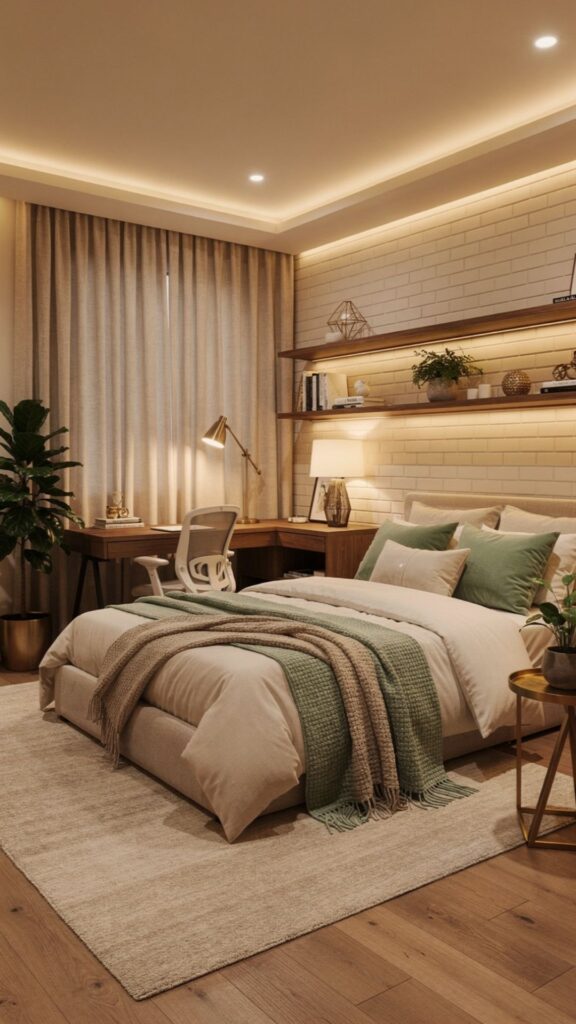
The hybrid bedroom-office is one of the most requested basement bedroom configurations in 2026, driven by the ongoing normalization of remote and hybrid work schedules. A basement location is ideal for a work-from-home setup: it’s naturally separated from main household activity and noise, has stable temperature year-round (important for equipment), and typically has floor space to accommodate a dedicated desk area that might not exist in smaller above-grade bedrooms.
Done right, the bedroom-office combination serves both functions fully without either compromising the other. Zone separation is the critical design principle in a basement bedroom with a home office nook. The work zone and sleep zone must feel visually and functionally distinct, even if they exist within the same four walls.
Physical separation a bookcase used as a room divider, a curtain on a ceiling track, a half-height partition wall creates the psychological boundary between “work mode” and “sleep mode” that research consistently shows is important for both productivity and sleep quality.
A work area that’s clearly visible from the bed is associated with higher rates of insomnia, according to sleep hygiene research so designing the desk area to be concealable or visually separated from the sleeping area is genuinely worth prioritizing.
The built-in desk nook is the most space-efficient execution of the bedroom-office concept for basement spaces. A desk surface built into an alcove, under-stair void, or recessed section of wall with overhead cabinets for storage and a monitor arm to free up desk surface concentrates the work zone into a minimal footprint while maximizing functionality.
When the workday ends, the addition of a simple curtain or sliding panel that closes across the nook effectively removes the visual presence of the work zone from the bedroom entirely. This “out of sight, out of mind” principle for home office spaces is backed by interior design psychology research on work-life boundary maintenance.
Lighting for a combined basement bedroom-office requires more thought than either use case alone. The work zone needs bright, cool-toned task lighting (5000K color temperature at the desk provides the alertness-supporting light spectrum) while the sleep zone needs warm, dimmable ambient lighting (2700K–3000K for relaxation and circadian rhythm support).
Installing these as separate circuits on separate switches or investing in smart bulbs that allow color temperature adjustment means the same room can transition between work-supportive and sleep-supportive lighting environments without any physical changes. This lighting flexibility is the technical detail that separates a genuinely functional bedroom-office from one that compromises both uses.
Use Mirrors Strategically, Basement Bedroom Ideas:
To Open Up the Space
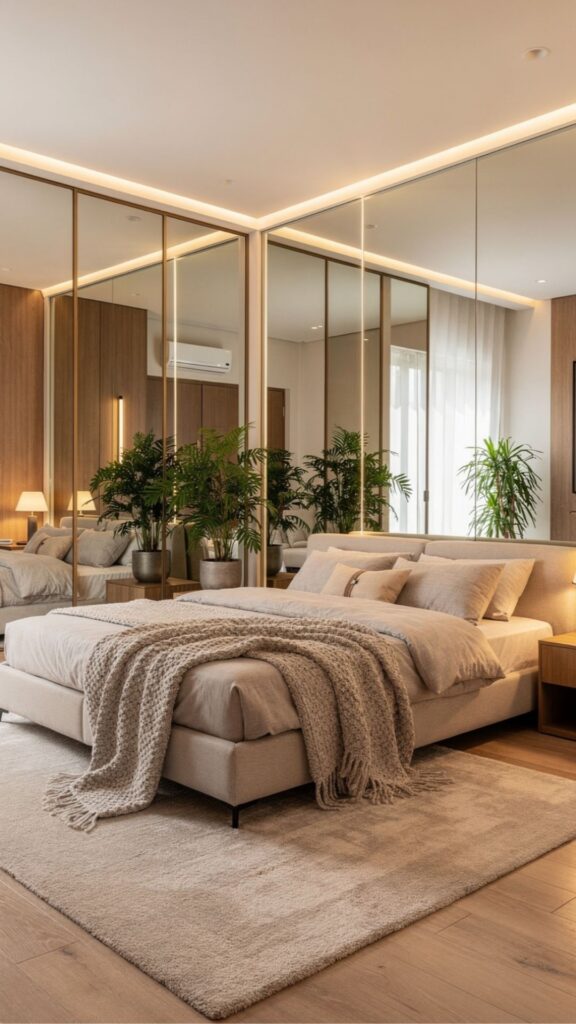
Mirrors in basement bedrooms do more work than they do anywhere else in a home. In above-grade rooms, they’re primarily decorative and practical useful for getting dressed, making a room feel a little larger. In a basement bedroom, they perform a genuine spatial and lighting function that directly affects how comfortable and spacious the room feels to occupy.
Used strategically rather than arbitrarily, mirrors can meaningfully transform the experience of a below-grade sleeping space. The most impactful mirror placement in a basement bedroom is directly across from or adjacent to the primary light source whether that’s a window well, a light well, or a bank of recessed lights near one wall.
A mirror positioned to catch and reflect light from these sources distributes that light further into the room than the source alone could reach. In a basement bedroom with a single egress window on one wall, a floor-to-ceiling mirror on the opposite wall can effectively make the room feel as though it has windows on two sides a dramatic improvement in perceived brightness and spaciousness.
The scale of mirrors matters enormously. A small decorative mirror makes a room feel like it has a small decorative mirror in it. A large-format mirror leaning floor to ceiling against a wall, mounted as a full wall panel, or framed as a piece of oversized art creates a genuinely spatial effect that small mirrors cannot achieve.
An oversized arched mirror leaning against the wall opposite the bed is one of the most consistently praised design choices in basement bedroom transformations. It’s on trend, accessible in price from mass-market retailers, and delivers a spatial impact out of all proportion to its cost.
One mirror application that competitors almost never discuss: the ceiling mirror panel. In very low-ceilinged basement bedrooms, small mirror panels installed on sections of the ceiling not across the entire ceiling, which tends to feel oppressive, but in a deliberate pattern or single strip above a specific area reflect floor and furniture surfaces downward and create an illusion of increased ceiling height.
This technique is used in commercial spaces (bars, restaurants) to create ambiance in low-ceilinged environments and translates surprisingly well to residential basement bedrooms when applied with restraint and design intention.
Incorporate Texture and Soft Furnishings:
For a Cozy Atmosphere
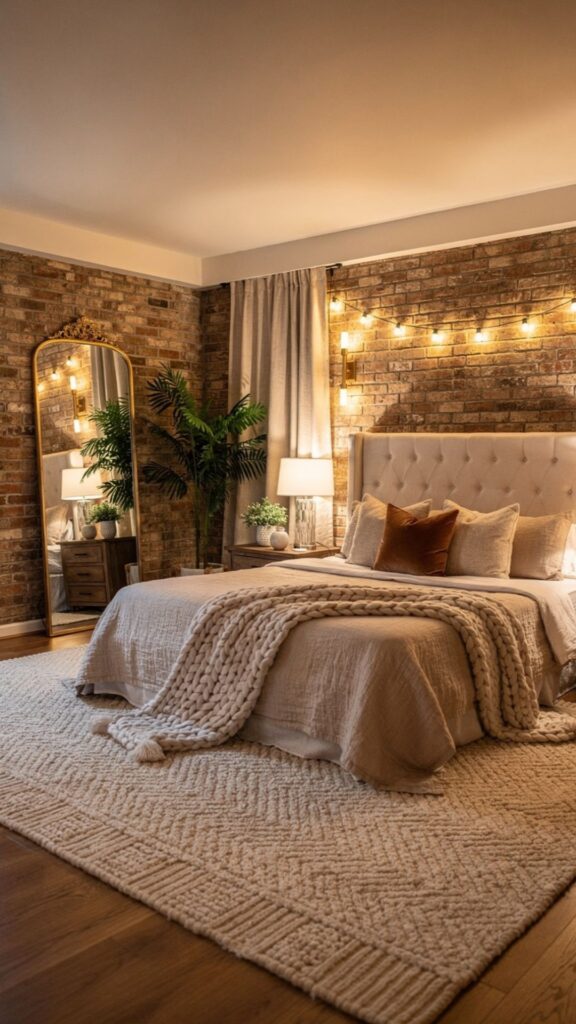
The psychological challenge of a basement bedroom is real: the brain associates below-grade spaces with utility areas, storage, and unfinished construction. Counteracting this association requires deliberate sensory design creating an environment that feels genuinely warm, soft, and inhabitable through every sensory channel, not just visually.
Texture and soft furnishings are the primary tools for this psychological transformation, and they work more quickly and effectively than structural changes in changing how a room feels to be in. Layered bedding is the fastest and most impactful soft furnishing investment for a basement bedroom.
A high-quality mattress with a plush topper, followed by cotton or linen sheets, a light duvet or coverlet, and a heavier throw folded at the foot of the bed this layering creates visual richness and physical comfort that signals “this is a comfortable, cared-for sleeping environment” the moment someone enters the room.
The texture contrast between crisp linen, soft cotton, and the nubby weave of a wool throw is as much a visual effect as a tactile one it makes a bedroom photograph beautifully and feel immediately inviting in person. Rugs are structurally important in basement bedrooms beyond their aesthetic role.
A thick area rug over LVP or concrete flooring provides thermal insulation between the occupant’s feet and the cold slab below a genuine comfort improvement that makes stepping out of bed on a winter morning a far less unpleasant experience. Dense wool rugs offer the best thermal and acoustic performance.
Persian or vintage-style rugs add visual warmth and character that works particularly well in basement bedrooms because their rich tones and patterns compensate for the absence of outdoor views and natural light variety. A large rug that extends well beyond the bed on all sides makes the sleeping zone feel defined and luxurious.
Window treatments in basement bedrooms deserve more consideration than the standard blackout curtain recommendation. Yes, blackout capability is valuable basement bedrooms are naturally darker, but morning light from an egress window can still be disruptive, and privacy from passersby looking down into window wells is important. However, the curtain’s fabric, color, and hanging height matter as much as its light-blocking properties.
Hanging curtains as high as possible (at ceiling height rather than just above the window frame) and extending the rod well beyond the window width draws the eye to the curtain’s full height and makes the window appear larger and the ceiling higher. This simple hanging technique costs nothing extra but dramatically improves the visual scale of any basement bedroom window treatment.
Click to Discover: Guest Bedroom Ideas That Turn Your Basement Bedroom into a Dramatic and Stunning Space.
Make It Feel Above-Grade with Vertical Design Elements:
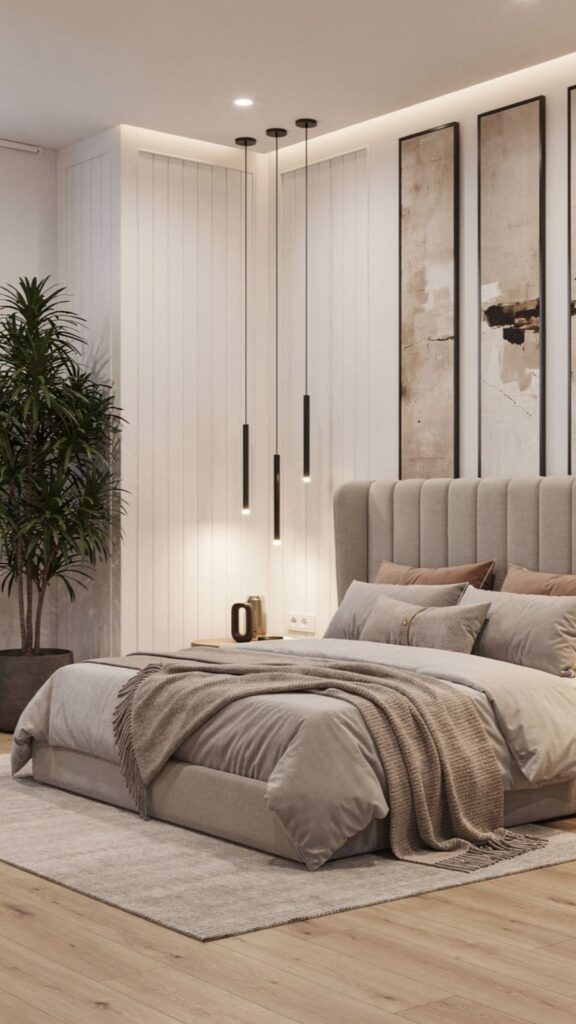
The most sophisticated approach to basement bedroom design isn’t trying to hide the fact that the room is below grade it’s designing the space with such confidence and intentionality that the question of grade becomes irrelevant. Vertical design elements are the primary tool for this: features that draw the eye upward, emphasize height, and shift the room’s visual energy from horizontal containment to vertical aspiration.
In a basement bedroom with 8-foot ceilings, thoughtful vertical design can create a space that genuinely feels as open and airy as a room with 10-foot ceilings above grade. Floor-to-ceiling built-ins are the most powerful vertical design element available. A wall of floor-to-ceiling bookshelves, a built-in wardrobe that runs from floor to ceiling, or a paneled wall treatment that extends from baseboard to cornice each creates a strong vertical line that the eye follows from floor to ceiling, emphasizing the full height of the space rather than the limited length or width.
In a basement bedroom, this vertical emphasis is particularly valuable because it redirects attention away from the horizontal boundaries (the walls that are partially or fully underground) and toward the vertical dimension, which is unconstrained. Vertical striping through wallpaper, painted stripes, or narrow wall paneling is a classic technique for visually raising ceiling height that remains as relevant as ever.
Narrow vertical stripes on the walls create a strong upward visual rhythm that pulls the eye to the ceiling line. The effect is measurable: research in environmental psychology has consistently shown that vertical lines make spaces feel taller and more open than equivalent spaces without them.
For basement bedrooms specifically, this effect helps counteract the psychological compression that many occupants report in below-grade rooms even when the actual ceiling height is adequate. Tall headboards are a vertical design element that’s particularly relevant in basement bedrooms.
A headboard that extends close to the ceiling whether upholstered, paneled, or created through a paint treatment or wallpaper application creates a vertical anchor that emphasizes the room’s height while also making the bed itself feel more substantial and luxurious.
A painted arch or arched wallpaper panel behind the bed is a contemporary variation on this idea that’s appearing increasingly in high-end residential design the arch’s curved form draws the eye upward and outward, creating a sense of expansiveness that’s remarkably effective in compact or low-ceilinged rooms. It’s one of the most photogenic and architecturally interesting things you can do to a basement bedroom wall without touching a single structural element.
Conclusion
A well-designed basement bedroom can be one of the most comfortable, private, and visually impressive rooms in your entire home if you approach it with the right ideas and the right design principles. From maximizing natural light and choosing the perfect color palette to adding soft textures, smart storage, and vertical design elements, every idea in this guide moves your basement bedroom closer to the space it has the potential to be.
Start with the changes that address your biggest current challenges, implement them thoughtfully, and watch how quickly a below-grade space transforms into somewhere you’re genuinely proud of. Your ideal basement bedroom is closer than you think pick one idea and start today.

Team TrandyVilla is the passionate home decor team behind Trandy Villa, where style meets comfort in everyday living. The team loves transforming simple spaces into beautiful, functional homes through smart ideas, budget-friendly hacks, and modern design trends. Their content focuses on helping readers create homes that feel both stylish and personal without spending too much.