
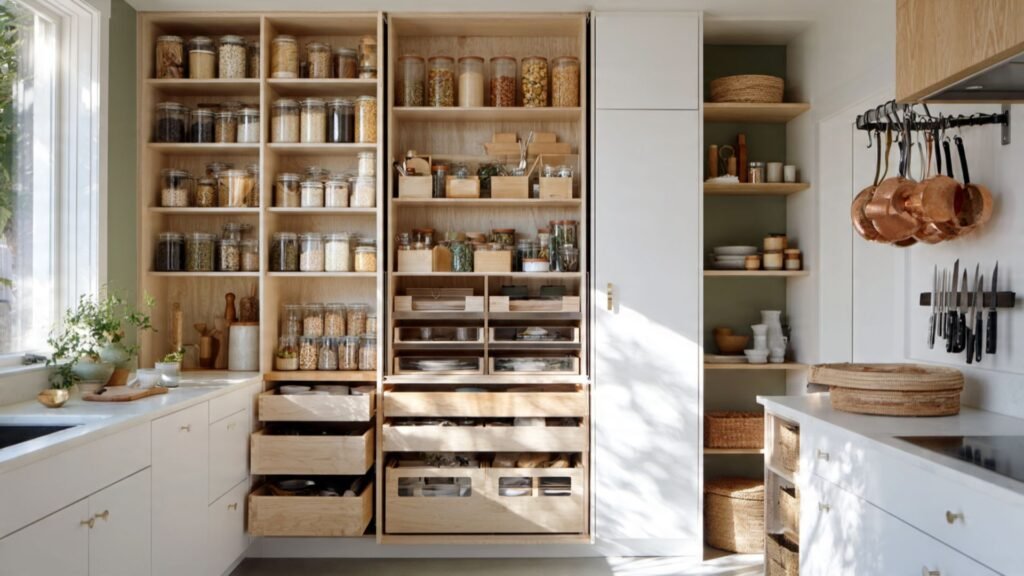
Kitchen Storage keeps cookware, food, and tools organized in a practical way. Kitchen Storage Ideas help maximize space, reduce clutter, improve access, and support efficient daily routines. They create a cleaner, more functional, and comfortable cooking environment for every household.
A well-organized kitchen saves time and makes daily tasks easier. Kitchen Storage offers smart ways to use cabinets, drawers, and shelves more effectively. Simple storage systems create order, improve workflow, reduce stress, and help maintain a neat and efficient space.
Kitchen Storage Ideas include pull-out shelves, drawer dividers, vertical organizers, and labeled containers. These solutions improve accessibility and increase usable space. They support better organization, simplify meal preparation, and help keep kitchens tidy, practical, and visually appealing.
Use Vertical Space with Tall Cabinet Organizers:

One of the most overlooked kitchen storage upgrades is going vertical. Most kitchen cabinets have significant empty air space between shelves space that’s completely wasted. Stackable shelf risers, pull-out cabinet organizers, and adjustable vertical dividers can literally double the usable storage in a standard cabinet without any renovation work.
For example, in a typical upper cabinet storing plates and bowls, adding a riser shelf can create two levels of storage within the same footprint. You can keep everyday plates on the lower level and rarely used serving dishes on top. This approach works particularly well in pantry cabinets, where canned goods and boxed items tend to pile up in chaotic stacks.
A smart upgrade many homeowners miss is installing pull-out shelving inside lower base cabinets. Instead of kneeling on the floor to dig through a dark cabinet, a slide-out shelf brings everything to eye level with a single pull. This is especially useful for storing pots, pans, baking sheets, and small appliances that tend to disappear into the back of deep cabinets.
When planning vertical storage upgrades, measure your cabinet interiors carefully before buying organizers. Cabinet depths and heights vary between manufacturers, and an ill-fitting shelf riser can actually reduce usable space. Brands like Rev-A-Shelf and SimpleHouseware offer modular systems that can be customized to nearly any cabinet configuration, making them worth the investment for a lasting solution.
Install a Pegboard, Kitchen Storage Ideas:
For Flexible Wall Storage

A kitchen pegboard is one of the most adaptable and cost-effective storage solutions available. Mounted on a wall especially in areas without upper cabinets a pegboard can hold pots, pans, utensils, cutting boards, and even small spice containers. What makes it brilliant is that it’s completely reconfigurable: you can rearrange hooks and shelves as your storage needs change over time.
For a practical scenario, imagine a small galley kitchen with limited cabinet space. Mounting a pegboard on the wall beside the stove creates a “cooking station” where your most-used tools are always within arm’s reach. Ladles, spatulas, whisks, and tongs hang neatly, freeing up an entire drawer for other items. This concept keeping tools where you use them is the foundation of professional kitchen organization.
Pegboards have evolved significantly in terms of aesthetics. Modern versions come in painted MDF, stainless steel, and even powder-coated metal that complement contemporary kitchen designs. IKEA’s SKÅDIS system and similar products offer purpose-built pegboard accessories including hooks, shelves, and containers specifically sized for kitchen use.
One often-missed tip: mount your pegboard with at least 1 inch of clearance from the wall. This gap allows hooks to be inserted from the front without needing to pull the board away from the wall. You’ll also want to ensure it’s anchored into wall studs, especially if you’re hanging cast iron pans or heavy cookware, which can easily exceed 10–15 pounds.
Seriously Worth a Look: Farmhouse Kitchen Ideas That Perfectly Complement Your Smart and Stylish Kitchen Storage Solutions
Add Under-Sink Storage with Stackable Organizers:
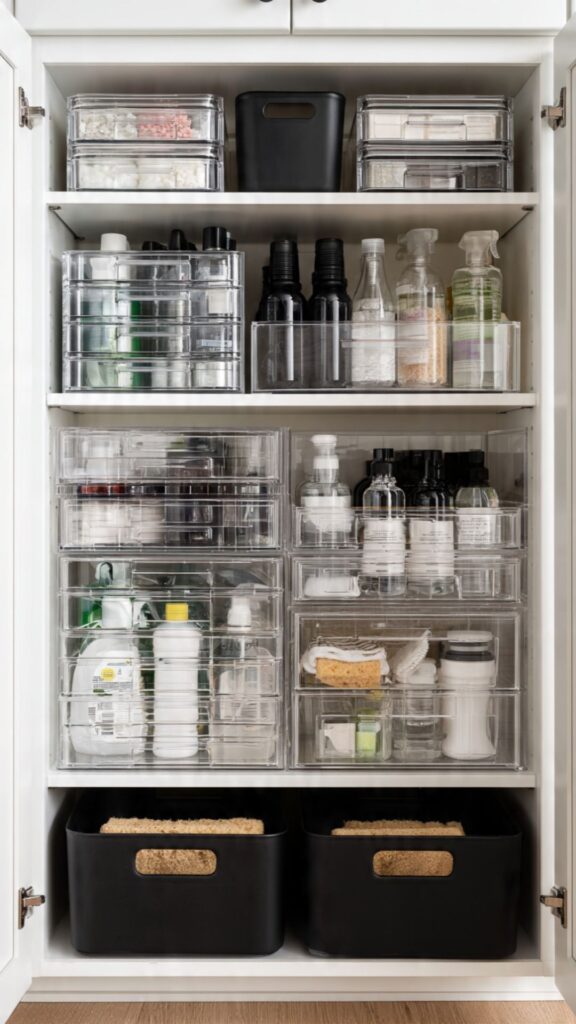
The cabinet under the kitchen sink is often the most chaotic and underutilized space in the entire kitchen. Between the plumbing pipes, odd angles, and tendency to become a dumping ground for cleaning supplies, this area presents a unique organizational challenge. However, with the right approach, it can become a highly functional storage zone.
The key is using organizers specifically designed for under-sink environments. Pull-out caddy systems with adjustable tiers work around pipes while maximizing the usable floor space. Slim stackable bins and turntables (lazy Susans) positioned beside and behind pipes ensure you can access everything without reaching blindly into the back.
A particularly smart strategy is to categorize under-sink items into zones: one side for cleaning products, one for dishwashing supplies, and perhaps a small section for trash bags or sponges. Adding adhesive hooks to the inside of the cabinet door for gloves, scrub brushes, or a small trash bag holder further extends the usable storage without taking up any floor space.
For households with young children, under-sink storage also becomes a child safety concern. Magnetic cabinet locks and tension rod barriers installed horizontally to block access to bottles provide security while keeping items accessible to adults. This dual purpose of organization and safety is something many basic storage guides overlook entirely.
Use a Lazy Susan:
For Corner Cabinets

Corner cabinets are one of the most frustrating design elements in traditional kitchen layouts. The deep, hard-to-reach corners are notoriously difficult to access and often become a graveyard for forgotten appliances and rarely used pantry items. A well-chosen lazy Susan a rotating circular tray is the most practical solution available for this problem.
There are several types to choose from depending on your cabinet configuration. A kidney-shaped lazy Susan is designed for blind corner cabinets where the door opening is offset from the cabinet interior. A full-circle lazy Susan works in standard corner cabinets with two doors. For pull-out corner drawers a more premium renovation option a magic corner system swings out and forward, completely exposing everything inside.
The practical impact of installing a lazy Susan is significant. In a standard corner cabinet, most homeowners can only comfortably access the first 12–18 inches of depth before the back becomes unreachable. A rotating tray eliminates this problem entirely, bringing every item to the front with a simple spin. This is especially useful for heavy items like stand mixers, stockpots, or large baking dishes.
When selecting a lazy Susan, choose one with a lip or raised edge to prevent items from sliding off during rotation. Stainless steel and BPA-free plastic models are the most hygienic and easiest to clean. If you’re retrofitting an existing cabinet, diameter is critical measure both the cabinet width and depth before purchasing to ensure the tray spins freely without hitting the door frame.
Maximize Drawer Space with Expandable Dividers:

Kitchen drawers, when unorganized, become chaotic black holes where utensils tangle and small items vanish. Expandable drawer dividers are one of the simplest and most impactful storage solutions available and yet most kitchens either have none or use cheap plastic trays that don’t fit properly. A well-organized drawer system speeds up cooking and reduces daily frustration.
The concept of “zoning” drawers is borrowed from professional chef kitchens. Rather than mixing all utensils in one drawer, assign each drawer a specific category: one for cooking tools (spatulas, tongs, ladles), one for prep tools (peelers, can openers, zesters), and one for cutlery. This sounds obvious, but most households never formalize it, leading to constant rummaging through mixed drawers to find a simple vegetable peeler.
For deep drawers common in modern kitchen designs consider double-stacking organization. Bamboo drawer organizers placed in the lower level hold larger items, while a removable tray on top holds smaller tools or spice packets. This layered approach takes advantage of drawer height in the same way that shelf risers use cabinet height, effectively creating two storage layers where there was previously one.
When choosing drawer organizers, avoid universal “one size fits all” trays that inevitably leave gaps at the sides, causing items to slide around. Instead, look for fully expandable systems or custom-cut bamboo organizers that fit your exact drawer dimensions. Bamboo has the added advantages of being naturally antimicrobial, durable, and far more attractive than plastic an important consideration for drawers that guests and family members open daily.
Install a Pull-Out Pantry or Slide-Out Cabinet:
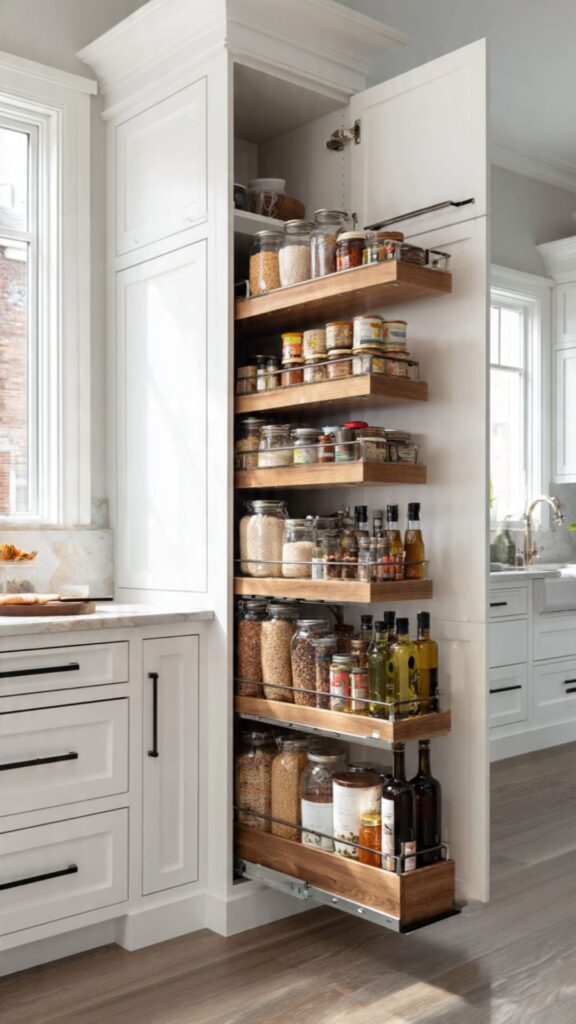
A pull-out pantry sometimes called a roll-out pantry or pantry cabinet is a tall, narrow cabinet filled with multiple shelves or rails that slides outward completely when opened. Unlike a standard pantry with fixed deep shelves where items hide behind each other, a pull-out pantry exposes every single item at once, making it one of the most space-efficient storage solutions in a modern kitchen Storage Ideas.
For kitchens that lack a dedicated pantry room, a pull-out pantry cabinet installed in an unused 6–9 inch gap between the refrigerator and wall can hold a surprisingly large amount of dry goods, canned items, and condiments. Custom cabinet makers and companies like Rev-A-Shelf make pull-out pantry inserts specifically for these narrow spaces, turning a dead zone into genuinely useful storage.
The organizational advantage of a pull-out pantry lies in visibility. Because all shelves pull outward simultaneously, you can see and reach items at the back just as easily as those at the front. This virtually eliminates the “forgotten pantry item” problem, where groceries expire at the back of a deep shelf while duplicates are repurchased unnecessarily. Households that switch to pull-out pantry systems often report significant reductions in food waste.
If a full installation isn’t feasible, a freestanding pull-out pantry on wheels is an effective apartment-friendly alternative. These standalone units can be rolled into a narrow gap beside the fridge or oven, parked in a corner, or even moved to a different room when not in use. Look for models with adjustable shelf heights to accommodate everything from cereal boxes to wine bottles within the same unit.
You Will Not Regret This: Modern Kitchen Design Ideas That Show How Beautiful Kitchen Storage Can Transform Your Whole Kitchen
Use Magnetic Strips:
For Knife and Spice Storage

Magnetic strips are a deceptively simple storage solution with a remarkably wide range of applications in the kitchen. The most common use is a knife magnetic strip mounted on the wall it replaces a bulky knife block that takes up valuable counter space, keeps blades accessible, and actually preserves knife edges better since knives aren’t banging against each other in a drawer or block.
Beyond knives, magnetic strips can hold metal spice tins, kitchen scissors, a bottle opener, and even metal measuring spoons. Mounting a magnetic strip inside a cabinet door takes this concept further, keeping these items completely hidden while freeing up counter and drawer space simultaneously. This “hidden organization” approach is a hallmark of well-designed small kitchens where every inch needs to serve a purpose.
From a food safety and hygiene perspective, magnetic knife storage is superior to in-drawer storage in several ways. Knives stored in a drawer can dull quickly from contact with other utensils, and the dark, enclosed environment is less hygienic. A wall-mounted magnetic strip keeps knives visible, dry, and separate, extending both the sharpness and cleanliness of your knife collection.
Installation is straightforward most magnetic knife strips mount with just two screws and hold anywhere from 5 to 12 knives depending on length. For the strongest hold, choose strips with rare earth neodymium magnets rather than ceramic magnets. Wooden and stainless steel models are the most popular and fit a wide range of kitchen aesthetics, from rustic farmhouse to sleek minimalist designs.
Optimize Cabinet Doors with Over-Door Organizers:
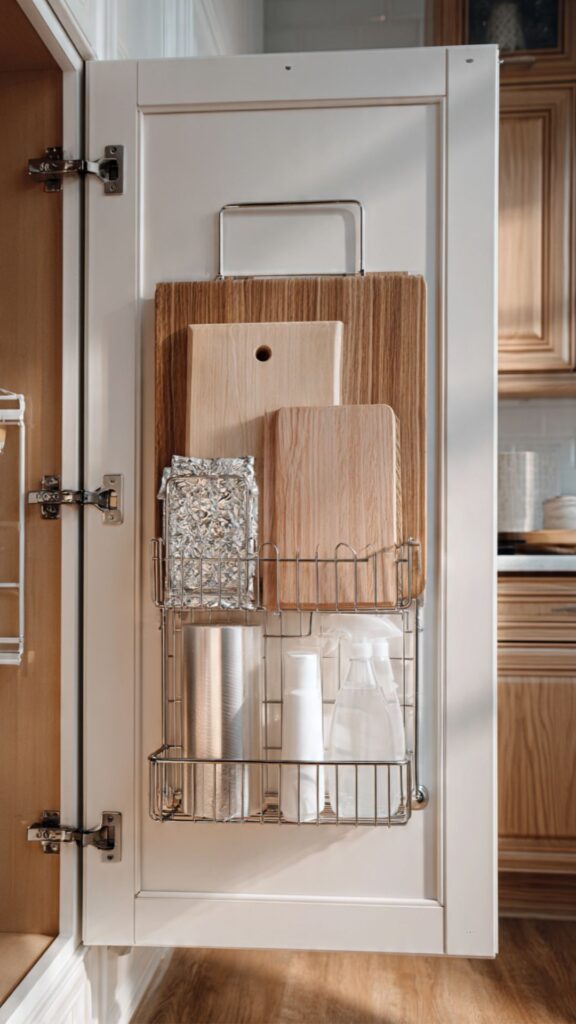
The backs of cabinet doors represent a significant amount of free storage real estate that most kitchens ignore completely. Over-door organizers thin wire or metal racks that hang from the inside edge of a cabinet door can hold spice jars, cleaning supplies, foil and wrap boxes, pot lids, cutting boards, and much more, all within the door’s footprint.
A particularly effective application is using over-door racks inside the pantry cabinet door to hold frequently used spices and condiment packets. This keeps everyday seasonings at eye level and within easy reach without taking up any shelf space. Meanwhile, the shelves themselves can be reserved for larger pantry items a clear separation that improves both accessibility and overall organization.
For the cabinet beneath the kitchen sink, an over-door caddy specifically designed for cleaning products can transform an otherwise chaotic space. Spray bottles hang neatly from hooks, sponge caddies mount to the door, and rolls of paper towels or trash bags tuck into side pockets. The door becomes a fully functional storage wall rather than just a barrier.
When shopping for over-door organizers, pay close attention to clearance. In cabinets with adjustable shelves, the first shelf may need to be moved up to accommodate the depth of an over-door rack. Also check the door’s weight capacity manufacturers typically rate cabinet door hinges at 5–10 pounds, and overloading them can cause hinges to sag or strip over time. For heavier loads, look for over-door organizers with a foot that rests on the cabinet floor for additional support.
Create a Dedicated Baking Station with Pullout Storage:
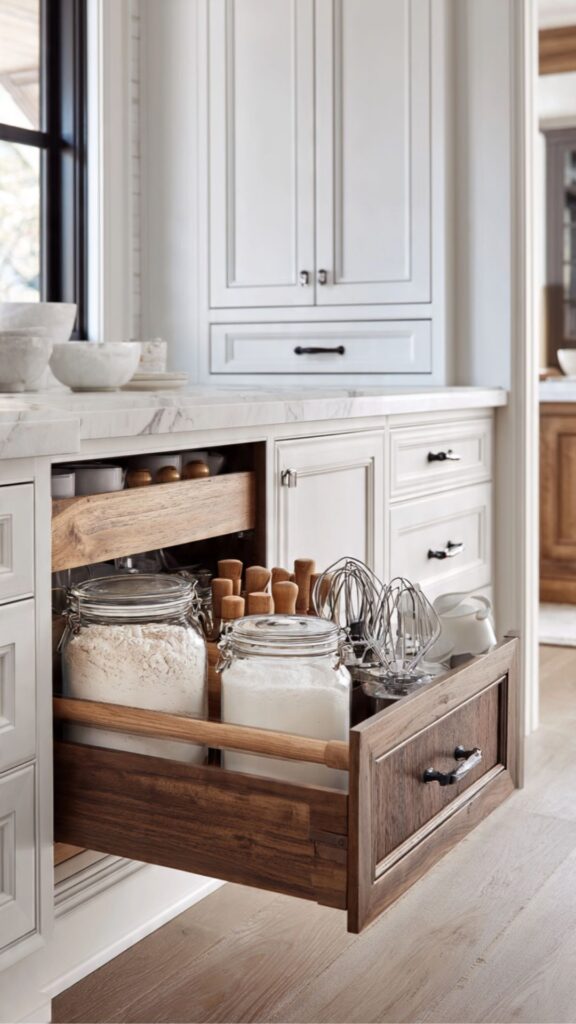
Baking requires a surprising number of specialized tools mixing bowls, measuring cups, rolling pins, baking pans, cooling racks, muffin tins, and a pantry’s worth of ingredients including flour, sugar, and leavening agents. When these items are scattered across multiple cabinets and shelves, baking becomes a frustrating scavenger hunt. A dedicated, centralized baking station solves this entirely.
The concept is simple: designate one lower cabinet as the “baking cabinet” and install pull-out shelves or deep drawers that hold all baking-related equipment. Directly above it, assign the corresponding wall cabinet to baking ingredients. When it’s time to bake, everything you need is in one place. Professional pastry chefs call this the “mise en place” principle everything in its place before you begin.
For baking pans and sheet trays specifically, vertical storage is far more efficient than stacking. A vertical divider system essentially a series of slots similar to a vinyl record storage unit allows each baking sheet, cutting board, or muffin tin to stand upright and be pulled out individually without disturbing the others. This eliminates the avalanche of sliding pans that plagues most kitchen cabinet storage.
Deep pullout drawers work exceptionally well for flour, sugar, and other dry baking ingredients when paired with airtight labeled canisters. Storing dry goods in labeled, stackable containers rather than in original bags prevents pantry moths, extends shelf life, and perhaps most importantly lets you see at a glance when you need to restock. Clear canisters with wide mouths make scooping flour and sugar effortless and reduce waste.
Mount a Pot Rack:
To Free Up Cabinet Space
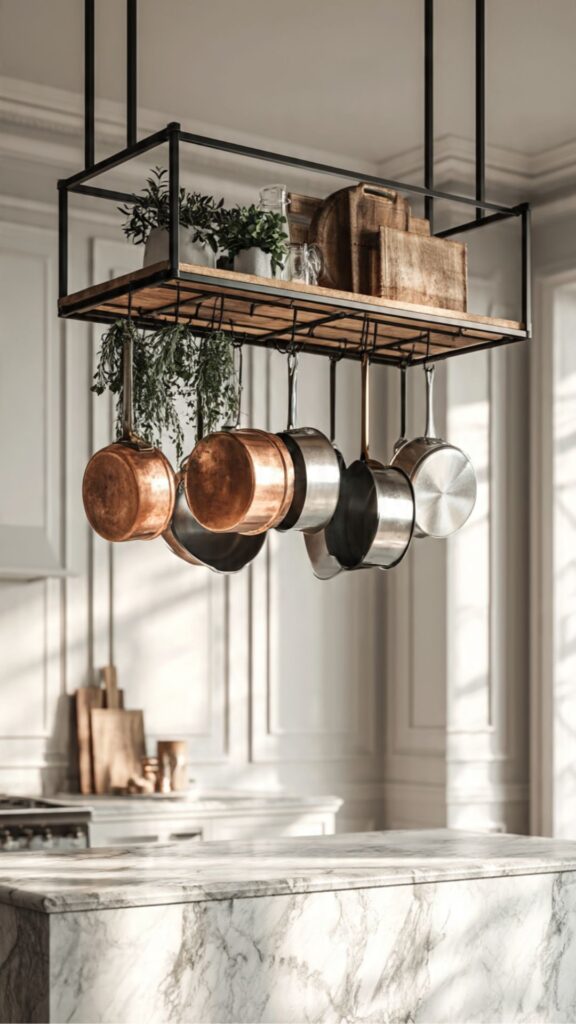
Pots and pans are among the most space-consuming items in any kitchen. They’re large, oddly shaped, and heavy and yet most kitchens try to squeeze them into a single lower cabinet, often resulting in precarious stacked towers that crash out every time you open the door. A pot rack, either wall-mounted or ceiling-hung, completely eliminates this problem by relocating cookware out of cabinets and into open air.
A ceiling-mounted pot rack directly above an island or central prep area is a classic professional kitchen design choice. It places cookware at arm’s length from the stovetop, eliminates the need to search through cabinets mid-cook, and visually creates a warm, “chef’s kitchen” aesthetic that many homeowners find both functional and beautiful. Stainless steel and wrought iron models are the most durable and widely available options.
Wall-mounted pot rails offer a lower-profile alternative for kitchens without a central island or high ceilings. Stainless steel rails with S-hooks can hold six to eight pots and pans across a relatively narrow wall section, freeing up an entire lower cabinet for other storage. Some rails also include built-in hooks or side slots for hanging lids separately, which solves the often-overlooked problem of where to store pot lids efficiently.
One consideration that storage guides often skip: not all cookware is suitable for hanging. Lightweight stainless steel and cast iron pans hang beautifully, but non-stick pans with delicate coatings should ideally be stored flat or with protective dividers to prevent scratching. When organizing your hanging pot rack, keep the most frequently used pieces at the most accessible hooks and reserve the upper or harder-to-reach hooks for occasional-use items.
Label Everything:
For Long-Term Organization
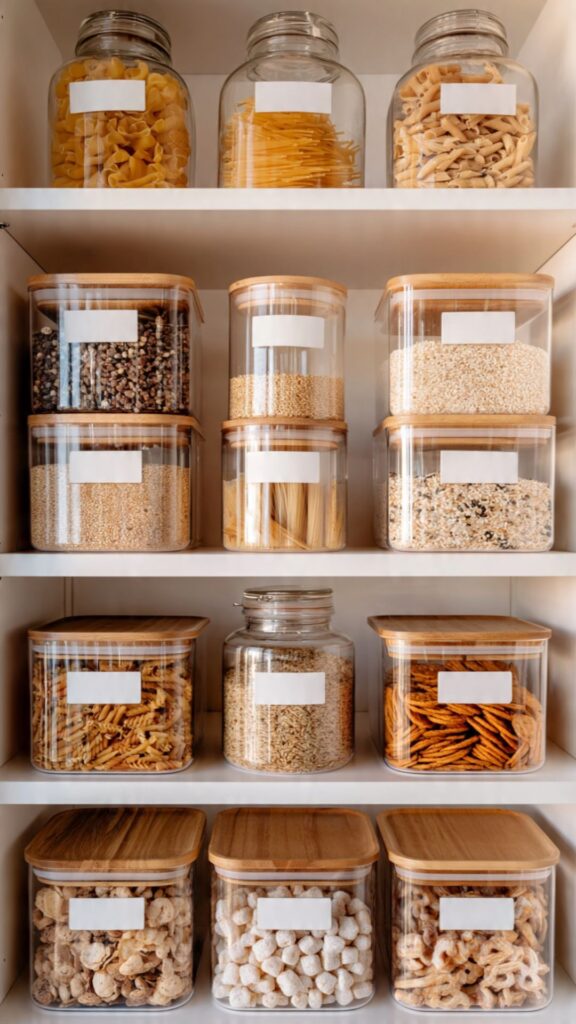
Organization systems fail when they’re inconsistent or when other household members don’t follow them. Labeling is the one tool that maintains a storage system over time it removes ambiguity, sets clear expectations, and makes putting things away just as easy as taking them out. This is a principle professional organizers call “return friction reduction.”
The kitchen items that benefit most from labeling include pantry containers, spice jars, freezer bags, drawer sections, and cabinet shelves. For spice jars in particular, a uniform set of labeled containers replaces a chaotic mix of different-sized bottles and allows you to alphabetize or organize by cuisine type a small change that makes a visible difference during cooking. Many home cooks who switch to uniform labeled spice jars report never accidentally reaching for cinnamon when they meant cumin again.
For pantry staples like flour, sugar, rice, and pasta, decanting into labeled airtight containers does two things simultaneously: it organizes visually and preserves food quality. Original packaging thin plastic bags and cardboard boxes doesn’t seal adequately against humidity, pantry pests, or odor transfer. Glass or BPA-free plastic canisters with silicone-sealed lids address all three concerns while looking dramatically cleaner on the shelf.
Modern label-making options range from simple chalkboard label stickers to thermal label printers like the DYMO Label Writer or Brother P-touch. For a cohesive kitchen aesthetic, choose one labeling style and stick with it throughout the kitchen. Handwritten labels on kraft paper tags can look charming in a farmhouse kitchen, while clean printed labels suit a minimalist space. The material matters less than the consistency inconsistent labeling defeats its own purpose.
Use the Space Above Cabinets:
For Extra Storage
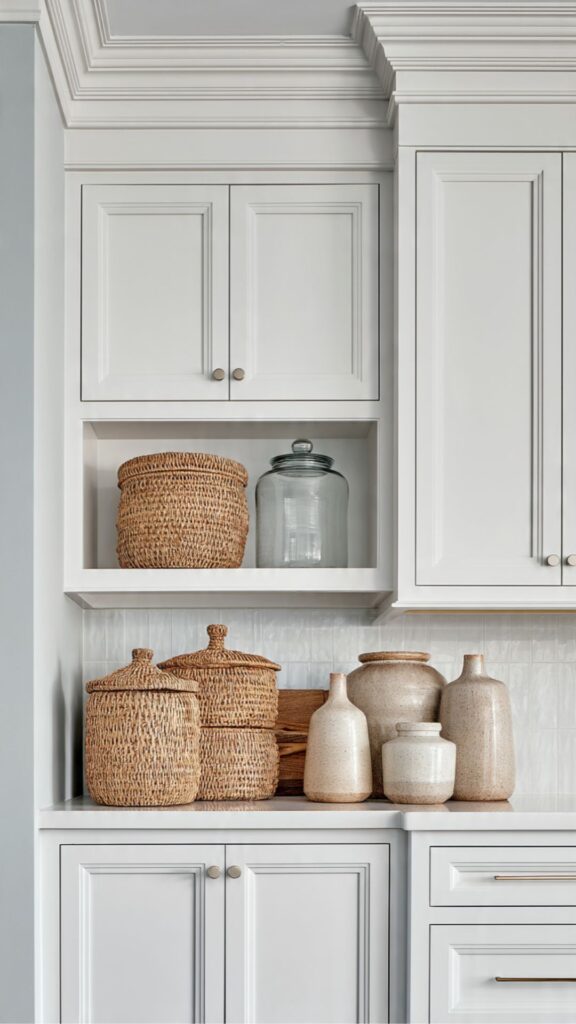
The space between the tops of upper kitchen cabinets and the ceiling is almost universally wasted in most homes. Depending on ceiling height, this gap can range from just a few inches to nearly a foot and with some thoughtful planning, it can become a useful storage or display zone without any renovation.
For storing large, infrequently used items holiday serving platters, extra casserole dishes, large stock pots, or seasonal bakeware the top of the cabinets is ideal. These items are used too rarely to justify prime cabinet real estate but need to be accessible a few times a year. Placing them in attractive lidded baskets or simple crates keeps the area looking intentional rather than cluttered, while making seasonal retrieval straightforward.
If your ceiling height allows for 12 or more inches above the cabinets, consider installing a simple floating shelf in that space. A narrow 6–8 inch deep shelf running the length of the upper cabinet run creates formal “display storage” for cookbooks, wine bottles, or decorative kitchen items a look often seen in high-end kitchen designs that’s achievable in any home with basic DIY skills.
One practical concern with above-cabinet storage is dust accumulation. Items stored openly on top of cabinets will collect grease and dust from normal kitchen use, especially near the stove. Lidded baskets, closed crates, or enclosed containers mitigate this significantly. A simple dusting schedule monthly for most households keeps the area clean and ensures the storage remains genuinely hygienic rather than becoming a grimy upper shelf that no one wants to use.
Right Up Your Alley: Under Stairs Storage Ideas That Inspire the Same Clever and Creative Approach for Your Kitchen Storage
Organize the Refrigerator with Bins and Lazy Susans:
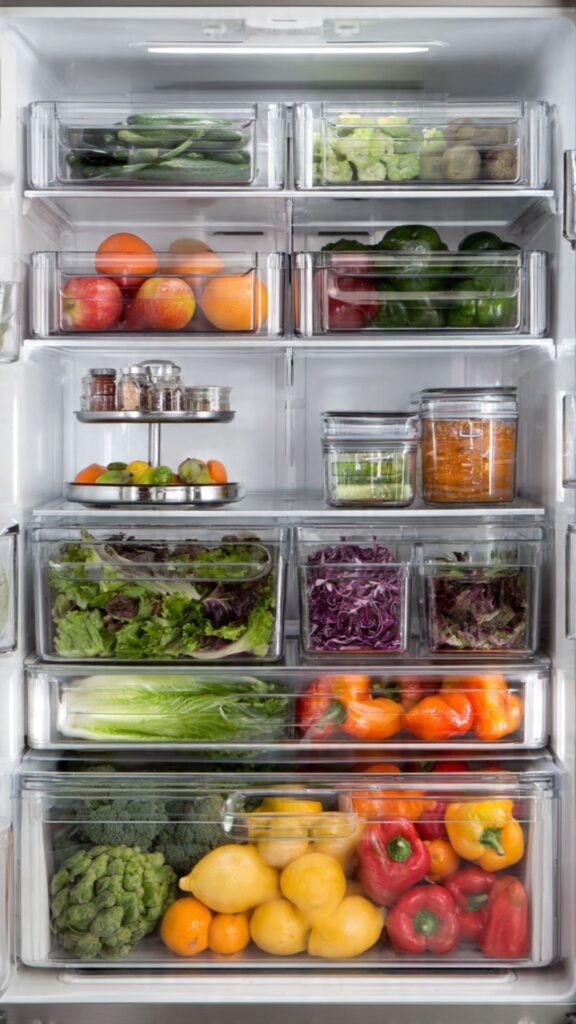
Kitchen storage Ideas doesn’t end at cabinets and countertops the refrigerator interior is one of the most consistently disorganized spaces in any kitchen. Produce wilts unnoticed in the back of the crisper drawer, condiments crowd the door shelves, and leftovers get buried behind fresh groceries until they become science experiments. A simple binning system transforms the fridge into a genuinely organized, waste-reducing tool.
Clear stackable bins from brands like OXO or Rubbermaid are the foundation of refrigerator organization. Group similar items into labeled bins one for deli meats and cheeses, one for condiment packets, one for snacks, and one for grab-and-go items. The bin structure prevents smaller items from scattering across the shelf and allows you to pull out an entire category at once when cleaning.
A small lazy Susan placed on the middle shelf is a brilliant and underused fridge hack. It’s perfect for condiment jars, yogurt cups, and small containers that would otherwise crowd the back of the shelf. A single spin brings every item to the front no more forgotten sauces or expired dressings hiding out of sight. This is one of those low-cost, high-impact solutions that refrigerator storage guides consistently overlook.
For produce, the principle of “first in, first out” the same system used in restaurant kitchens dramatically reduces food waste. When restocking groceries, move older produce to the front and place newer items behind. Storing cut fruits and vegetables in clear containers at eye level (rather than buried in the crisper) makes healthy snacking far more convenient and dramatically reduces produce waste, which averages nearly 30% in most households according to food waste research.
Create a Command Center:
For Kitchen Paperwork and Supplies
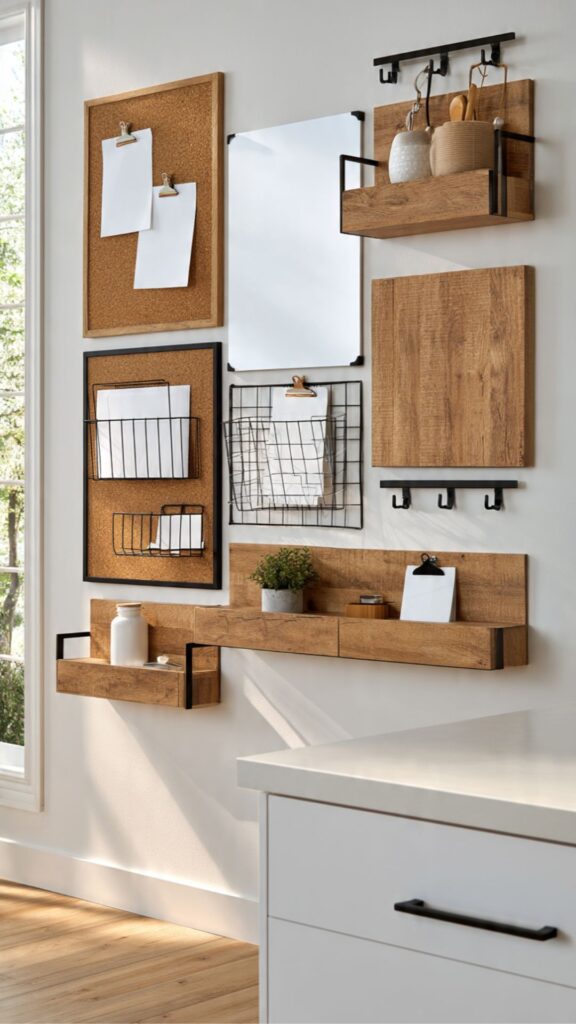
Every kitchen accumulates a layer of non-food items takeout menus, shopping lists, mail, phone chargers, keys, pens, scissors, tape, and batteries that have no natural home. Without a designated space for these items, they spread across the counter and create the visual clutter that makes even a clean kitchen feel messy. A small kitchen command center solves this by giving every “miscellaneous” item a specific, contained location.
A command center doesn’t need to be elaborate. A wall-mounted organizer with a few pockets, hooks, and a small chalkboard or whiteboard can handle the bulk of kitchen paperwork and small tools in a footprint of about 12 by 18 inches. Mounted beside the entrance to the kitchen or on the inside of a pantry door, it keeps these items accessible without contributing to counter clutter.
For families with children, a kitchen command center becomes even more valuable. School permission slips, homework reminders, weekly schedules, and activity sign-up sheets all need a visible, accessible location. A simple system inbox pocket for new papers, outbox for items that need to leave the house, and a small calendar handles the administrative layer of family life without turning the kitchen counter into a paper archive.
The deeper benefit of a kitchen command center is that it establishes a boundary: these items live here, not on the counter. This single organizational boundary has a disproportionate impact on kitchen cleanliness because it addresses one of the root causes of kitchen clutter the accumulation of small, category-less objects that don’t belong anywhere else. Once established, this boundary is surprisingly easy to maintain.
Conclusion
Great kitchen storage ideas aren’t just about buying more organizers they’re about understanding how your kitchen actually works and designing smart systems around that reality. From vertical cabinet risers to pull-out pantries and dedicated baking stations, the 14 ideas in this guide offer practical, tested solutions for every kitchen size and style.
The key takeaway is this: start by decluttering, then organize by use zone, and finally invest in tools that support the system you’ve built. A well-organized kitchen doesn’t just look better it saves time, reduces stress, and makes cooking genuinely enjoyable. Pick two or three ideas from this guide today and start transforming your kitchen, one smart solution at a time.

Team TrandyVilla is the passionate home decor team behind Trandy Villa, where style meets comfort in everyday living. The team loves transforming simple spaces into beautiful, functional homes through smart ideas, budget-friendly hacks, and modern design trends. Their content focuses on helping readers create homes that feel both stylish and personal without spending too much.